


- The MCAT provides no equation sheet and no calculator. A periodic table appears in the Chem/Phys section only.
- Physics carries the heaviest memorization load, but general chemistry and biochemistry equations show up in two sections each.
- Most questions are decided by picking the right relationship, not by arithmetic. Knowing that flow scales with r⁴ beats knowing Poiseuille's constant.
- Roughly 60 equations cover everything the exam expects. They're all below, grouped the way the test uses them.
- Every free MCAT formula sheet download (UWorld, Blueprint, MedSchoolCoach) covers chem/phys only. None include the biochemistry equations, which are on this page.
You need every MCAT equation in your head before you sit down. The exam gives you a periodic table and nothing else, so there's no reference to fall back on and no calculator to bail you out of messy arithmetic. This is the full MCAT formula sheet: physics, general chemistry, and biochemistry, grouped by how the exam actually uses them. If you came here for a printable download, skip to how the free formula sheets compare.
Related free resource:

Blueprint's Free MCAT Flashcards
1,600+ expert-made cards covering every section. No Anki setup.
Free account · No credit card
What the MCAT gives you on test day
| Resource | Available? |
|---|---|
| Equation sheet | No |
| Calculator | No |
| Periodic table | Yes, in the Chem/Phys section only |
| Scratch paper and marker | Yes |
The exam format, the four-section structure, and the discipline percentages behind this page are from the AAMC Chemical and Physical Foundations of Biological Systems section overview, verified August 28, 2026. AAMC notes discipline percentages are approximated to the nearest 5% and vary between test forms.
That constraint shapes everything about how the AAMC writes quantitative items. Numbers are kept clean, exponents do most of the work, and a large share of "calculation" questions can be answered from a proportionality without computing anything at all.
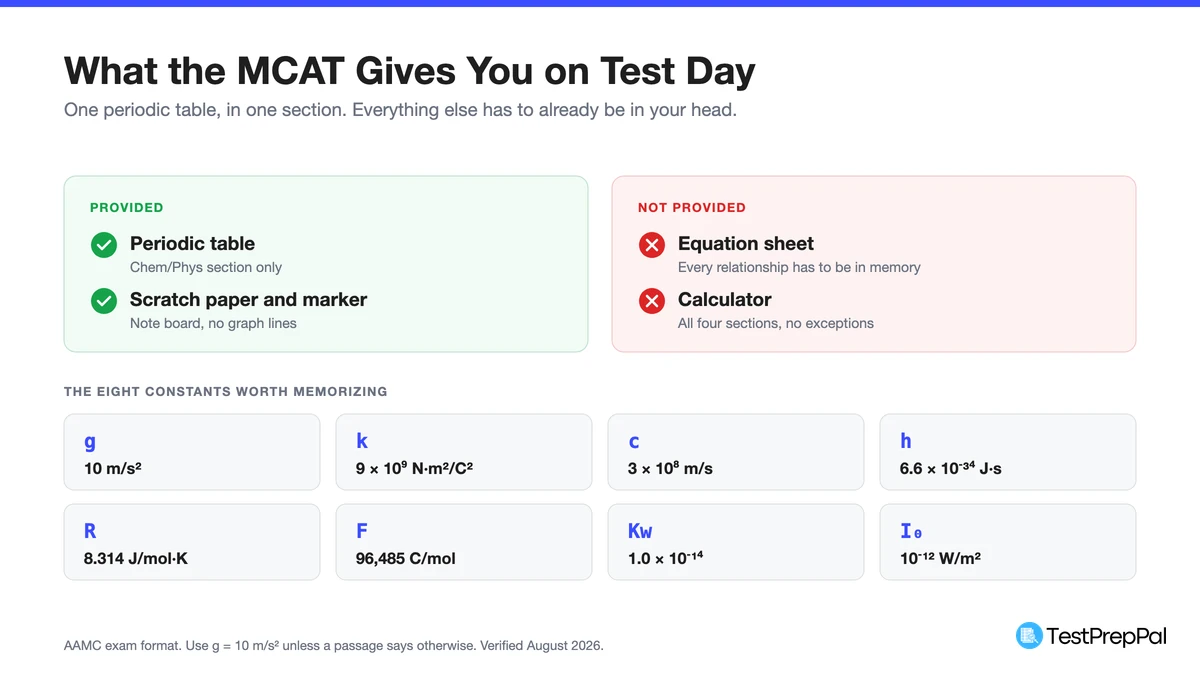 One periodic table, in one section. The eight constants below are the ones worth committing to memory.
MCAT physics equations
Physics is 25% of the Chem/Phys section, roughly 15 questions, and it appears nowhere else on the exam. It's also the section of this sheet with the most to memorize.
Mechanics
| Quantity | Equation |
|---|---|
| Kinematics (constant a) | v = v₀ + at · x = v₀t + ½at² · v² = v₀² + 2ax |
| Newton's second law | F = ma |
| Friction | f = μN |
| Work | W = Fd cosθ |
| Kinetic energy | KE = ½mv² |
| Gravitational PE | PE = mgh |
| Power | P = W/t = Fv |
| Momentum / impulse | p = mv · FΔt = Δp |
| Torque | τ = rF sinθ |
| Centripetal force | F = mv²/r |
Fluids
| Quantity | Equation |
|---|---|
| Density | ρ = m/V |
| Pressure | P = F/A · P = ρgh |
| Buoyant force | F_b = ρ_fluid·V_displaced·g |
| Continuity | A₁v₁ = A₂v₂ |
| Bernoulli | P + ½ρv² + ρgh = constant |
| Poiseuille | Q = πΔPr⁴ / 8ηL |
Electricity and magnetism
| Quantity | Equation |
|---|---|
| Coulomb's law | F = kq₁q₂/r² |
| Electric field | E = F/q · E = V/d (uniform) |
| Ohm's law | V = IR |
| Electrical power | P = IV = I²R = V²/R |
| Capacitance | C = Q/V · U = ½CV² |
| Resistors in series / parallel | R = ΣR · 1/R = Σ(1/R) |
| Capacitors in series / parallel | 1/C = Σ(1/C) · C = ΣC |
| Magnetic force | F = qvB sinθ |
| RC time constant | τ = RC |
Waves, sound, and light
| Quantity | Equation |
|---|---|
| Wave relation | v = fλ |
| Sound intensity level | β = 10 log₁₀(I/I₀), I₀ = 10⁻¹² W/m² |
| Intensity falloff | I ∝ 1/r² |
| Index of refraction | n = c/v |
| Snell's law | n₁sinθ₁ = n₂sinθ₂ |
| Critical angle | sinθ_c = n₂/n₁ (requires n₂ smaller than n₁) |
| Thin lens / mirror | 1/f = 1/dₒ + 1/dᵢ · m = −dᵢ/dₒ |
| Lens power | P = 1/f (diopters, f in meters) |
Thermal and atomic
| Quantity | Equation |
|---|---|
| Heat transfer | Q = mcΔT |
| First law | ΔU = Q − W |
| Photon energy | E = hf = hc/λ |
| Radioactive decay | N = N₀(1/2)^(t/t½) |
Note that capacitors and resistors combine in opposite ways. Capacitors add in parallel, resistors add in series. That reversal is one of the most reliably tested traps in MCAT circuits.
MCAT general chemistry equations
General chemistry is about 30% of Chem/Phys and roughly 5% of Bio/Biochem, which makes it the single largest content block in the science sections. Acid-base and thermodynamics dominate.
Acids, bases, and buffers
| Quantity | Equation |
|---|---|
| pH and pOH | pH = −log[H⁺] · pOH = −log[OH⁻] · pH + pOH = 14 (at 25 °C) |
| Water autoionization | Kw = [H⁺][OH⁻] = 1.0 × 10⁻¹⁴ (at 25 °C) |
| Conjugate pair relationship | Ka × Kb = Kw · pKa + pKb = 14 |
| Henderson-Hasselbalch | pH = pKa + log([A⁻]/[HA]) |
| Buffer midpoint | pH = pKa when [A⁻] = [HA] |
Henderson-Hasselbalch is worth more than any other equation in general chemistry, because it also answers biochemistry questions about side-chain charge and protein behavior. If the log term is zero you're at the pKa; if the ratio is 10:1 you're one full unit above it.
Thermodynamics and electrochemistry
| Quantity | Equation |
|---|---|
| Gibbs free energy | ΔG = ΔH − TΔS |
| Free energy and equilibrium | ΔG° = −RT ln K |
| Free energy away from standard state | ΔG = ΔG° + RT ln Q |
| Free energy and cell potential | ΔG° = −nFE° (F = 96,485 C/mol) |
| Nernst equation | E = E° − (RT/nF) ln Q · at 25 °C: E = E° − (0.0592/n) log Q |
Sign conventions carry most of the points here. Negative ΔG means spontaneous, which pairs with a positive E° in a galvanic cell. Because ΔG° = −nFE°, the two always point in opposite directions, and the AAMC tests that pairing constantly.
Gases, solutions, and solubility
| Quantity | Equation |
|---|---|
| Ideal gas law | PV = nRT (R = 8.314 J/mol·K = 0.0821 L·atm/mol·K) |
| Combined gas law | P₁V₁/T₁ = P₂V₂/T₂ (T in kelvin) |
| Dalton's law | P_total = ΣP_i · P_i = X_i · P_total |
| Solubility product | For A_xB_y ⇌ xA + yB: Ksp = [A]ˣ[B]ʸ |
| Molar solubility examples | AB: Ksp = s² · AB₂: Ksp = 4s³ · A₃B₂: Ksp = 108s⁵ |
| Freezing point depression | ΔTf = iKf·m |
| Boiling point elevation | ΔTb = iKb·m |
| Osmotic pressure | Π = iMRT |
| Molarity and molality | M = mol solute / L solution · m = mol solute / kg solvent |
The van 't Hoff factor i is the number of particles a solute dissociates into: 1 for glucose, 2 for NaCl, 3 for CaCl₂. Colligative property questions are usually testing whether you counted particles, not whether you can multiply.
Kinetics
| Quantity | Equation |
|---|---|
| Rate law | rate = k[A]ᵐ[B]ⁿ (orders come from data, not stoichiometry) |
| First-order integrated rate | ln[A] = ln[A]₀ − kt |
| First-order half-life | t½ = 0.693/k (independent of starting concentration) |
| Arrhenius equation | k = Ae^(−Ea/RT) |
Two traps show up again and again. Reaction order is determined experimentally and does not follow the balanced coefficients unless the step is elementary. And a catalyst lowers Ea, which raises k through the Arrhenius relationship, but it never changes ΔG, K, or the position of equilibrium.
MCAT biochemistry equations
Biochemistry is weighted at 25% in both science sections, roughly 30 questions across the exam, but it carries only three real equations. The rest of biochemistry is pattern recognition.
| Quantity | Equation |
|---|---|
| Michaelis-Menten | v = Vmax[S] / (Km + [S]) |
| Km definition | [S] at which v = ½Vmax |
| Lineweaver-Burk | 1/v = (Km/Vmax)(1/[S]) + 1/Vmax |
| Lineweaver-Burk intercepts | y-intercept = 1/Vmax · x-intercept = −1/Km · slope = Km/Vmax |
| Isoelectric point | pI = average of the two pKa values flanking the neutral species |
The double-reciprocal plot is only worth memorizing for its intercepts. Competitive inhibition raises apparent Km and preserves Vmax, so the y-intercept is unchanged. Noncompetitive inhibition lowers Vmax and preserves Km, so the x-intercept is unchanged. That single sentence answers most inhibition questions without any algebra.
For pI, average the two pKa values on either side of the zwitterion. Glycine, with no ionizable side chain, gives (2.34 + 9.60)/2 = 5.97. An acidic residue like aspartate averages its two acidic groups and lands near 2.8. Below its pI a molecule carries net positive charge; above it, net negative. You'll also need the pKa values of the nine ionizable groups (the two termini plus the seven ionizable side chains) to use this rule on real questions.
Constants worth memorizing
| Constant | Value to use |
|---|---|
| g | 10 m/s² |
| Coulomb's constant k | 9 × 10⁹ N·m²/C² |
| Speed of light c | 3 × 10⁸ m/s |
| Planck's constant h | 6.6 × 10⁻³⁴ J·s |
| Gas constant R | 8.314 J/mol·K or 0.0821 L·atm/mol·K |
| Faraday's constant F | 96,485 C/mol (round to 10⁵) |
| Kw at 25 °C | 1.0 × 10⁻¹⁴ |
| Reference sound intensity I₀ | 10⁻¹² W/m² |
Use g = 10 m/s² unless a passage says otherwise. The AAMC builds questions so the approximation never changes which choice is correct.
Free MCAT formula sheet downloads compared
Three prep companies give away a printable MCAT formula sheet. All three are genuinely free, and all three have the same gap.
| Formula sheet | Physics | Gen chem | Biochem | Email required |
|---|---|---|---|---|
| UWorld MCAT formula sheet | Yes | Yes | No | Not stated on the page |
| Blueprint equation sheets | Yes | Yes | No | Yes, form submission |
| MedSchoolCoach equations sheet | Yes | Yes | No | Not stated on the page |
| This page | Yes | Yes | Yes | No |
Every free download stops at chem/phys. That is the omission worth knowing about, because biochemistry is weighted at 25% in both science sections and carries its own equations. Michaelis-Menten, the Lineweaver-Burk intercepts, and the isoelectric point rule are all fair game, and none of them appear on any of the three downloadable sheets. The biochemistry section above covers them.
None of them is an arithmetic reference. For that, the free Leah4Sci MCAT math cheat sheet is the complement: two printable pages of times tables, rounded trig values and log anchors, with no science equations at all.
All of them are also files you download. If you would rather search than print, MCAT Cheat Sheet is the free web alternative: 278 topic pages across the six science subjects, each ending in a common trap and a set of recall questions, with nothing to save to disk.
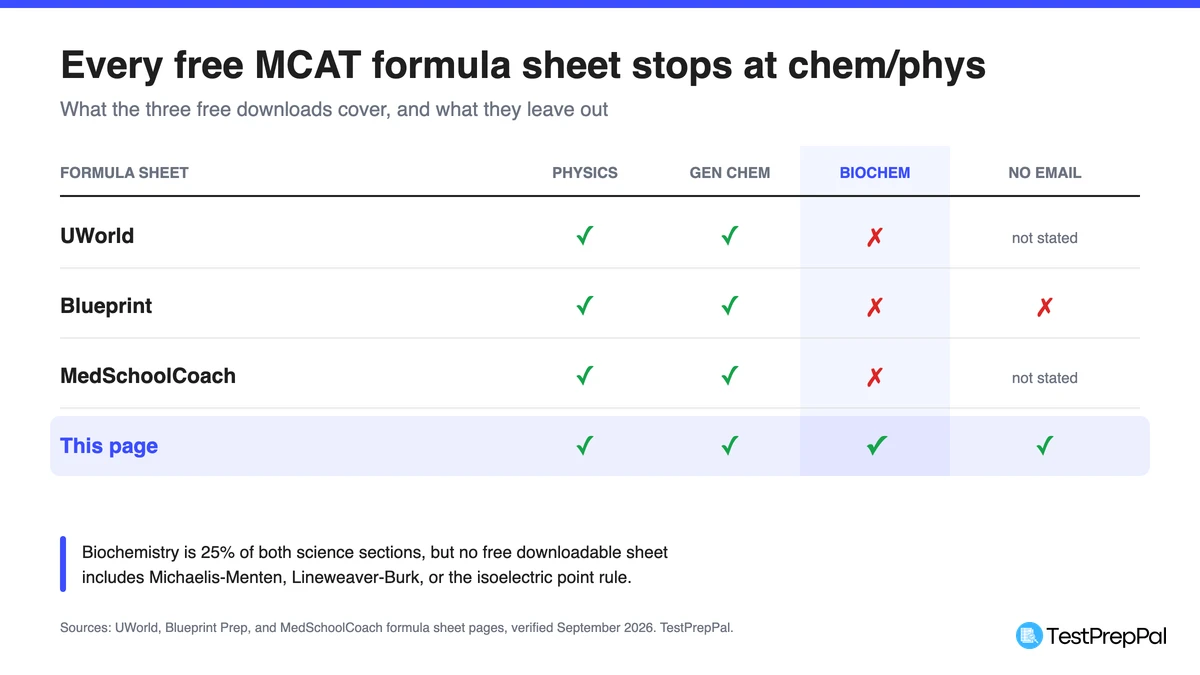 All three free downloads cover the same chem/phys ground. Biochemistry is the gap.
The UWorld MCAT formula sheet
UWorld's is the one students ask about most often. It is a free PDF split into physics (kinematics, projectile motion, circular motion, torque, friction, fluids, thermodynamics, circuits, electrostatics, capacitors, magnetism, waves, optics, sound) and general chemistry (mole relationships, gases, atomic chemistry, electrochemistry, thermodynamics, acids and bases, equilibrium, kinetics). It is well organized and worth grabbing if you want something to print.
Two things to keep in mind. It covers the same chem/phys ground as the others, so it is not a complete equation set for the exam. And a sheet on your desk is not a sheet in your head, a point UWorld makes on its own page: "You do not get a formula sheet on the MCAT."
If you are already working through UWorld's question bank, the free sheet pairs with it. Our UWorld MCAT question bank review covers what the paid product adds, and is UWorld harder than the MCAT explains why its practice questions feel tougher than the real thing.
Memorize relationships, not equations
Rote-memorizing 60 formulas is the slow way to do this, and it fails under time pressure because you end up hunting through a mental list. Learn each equation as a statement about what depends on what.
- Strip it to a proportionality. Poiseuille's law is really Q ∝ r⁴. Halve the radius and flow drops by a factor of 16. You'll answer that faster than anyone plugging in π and viscosity.
- Watch the exponents. Coulomb's law and intensity both fall off as 1/r², so tripling the distance divides the effect by 9. Anything squared or to the fourth power is where the AAMC hides the trap.
- Group equations that share a variable. ΔG appears in ΔG = ΔH − TΔS, ΔG° = −RT ln K, and ΔG° = −nFE°. Learning them as one cluster means a question about cell potential immediately connects to spontaneity and to the equilibrium constant.
- Learn the physical meaning of every constant. Km is a concentration. τ = RC is a time. β is dimensionless. If your units don't come out right, you picked the wrong equation, and that check is faster than redoing the math.
- Test yourself by producing the sheet, not reading it. Write out each section from memory once a week. Recognition feels like knowledge and isn't.
Doing the math without a calculator
The arithmetic on the MCAT is deliberately manageable, but only if you work the way the exam expects.
- Convert units before anything else. Centimeters to meters, grams to kilograms, microfarads to farads, Celsius to kelvin for any gas law. The most common wrong answer on a quantitative item is the value you get by skipping the conversion.
- Separate the digits from the exponents. For 3.1 × 10⁵ divided by 6.2 × 10², do 3.1/6.2 = 0.5 and 10⁵/10² = 10³, then combine: 5 × 10². Most of the work is bookkeeping on powers of ten.
- Round aggressively, then check the spread. Answer choices are usually an order of magnitude apart. If two are close, tighten your estimate; otherwise a one-digit approximation is enough.
- Use log shortcuts. log(10ⁿ) = n, and log 2 ≈ 0.3. That handles nearly every pH and decibel question. A hydrogen ion concentration of 2 × 10⁻⁵ M gives pH = 5 − 0.3 = 4.7.
- Answer proportionality questions with ratios. If a question asks what happens when a variable doubles, don't compute either value. Compute the ratio.
If those five habits still feel slow, the free nine part math series reviewed in our Leah4Sci MCAT review works each one as a drill, with a worksheet attached. If it is the physics behind an equation that will not stick, the 46 free physics videos in our PremedHQ MCAT review take one concept at a time.
Frequently asked questions
Does the MCAT give you an equation sheet?
No. The MCAT provides no equation sheet at any point during the exam. A periodic table is available in the Chem/Phys section only. Every relationship on this page has to be memorized.
Are you allowed a calculator on the MCAT?
No, in any section. The AAMC compensates by keeping numbers clean and by writing many quantitative questions so that a proportionality or an estimate is enough to identify the right answer.
Which MCAT equations are highest yield?
Henderson-Hasselbalch, ΔG = ΔH − TΔS, PV = nRT, Michaelis-Menten, and the fluid dynamics set (continuity, Bernoulli, Poiseuille). Those cover the passage topics the AAMC returns to most often, especially anything framed around blood flow, buffering, or enzyme kinetics.
Do I need equations for Bio/Biochem and Psych/Soc?
Far fewer. Bio/Biochem uses the biochemistry equations above plus some general chemistry, mostly acid-base. Psych/Soc is essentially equation-free. Physics appears in Chem/Phys and nowhere else.
Is the UWorld MCAT formula sheet free?
Yes. UWorld publishes a free downloadable formula sheet covering physics and general chemistry. It does not require a purchase, and it is separate from the paid QBank. It does not cover biochemistry.
Which MCAT formula sheet is best?
For chem/phys alone, the free UWorld, Blueprint, and MedSchoolCoach sheets are close to interchangeable, though Blueprint asks for your email first, and for six required answers on the form, as our Blueprint free books and guides review sets out. None of the three include biochemistry equations, so whichever you download, you still need the biochem set separately.
How long does it take to memorize the MCAT equations?
Two to three weeks of short daily sessions gets most students to reliable recall, assuming you're also doing practice questions. Passive review takes far longer than active recall, so write the sheet out from memory rather than rereading it.
Put the equations to work
An equation sheet only pays off inside real questions. Drill these in the AAMC test interface with our free MCAT physics practice questions, MCAT general chemistry practice questions, and MCAT biochemistry practice questions.
For more free material, see our roundup of free MCAT resources and our guide to how hard the MCAT is.
MCAT Reference Sheets
The rest of the high-yield memorization set:
MCAT amino acid chart · MCAT hormone chart · MCAT organic chemistry reactions sheet
Then test what stuck with our free MCAT practice questions: 25 questions per subject in the AAMC test interface, with full worked solutions.
We may earn commissions from some links on this page, but this does not affect our reviews or your experience.