


MCAT Cheat Sheet Review
by MCAT Cheat Sheet
Free high-yield formulas and concepts for every MCAT section
✓Pros
- ✓Free with no credit card and no paid tier
- ✓278 topics across the 6 science subjects
- ✓Every topic page flags the common MCAT trap
- ✓Quick Recall questions turn each page into active recall
- ✓Instant search finds any topic in seconds
- ✓Progress and favorites sync across devices
✗Cons
- ✗Only Biology chapters 1 to 3 open without an account
- ✗No CARS coverage at all
- ✗Web only, nothing to download or print
- ✗Google sign-in is the only way in
Highlights
- ✓278 topics across 6 MCAT subjects
- ✓Biology, Biochemistry, Physics and Math, General Chemistry, Organic Chemistry, Psychology and Sociology
- ✓High-yield summary and key terms on every topic page
- ✓Common MCAT Trap section on every topic page
- ✓Quick Recall self-quiz with hidden answers
- ✓Instant search, favorites, and reviewed-topic tracking
Price
✓Free
What Students Are Saying
Sign in to leave a review

Expert Rating
MCAT Cheat Sheet is free, and it is worth a look if you want your high-yield review searchable instead of printed. The site holds 278 topics across six MCAT science subjects, every topic page ends with a common trap and a short recall quiz, and there is no paid tier anywhere on it.
Two limits decide whether it fits you. Only Biology chapters 1 to 3 are readable without an account, so the other 69 chapters need a free Google sign-in. And nothing on the site addresses Critical Analysis and Reasoning Skills, which is 53 of your questions on test day.
Summary Table
| Feature | MCAT Cheat Sheet |
|---|---|
| Price | Free, no paid tier |
| Account required | Only past Biology chapters 1 to 3 |
| Sign-in method | Google, one click |
| Subjects | 6 |
| Chapters | 72, 12 per subject |
| Topics | 278 |
| Largest subject | Biochemistry, 57 topics |
| Smallest subject | Organic Chemistry, 38 topics |
| CARS coverage | None |
| Format | Web app, nothing to download or print |
| Practice | Hidden-answer recall questions on each topic page |
| Progress tracking | Mark reviewed, favorite, sync across devices |
| Guarantee | None, nothing is paid for |
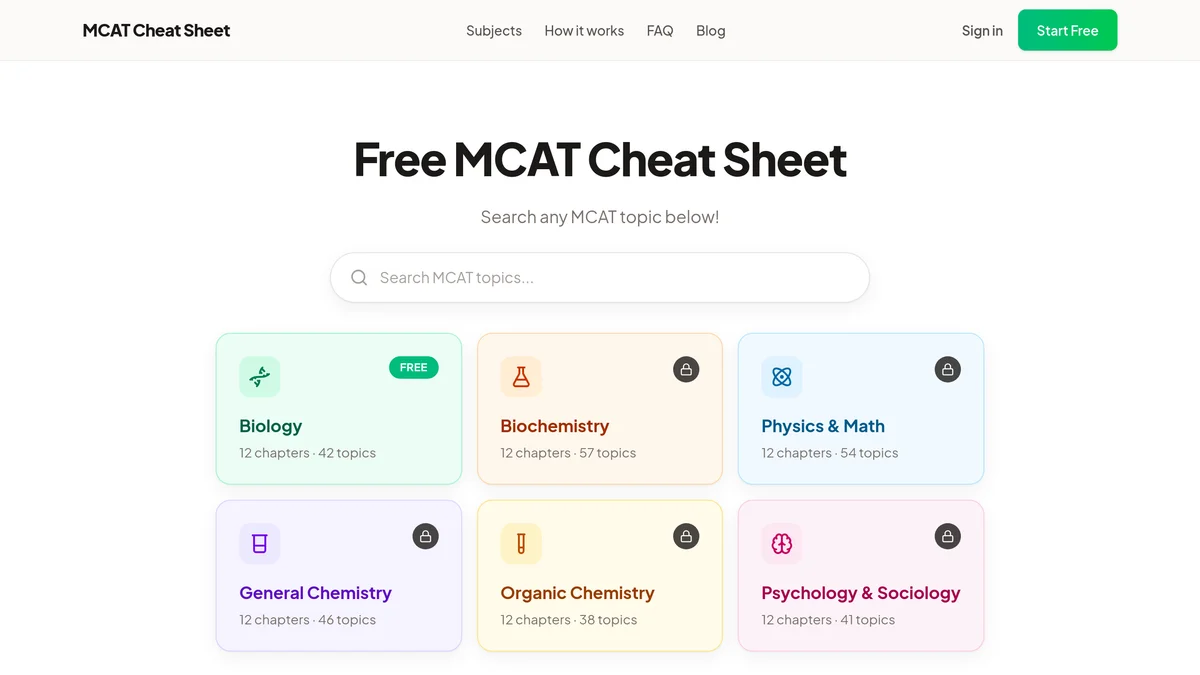 The mcatcheatsheet.com homepage, captured September 2026. Five of the six subject cards carry a lock.
MCAT Cheat Sheet Overview
MCAT Cheat Sheet is a browsable site of condensed topic pages, organized the way a review book is: subject, then chapter, then subtopic. The homepage states the scale plainly, and the subject pages confirm it.
- Biology, 12 chapters, 42 topics
- Biochemistry, 12 chapters, 57 topics
- Physics and Math, 12 chapters, 54 topics
- General Chemistry, 12 chapters, 46 topics
- Organic Chemistry, 12 chapters, 38 topics
- Psychology and Sociology, 12 chapters, 41 topics
That is 72 chapters and 278 topics, which matches the "278 MCAT Topics" the homepage advertises. The site also gives you instant search across every subject, a favorites list, and a reviewed marker that remembers where you stopped.
What it is not is a download. There is no PDF, no printable sheet, and no image file to save. That single fact separates it from almost everything else a student finds under this search: the MilesDown review sheets are a PDF, the Leah4Sci math sheet is a pair of images, and the MedLife Mastery sheets are a download library. This one only exists in a browser tab.
MCAT Cheat Sheet Review For 2026
How much of it you can actually read for free
The site says "Free Forever" and "No credit card required", and both are true. There is no paid plan on any page. But free is not the same as open.
The FAQ states it directly: "Biology chapters 1-3 are fully browsable without an account. Sign in free with Google to unlock every subject and sync your progress across devices." The Biology subject page backs that up, tagging chapters 1, 2 and 3 as FREE and leaving chapters 4 through 12 untagged. On the homepage, five of the six subject cards show a padlock.
So the honest figure is 3 of 72 chapters, about 4 percent of the site, readable with no account at all. Everything else costs you a Google sign-in and nothing more.
Free here means no money, not no account. Budget one Google sign-in, then all 278 topics are open with nothing else to pay or unsubscribe from.
That is a mild price. It is worth stating anyway, because the phrase attached to this site in most places is "no registration required", and that has stopped being accurate.
What a topic page actually contains
Every topic page runs the same six blocks, which is the strongest thing about the product. Taking the Cell Theory page as the sample:
- High-Yield Summary. Four bullets. The three classical tenets, the modern fourth tenet about DNA, the dated discovery sequence, and the virus exception.
- Key Terms. Term and one-line definition. Here: cell theory, omnis cellula e cellula, obligate intracellular parasite.
- A topic expansion. On this page a six-step history from Hooke in 1665 to twentieth-century molecular biology.
- A question-framed section. "Do Viruses Violate Cell Theory?", answered against each tenet.
- Common MCAT Trap. Three of them on this page: that 3 and 4 tenets are both defensible answers, that "structural" and "functional" unit are both meant and a passage can hinge on the wording, and that the exam applies the tenets to unfamiliar scenarios rather than asking you to list them.
- Quick Recall. Four questions with answers hidden behind a Show Answer control.
Blocks 5 and 6 are the ones that matter. Most free summary notes stop at block 1, and reading a summary is the least effective thing you can do with it. A trap section and a covered-answer quiz turn the same page into something closer to a flashcard deck, which is the format our MCAT flashcard reviews cover in more depth.
One caveat about this section, stated plainly: 3 of 72 chapters are readable without an account, so this template is verified across Biology chapters 1 to 3 and the counts come from the site's own subject pages. It is consistent across every free page read, but no reviewer without an account can confirm chapter 47 is as careful as chapter 1.
The CARS gap, and why it is defensible
None of the 278 topics covers Critical Analysis and Reasoning Skills. The subject list has six entries and CARS is not one of them.
That matters in size. The AAMC puts 53 questions and 90 minutes into CARS, against 59 questions and 95 minutes for Biological and Biochemical Foundations. CARS is close to a full quarter of your scored questions.
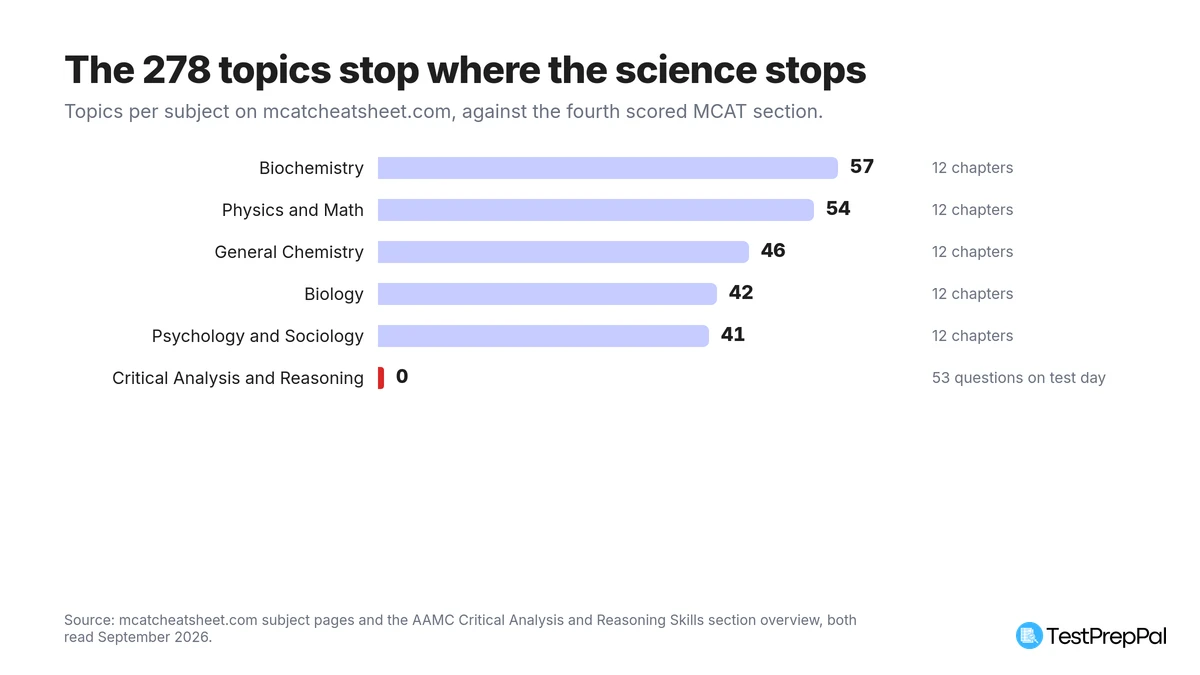 Topics per subject, read September 2026, against the fourth scored section.
The defence is that the AAMC agrees there is nothing to memorize. Its own CARS overview says "Everything you need to know to answer test questions is in the passages and the questions themselves. No additional coursework or specific knowledge is required to do well on the Critical Analysis and Reasoning Skills section." Passages run 500 to 600 words and split evenly between humanities and social sciences. A cheat sheet has genuinely nothing to put on a CARS page.
So this is not a flaw in the writing. It is a boundary on the product, and the only mistake is expecting a complete study plan from it. Pair it with timed passages from Jack Westin or the AAMC's own CARS material, which is the practice this site cannot substitute for.
Pricing
There is nothing to buy. No plan page, no tiers, no trial, no upsell to a paid product anywhere on the site.
| What you want | Price | What you give up |
|---|---|---|
| Biology chapters 1 to 3 | Free | Nothing |
| All 6 subjects, 278 topics | Free | A Google sign-in |
| Favorites and reviewed tracking | Free | The same sign-in |
| Search across every subject | Free | Nothing |
| A printable copy | Not offered | Not applicable |
Per-month math does not apply, because there is no subscription and no access window. The only real cost is that your progress lives in someone else's account rather than in a file you keep. If a free download you own outright matters more to you than search and recall questions, the MCAT equation sheet roundup compares the sheets you can save.
Who MCAT Cheat Sheet Is Best For
This suits the student in content review who keeps reaching for the same forgotten fact. Search beats flipping through a 90 page PDF, and 278 topic pages at this grain size means the thing you half-remember usually has its own page.
It fits well next to a question bank. When a UWorld explanation names a mechanism you have lost, the topic page gives you the summary, the trap and four recall questions in about the time a review book costs you to find the chapter. Slotting that into a plan is what our MCAT study schedule guide is for.
It is also a reasonable free second pass over Psych and Soc, where 41 topics is enough to cover the terminology load that section leans on.
Skip it if you study on paper. There is nothing to print, and the brain-dump practice that most MCAT advice recommends, writing your own sheet from memory in the tutorial minutes, is not something this format helps you rehearse. Skip it too if you want depth on a hard topic: these are summaries, and a page that fits on a screen is not going to fix a real gap in organic chemistry mechanisms.
When You Might Look Elsewhere
If you want a file you own, look at the other options on our MCAT cheat sheets list. MilesDown is the condensed review sheet set that circulates most widely, and it prints. MedLife Mastery publishes a subject library rather than a single sheet. For arithmetic specifically, the Leah4Sci MCAT math cheat sheet prints the rounded values you are expected to work from with no calculator, which is a job none of the others do.
If your weak spot is a chart rather than a concept, our MCAT amino acid chart and MCAT hormone chart are the two tables most students end up hunting for. And if CARS is the section holding your score down, no cheat sheet of any kind will move it. The way we score every resource is set out in our review methodology.
Final Verdict
MCAT Cheat Sheet earns 4.0 out of 5. It is free with no paid tier, it covers the three science sections at 278 topics, and the per-topic template is better built than most paid summary notes: a trap section and hidden-answer recall questions on every page turn passive reading into something closer to practice. The score is held back by three things: the Google sign-in past Biology chapter 3, the total absence of CARS, and the fact that nothing here can be printed or saved.
Use it as a searchable index during content review, not as your study plan. Sign in, favorite the topics you keep losing, and get your CARS practice and your printable sheets somewhere else.
MCAT Cheat Sheet FAQs
Is MCAT Cheat Sheet really free?
Yes. There is no paid plan, no trial and no credit card on any page of the site, and the homepage states no card is required. The only thing it asks for is a Google sign-in, and that is free too. Biology chapters 1 to 3 can be read without even that.
Do you need an account to use MCAT Cheat Sheet?
For most of it, yes. The site's FAQ says Biology chapters 1 to 3 are fully browsable without an account and that signing in with Google unlocks every subject. That works out to 3 of the site's 72 chapters open to anyone, with the other 69 behind a free one-click sign-in.
Does MCAT Cheat Sheet cover CARS?
No. It publishes six subjects, Biology, Biochemistry, Physics and Math, General Chemistry, Organic Chemistry, and Psychology and Sociology, and none of its 278 topics addresses Critical Analysis and Reasoning Skills. The AAMC says CARS needs no outside coursework or specific knowledge, so there is little for a cheat sheet to put there, but CARS is still 53 questions and 90 minutes on test day.
Can you download MCAT Cheat Sheet as a PDF?
No. It is a web app only, with no PDF, no printable version and no image files to save. If you want something to print and annotate, a download like the MilesDown review sheets is the closer fit; if you want search and progress tracking, this format is the reason to use it.
How many topics does MCAT Cheat Sheet have?
278 topics across 72 chapters, 12 chapters in each of the six subjects. Biochemistry is the largest at 57 topics, then Physics and Math at 54, General Chemistry at 46, Biology at 42, Psychology and Sociology at 41, and Organic Chemistry at 38.
We may earn commissions from some links on this page, but this does not affect our reviews or your experience.
Our Verdict
A free, genuinely well built reference for the three science sections, and the only serious free MCAT cheat sheet that is a searchable site rather than a PDF. Every topic page ends with a common trap and a set of hidden-answer recall questions, which is more than most paid summary notes do. Two things to know before you commit: 3 of its 72 chapters are readable without a Google account, and none of its 278 topics touches CARS.