


The MCAT amino acids are the highest-yield memorization block on the entire exam, and they're one of the few things you genuinely have to know cold. The test gives you a periodic table and nothing else. Passages use one-letter codes without defining them, ask you to predict charge at physiological pH, and expect you to know which side chains buffer, which ones bury themselves in a protein core, and which two can form a disulfide bond.
This is the full chart, plus the pKa values and the memorization strategy that makes the 20 stick.
- All 20 amino acids, both code systems, and the side-chain class of each have to be in memory. The MCAT provides no reference sheet.
- Only 7 side chains ionize. Those 7 plus the 2 termini are the entire pKa set you need.
- Histidine (pKa about 6.0) is the only side chain that buffers near physiological pH, which is why it shows up in active sites and the Bohr effect.
- Below its pI a molecule is net positive; above its pI it's net negative and migrates toward the anode.
- Learn the 20 by class, not alphabetically. Tryptophan is W and glutamine is Q, and those two trip up almost everyone.
Related free resource:

Blueprint's Free MCAT Flashcards
1,600+ expert-made cards covering every section. No Anki setup.
Free account · No credit card
MCAT Amino Acid Chart
The MCAT gives you a periodic table and nothing else. All 20 standard amino acids have to be in memory: names, both code systems, and side-chain properties. Passages routinely use one-letter codes without defining them.
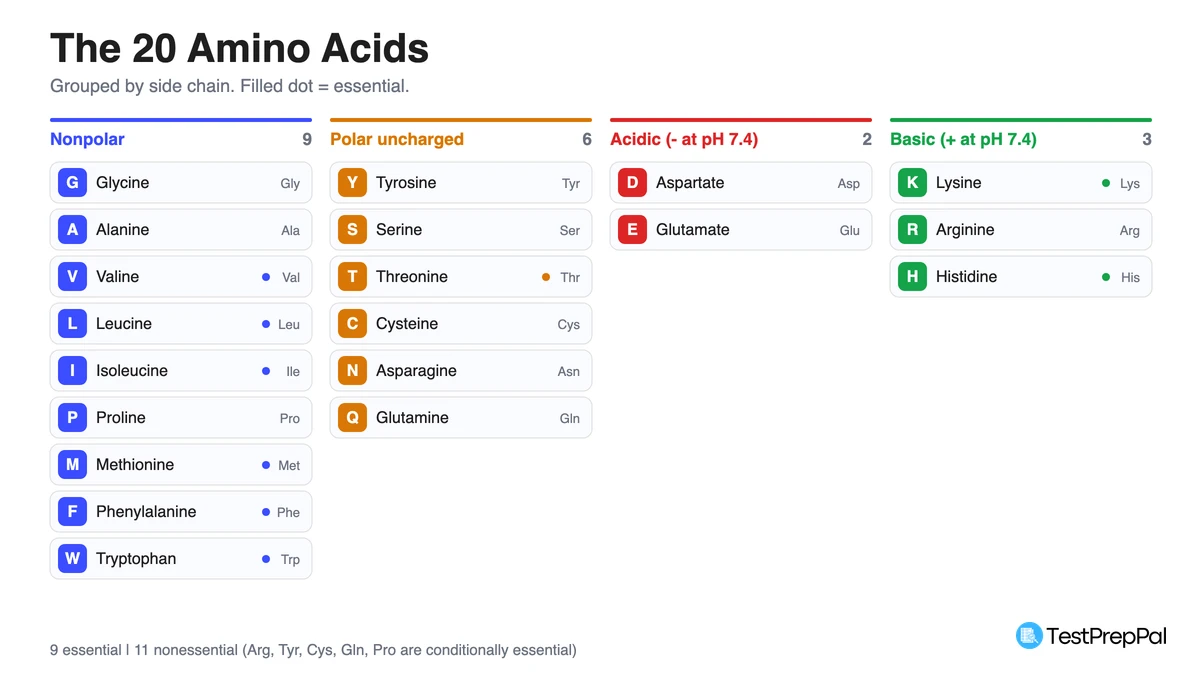 The 20 amino acids grouped by side-chain class. Filled dot marks the 9 essential amino acids.
| Amino acid | 3-letter | 1-letter | Side-chain class | Essential? |
|---|---|---|---|---|
| Glycine | Gly | G | Nonpolar, aliphatic (H only) | Nonessential |
| Alanine | Ala | A | Nonpolar, aliphatic | Nonessential |
| Valine | Val | V | Nonpolar, aliphatic (branched) | Essential |
| Leucine | Leu | L | Nonpolar, aliphatic (branched) | Essential |
| Isoleucine | Ile | I | Nonpolar, aliphatic (branched) | Essential |
| Proline | Pro | P | Nonpolar, cyclic secondary amine | Nonessential |
| Methionine | Met | M | Nonpolar, sulfur-containing (thioether) | Essential |
| Phenylalanine | Phe | F | Nonpolar, aromatic | Essential |
| Tryptophan | Trp | W | Nonpolar, aromatic (indole) | Essential |
| Tyrosine | Tyr | Y | Polar, aromatic (phenol, ionizable) | Nonessential (conditionally; made from Phe) |
| Serine | Ser | S | Polar uncharged (hydroxyl) | Nonessential |
| Threonine | Thr | T | Polar uncharged (hydroxyl) | Essential |
| Cysteine | Cys | C | Polar uncharged (thiol, ionizable) | Nonessential (conditionally; made from Met) |
| Asparagine | Asn | N | Polar uncharged (amide) | Nonessential |
| Glutamine | Gln | Q | Polar uncharged (amide) | Nonessential (conditionally) |
| Aspartate (aspartic acid) | Asp | D | Acidic, negatively charged at pH 7.4 | Nonessential |
| Glutamate (glutamic acid) | Glu | E | Acidic, negatively charged at pH 7.4 | Nonessential |
| Lysine | Lys | K | Basic, positively charged at pH 7.4 | Essential |
| Arginine | Arg | R | Basic, positively charged at pH 7.4 (guanidinium) | Conditionally essential |
| Histidine | His | H | Basic, aromatic imidazole; partly charged at pH 7.4 | Essential |
Counting the classes: 7 nonpolar aliphatic (Gly, Ala, Val, Leu, Ile, Pro, Met), 3 aromatic (Phe, Trp, Tyr), 5 polar uncharged (Ser, Thr, Cys, Asn, Gln), 2 acidic (Asp, Glu), and 3 basic (Lys, Arg, His).
The nine essential amino acids are phenylalanine, valine, threonine, tryptophan, isoleucine, methionine, histidine, leucine, and lysine. The mnemonic is PVT TIM HLL ("private Tim Hall"). Arginine is often taught as a tenth because it is essential during growth and illness, giving the longer version PVT TIM HALL.
Two codes worth flagging because they trip people up: tryptophan is W and glutamine is Q. Neither letter appears in the name.
Ionizable Group pKa Values
Only seven side chains ionize. These plus the two termini are the entire set of pKa values the MCAT expects, and they drive every question about charge, buffering, isoelectric point, and electrophoresis.
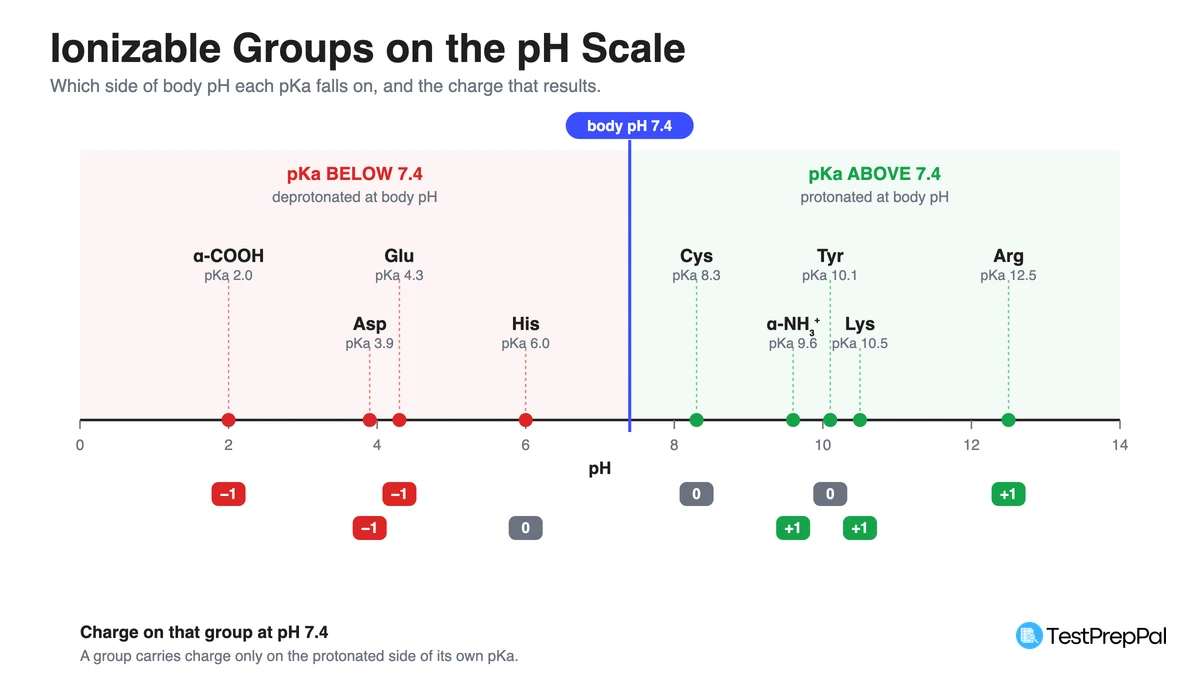 Every ionizable group on one pH axis. Groups left of 7.4 are deprotonated in the body; groups right of it stay protonated.
| Group | Approx. pKa | Charge below pKa | Charge above pKa |
|---|---|---|---|
| α-carboxyl terminus (COOH) | 2.0 (range 1.8–2.4) | 0 | −1 |
| Aspartate side chain | 3.9 | 0 | −1 |
| Glutamate side chain | 4.3 | 0 | −1 |
| Histidine side chain (imidazole) | 6.0 | +1 | 0 |
| Cysteine side chain (thiol) | 8.3 | 0 | −1 |
| α-amino terminus (NH₃⁺) | 9.6 (range 9.0–10.5) | +1 | 0 |
| Tyrosine side chain (phenol) | 10.1 | 0 | −1 |
| Lysine side chain (ε-amino) | 10.5 | +1 | 0 |
| Arginine side chain (guanidinium) | 12.5 | +1 | 0 |
Two notes on these numbers. The values shown are for free amino acids; inside a polypeptide the terminal α-amino pKa drops to roughly 8 to 9, and any side-chain pKa can shift by a unit or more depending on its local environment. And histidine is the only side chain within about one pH unit of physiological pH, which is why it dominates active-site chemistry, the Bohr effect, and every MCAT question about protein buffering.
The pI Rules Worth Memorizing
- pI is the average of the two pKa values that flank the neutral species. For an amino acid with no ionizable side chain, that means the average of the two termini: glycine is (2.34 + 9.60)/2 = 5.97. Note that the 2.0 in the table above is the typical alpha-carboxyl value across amino acids; individual amino acids vary within that 1.8 to 2.4 range, and glycine's own alpha-carboxyl pKa is 2.34.
- Below the pI a molecule is net positive; above the pI it is net negative. In electrophoresis a protein at a pH above its pI carries negative charge and migrates toward the anode.
- Acidic amino acids have low pI values (aspartate ≈ 2.8, glutamate ≈ 3.2) because you average the two acidic groups. Basic amino acids have high pI values (lysine ≈ 9.7, arginine ≈ 10.8) because you average the two basic groups.
- At its pI a protein carries no net charge, so it does not migrate in an electric field and is at its least soluble, which is the basis of isoelectric focusing and of isoelectric precipitation.
How to Actually Memorize the 20
Nobody memorizes this chart alphabetically and keeps it. The version that survives test day is built in groups, because the group is what the exam actually asks about.
Learn the five classes as five separate lists. Seven nonpolar aliphatic, three aromatic, five polar uncharged, two acidic, three basic. Those counts are your checksum: if you can only produce four polar uncharged residues, you know exactly where the gap is. Recite the counts first, then fill each bucket.
Anchor each class to one physical idea. Nonpolar means it hides in the protein core, away from water. Polar uncharged means it sits on the surface and hydrogen bonds. Acidic means it lost a proton and is negative in the body. Basic means it holds a proton and is positive. Every property question the MCAT asks is a variation on one of those four sentences.
Use PVT TIM HLL for the essentials. If you're asked which amino acid the body cannot synthesize, that mnemonic answers it in about two seconds, and PVT TIM HALL adds conditionally essential arginine.
Attack the one-letter codes in three tiers. Eleven are just the first letter of the name (A, C, G, H, I, L, M, P, S, T, V). A second group takes a distinctive sound: R for arginine, F for phenylalanine, Y for tyrosine. The last tier is the pair that catches people every year: tryptophan is W and glutamine is Q, and neither letter appears in the name. Note too that of each acid-amide pair, the shorter member gets the earlier letter: D for aspartate and E for glutamate, N for asparagine and Q for glutamine.
Write it from memory, not by re-reading. Blank paper, five columns, fill them in, then check against the chart above. Two or three passes over a week beat an hour of staring at it.
If the structures are the part that will not stick, the drawing videos covered in our Leah4Sci MCAT review build all 20 side chains one group at a time. For a faster pass, the six video amino acids and proteins collection in our PremedHQ MCAT review runs about seven minutes a topic.
What the MCAT Actually Tests About Amino Acids
The exam almost never asks you to draw a side chain. It asks what that side chain does. These five patterns cover the overwhelming majority of amino acid questions.
Charge at physiological pH. The question is always the same comparison: is pH 7.4 above or below this group's pKa? Above the pKa, the group is deprotonated. Below it, protonated. That single habit answers questions about salt bridges, active-site catalysis, and which residues interact with a negatively charged substrate. At 7.4, Asp and Glu are negative, Lys and Arg are positive, and histidine is partly protonated.
pI and electrophoresis direction. Give a protein a pI of 5.0 and a buffer at pH 8.0, and the protein is negative and runs toward the anode. Flip the buffer to pH 3.0 and it runs toward the cathode. Ion-exchange chromatography questions use the same logic: a protein binds a positively charged resin when the buffer pH sits above its pI. Notice that you never actually calculate anything, you just compare two numbers.
Buffering near a pKa. A group buffers best when the pH equals its pKa, where it's half protonated. Histidine at about 6.0 is the only side chain close enough to 7.4 to matter physiologically, which is why it appears in the catalytic triad of serine proteases and in the Bohr effect in hemoglobin. If a passage introduces a mutant enzyme that loses activity at a specific pH, histidine is usually the residue involved.
Hydrophobic core versus surface residues. In a globular cytoplasmic protein, nonpolar residues bury inward and polar or charged residues face the aqueous surface. In a transmembrane segment the logic inverts: the stretch inside the lipid bilayer is nonpolar. A common item gives you a sequence and asks which region spans a membrane, and the answer is the run of Val, Leu, Ile, Phe, and Ala.
Disulfide bonds. Two cysteine residues oxidize to form a covalent disulfide bridge, the only covalent side-chain link in the standard set. Disulfides stabilize tertiary and quaternary structure and are common in secreted and extracellular proteins, rare in the reducing cytoplasm. Reducing agents such as beta-mercaptoethanol or DTT break them, which is why SDS-PAGE run with a reducing agent splits a disulfide-linked protein into its individual chains. Methionine also contains sulfur but cannot form a disulfide, because its sulfur sits in a thioether rather than a free thiol.
Why This Chart Is Worth the Time
Biochemistry is the only discipline the AAMC weights at 25% in two different sections: 25% of the Chemical and Physical Foundations section and 25% of the Biological and Biochemical Foundations section. Each of those sections has 59 questions, so biochemistry is roughly 15 questions in each, about 30 across the exam. Section formats and discipline percentages are from the AAMC Chemical and Physical Foundations of Biological Systems section overview and the AAMC Biological and Biochemical Foundations of Living Systems section overview, both verified August 28, 2026. AAMC notes these percentages are approximated to the nearest 5% and vary between test forms.
Amino acids sit underneath a large share of those questions. Protein structure, enzyme active sites, separation techniques, and hemoglobin all resolve back to this chart, which is why it repays memorization more than almost anything else on the exam.
Frequently Asked Questions
Do I need to memorize all 20 amino acids for the MCAT?
Yes. You need the names, the three-letter and one-letter codes, the side-chain class, and the approximate side-chain pKa values for the seven ionizable side chains. The AAMC will use one-letter codes in a passage without defining them, and questions on charge, pI, electrophoresis, and enzyme active sites all assume you know which side chains are acidic, basic, polar, and nonpolar.
Do I have to draw the amino acid structures?
Not usually. The exam tests properties far more often than structures. You should be able to recognize a side chain from a drawing and say whether it's polar, charged, or aromatic, but reproducing all 20 structures from memory is a poor use of study time compared with drilling class, code, and pKa.
Which amino acid pKa values actually get tested?
Histidine at about 6.0 matters most, because it's the only side chain that buffers near physiological pH. Then aspartate at about 3.9 and glutamate at about 4.3, the two acidic residues; lysine at about 10.5 and arginine at about 12.5, the two strongly basic ones; and cysteine at about 8.3 and tyrosine at about 10.1. You also need the termini: roughly 2 for the carboxyl group and roughly 9 to 10 for the amino group.
Is histidine acidic or basic?
Basic. Its imidazole side chain accepts a proton, and at a pH below 6.0 it carries a +1 charge. What makes it unusual is that its pKa of about 6.0 sits close to physiological pH, so at 7.4 the population is only partly protonated. That's exactly what makes it useful as a biological buffer and as an active-site residue that can shuttle protons.
How many amino acids are essential?
Nine: phenylalanine, valine, threonine, tryptophan, isoleucine, methionine, histidine, leucine, and lysine, remembered as PVT TIM HLL. Arginine is frequently counted as a tenth because it becomes essential during growth, injury, and illness, which gives the alternative mnemonic PVT TIM HALL.
Does the MCAT give you an amino acid chart?
No. The only reference the MCAT provides in the science sections is a periodic table. There's no equation sheet and no calculator, so the chart, the pKa values, and the pI rule all have to come from memory.
Put It to Work
A chart you've read is not a chart you know. Test yourself against passage-based items with our free MCAT biochemistry practice questions, which run in a replica of the AAMC interface and lean heavily on charge, pI, and enzyme kinetics. If you would rather carry the 20 on a printed page, the MedLife Mastery MCAT cheat sheets include an amino acids sheet in a free library of 69. Then see what else is free in our roundup of free MCAT resources, or get a realistic read on the exam with our guide to how hard the MCAT is.
MCAT Reference Sheets
The rest of the high-yield memorization set:
MCAT equation sheet · MCAT hormone chart · MCAT organic chemistry reactions sheet
Then test what stuck with our free MCAT practice questions: 25 questions per subject in the AAMC test interface, with full worked solutions.
We may earn commissions from some links on this page, but this does not affect our reviews or your experience.