


PremedHQ Science Academy Review
by PremedHQ
High-yield topic summaries for C/P and B/B sections
✓Pros
- ✓Free, no account needed to watch
- ✓170 videos across 30 high-yield topic collections
- ✓Strong chemistry, physics and organic chemistry coverage
- ✓Concise single-topic videos
- ✓90K subscribers
✗Cons
- ✗No new videos since January 2016
- ✗No organ physiology, psychology, sociology or CARS content
- ✗No practice questions or full-length exams
- ✗Summary format only, not detailed lectures
Highlights
- ✓173 video lectures
- ✓170+ high-yield topics
- ✓Chemistry, Physics, Biology, Biochemistry coverage
- ✓Concise chapter summaries
- ✓Organic Chemistry included
Price
✓Free
What Students Are Saying
Sign in to leave a review

Expert Rating
PremedHQ Science Academy is worth an hour of your time if general chemistry, physics or organic chemistry has stopped making sense and you want a short, clear explanation for free. It is not worth building a MCAT study plan around, because the channel stopped publishing in January 2016 and its biology coverage ends where the organ systems begin.
The channel runs under the handle @PremedHQ and had 90,000 subscribers and 173 videos when we read it on September 30, 2026. It belongs to PremedHQ, Inc., which describes itself on the channel as a medical school admissions consulting firm featured in Forbes. The videos themselves are the product here, and they are free.
Summary Table
| Feature | PremedHQ Science Academy |
|---|---|
| Price | Free |
| Format | On-demand video on YouTube, no account needed |
| Library size | 173 videos, 170 of them inside 30 topic collections |
| Subjects | Chemistry, physics, organic chemistry, biology and biochemistry |
| Organ physiology | None |
| Psych/Soc content | None |
| CARS content | None |
| Practice questions | None |
| Full length exams | None |
| Newest upload | January 22, 2016 |
| Typical video length | About 7 minutes |
| Guarantee | None |
| Subscribers | 90K |
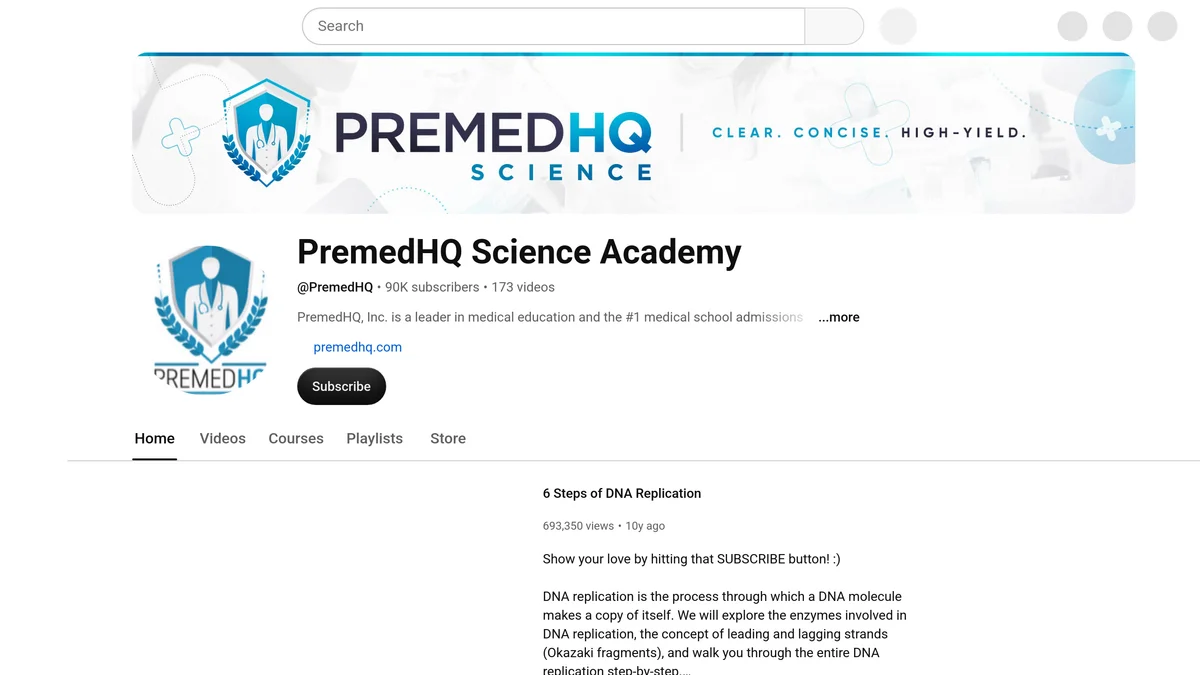 The PremedHQ Science Academy channel on youtube.com, captured September 2026.
PremedHQ Science Academy Overview
PremedHQ Science Academy is a fixed library of short science explainers, not a course. Each video takes one named concept and finishes it, usually in about seven minutes, with a slide-and-voice format rather than a whiteboard. There is no syllabus, no schedule, no account and no progress tracking. You arrive with a topic and you leave with an explanation.
The organisation is the best thing about it. The channel sorts its videos into 30 topic collections, split across four shelves on the channel home page, and those collections hold 170 of the 173 videos. Fifteen of the collections are ordinary playlists and fifteen are published through YouTube's Courses feature, but all 30 are public and free to watch in the same way.
What the library contains, counted collection by collection on the Courses and Playlists tabs:
- Chemistry: 8 collections, 49 videos, including acid and base chemistry, thermochemistry, reaction rates and equilibria, solubility and electrochemistry
- Physics: 9 collections, 46 videos, including mechanics, machines, fluids, gas phase, electrostatics and circuits, waves and sound, and optics
- Organic chemistry: 5 collections, 24 videos, including stereochemistry, separation and purification, and spectroscopy and NMR
- Biology and biochemistry: 8 collections, 51 videos, covering nucleic acids, the genetic code, transcription, translation, amino acids and proteins, enzymes, chromosome structure and genetics
What it does not contain anywhere: organ physiology, psychology, sociology, critical reading, practice questions, full length exams and score tracking. The only thing the channel sells is a merchandise shelf of science t-shirts, so there is no paid tier waiting behind the free videos and no guarantee attached to anything.
PremedHQ Science Academy Review For 2026
The library stopped growing in January 2016
This is the fact that should decide whether you open the channel, and it is the one no roundup mentions. PremedHQ Science Academy has not published a video since January 22, 2016. The channel's own upload feed gives that date, the Videos tab shows every one of its most recent uploads as 10 years old, and the most viewed video featured on the channel home page, on the six steps of DNA replication, carries 693,350 views and the same 10 year stamp.
For the science itself, a decade matters less than it sounds. Glycolysis, Snell's law and the Henderson-Hasselbalch equation have not moved. What has moved is everything around them: the exam's format guidance, the official practice material, the way questions frame experiments, and the study advice that used to sit alongside content review. Nothing in this library has been revised against the current AAMC content outline, and nothing in it was written with the current official practice products in mind.
So treat it the way you would treat a good textbook from 2016. The explanations are fine. The exam strategy is not there, and you should not go looking for it here.
The biology half is molecular only
The second finding takes a full count to see. PremedHQ's biology and biochemistry shelf is its biggest, at 51 videos, which makes the channel look strong for the Biological and Biochemical Foundations of Living Systems section. Read the collection names and the picture changes. All eight are molecular: nucleic acids, the genetic code, transcription, translation, amino acids and proteins, enzymes, chromosome structure and genetics.
That is one half of the section. The AAMC splits Bio/Biochem across three foundational concepts and puts Foundational Concept 3 at 25 percent of it. Foundational Concept 3 is the organ systems concept: category 3A is the nervous and endocrine systems, and category 3B is the circulatory, respiratory, digestive, immune, lymphatic, muscular, skeletal and reproductive systems. The section runs 59 questions in 95 minutes, so a quarter of it is roughly 15 questions, and PremedHQ has no video on any of it. The AAMC notes those percentages are approximated to the nearest 5 percent and vary between test forms.
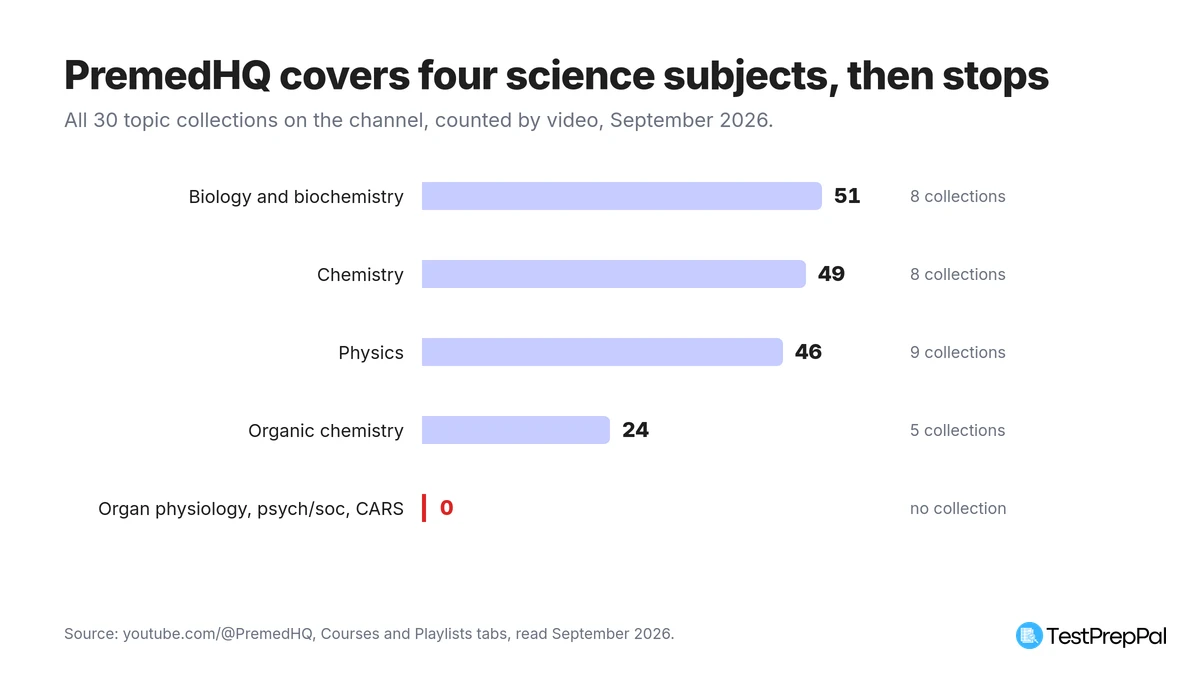 All 30 PremedHQ topic collections counted by video, read September 2026.
Psychology, sociology and CARS are the simpler gaps, because the channel never claimed them. There is no collection for any of the three, which leaves a whole section and the reading section untouched. If you need the physiology, our MCAT hormone chart covers the endocrine half of category 3A, and you will want a proper resource for the rest.
Counted honestly, then, PremedHQ is a strong free option for the physical sciences and a partial one for biology. That is a narrower product than "170 high-yield MCAT topics" suggests, and it is a useful thing to know before you build a week around it.
Short videos are the real strength
Where PremedHQ does cover a topic, the format is its advantage. The 30 most recent videos run 3 hours 33 minutes between them, an average of just over 7 minutes each, which puts the whole 173 video library at roughly 20 hours if that average holds. Compare that with the free science libraries that run to hundreds of hours and you can see the appeal: this one is small enough to use as a lookup table.
Seven minutes is also the right length for the job. A single PremedHQ video answers one question, states the rule, works one example and ends. It does not go further than the MCAT needs, which is the common complaint about deeper free libraries. For students who keep losing the same handful of points on electrochemistry or torque, that restraint is worth more than depth.
The production is dated but clean. Slides, a steady voice, legible diagrams, consistent audio. Most students will watch at 1.25 speed. The captions are auto-generated and imperfect, which is worth knowing if you rely on them.
Pricing
PremedHQ Science Academy is free. Every one of the 30 topic collections is public, nothing asks you to create an account, there is no trial, no tier and no upsell into a paid version of the same content. The only thing for sale on the channel is a merchandise shelf of science-themed shirts, which has nothing to do with the videos.
There is no guarantee, because nothing is being sold. That also means there is nobody to ask when a video is wrong or out of date, and no mechanism for the library to be corrected. In a library that has been static for a decade, that is worth a moment's thought rather than a shrug.
What the price does change is the calculation about time. A free resource still costs you hours, and hours are the scarce thing in MCAT prep. Watching video feels productive in a way that answering questions does not, and this library contains no questions at all. Our MCAT study schedule guide sets out how much of a week should go to content review against practice.
Who PremedHQ Science Academy Is Best For
PremedHQ suits a student who is early in content review, is working mainly on the physical sciences, and wants a short explanation rather than a lecture. If your weak areas are general chemistry, physics or organic chemistry, the 119 videos across those three subjects are a reasonable free first stop, and the collection structure means you can work through one topic without hunting.
It also suits anyone who wants a quick refresh on molecular biology. The transcription, translation and enzymes collections are the strongest part of the biology shelf, and those topics change slowly.
It is a poor fit if you are inside eight weeks of test day, if your weakness is physiology or Psych/Soc, if you need practice rather than explanation, or if you want anything about the exam itself rather than the science on it. It is also a poor fit as a primary resource for anyone, because a library that covers two and a half sections cannot be the spine of a study plan.
When You Might Look Elsewhere
Khan Academy MCAT is the broader free alternative and the obvious one to pair with this, because it does cover the psychology and sociology that PremedHQ leaves out entirely.
If you want more depth on the same science, AK Lectures has a far larger free library and explains where the rules come from rather than just stating them, at the cost of much longer videos. For organic chemistry specifically, Leah4sci is more thorough than PremedHQ's 24 video organic collection and is still being updated.
If the real gap is practice rather than explanation, video is the wrong purchase at any price. A question bank such as UWorld MCAT puts you in passages with explanations attached, and spaced repetition through the AnKing MCAT decks does more for retention than rewatching. You can compare the rest of the free video options on our list of MCAT YouTube channels, and the way we score every resource is set out in our review methodology.
Final Verdict
PremedHQ Science Academy earns 3.4 out of 5. It is free, well organised and genuinely efficient for the physical sciences, and the seven minute format is better suited to MCAT content review than most free video. The score is held down by a decade of silence and by a coverage map that stops at the molecular level.
Use PremedHQ for a fast refresh on chemistry, physics or organic chemistry, and for molecular biology. Get your organ physiology, psychology, sociology and CARS somewhere else, because this channel has never covered them and has not added anything since January 2016.
PremedHQ Science Academy FAQs
Is PremedHQ Science Academy free?
Yes. All 30 topic collections are public on YouTube and none requires an account, a trial or a payment. The channel has no paid tier and no premium version of the same videos. The only thing it sells is a merchandise shelf of science t-shirts, which is unrelated to the study content.
Is PremedHQ still updated?
No. The channel's newest video was published on January 22, 2016, and every upload on its Videos tab is around 10 years old. The science explanations still hold, but nothing in the library has been revised against the current AAMC content outline, and there is no exam format or strategy content to be out of date in the first place.
Does PremedHQ cover MCAT physiology?
No. Its biology and biochemistry collections are entirely molecular: nucleic acids, transcription, translation, amino acids, enzymes, chromosomes and genetics. The AAMC puts Foundational Concept 3, which is the nervous, endocrine, circulatory, respiratory, digestive, immune, lymphatic, muscular, skeletal and reproductive systems, at 25 percent of the 59 question Bio/Biochem section, so you need another resource for roughly 15 of its questions.
How long are PremedHQ videos?
About seven minutes on average. The 30 most recent videos total 3 hours 33 minutes, which works out at just over 7 minutes each, and the whole 173 video library is roughly 20 hours at that rate. That makes it one of the shorter free MCAT science libraries, which is the main reason to use it.
Is PremedHQ better than Khan Academy for the MCAT?
They do different jobs. PremedHQ is faster and better organised for a single chemistry or physics concept. Khan Academy covers far more of the exam, including the psychology and sociology that PremedHQ does not touch at all. Most students who use both use Khan Academy for coverage and PremedHQ when they want one topic explained quickly.
We may earn commissions from some links on this page, but this does not affect our reviews or your experience.
Our Verdict
PremedHQ Science Academy is a tidy, free library of 170 single-topic science videos, and the chemistry, physics and organic chemistry collections are genuinely good for a fast concept refresh. Two things keep the score down. The channel has published nothing since January 22, 2016, and its biology half is entirely molecular, so there is no organ physiology anywhere, plus no psychology, no sociology and no CARS. Use it to unstick a science concept, not to plan a section.