

Best MCAT YouTube Channels in 2026

by John Reed· Last Updated: Nov 26, 2026
Start with the Khan Academy MCAT channel. It holds 1,124 free videos across 11 playlists, filed under the AAMC foundational concepts, and it covers Chem/Phys, Bio/Biochem and Psych/Soc properly. Then add Leah4Sci for calculator-free math and AK Lectures when one science concept will not click.
All five channels on this page are free and none needs an account to watch. They are good at one job: explaining content you got wrong in practice.
They share the same limits. None of them teaches CARS properly, none has passage-based practice or full length exams, and most of the libraries are years old. Treat them as a reference next to a question source, not as a study plan.
Here are the main takeaways:
- Khan Academy MCAT: Best for content review across three sections, including Psych/Soc. 1,124 videos, of which 291 are Psych/Soc and 9 are CARS.
- PremedHQ Science Academy: Best for a fast refresh on one chemistry, physics or organic chemistry concept. 173 videos at about 7 minutes each, with nothing new since January 22, 2016.
- MedSchoolCoach: Best for free mnemonics for lists that will not stick. The whole MCAT library is 42 videos and 1 hour 19 minutes.
- Leah4Sci MCAT: Best for MCAT math without a calculator. A nine part series with a downloadable worksheet, inside a 317 video channel.
- AK Lectures: Best for deep explanations of biochemistry, organic chemistry and physics. More than 2,000 free lectures across six science subjects.
MCAT YouTube channels summary table
| Channel | Cost | Library | What you get | Main gap | Best for |
|---|---|---|---|---|---|
| Khan Academy MCAT | Free | 1,124 videos in 11 playlists | Chem/Phys, Bio/Biochem and Psych/Soc by AAMC foundational concept | 9 CARS videos, no practice questions on the channel | Broad content review |
| PremedHQ Science Academy | Free | 173 videos, about 7 minutes each | Chemistry, physics, organic chemistry, molecular biology | No organ physiology, Psych/Soc or CARS. Last upload January 2016 | Quick single-concept refreshers |
| MedSchoolCoach | Free | 42 MCAT videos, 1 hour 19 minutes | Mnemonic Monday and flashcard videos | No CARS, 5 Psych/Soc videos, nothing newer than four years | Memory aids |
| Leah4Sci MCAT | Free | 317 videos | Nine part no-calculator math series, plus chemistry, physics and biochemistry | No Psych/Soc, no CARS passages | Calculation speed |
| AK Lectures | Free | 2,000 plus lectures | Six science subjects, explained in depth | No Psych/Soc, no CARS, no practice questions | Concepts that will not click |
Which MCAT YouTube channel is right for you?
- If you need one free library for content review across the science sections and Psych/Soc, use Khan Academy MCAT.
- If you know the concept but keep botching the arithmetic, use Leah4Sci MCAT.
- If you need the mechanism behind a biochemistry or organic chemistry topic, use AK Lectures.
- If you need a seven minute answer on a chemistry or physics topic, use PremedHQ Science Academy.
- If you need a memory device for Krebs cycle or glycolysis intermediates, use MedSchoolCoach.
The MCAT YouTube channels we reviewed
1. Khan Academy MCAT
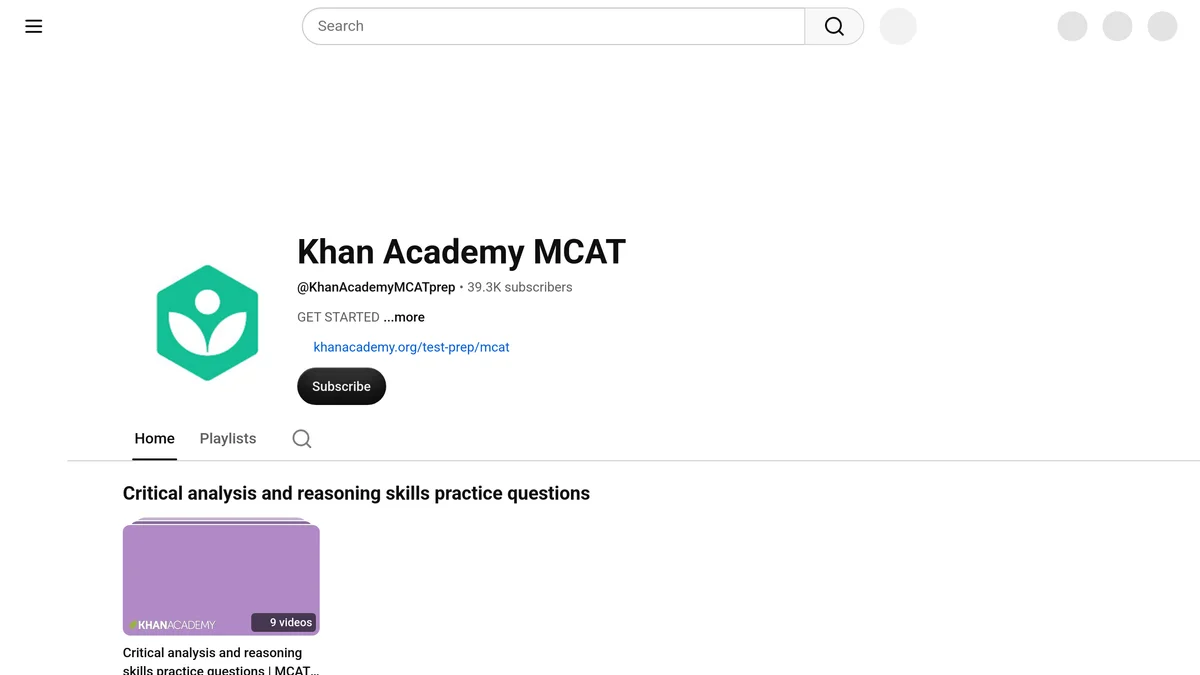
The Khan Academy MCAT channel is a dedicated MCAT video library built with AAMC support, separate from the main Khan Academy channel.
What you get:
a) 1,124 videos in 11 playlists: 456 for Chem/Phys, 368 for Bio/Biochem and 291 for Psych/Soc, on the @KhanAcademyMCATprep channel.
b) AAMC organisation: Playlists are named after AAMC foundational concepts, such as Biomolecules (140 videos) and Processing the environment (80 videos). You can go from a missed question to the right playlist without guessing.
c) Real Psych/Soc coverage: Five playlists and 291 videos, the section most free video skips entirely.
d) No cost of any kind: No plan, no trial, no account and no upsell.
Best for: Budget content review across Chem/Phys, Bio/Biochem and Psych/Soc, for students who already have a question source.
Limitation: CARS gets 9 videos, which is 0.8 percent of the library. The channel is video only, so the 3,000 review questions the AAMC describes for the original course are not on YouTube. The channel started in 2016 and has not been revised against the current exam. Our Khan Academy MCAT prep review covers the website course.
2. PremedHQ Science Academy
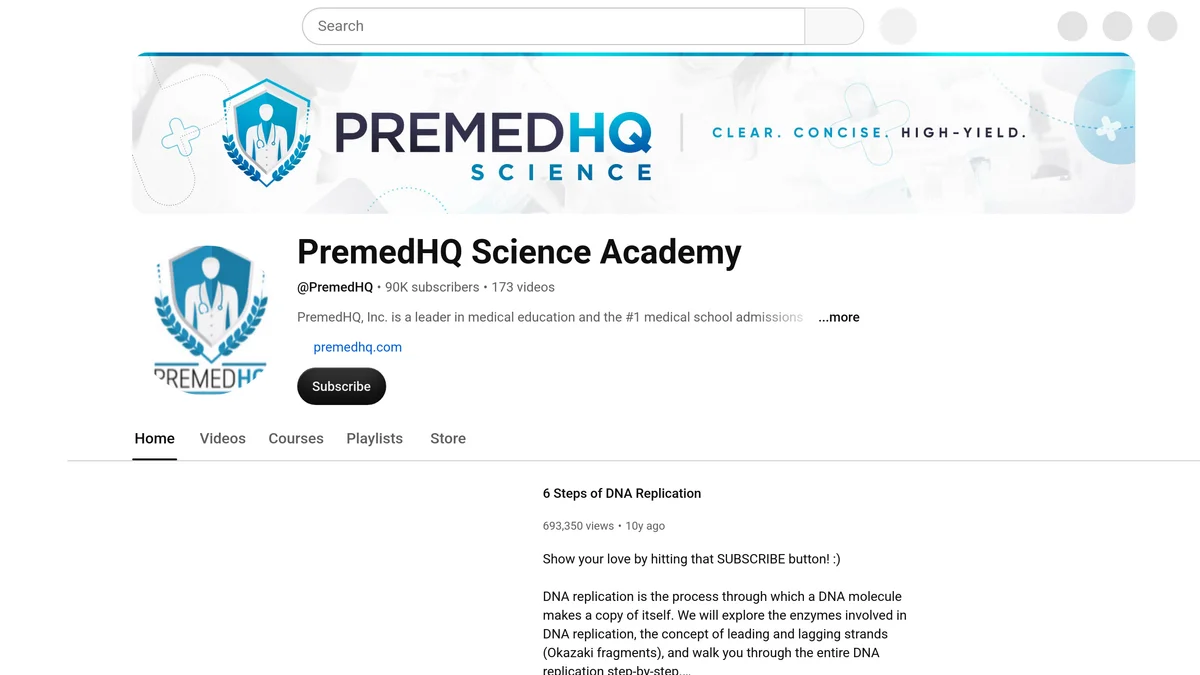
PremedHQ Science Academy is a fixed library of short, single-topic science explainers, not a course.
What you get:
a) 173 short videos: 170 of them sit inside 30 topic collections on the @PremedHQ channel. Videos average just over 7 minutes, so the whole library is roughly 20 hours.
b) Physical sciences coverage: 49 chemistry videos, 46 physics videos and 24 organic chemistry videos, covering topics such as electrochemistry, fluids, optics, stereochemistry and spectroscopy.
c) Molecular biology: 51 biology and biochemistry videos on nucleic acids, transcription, translation, amino acids, enzymes and genetics.
d) No paid tier: Nothing is gated and there is no premium version. The only thing the channel sells is science t-shirts.
Best for: Students early in content review who want one chemistry, physics or organic chemistry concept explained quickly.
Limitation: The channel has published nothing since January 22, 2016, and its biology is molecular only. There is no organ physiology, which the AAMC puts at 25 percent of Bio/Biochem, and no psychology, sociology or CARS.
3. MedSchoolCoach
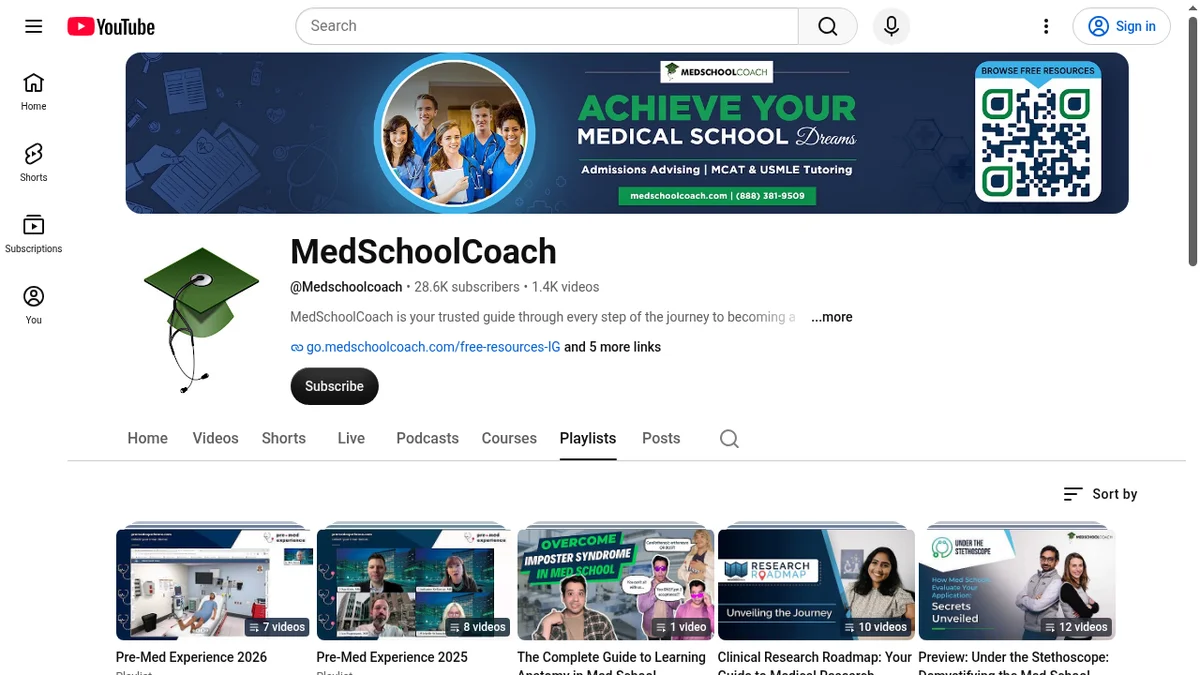
The MedSchoolCoach YouTube channel is an admissions channel of about 1,400 videos with a small set of old MCAT mnemonics on it.
What you get:
a) MCAT Mnemonic Monday: 25 numbered lessons, 52 minutes 12 seconds in total, on the @Medschoolcoach channel. Each one opens with the list to memorise and closes with the memory device.
b) MCAT Flashcards: 15 videos in 22 minutes 37 seconds, one term per video.
c) Section spread: 23 Chem/Phys videos, 14 Bio/Biochem, 5 Psych/Soc and 0 CARS. The average video runs 1 minute 53 seconds.
d) Admissions content: The rest of the channel covers medical school admissions, interviews and pre-med advice, and that material is current.
Best for: Students who already have a content plan and want a quick memory aid for lists such as Krebs intermediates, periodic trends or stop codons.
Limitation: The whole MCAT library is 42 videos and 1 hour 19 minutes, and nothing in it is under four years old. The 200 plus lesson library people expect from the name is the paid MCAT Prep App, which is bundled into tutoring packages that start at $2,200 for 10 hours (Bronze). It is not on YouTube.
4. Leah4Sci MCAT
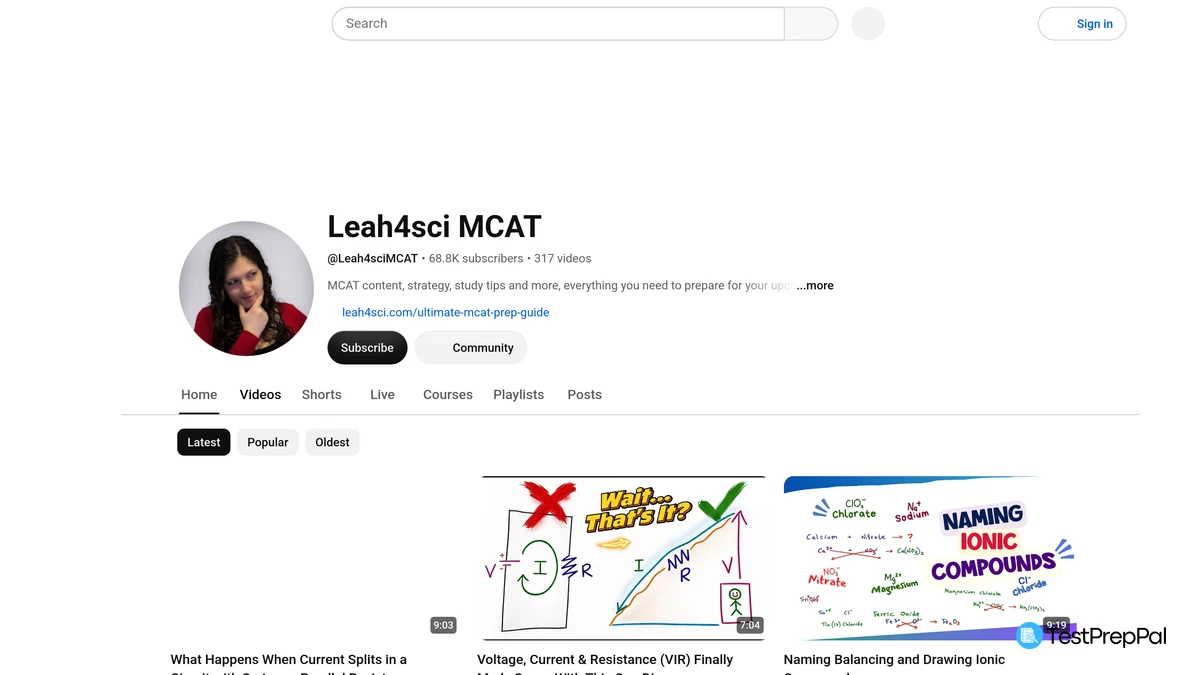
Leah4Sci MCAT is one tutor, Leah Fisch, working MCAT calculations step by step on a digital whiteboard.
What you get:
a) MCAT Math Without A Calculator: A nine part series with a downloadable worksheet on the @Leah4sciMCAT channel. It teaches rounding and estimation, unit conversion, trigonometry, scientific notation, exponents and logarithms.
b) Science videos: General chemistry, physics and biochemistry, including amino acids, Fischer projections and electrochemical cells. Videos run 5 to 20 minutes.
c) Written practice: Free worksheets and cheat sheets on the site, with quizzes on a few topics. Our review of the Leah4Sci MCAT math cheat sheet covers the printed reference card.
d) CARS and planning advice: Passage timing and a reading method, plus a three month study plan. There are no CARS passages to practise on.
Best for: Students whose practice review keeps saying they knew the concept and lost the point on the calculation.
Limitation: The math series covers three of the AAMC's seven mathematical requirement groups in full and has no lesson on reading slopes from graphs or log scales. There is no Psych/Soc content, and only three of the newest 30 uploads are under two years old. Private tutoring is a separate paid product at $249 an hour on weekdays.
5. AK Lectures
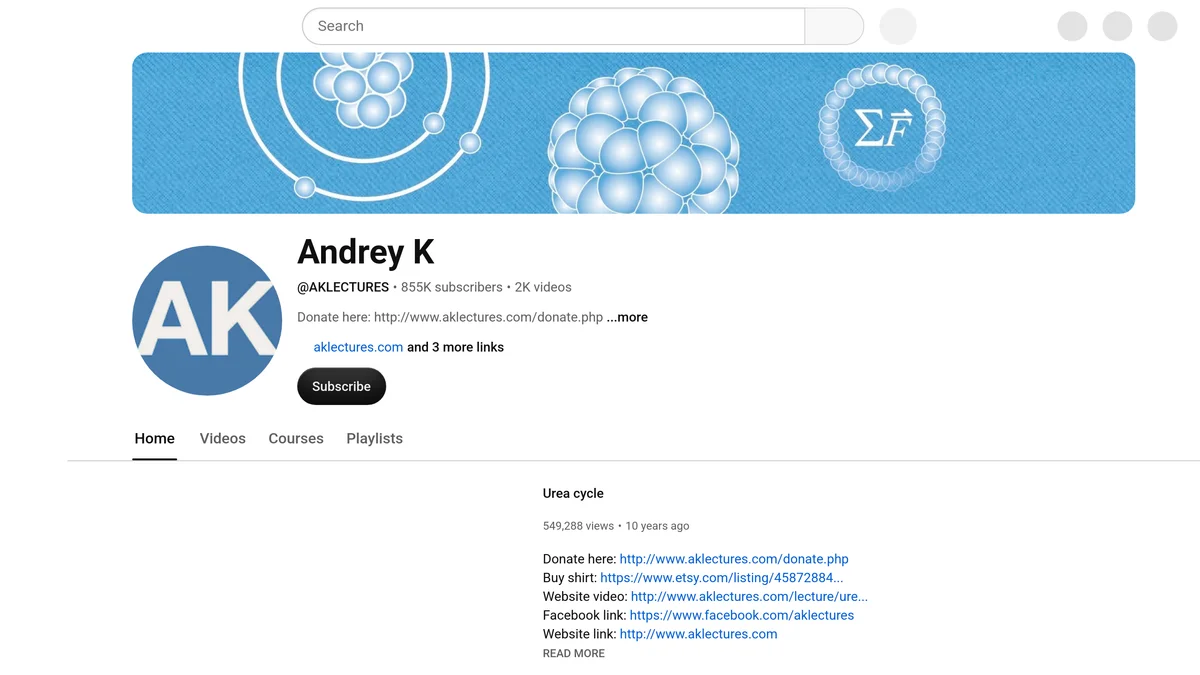
AK Lectures is a one-person library of whiteboard science lectures, filed by subject and not by exam.
What you get:
a) 2,000 plus free lectures: Biology, general chemistry, organic chemistry, biochemistry, classical physics and modern physics, on the @AKLECTURES channel and on the creator's website.
b) Depth on single concepts: Lectures usually run 5 to 15 minutes and explain where a rule comes from. Biochemistry is the strongest part of the library.
c) Mechanisms drawn out: Organic chemistry mechanisms are worked step by step, which suits topics where seeing a process beats reading it.
d) No account needed: Access is unlimited and nothing free is gated.
Best for: Self-studiers who are already doing practice questions and keep hitting the same concept wall in biochemistry, organic chemistry or physics.
Limitation: The free library has no psychology, no sociology, no CARS and no practice questions. Lectures often go further than the MCAT requires, so they cost time. The paid medical packages, from $19.99 a month on the six month plan, are aimed at medical students and are not MCAT material.
How to use these together
Video review works when a practice question sends you to it. Build the plan in that order.
- Set your hours first. Use our MCAT study schedule guide to decide how much of each week goes to video. It is less than most students give it.
- Get a question source. Pick one from our MCAT question bank roundup and add the AAMC official practice tests. No channel here replaces either.
- Use Khan Academy as the default lookup. When you miss a question, find the playlist for that foundational concept, watch the one video, and go back to questions.
- Fix the math in one weekend. Watch the Leah4Sci series, do the worksheet, then keep our MCAT equation sheet beside you and test it on our free MCAT physics practice questions.
- Escalate stubborn concepts. Use PremedHQ for a short answer and AK Lectures for the full mechanism. PremedHQ has no physiology, so cover that elsewhere.
- Lock in the lists. Take the MedSchoolCoach mnemonics, then move retention into spaced repetition with the AnKing MCAT decks.
- Plan CARS separately from day one. Our MCAT CARS practice roundup compares the resources built for it.
For free practice and official material to pair with these channels, see our free MCAT resources page. Paid options are on the MCAT hub.
MCAT YouTube channels FAQs
Can you study for the MCAT using only YouTube?
No. The five channels here are content explanation only. None has passage-based practice or full length exams, and none covers CARS properly. Pair them with a question bank and official AAMC practice material.
Which free MCAT YouTube channel covers Psych/Soc?
Khan Academy MCAT. It has five Psych/Soc playlists holding 291 videos built to the AAMC vocabulary. PremedHQ, Leah4Sci and the free AK Lectures library have no psychology or sociology, and MedSchoolCoach has five short Psych/Soc videos.
Is there a free YouTube channel for MCAT CARS?
Not among these five. Khan Academy has 9 CARS videos, Leah4Sci offers timing and reading strategy without passages, and the other three have none. CARS is 53 passage-based questions in 90 minutes, so it needs a resource built for passage practice, such as Jack Westin CARS practice.
Are these MCAT YouTube channels still up to date?
Mostly not. PremedHQ last uploaded on January 22, 2016, the Khan Academy MCAT channel dates from 2016, and the MedSchoolCoach MCAT playlists are at least four years old. That matters little for science such as glycolysis or logarithms. Take exam format and strategy from the AAMC, not from these videos.
Which YouTube channel is best for MCAT math?
Leah4Sci MCAT. Its nine part MCAT Math Without A Calculator series comes with a worksheet and covers estimation, unit conversion, trigonometry, exponents and logarithms. It has no lesson on reading slopes or log scales from graphs, so practise those separately.
We may earn commissions from some links on this page, but this does not affect our reviews or your experience.


