

Free MCAT Physics Practice Questions
25 questions across 5 sets — passage-based and discrete, in the AAMC test interface
Related free resource:
Blueprint's Free MCAT Resources
Diagnostic, full-length practice exam, 1,600+ flashcards, and a study planner.
Free account · No credit card
About These Free MCAT Physics Practice Questions
These 25 free MCAT physics questions run inside a replica of the AAMC test interface — passage on the left, question on the right, with highlighting, answer strikethrough, flag for review, and a running timer. Four of the five sets are passage-based, mirroring the real exam, and every passage is framed through a living system, which is how the MCAT actually tests physics.
| Set | Topic | Questions |
|---|---|---|
| Hemodynamics in a Stenotic Artery | Poiseuille's law, continuity, Bernoulli, viscosity | 4 |
| Sound Transmission in the Auditory System | Intensity, decibels, wave speed, impedance | 4 |
| Capacitive Discharge in a Cardiac Defibrillator | Capacitance, stored energy, RC time constant, Ohm's law | 4 |
| The Energetics of Human Gait | Work, energy, projectile motion, torque and levers | 4 |
| Discrete Questions | Nuclear decay, optics, fields, buoyancy, thermal physics, power | 9 |
How Much Physics Is on the MCAT?
Introductory physics is 25% of the Chemical and Physical Foundations (Chem/Phys) section per the AAMC content outline. That section contains 59 questions, so physics accounts for roughly 15 questions — and it appears in no other section of the exam.
| Chem/Phys section | Detail |
|---|---|
| Questions | 59 |
| Time | 95 minutes (about 95 seconds each) |
| Passage-based | 44 questions across 10 passages |
| Discrete | 15 questions |
| Physics share | 25% (≈15 questions) |
| Calculator | Not permitted |
| Equation sheet | Not provided |
| Periodic table | Provided in this section |
Section format and discipline percentages are from the AAMC Chemical and Physical Foundations of Biological Systems section overview, verified August 28, 2026. AAMC notes these percentages are approximated to the nearest 5% and vary between test forms.
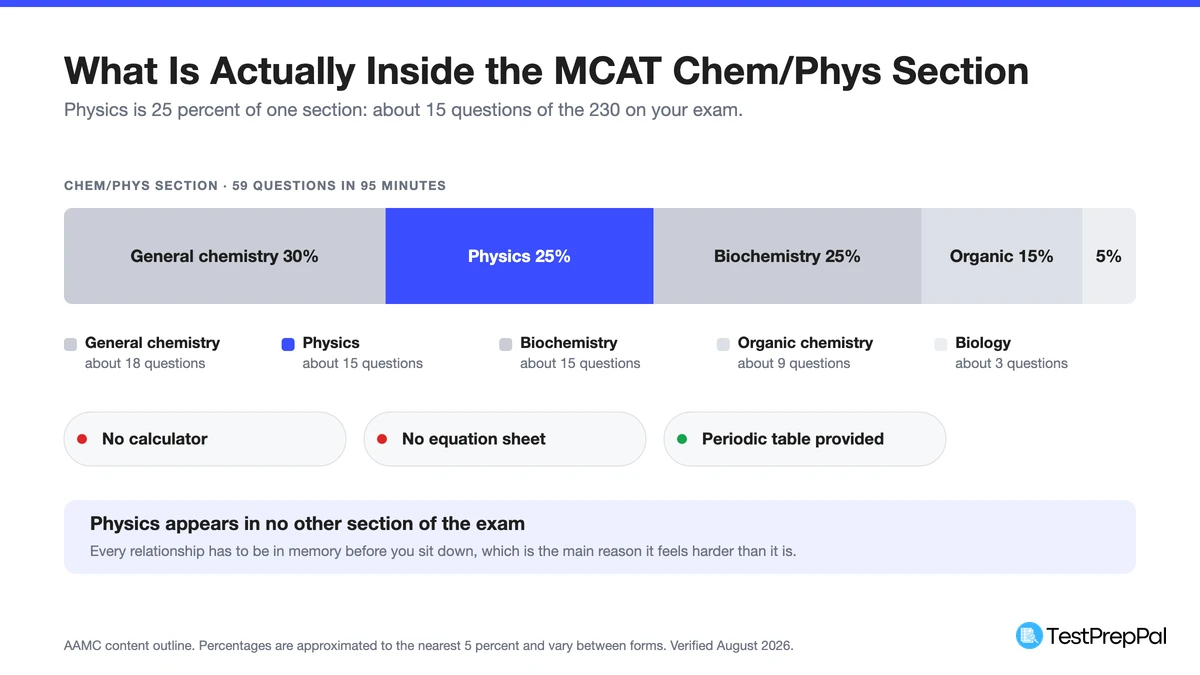 Physics is 25 percent of one section and appears nowhere else, which is about 15 questions on your exam.
You Get No Equation Sheet on Test Day
The MCAT provides no equation sheet and no calculator. Every relationship these questions use has to be in memory before you sit down, which is the main reason physics feels harder than it is.
Our MCAT equation sheet collects every formula the exam expects, covering physics, general chemistry, and biochemistry, with the constants to memorize and the estimation shortcuts that replace a calculator.
How to Use These Practice Questions
- Identify the relationship before you touch the arithmetic. MCAT physics rewards choosing the right equation far more than computing accurately. A question asking what happens to flow when radius halves is answered by
Q ∝ r⁴, not by plugging in numbers. - Convert units first, every time. Centimeters to meters, microfarads to farads, grams to kilograms. In the discrete set below, four of the nine questions have a distractor that is exactly the answer you get by skipping the conversion.
- Use g = 10 m/s². The AAMC builds questions so this approximation never changes the correct choice.
- Reason in powers of ten. Without a calculator, tracking exponents is most of the work: 50 × 10⁻⁴ = 5 × 10⁻³.
- Read every explanation, including on questions you got right — each one names the specific distractor logic the exam reuses.
Why Physics Feels Harder Than It Is
Most students overestimate the mathematical difficulty of MCAT physics and underestimate the reading. The exam almost never asks you to derive anything. It buries a radius, a viscosity, and a pressure gradient in a passage about coronary stenosis and asks what happens to perfusion — the physics is first-year, but the retrieval is the test.
That is why four of the five sets here are passage-based, and why every explanation walks through the setup and the unit handling rather than just stating the formula.
Keep Practicing
Drill the other half of this section with our MCAT general chemistry practice questions — together the two cover 55% of the Chem/Phys section.
Then put your target score in context with our MCAT score calculator, see where you stand against admitted applicants with the MCAT statistics dashboard, and turn the weeks you have left into a schedule with the MCAT study plan generator.
For more free material, see our roundup of free MCAT resources, our guide to how hard the MCAT is, and our MCAT question bank comparison.
All Six MCAT Subject Drills
Every subject tested on the MCAT, each in the AAMC test interface with full solutions:
General chemistry · Biochemistry · Organic chemistry · Biology · Psych/Soc
We may earn commissions from some links on this page, but this does not affect our reviews or your experience.