

Free MCAT Organic Chemistry Practice Questions
25 questions across 5 sets — passage-based and discrete, in the AAMC test interface
Related free resource:
Blueprint's Free MCAT Resources
Diagnostic, full-length practice exam, 1,600+ flashcards, and a study planner.
Free account · No credit card
About These Free MCAT Organic Chemistry Practice Questions
These 25 free MCAT organic chemistry questions run inside a replica of the AAMC test interface — passage on the left, question on the right, with highlighting, answer strikethrough, flag for review, and a running timer. Four of the five sets are passage-based, mirroring the real exam, and each passage is built around the way the MCAT actually uses organic chemistry: as the chemical logic underneath a biological or laboratory scenario.
Every item here is written to be solved from names, tabulated data, and verbal descriptions rather than from a drawn structure. That is a harder constraint than the real exam imposes, and it is deliberate — if you can assign a configuration from a description of substituent priorities, you will not be slowed down when the exam hands you the picture.
| Set | Topic | Questions |
|---|---|---|
| Acid–Base Extraction of a Crude Plant Extract | Liquid–liquid extraction, pKa selectivity, TLC, solvent density | 4 |
| Spectroscopic Identification of Two C₄H₈O₂ Isomers | IR bands, ¹H NMR shifts, splitting, integration, D₂O exchange | 4 |
| Schiff Base Catalysis by Fructose-1,6-Bisphosphate Aldolase | Nucleophilic addition, imine formation, electron sinks, aldol | 4 |
| Stereochemistry of Chiral Drugs | Chirality, 2ⁿ rule, enantiomers vs diastereomers, CIP, optical activity | 4 |
| Discrete Questions | Oxidation states, acidity, basicity, carbocations, SN1/SN2/E1/E2, IR, NMR, amino acids, alcohol oxidation | 9 |
How Much Organic Chemistry Is on the MCAT?
Organic chemistry is tested in two of the four sections, and the totals surprise students who assume it dominates the exam.
| Section | Organic chemistry share | Questions in section | Approximate organic questions |
|---|---|---|---|
| Chemical and Physical Foundations (Chem/Phys) | 15% | 59 | About 9 |
| Biological and Biochemical Foundations (Bio/Biochem) | 5% | 59 | About 3 |
| Psychological, Social, and Biological Foundations | None | 59 | 0 |
| Critical Analysis and Reasoning Skills | None | 53 | 0 |
That is roughly 12 organic chemistry questions across the entire MCAT. For comparison, the same Chem/Phys section is 30% general chemistry, 25% first-semester biochemistry, 25% introductory physics, and 5% introductory biology.
Discipline percentages are from the AAMC Chemical and Physical Foundations of Biological Systems section overview and the AAMC Biological and Biochemical Foundations of Living Systems section overview, verified August 28, 2026. AAMC notes these percentages are approximated to the nearest 5% and vary between test forms.
The practical takeaway: organic chemistry is not worth a second full pass through a year-long course. It is worth knowing a short list of mechanisms cold, plus spectroscopy, plus acid-base reasoning.
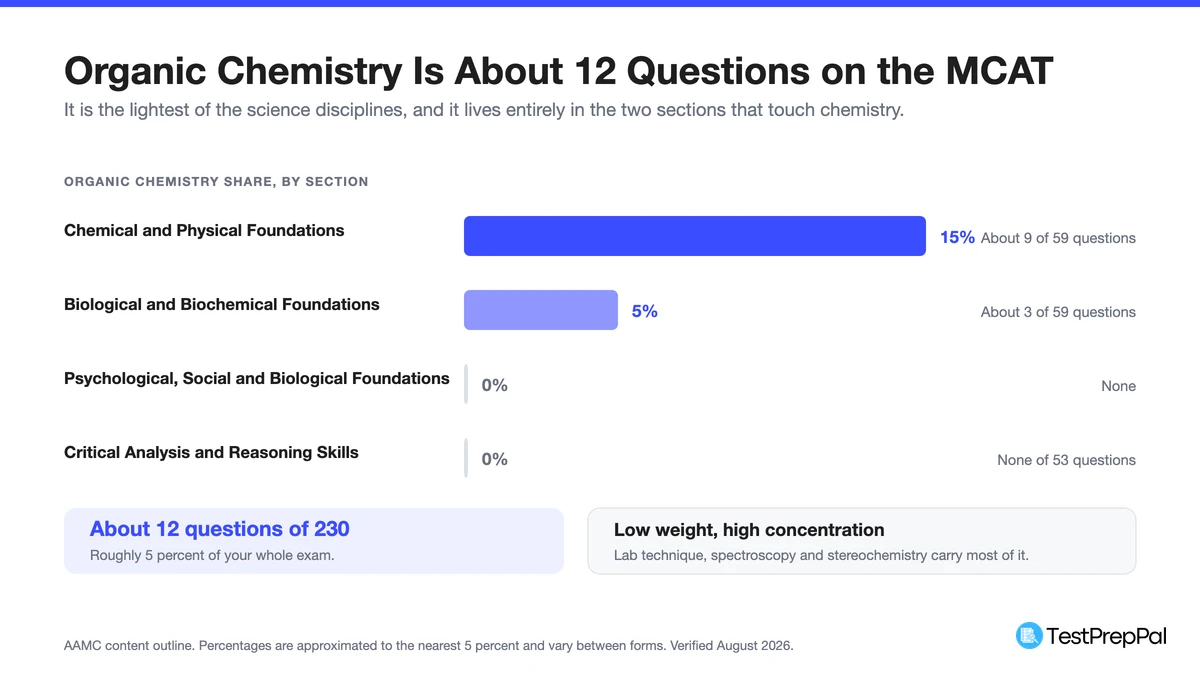 About 12 questions of 230, concentrated in lab technique, spectroscopy and stereochemistry.
The Reactions, IR Bands, and NMR Shifts These Questions Assume
Every question here is written against the same short list of high-yield reactions, IR wavenumbers, and ¹H NMR chemical shifts the AAMC reuses. Rather than repeat all of it on this page, we keep it in one place: our MCAT organic chemistry reactions, IR, and NMR reference sheet.
Work through that sheet first if you want the tables in front of you, or take the section cold and use it during review to look up whatever you missed.
How to Use These Practice Questions
- Name the mechanism before you look at the choices. Nearly every organic item on the MCAT reduces to one question: what is the nucleophile, what is the electrophile, and what leaves? Getting that far usually eliminates two answers immediately.
- Treat every pKa as a comparison, not a number. You are almost never asked for an absolute value. You are asked whether one species can deprotonate another, and the rule is that the reaction goes if the acid being deprotonated is stronger than the conjugate acid that forms.
- Read spectra as constraints. A band at 1710 with a very broad 2500–3300 absorption does not merely suggest a carboxylic acid; it excludes ketones, esters, and alcohols in one step. Use IR to eliminate, then NMR to identify.
- Check the orientation of the lowest-priority group before assigning R or S. If the hydrogen is pointing at you, read the direction as drawn and flip the answer.
- Read every explanation, including on questions you got right — each one names the specific distractor logic the exam reuses.
Why Organic Chemistry Feels Harder Than Its Weight
Organic chemistry is only about 12 of the 230 scored questions on the MCAT, yet it consumes a disproportionate share of most students' study time. The reason is that premed organic courses are optimized for synthesis problems the MCAT does not ask, while the MCAT tests reasoning those courses treat as background: acid-base comparison, separation logic, spectroscopy, stereochemical assignment, and a handful of biologically relevant mechanisms.
That mismatch is why every passage here is either a laboratory workflow or an enzyme mechanism, and why none of the questions require you to plan a synthesis. If you can explain why bicarbonate pulls a carboxylic acid into water but leaves a phenol behind, and why a protonated Schiff base makes an adjacent carbanion possible, you have the version of organic chemistry the exam actually rewards.
Keep Practicing
Cover the rest of Chem/Phys with our MCAT general chemistry practice questions and MCAT physics practice questions — together with the organic set above, the three account for 70% of that section.
Then put your target score in context with our MCAT score calculator, see where you stand against admitted applicants with the MCAT statistics dashboard, and turn the weeks you have left into a schedule with the MCAT study plan generator.
For more free material, see our roundup of free MCAT resources, our guide to how hard the MCAT is, and our MCAT question bank comparison.
All Six MCAT Subject Drills
Every subject tested on the MCAT, each in the AAMC test interface with full solutions:
General chemistry · Physics · Biochemistry · Biology · Psych/Soc
We may earn commissions from some links on this page, but this does not affect our reviews or your experience.