

Free MCAT Biology Practice Questions
25 questions across 5 sets — passage-based and discrete, in the AAMC test interface
Related free resource:
Blueprint's Free MCAT Resources
Diagnostic, full-length practice exam, 1,600+ flashcards, and a study planner.
Free account · No credit card
About These Free MCAT Biology Practice Questions
These 25 free MCAT biology questions run inside a replica of the AAMC test interface — passage on the left, question on the right, with highlighting, answer strikethrough, flag for review, and a running timer. Four of the five sets are passage-based, and each passage is written the way the real exam writes them: as an experiment with a control condition, or as a clinical workup with a table of results.
| Set | Topic | Questions |
|---|---|---|
| Uncoupling the Mitochondrial Electron Transport Chain | Oxidative phosphorylation, uncouplers, respiratory control, Complex II | 4 |
| Carrier Screening in an Isolated Community | Autosomal recessive inheritance, pedigree logic, Hardy-Weinberg, non-random mating | 4 |
| Interpreting the Hypothalamic-Pituitary-Thyroid Axis | Negative feedback, primary vs central failure, peptide vs amine signaling | 4 |
| Renal Handling of Glucose and the Transport Maximum | Filtered load, transport maximum, secondary active transport, SGLT2 | 4 |
| Discrete Questions | Meiosis, cell cycle, replication, splicing, membrane transport, viruses, muscle, gas exchange, evolution | 9 |
How Much Biology Is on the MCAT?
Introductory biology is 65% of the Biological and Biochemical Foundations of Living Systems (Bio/Biochem) section and 5% of the Chemical and Physical Foundations (Chem/Phys) section, per the AAMC content outline. Bio/Biochem has 59 questions, so introductory biology accounts for roughly 38 questions there, plus about 3 more in Chem/Phys — more raw questions than any other single discipline on the exam.
| Bio/Biochem section | Detail |
|---|---|
| Questions | 59 |
| Time | 95 minutes (about 95 seconds each) |
| Passage-based | 44 questions across 10 passages |
| Discrete | 15 questions |
| Introductory biology share | 65% (roughly 38 questions) |
| First-semester biochemistry | 25% |
| General chemistry | 5% |
| Organic chemistry | 5% |
| Calculator | Not permitted |
| Periodic table | Provided in this section |
Discipline percentages and section format are from the AAMC Biological and Biochemical Foundations of Living Systems overview and the Chemical and Physical Foundations of Biological Systems section overview, both verified August 28, 2026. The passage-based and independent question counts come from AAMC's What's on the MCAT Exam? chapter, which lists 10 passage-based sets (4–6 questions each) plus 15 independent questions for this section. AAMC notes these percentages are approximated to the nearest 5% and vary between test forms.
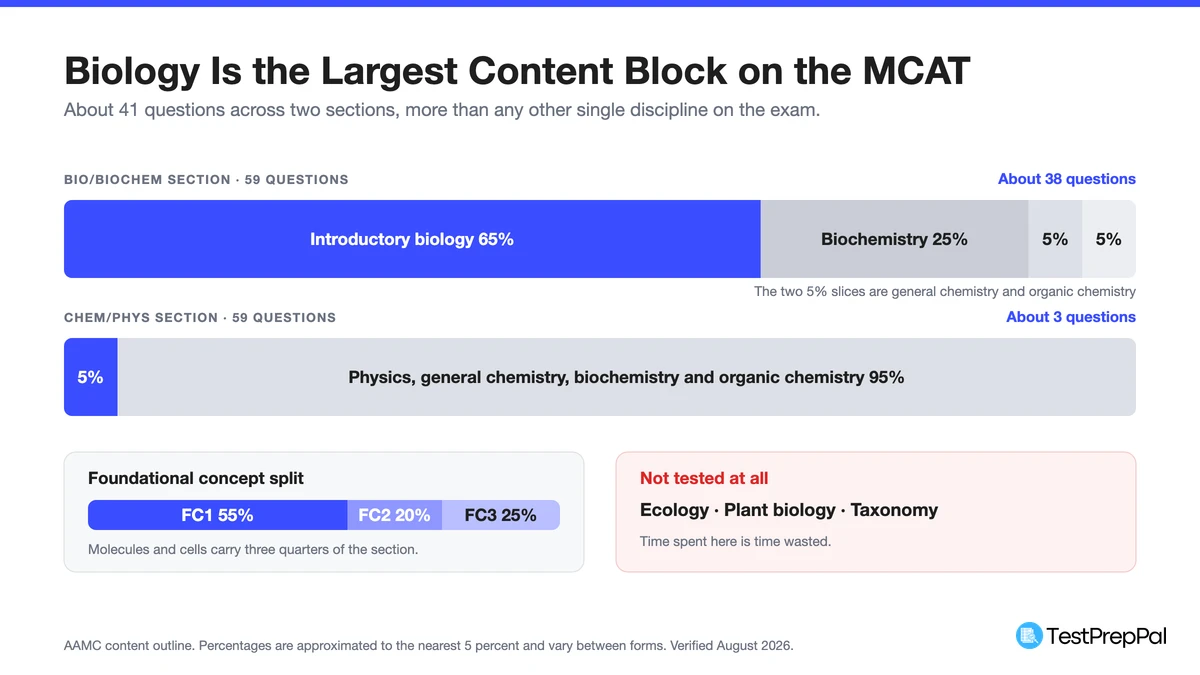 About 41 biology questions across two sections. Ecology, plant biology and taxonomy are not tested at all.
Need the Hormones?
The endocrine system is the one part of MCAT biology that is genuinely a memorization problem, and the thyroid passage above assumes you already know the axis cold. We moved that reference to its own page: the MCAT hormone chart has source, target, action, and class for every hormone the AAMC tests, organized by axis.
It also works through peptide vs steroid signaling and the primary-versus-central feedback patterns that passage 3 here is built around.
AAMC Biology Topic Coverage
Everything the MCAT tests in biology maps to one of eight content categories. This is where the topics in the practice sets above actually live.
| Biology topic | AAMC content category | Section |
|---|---|---|
| Amino acids, protein structure, enzyme kinetics and regulation | 1A — Structure and function of proteins and their constituent amino acids | Bio/Biochem and Chem/Phys |
| DNA replication, transcription, translation, gene regulation, biotechnology | 1B — Transmission of genetic information from the gene to the protein | Bio/Biochem |
| Mendelian genetics, pedigrees, Hardy-Weinberg, meiosis, evolution | 1C — Transmission of heritable information and processes that increase genetic diversity | Bio/Biochem |
| Glycolysis, citric acid cycle, oxidative phosphorylation, fuel metabolism | 1D — Principles of bioenergetics and fuel molecule metabolism | Bio/Biochem |
| Membranes and transport, organelles, cytoskeleton, cell junctions, tissue types | 2A — Assemblies of molecules, cells, and groups of cells | Bio/Biochem |
| Bacterial structure and genetics, viral life cycles, retroviruses | 2B — Structure, growth, physiology, and genetics of prokaryotes and viruses | Bio/Biochem |
| Cell cycle and checkpoints, mitosis, apoptosis, stem cells, gametogenesis | 2C — Processes of cell division, differentiation, and specialization | Bio/Biochem |
| Neurons and action potentials, endocrine glands and hormones | 3A — Structure and function of the nervous and endocrine systems | Bio/Biochem and Psych/Soc |
| Circulatory, respiratory, renal, digestive, immune, musculoskeletal, skin, reproductive | 3B — Structure and integrative functions of the main organ systems | Bio/Biochem |
Foundational Concept 1 is about 55% of the section, Foundational Concept 2 about 20%, and Foundational Concept 3 about 25%. Note what is not on the list: ecology, plant biology, animal behavior beyond what Psych/Soc covers, and taxonomy. Time spent there is time wasted.
How to Use These Practice Questions
- Find the manipulated variable first. Four of the five sets here are experiments. Before reading a single question, identify the control condition and what was changed. In the mitochondria passage, everything follows from knowing which of the four conditions is which.
- Predict the direction, then check the choices. Endocrine and renal questions are almost always answerable as "up or down" before you read a single answer choice. Committing to a direction first stops you from being talked out of it by a plausible-sounding distractor.
- Set genetics problems up as a product of probabilities. The 1/9 answer in the carrier-screening set is 2/3 times 2/3 times 1/4. Write the factors down separately; the errors come from dropping one, not from the arithmetic.
- Treat feedback loops as three-part chains. Hypothalamus, pituitary, gland. Almost every endocrine question on the exam is asking you to locate a lesion in that chain by reading two lab values against each other.
- Read every explanation, including on questions you got right — each one names the specific distractor logic the exam reuses.
Why Biology Is the Highest-Leverage Content on the Exam
Introductory biology is the single largest content block on the MCAT: roughly 38 questions in Bio/Biochem plus a handful in Chem/Phys. It is also the block where content review pays off most directly, because unlike CARS there is a finite list of facts, and unlike physics there is very little computation to slow you down.
The catch is that knowing the facts is not the same as scoring. The AAMC almost never asks you to state a fact — it hands you an experiment with an uncoupler in it and asks why oxygen consumption tripled, or it hands you two lab values and asks where in a three-organ axis the lesion sits. That is why every passage here is built as a study with results, and why the explanations reason from the data rather than from recall.
Keep Practicing
Round out the sciences with our MCAT general chemistry practice questions and MCAT physics practice questions — together those two cover 55% of the Chem/Phys section.
Then put your target score in context with our MCAT score calculator, see where you stand against admitted applicants with the MCAT statistics dashboard, and turn the weeks you have left into a schedule with the MCAT study plan generator.
For more free material, see our roundup of free MCAT resources, our guide to how hard the MCAT is, and our MCAT question bank comparison.
All Six MCAT Subject Drills
Every subject tested on the MCAT, each in the AAMC test interface with full solutions:
General chemistry · Physics · Biochemistry · Organic chemistry · Psych/Soc
We may earn commissions from some links on this page, but this does not affect our reviews or your experience.