

Free MCAT General Chemistry Practice Questions
25 questions across 5 sets — passage-based and discrete, in the AAMC test interface
Related free resource:
Blueprint's Free MCAT Resources
Diagnostic, full-length practice exam, 1,600+ flashcards, and a study planner.
Free account · No credit card
About These Free MCAT General Chemistry Practice Questions
These 25 free MCAT general chemistry questions run inside a replica of the AAMC test interface — passage on the left, question on the right, with highlighting, answer strikethrough, flag for review, and a running timer. It is the same working environment you will face on test day, which matters more than most students expect: the mechanics of marking up a passage under time pressure are a skill in themselves.
Four of the five sets are passage-based, mirroring the real exam, where roughly three quarters of every science section is tied to a passage. The fifth set is discrete questions.
| Set | Topic | Questions |
|---|---|---|
| The Bicarbonate Buffer System | Acids and bases, Henderson–Hasselbalch | 4 |
| A Zinc–Copper Galvanic Cell | Electrochemistry, cell potential, Nernst | 4 |
| Catalytic Decomposition of Hydrogen Peroxide | Kinetics, catalysis, Arrhenius | 4 |
| Delivery of a Volatile Anesthetic | Gases, partial pressure, real gas behavior | 4 |
| Discrete Questions | Periodic trends, VSEPR, Ksp, colligative properties, thermodynamics | 9 |
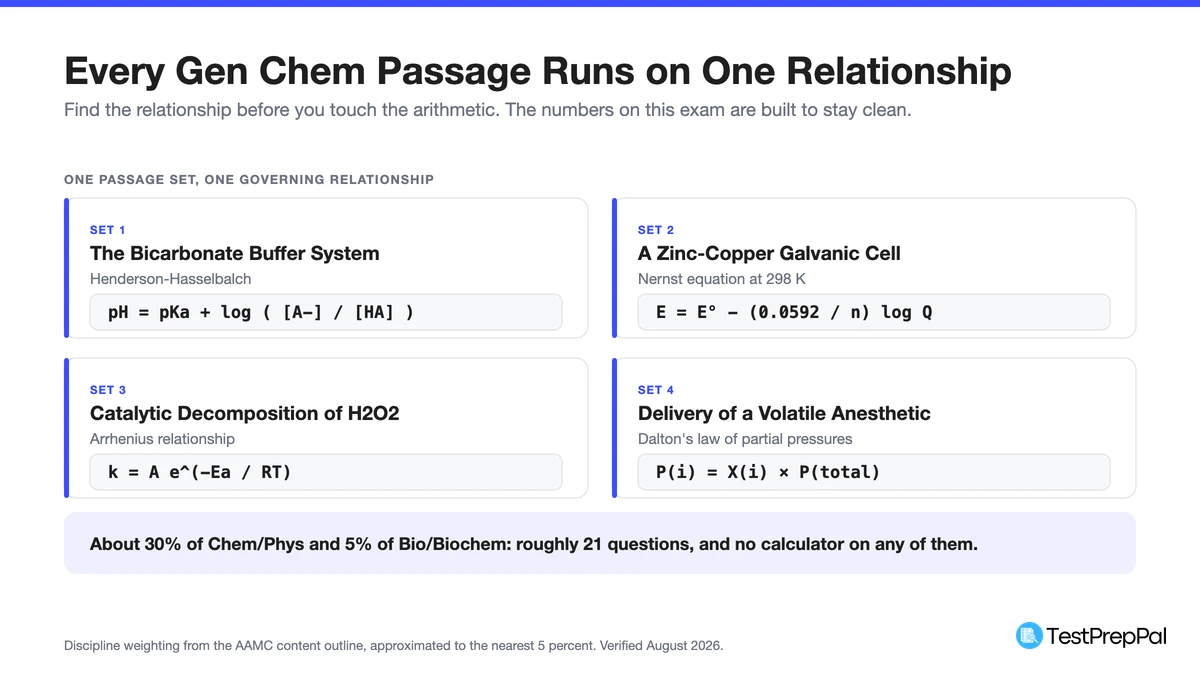 Each passage set runs on one relationship. Find it before you touch the arithmetic.
How Much General Chemistry Is on the MCAT?
General chemistry is about 30% of the Chemical and Physical Foundations (Chem/Phys) section and roughly 5% of the Bio/Biochem section. Each section has 59 questions, so in practice that is about 18 questions in Chem/Phys plus roughly 3 in Bio/Biochem — around 21 across the exam. Enough that a weak general chemistry foundation shows up directly in your Chem/Phys score.
| Chem/Phys section | Detail |
|---|---|
| Questions | 59 |
| Time | 95 minutes (about 95 seconds each) |
| Passage-based | 44 questions across 10 passages |
| Discrete | 15 questions |
| Calculator | Not permitted; a periodic table is provided |
Section format and discipline percentages above are from the AAMC Chemical and Physical Foundations of Biological Systems section overview and Biological and Biochemical Foundations of Living Systems overview, verified August 28, 2026. AAMC notes these percentages are approximated to the nearest 5% and vary between test forms.
What This Tool Tests
The five sets cover the highest-yield general chemistry content on the exam:
- Acids and bases — pH, pKa, Henderson–Hasselbalch, buffer capacity, titration curves
- Electrochemistry — galvanic and electrolytic cells, standard reduction potentials, ΔG = −nFE°, the Nernst equation
- Kinetics — rate laws, reaction order, half-life, catalysis, activation energy and the Arrhenius relationship
- Thermodynamics — enthalpy, entropy, spontaneity, and the temperature at which ΔG changes sign
- Gases — the ideal gas law, Dalton's law of partial pressures, and deviations from ideality
- Periodicity and bonding — ionization energy, electronegativity, quantum numbers, VSEPR geometry
- Solutions — solubility product, molar solubility, and colligative properties
How to Use These Practice Questions
- Read the passage before the question. The MCAT rewards students who orient themselves in the passage first rather than hunting for keywords after reading the stem.
- Highlight the data, not the prose. Turn on the Highlight tool and mark the numbers, constants, and relationships. Highlighting whole paragraphs defeats the purpose.
- Strike through as you eliminate. Two of the four choices in most MCAT questions can be ruled out on reasoning alone. Striking them keeps your working memory free.
- Read every explanation, including on questions you got right. Each solution explains why the distractors fail — which is where the real learning is, because the MCAT reuses distractor logic.
- Retake the full section timed at about 95 seconds per question once you have worked through the sets untimed.
Why Passage-Based Practice Matters More Than Content Recall
A common trap in MCAT general chemistry prep is drilling isolated equations. The exam rarely asks you to state Henderson–Hasselbalch; it gives you a physiological scenario, buries a pKa in the third paragraph, and asks what happens to blood pH when a subject hypoventilates. The chemistry is introductory. The reasoning is not.
That is why four of the five sets here attach questions to a passage, and why the explanations walk through the passage reasoning rather than just the algebra.
Keep Practicing
Drill the other half of this section with our free MCAT physics practice questions — together the two cover 55% of the Chem/Phys section.
Once you are scoring well here, put your target score in context with our MCAT score calculator, see where you stand against admitted applicants with the MCAT statistics dashboard, and turn the weeks you have left into a schedule with the MCAT study plan generator.
For more free practice material across every section, see our roundup of free MCAT resources and our guides on how hard the MCAT is and building an MCAT study schedule. When you are ready for a full question bank, compare options in our MCAT question bank roundup and our review of Jack Westin.
Every equation these questions assume is collected on our MCAT equation sheet, which covers gen chem, physics, and biochem in one sheet.
All Six MCAT Subject Drills
Every subject tested on the MCAT, each in the AAMC test interface with full solutions:
Physics · Biochemistry · Organic chemistry · Biology · Psych/Soc
We may earn commissions from some links on this page, but this does not affect our reviews or your experience.