

Free MCAT Psych/Soc Practice Questions
25 questions across 5 sets — passage-based and discrete, in the AAMC test interface
Related free resource:
Blueprint's Free MCAT Resources
Diagnostic, full-length practice exam, 1,600+ flashcards, and a study planner.
Free account · No credit card
About These Free MCAT Psych/Soc Practice Questions
These 25 free MCAT psych/soc practice questions run inside a replica of the AAMC test interface — passage on the left, question on the right, with highlighting, answer strikethrough, flag for review, and a running timer. Four of the five sets are passage-based, and every passage is written as a research study with methods and a results table, because that is how the real section presents most of its content.
| Set | Topic | Questions |
|---|---|---|
| Reinforcement Schedules in a Smoking Cessation Trial | Operant schedules, classical conditioning, control conditions | 4 |
| Test Framing and Attributions of Failure | Stereotype threat, interactions, attribution, external validity | 4 |
| Neighborhood Deprivation and Incident Hypertension | Stratification, social gradient in health, reverse causation | 4 |
| Depth of Encoding, Retrieval Cues, and Recognition Criterion | Levels of processing, retrieval cues, signal detection, confounds | 4 |
| Discrete Questions | Emotion, motivation, personality, disorders, sleep, development, sociological theory, demography, research ethics | 9 |
How Much Psychology and Sociology Is on the MCAT?
The Psychological, Social, and Biological Foundations of Behavior section is 59 questions in 95 minutes, a combination of passage-based and discrete questions.
| Psych/Soc section | Detail |
|---|---|
| Questions | 59 |
| Time | 95 minutes (about 95 seconds each) |
| Introductory psychology | 65% |
| Introductory sociology | 30% |
| Introductory biology | 5% |
| Additional biologically relevant psychology | About 5%, on top of the biology target |
| Calculator | Not permitted |
The four Scientific Inquiry and Reasoning Skills are weighted as follows in this section:
| Scientific Inquiry and Reasoning Skill | Share |
|---|---|
| Skill 1 — Knowledge of scientific concepts and principles | 35% |
| Skill 2 — Scientific reasoning and problem-solving | 45% |
| Skill 3 — Reasoning about the design and execution of research | 10% |
| Skill 4 — Data-based statistical reasoning | 10% |
Section format, discipline percentages, and skill percentages are from the AAMC Psychological, Social, and Biological Foundations of Behavior section overview, verified August 28, 2026. AAMC notes these percentages are approximated to the nearest 5% and vary between test forms.
Read those last two rows together: 20% of this section is research design and data interpretation. That is roughly 12 questions that reward reading a methods paragraph correctly, regardless of how many MCAT psychology terms you have memorized.
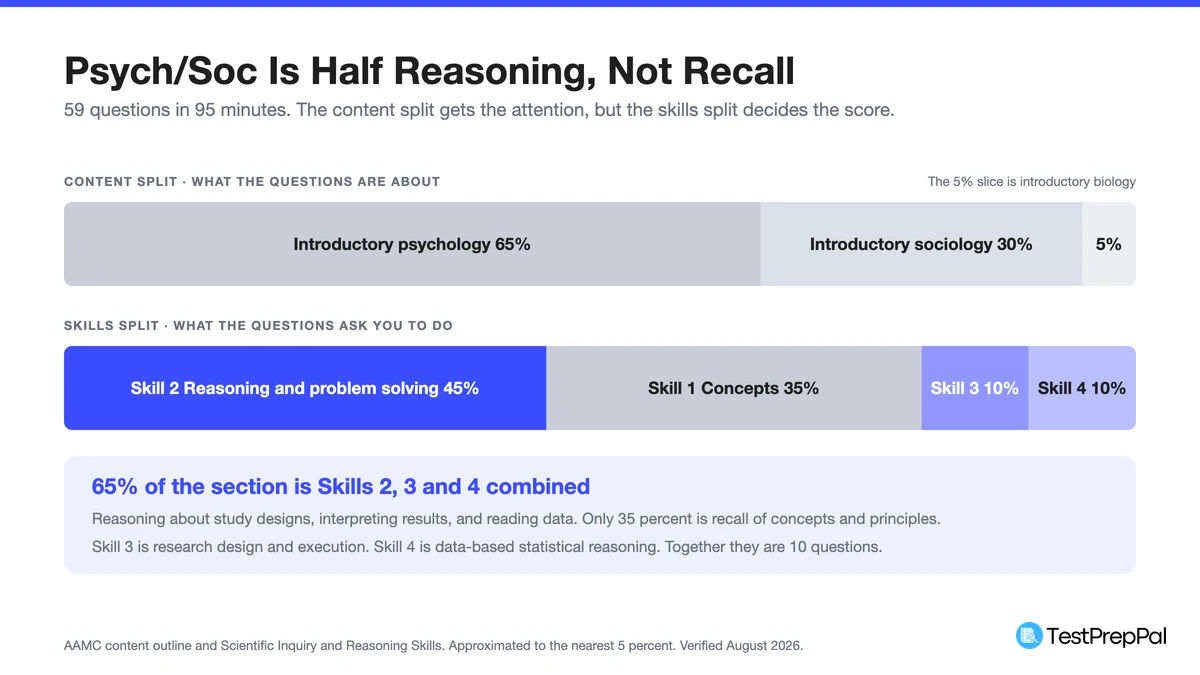 The content split gets the attention. The skills split, where 65 percent is reasoning rather than recall, decides the score.
High-Yield MCAT Psychology Terms and Theory Reference
The exam almost never asks you to define a theory in isolation. It puts two neighboring theories in the answer choices and asks which one the passage supports. Everything below is grouped by the confusion the AAMC actually exploits.
Theories of Emotion
| Theory | Theorist | Core claim | Most often confused with |
|---|---|---|---|
| James–Lange | William James · Carl Lange | A stimulus triggers a distinct physiological response first · the emotion is the perception of that bodily response | Cannon–Bard, which denies that the body leads |
| Cannon–Bard | Walter Cannon · Philip Bard | Physiological arousal and the subjective emotion occur simultaneously and independently | James–Lange, which is sequential |
| Schachter–Singer two-factor | Stanley Schachter · Jerome Singer | Nonspecific arousal plus a cognitive label drawn from the situation produces the emotion | Lazarus, which places appraisal before arousal |
| Cognitive appraisal | Richard Lazarus | Appraisal of the stimulus comes first and determines both the arousal and the emotion felt | Schachter–Singer, where appraisal comes after arousal |
Theories of Motivation
| Theory | Theorist | Core claim | Most often confused with |
|---|---|---|---|
| Drive reduction | Clark Hull | An unmet biological need creates a drive · behavior reduces the drive and restores homeostasis | Incentive theory — internal push versus external pull |
| Incentive theory | Behaviorist tradition, no single attribution | Behavior is pulled by the value of external rewards rather than pushed by internal need | Drive reduction |
| Arousal theory (Yerkes–Dodson) | Robert Yerkes · John Dodson | Performance peaks at intermediate arousal · the optimum is lower for difficult or novel tasks | Drive reduction, which implies less arousal is always better |
| Hierarchy of needs | Abraham Maslow | Needs are ordered from physiological through safety, love, and esteem to self-actualization | Self-determination theory |
| Self-determination theory | Edward Deci · Richard Ryan | Autonomy, competence, and relatedness are the three needs underlying intrinsic motivation | Maslow, which is hierarchical and not specifically about intrinsic motivation |
Personality Theories
| Theory | Theorist | Core claim | Most often confused with |
|---|---|---|---|
| Psychoanalytic | Sigmund Freud | Personality emerges from largely unconscious conflict among id, ego, and superego, managed by defense mechanisms | Neo-Freudian theories, which keep the unconscious but drop libido as the engine |
| Neo-Freudian | Carl Jung · Alfred Adler | Collective unconscious and archetypes (Jung) · striving for superiority and the inferiority complex (Adler) | Freud |
| Humanistic | Carl Rogers · Abraham Maslow | People move toward self-actualization when given unconditional positive regard · congruence between real and ideal self | Social-cognitive theory |
| Trait and five-factor | Gordon Allport · Raymond Cattell · Hans Eysenck · Big Five from Paul Costa and Robert McCrae | Personality is a set of stable dimensions (openness, conscientiousness, extraversion, agreeableness, neuroticism) that describe rather than explain | Social-cognitive theory, which stresses the situation |
| Social-cognitive | Albert Bandura | Reciprocal determinism · behavior, personal and cognitive factors, and environment mutually influence one another · self-efficacy | Behaviorism, which denies internal causes |
| Behaviorist | B. F. Skinner | Personality is the accumulated set of learned response tendencies · no internal structures required | Social-cognitive theory |
Developmental Stage Models
| Model | Theorist | Core claim | Most often confused with |
|---|---|---|---|
| Cognitive development | Jean Piaget | Sensorimotor (object permanence) · preoperational (egocentrism, no conservation) · concrete operational (conservation, logic about concrete objects) · formal operational (abstract and hypothetical reasoning) | Erikson, whose stages are psychosocial rather than cognitive |
| Psychosocial development | Erik Erikson | Eight lifespan stages, each a conflict from trust versus mistrust through integrity versus despair | Freud's psychosexual stages, which end in adolescence |
| Moral development | Lawrence Kohlberg | Preconventional (punishment and self-interest) · conventional (approval and law and order) · postconventional (social contract and universal ethical principles) | Piaget, whose stages concern reasoning about the physical world |
| Sociocultural development | Lev Vygotsky | Cognition develops through social interaction · the zone of proximal development is bridged by scaffolding from a more knowledgeable other | Piaget, who emphasizes individual discovery over social transmission |
| Psychosexual development | Sigmund Freud | Oral, anal, phallic, latency, and genital stages · fixation at a stage shapes adult personality | Erikson, whose eight stages continue through old age |
The Three Major Sociological Paradigms
| Paradigm | Theorist | Core claim | Most often confused with |
|---|---|---|---|
| Structural functionalism | Émile Durkheim · Talcott Parsons · Robert Merton | Macro · society is interdependent parts whose manifest and latent functions maintain stability | Conflict theory — consensus versus contest |
| Conflict theory | Karl Marx · Max Weber on multidimensional stratification | Macro · society is competition over scarce resources, and inequality and power drive social change | Functionalism |
| Symbolic interactionism | George Herbert Mead · term coined by Herbert Blumer | Micro · meaning is created and negotiated through shared symbols in everyday face-to-face interaction | Goffman's dramaturgical approach and social constructionism, both micro relatives |
| Social exchange and rational choice | George Homans · Peter Blau | Micro · actors weigh costs against benefits and act to maximize net reward | Symbolic interactionism |
Research Methods Table
A fifth of this section turns on knowing what a given design can and cannot establish. Read the second and third columns as a pair.
| Design | What it can show | What it cannot show |
|---|---|---|
| Randomized controlled experiment | Causation · random assignment equates groups on everything not manipulated | Whether the effect generalizes beyond the sample and setting |
| Prospective cohort | Incidence and temporal order, since exposure is recorded before the outcome | Causation on its own · unmeasured confounding and selection into exposure remain |
| Case-control | Association between a past exposure and a rare outcome, efficiently | Incidence or absolute risk · it is vulnerable to recall bias |
| Cross-sectional survey | Prevalence and associations at a single point in time | Which variable came first · there is no temporal ordering |
| Longitudinal study | Change within the same individuals over time | Causation without a manipulation · attrition can bias who remains |
| Quasi-experiment | Effects of a manipulation that cannot ethically or practically be randomly assigned | Clean causal attribution · the groups may have differed at baseline |
| Case study | Rich detail on a rare phenomenon · a good source of hypotheses | Frequency, prevalence, or generalizability |
| Twin and adoption study | Relative contributions of heredity and shared environment | The specific genes or biological mechanisms involved |
Two definitions worth having automatic: the independent variable is what the researchers assign, and the dependent variable is what they measure. A confound is a third variable that differs systematically between conditions, which is why the answer to almost every "which finding would weaken this conclusion" question is the choice that introduces one.
How to Use These Practice Questions
- Read the methods before the results. Identify who was randomly assigned to what, what was held constant, and what was merely measured. Two of the twenty-five questions here are answered entirely from that paragraph.
- Distinguish a subject variable from an independent variable. Gender, age, race, and socioeconomic status are measured, not assigned, so no causal claim can rest on them no matter how clean the data look.
- Predict the theory before reading the choices. When all four options are real theories, recognizing the correct one first is far faster than evaluating four adjacent candidates.
- Treat "best supported" literally. A choice can be true in the world and still be wrong on the MCAT if the passage does not support it — and a three-point difference with no statistics reported is not a substantial difference.
- Read every explanation, including on questions you got right — each one names the specific neighboring theory the exam reuses as a distractor.
Why Psych/Soc Rewards Reading, Not Memorizing
Students who miss their Psych/Soc target usually know the terms. What separates a 128 from a 125 is that the passage describes a variable-ratio schedule without ever using the phrase, or reports an adjustment that shrinks an association without eliminating it, and the question asks what follows. The content is introductory; the retrieval and the inference are the test.
That is why four of the five sets here are studies with tables, and why several questions ask what a result does not support.
Keep Practicing
Work the science sections next with our MCAT general chemistry practice questions and MCAT physics practice questions, which together cover 55% of the Chem/Phys section.
Then put your target score in context with our MCAT score calculator, see where you stand against admitted applicants with the MCAT statistics dashboard, and turn the weeks you have left into a schedule with the MCAT study plan generator.
For more free material, see our roundup of free MCAT resources, our guide to how hard the MCAT is, and our MCAT question bank comparison.
All Six MCAT Subject Drills
Every subject tested on the MCAT, each in the AAMC test interface with full solutions:
General chemistry · Physics · Biochemistry · Organic chemistry · Biology
We may earn commissions from some links on this page, but this does not affect our reviews or your experience.