

Free MCAT Biochemistry Practice Questions
25 questions across 5 sets — passage-based and discrete, in the AAMC test interface
Related free resource:
Blueprint's Free MCAT Resources
Diagnostic, full-length practice exam, 1,600+ flashcards, and a study planner.
Free account · No credit card
About These Free MCAT Biochemistry Practice Questions
These 25 free MCAT biochemistry questions run inside a replica of the AAMC test interface — passage on the left, question on the right, with highlighting, answer strikethrough, flag for review, and a running timer. Four of the five sets are passage-based, and every passage is framed through a clinical or experimental scenario, which is how the real exam tests biochemistry.
| Set | Topic | Questions |
|---|---|---|
| Alcohol Dehydrogenase and Methanol Poisoning | Michaelis-Menten, Km and Vmax, competitive vs. noncompetitive inhibition, Lineweaver-Burk | 4 |
| Characterizing a Recombinant Protein Hormone | Levels of structure, disulfide bonds, denaturation, SDS-PAGE, pI and ion exchange | 4 |
| Fuel Use in Exercising Skeletal Muscle | Glycolysis, ATP yield, PFK-1 allosteric control, lactate dehydrogenase, uncouplers | 4 |
| Membrane Lipid Composition During Therapeutic Hypothermia | Amphipathic lipids, fluidity, cholesterol, diffusion, fatty acid energy yield | 4 |
| Discrete Questions | Amino acid classes and pKa, pI, feedback inhibition, coupled thermodynamics, hemoglobin, Chargaff, blotting | 9 |
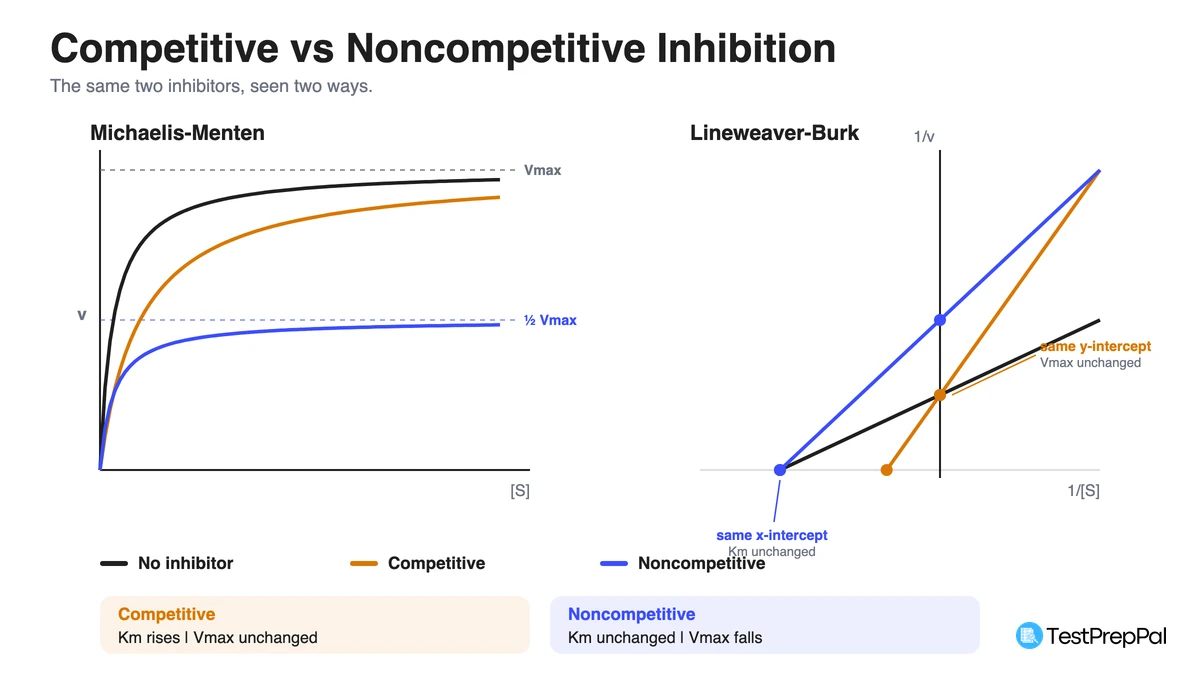 The first passage set turns on this distinction. On the double-reciprocal plot, competitive inhibition keeps the y-intercept and noncompetitive keeps the x-intercept.
How Much Biochemistry Is on the MCAT?
Biochemistry is the only discipline the AAMC weights at 25% in two different sections. It is 25% of the Chemical and Physical Foundations (Chem/Phys) section and 25% of the Biological and Biochemical Foundations (Bio/Biochem) section. Each of those sections contains 59 questions, so biochemistry accounts for roughly 15 questions in each section — about 30 questions on your exam.
| Section | Questions | Time | Biochem share | Approx. biochem questions |
|---|---|---|---|---|
| Chemical and Physical Foundations | 59 | 95 minutes | 25% | ~15 |
| Biological and Biochemical Foundations | 59 | 95 minutes | 25% | ~15 |
The full discipline breakdowns are worth seeing side by side, because they explain why biochemistry pays off twice:
| Discipline | Chem/Phys | Bio/Biochem |
|---|---|---|
| First-semester biochemistry | 25% | 25% |
| Introductory biology | 5% | 65% |
| General chemistry | 30% | 5% |
| Organic chemistry | 15% | 5% |
| Introductory physics | 25% | — |
Section formats and discipline percentages are from the AAMC Chemical and Physical Foundations of Biological Systems section overview and the AAMC Biological and Biochemical Foundations of Living Systems section overview, both verified August 28, 2026. AAMC notes these percentages are approximated to the nearest 5% and vary between test forms.
The Amino Acids These Questions Assume
Several questions here turn on side-chain class, charge at physiological pH, and pKa values, and the passages use one-letter codes without defining them. The MCAT hands you a periodic table and nothing else, so all 20 have to be in memory before this set is worth timing.
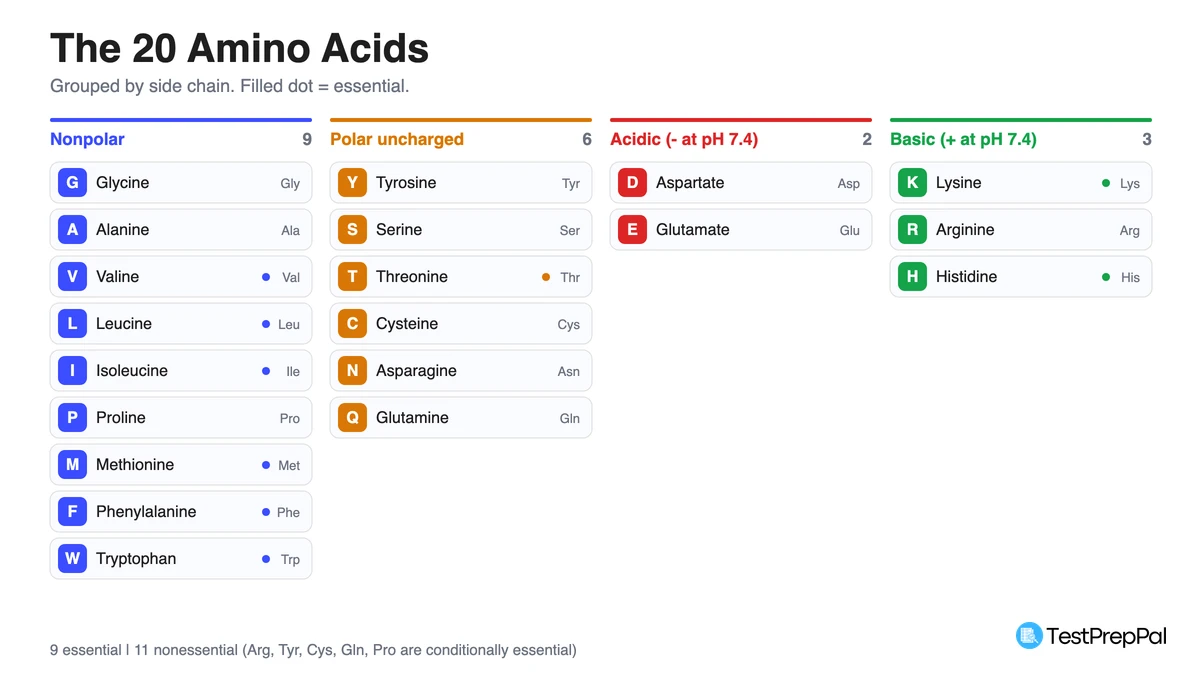 The 20 amino acids grouped by side-chain class. Filled dot marks the 9 essential amino acids.
The full reference — all 20 with both code systems, the nine ionizable pKa values, and the pI rules — lives in our MCAT amino acid chart.
How to Use These Practice Questions
- Learn to recognize kinetic signatures instantly. Competitive inhibition raises apparent Km and preserves Vmax. Noncompetitive lowers Vmax and preserves Km. Uncompetitive lowers both. Two of the questions below turn entirely on reading a table for that pattern.
- Convert every charge question into a pKa comparison. Ask only whether the solution pH sits above or below the relevant pKa. That single habit answers pI, electrophoresis, ion exchange, and buffering questions without any calculation.
- Do not memorize structures at the expense of properties. The exam almost never asks you to draw a side chain. It asks whether that side chain would sit in a hydrophobic core, form a salt bridge, or accept a proton at pH 7.4.
- Know the regulatory logic, not just the pathway. Which enzyme catalyzes the committed step, what activates it, what shuts it off. PFK-1 alone accounts for a remarkable share of glycolysis questions.
- Read every explanation, including on questions you got right — each one names the specific distractor logic the exam reuses.
Why Biochemistry Is the Highest-Leverage MCAT Subject
Physics appears in one section. Organic chemistry is weighted at 15% and 5%. Biochemistry is 25% in both science sections, which makes it the best return on study time of any single subject on the exam — and the concepts repeat. Enzyme inhibition, amino acid charge, and metabolic regulation come back on passage after passage in slightly different clothing.
That is also why four of the five sets here are passage-based. The AAMC rarely asks a fact outright. It buries a Km, a pI, and a band size in an experimental description and asks what the data mean.
Keep Practicing
Cover the rest of the Chem/Phys section with our MCAT general chemistry practice questions and MCAT physics practice questions — together with the biochemistry above, those three account for 80% of that section.
Then put your target score in context with our MCAT score calculator, see where you stand against admitted applicants with the MCAT statistics dashboard, and turn the weeks you have left into a schedule with the MCAT study plan generator.
For more free material, see our roundup of free MCAT resources, our guide to how hard the MCAT is, and our MCAT question bank comparison.
The Michaelis-Menten and pI relationships used here are on our MCAT equation sheet.
All Six MCAT Subject Drills
Every subject tested on the MCAT, each in the AAMC test interface with full solutions:
General chemistry · Physics · Organic chemistry · Biology · Psych/Soc
We may earn commissions from some links on this page, but this does not affect our reviews or your experience.