


- The endocrine system is the one part of MCAT biology that's genuinely a memorization problem. Everything else the exam can build from a passage; hormone source, target, and action it expects you to already know.
- Learn the hormones as axes, not as an alphabetical list. Almost every endocrine question is asking you to locate a lesion in a three-part chain: hypothalamus, pituitary, gland.
- The single most testable concept isn't any individual hormone. It's peptide vs steroid: water-soluble hormones bind surface receptors and act fast, lipid-soluble ones bind intracellular receptors and act slow.
- If TSH and T4 move in opposite directions, the problem is in the thyroid. If they move in the same direction, the problem is above it.
- Introductory biology is 65% of the Bio/Biochem section, and the endocrine system sits in content category 3A alongside the nervous system.
Most students learn the MCAT hormones from a flashcard deck sorted by gland, then get to a passage that gives them two lab values and asks where the lesion is, and freeze. The chart below is the recall layer, and you do need it cold. But the exam almost never asks you to state a hormone's action. It hands you an axis with something broken in it and asks you to reason forward.
So this page does both. First, how to organize the hormones so the reasoning questions become answerable. Then the full chart. Then the two mechanisms that carry most of the points: hormone class and negative feedback.
Related free resource:

Blueprint's Free MCAT Flashcards
1,600+ expert-made cards covering every section. No Anki setup.
Free account · No credit card
Learn the hormones by axis, not alphabetically
There are three classic hypothalamic-pituitary axes, plus a growth axis and a prolactin loop that behave differently. Every one of them is a chain, and the end hormone shuts off the steps above it.
| Axis | Hypothalamus | Anterior pituitary | Peripheral gland | End hormone | What turns it off |
|---|---|---|---|---|---|
| Adrenal (HPA) | CRH | ACTH | Adrenal cortex, zona fasciculata | Cortisol | Cortisol inhibits both CRH and ACTH |
| Thyroid (HPT) | TRH | TSH | Thyroid follicular cells | T3 and T4 | T3 and T4 inhibit both TRH and TSH |
| Gonadal (HPG) | GnRH | FSH and LH | Ovary or testis | Estradiol, progesterone, testosterone, inhibin | Sex steroids inhibit GnRH and LH; inhibin selectively inhibits FSH |
| Growth | GHRH (plus somatostatin as the brake) | GH | Liver | IGF-1 | IGF-1 inhibits GH and GHRH and stimulates somatostatin |
| Prolactin | Dopamine, which inhibits rather than releases | Prolactin | None | Prolactin | Prolactin raises hypothalamic dopamine output |
Two things to notice, because the MCAT tests both.
Prolactin runs backwards. Its hypothalamic control is tonic inhibition by dopamine, not stimulation. Cut the pituitary stalk and every other anterior pituitary hormone falls, while prolactin rises, because you removed the brake. That's a favorite question.
Not every hormone has an axis. Three of the biggest ones sense a blood value directly and skip the pituitary entirely:
- Glucose. Beta and alpha cells of the pancreas read plasma glucose themselves. There's no trophic hormone from the pituitary telling them to release insulin.
- Calcium. Parathyroid chief cells carry a calcium-sensing receptor. Low plasma calcium releases PTH; PTH raises calcium and activates calcitriol; calcium and calcitriol feed back and shut PTH off.
- Volume and osmolarity. Aldosterone is driven by angiotensin II and plasma potassium, not by ACTH. ADH is driven by hypothalamic osmoreceptors and by low blood volume. This matters clinically: in adrenal failure caused by a pituitary problem, cortisol collapses but aldosterone is relatively preserved, because ACTH was never its main driver.
If you can draw those five chains and three sensor loops from memory, you can reason your way to most endocrine answers even on a hormone whose row you've half forgotten.
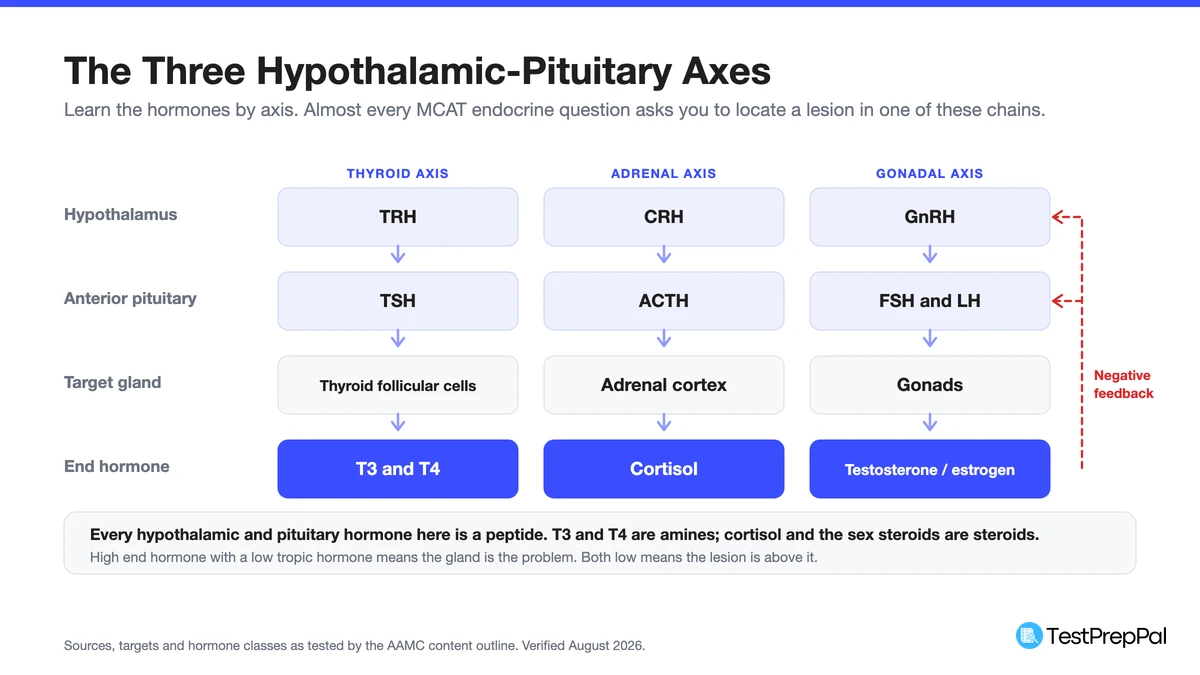 Three chains, four tiers each. Almost every MCAT endocrine question asks you to locate a lesion in one of them.
The MCAT hormone chart
Work down the chart until you can produce each row from the hormone name alone.
Hypothalamic releasing and inhibiting hormones
All of these reach the anterior pituitary through the hypophyseal portal system rather than the systemic circulation.
| Hormone | Source | Target | Primary action | Class |
|---|---|---|---|---|
| GnRH | Hypothalamus | Anterior pituitary gonadotropes | Stimulates FSH and LH release | Peptide |
| TRH | Hypothalamus | Anterior pituitary thyrotropes | Stimulates TSH release (and prolactin) | Peptide |
| CRH | Hypothalamus | Anterior pituitary corticotropes | Stimulates ACTH release | Peptide |
| GHRH | Hypothalamus | Anterior pituitary somatotropes | Stimulates GH release | Peptide |
| Somatostatin (GHIH) | Hypothalamus | Anterior pituitary | Inhibits GH and TSH release | Peptide |
| Dopamine (PIF) | Hypothalamus | Anterior pituitary lactotropes | Inhibits prolactin release | Amine (catecholamine) |
Pituitary hormones
| Hormone | Source | Target | Primary action | Class |
|---|---|---|---|---|
| TSH | Anterior pituitary | Thyroid follicular cells | Stimulates T3 and T4 synthesis and release | Peptide (glycoprotein) |
| ACTH | Anterior pituitary | Adrenal cortex (zona fasciculata) | Stimulates cortisol synthesis | Peptide |
| FSH | Anterior pituitary | Ovarian granulosa cells; Sertoli cells | Follicle maturation; supports spermatogenesis | Peptide (glycoprotein) |
| LH | Anterior pituitary | Theca cells and corpus luteum; Leydig cells | Triggers ovulation and progesterone output; testosterone synthesis | Peptide (glycoprotein) |
| Growth hormone (GH) | Anterior pituitary | Liver, bone, muscle | Stimulates IGF-1 and linear growth; raises blood glucose | Peptide |
| Prolactin | Anterior pituitary | Mammary gland | Milk production | Peptide |
| ADH (vasopressin) | Made in hypothalamus, released from posterior pituitary | Renal collecting duct; vascular smooth muscle | Inserts aquaporin-2 for water reabsorption; vasoconstriction | Peptide |
| Oxytocin | Made in hypothalamus, released from posterior pituitary | Uterine smooth muscle; mammary myoepithelium | Uterine contraction; milk ejection | Peptide |
The posterior pituitary is not a gland. It's axon terminals of hypothalamic neurons, which is why ADH and oxytocin are "made in the hypothalamus, released from the posterior pituitary" and why there's no releasing hormone controlling them.
Thyroid and parathyroid
| Hormone | Source | Target | Primary action | Class |
|---|---|---|---|---|
| T3 and T4 | Thyroid follicular cells | Nearly all tissues | Raise basal metabolic rate; required for normal development | Amine (tyrosine-derived, acts on nuclear receptors) |
| Calcitonin | Thyroid parafollicular (C) cells | Bone osteoclasts, kidney | Lowers plasma calcium | Peptide |
| PTH | Parathyroid chief cells | Bone, kidney, indirectly intestine | Raises plasma calcium; activates vitamin D to calcitriol | Peptide |
One honest caveat on calcitonin: "lowers plasma calcium" is the MCAT answer and the answer you should pick, but its physiological role in adult humans is minimal. People who have had their thyroid removed don't become hypercalcemic, and people with medullary thyroid carcinoma pumping out huge amounts of calcitonin don't become hypocalcemic. PTH does essentially all of the real regulating. Learn the exam answer, and know it's a simplification.
Adrenal gland
| Hormone | Source | Target | Primary action | Class |
|---|---|---|---|---|
| Cortisol | Adrenal cortex, zona fasciculata | Most tissues | Gluconeogenesis, protein catabolism, immunosuppression, stress response | Steroid |
| Aldosterone | Adrenal cortex, zona glomerulosa | Distal tubule and collecting duct principal cells | Sodium reabsorption, potassium and hydrogen ion secretion | Steroid |
| DHEA and adrenal androgens | Adrenal cortex, zona reticularis | Peripheral tissues | Androgen precursors | Steroid |
| Epinephrine and norepinephrine | Adrenal medulla (chromaffin cells) | Heart, vasculature, liver, bronchioles | Fight-or-flight: raises heart rate, glycogenolysis, bronchodilation | Amine (catecholamine) |
The cortex layers run outside to inside as glomerulosa, fasciculata, reticularis, producing salt, sugar, and sex hormones in that order. The medulla is different tissue entirely: it's neural crest derived, functionally a sympathetic ganglion, and it releases amines rather than steroids.
Pancreatic islets
| Hormone | Source | Target | Primary action | Class |
|---|---|---|---|---|
| Insulin | Beta cells of the islets of Langerhans | Liver, skeletal muscle, adipose | Lowers blood glucose; inserts GLUT4; promotes glycogenesis and lipogenesis | Peptide |
| Glucagon | Alpha cells | Liver | Raises blood glucose via glycogenolysis and gluconeogenesis | Peptide |
| Somatostatin | Delta cells | Neighboring islet cells, GI tract | Inhibits insulin and glucagon secretion | Peptide |
Reproductive and placental
| Hormone | Source | Target | Primary action | Class |
|---|---|---|---|---|
| Testosterone | Leydig cells of the testis | Reproductive tract, muscle, bone, brain | Male secondary sex characteristics; supports spermatogenesis | Steroid |
| Estradiol | Ovarian granulosa cells; placenta | Uterus, breast, bone | Endometrial proliferation; female secondary sex characteristics | Steroid |
| Progesterone | Corpus luteum; placenta | Uterus | Maintains the secretory endometrium; suppresses uterine contraction | Steroid |
| hCG | Syncytiotrophoblast of the placenta | Corpus luteum | Maintains the corpus luteum through the first trimester | Peptide (glycoprotein) |
Other high-yield hormones
| Hormone | Source | Target | Primary action | Class |
|---|---|---|---|---|
| Melatonin | Pineal gland | Brain, suprachiasmatic nucleus | Entrains circadian rhythm; released in darkness | Amine (tryptophan-derived) |
| ANP | Atrial cardiac myocytes | Kidney, vasculature | Natriuresis and vasodilation; opposes aldosterone and ADH | Peptide |
| Erythropoietin | Kidney (peritubular interstitial cells) | Bone marrow | Stimulates red blood cell production in response to hypoxia | Peptide |
| Calcitriol | Activated in the kidney from vitamin D | Intestine, bone | Increases intestinal calcium and phosphate absorption | Steroid-derived (secosteroid) |
| Thymosin | Thymus | Developing T lymphocytes | Supports T cell maturation | Peptide |
Peptide, steroid, or amine: why the class decides everything
If you only get one concept off this page, get this one. Hormone class isn't trivia. It predicts where the receptor is, what the cell does next, how fast the effect appears, and how long it lasts. The AAMC asks about this more than it asks about any single hormone.
The whole thing follows from solubility. Peptides and catecholamines are water-soluble, so they dissolve fine in plasma but can't cross the lipid bilayer. Steroids and thyroid hormone are lipid-soluble, so they cross the membrane easily but need a carrier protein to travel in blood.
| Property | Peptides and catecholamines | Steroids | Thyroid hormone |
|---|---|---|---|
| Solubility | Water-soluble | Lipid-soluble | Lipid-soluble |
| Travels in blood | Freely dissolved | Bound to carrier protein (CBG, SHBG, albumin) | Bound to thyroxine-binding globulin |
| Receptor location | Cell surface | Cytoplasm or nucleus | Nucleus |
| What the receptor does | Triggers a second messenger cascade | Acts as a transcription factor | Acts as a transcription factor |
| Onset | Seconds to minutes | Hours | Hours to days |
| Duration | Minutes | Hours to days | Days |
| Storage | Stored in secretory vesicles, released on demand | Not stored; made from cholesterol on demand | Stored extracellularly in thyroglobulin colloid |
| Half-life in plasma | Short | Long | Very long |
The second half of the mechanism is which surface receptor a water-soluble hormone uses:
- Gs, raising cAMP and activating PKA. Glucagon, ACTH, TSH, LH, FSH, PTH, ADH at the V2 receptor, and beta-adrenergic catecholamines.
- Gq, raising IP3 and DAG and releasing intracellular calcium. GnRH, TRH, oxytocin, angiotensin II, ADH at the V1 receptor, and alpha-1 adrenergic catecholamines.
- Gi, lowering cAMP. Somatostatin and alpha-2 adrenergic catecholamines.
- Receptor tyrosine kinase. Insulin and IGF-1, which is why insulin signaling questions involve autophosphorylation and a kinase cascade rather than cAMP.
- JAK-STAT. Growth hormone and prolactin.
Two exceptions the exam likes. Thyroid hormone is an amine by chemistry but behaves like a steroid by mechanism. It's built from tyrosine, same as the catecholamines, but it's lipophilic, carried on a plasma protein, and binds a nuclear receptor. Anything that sorts hormones by chemical class will put it with epinephrine, and that's the trap. Nitric oxide is a gas that diffuses in and activates guanylate cyclase to make cGMP, which fits none of the categories cleanly.
A practical way to use this on test day: if a passage describes an effect that appeared within seconds, the hormone is acting through a surface receptor and a second messenger. If the effect took hours and involved new protein synthesis, you're looking at a nuclear receptor and a steroid or thyroid hormone. That inference alone eliminates two answer choices on a lot of questions.
Negative feedback, worked end to end
Take the thyroid axis. The hypothalamus releases TRH into the portal system. TRH tells pituitary thyrotropes to release TSH. TSH tells thyroid follicular cells to make and release T4 and a smaller amount of T3. T4 is mostly a prohormone; peripheral deiodinases strip an iodine to make T3, which is the more potent form. Circulating T3 and T4 then inhibit both the pituitary and the hypothalamus, so a rising thyroid hormone level throttles its own production.
That's the loop. Now break it in two different places and read the labs.
| Scenario | TSH | Free T4 | Where the lesion is |
|---|---|---|---|
| Primary hypothyroidism | High | Low | Thyroid gland |
| Central (secondary) hypothyroidism | Low or inappropriately normal | Low | Pituitary or hypothalamus |
| Primary hyperthyroidism | Low | High | Thyroid gland |
| Central hyperthyroidism (TSH-secreting adenoma) | High or inappropriately normal | High | Pituitary |
The pattern generalizes to every axis, and it's worth memorizing as a single sentence: if the trophic hormone and the end hormone move in opposite directions, the peripheral gland is the problem; if they move in the same direction, the problem is upstream.
The logic is just feedback. A failing thyroid produces little T4, so there's nothing to inhibit the pituitary, and TSH climbs. A failing pituitary can't produce TSH in the first place, so the thyroid is understimulated and T4 falls with it. Both patients have low T4 and both feel the same. The TSH is the only thing that tells you which one you're looking at.
Run the same reasoning on the adrenal axis and you get the same shape. Primary adrenal insufficiency gives low cortisol with high ACTH. Secondary gives low cortisol with low ACTH. Cushing disease, which is a pituitary adenoma, gives high cortisol with high ACTH, while an adrenal tumor making cortisol on its own gives high cortisol with suppressed ACTH.
You can practice this pattern on a full passage in our free MCAT biology practice questions, where one of the four passage sets is built entirely around reading TSH against T4.
How much of this does the MCAT actually test?
Introductory biology is 65% of the Biological and Biochemical Foundations of Living Systems (Bio/Biochem) section and 5% of the Chemical and Physical Foundations (Chem/Phys) section, per the AAMC content outline. Bio/Biochem has 59 questions, so introductory biology accounts for roughly 38 questions there, plus about 3 more in Chem/Phys.
The endocrine system lives in content category 3A, "Structure and function of the nervous and endocrine systems," which is shared between Bio/Biochem and Psych/Soc. That means hormones can show up in two of the four sections. Psych/Soc tends to ask about cortisol and stress, about the hypothalamus as the link between the nervous and endocrine systems, and about melatonin and circadian rhythm. Bio/Biochem asks about the axes and the mechanisms.
Discipline percentages and section format are from the AAMC Biological and Biochemical Foundations of Living Systems overview and the Chemical and Physical Foundations of Biological Systems section overview, both verified August 28, 2026. AAMC notes these percentages are approximated to the nearest 5% and vary between test forms.
Frequently asked questions
How many hormones do I need to know for the MCAT?
The chart above is the working list, roughly 35 hormones. That's the realistic ceiling. You need source, target, primary action, and class for each one, and you need it fast enough that recall doesn't eat your passage time. Anything beyond this list is medical school material.
Is thyroid hormone a steroid?
No. T3 and T4 are amines derived from tyrosine, the same starting material as the catecholamines. But they act like steroids: lipid-soluble, carried on a plasma binding protein, and binding a nuclear receptor to change gene transcription. The MCAT asks about this specifically because the chemical class and the mechanistic behavior point in different directions.
What's the difference between primary and secondary endocrine failure?
Primary means the peripheral gland itself has failed, so the trophic hormone above it rises to compensate. Secondary, also called central, means the pituitary or hypothalamus has failed, so both hormones fall together. Read the two lab values against each other rather than looking at either one alone.
Does the MCAT test calcitonin?
Yes, and the answer it wants is that calcitonin lowers plasma calcium by inhibiting osteoclasts. Give it that answer. Just be aware that calcitonin's actual contribution to calcium regulation in adult humans is small, and PTH plus calcitriol do nearly all of the work.
What's the fastest way to memorize the hormone chart?
Build the five axes first, on one sheet of paper, from memory, until you can do it in under two minutes. Then add the sensor-driven loops for glucose and calcium. Only then drill individual rows, and drill them by producing the row from the hormone name rather than by recognizing it. Recognition feels like knowing and isn't.
MCAT Reference Sheets
The rest of the high-yield memorization set:
MCAT amino acid chart · MCAT equation sheet · MCAT organic chemistry reactions sheet
Then test what stuck with our free MCAT practice questions — 25 questions per subject in the AAMC test interface, with full worked solutions.
We may earn commissions from some links on this page, but this does not affect our reviews or your experience.