


- Organic chemistry is 15% of Chem/Phys and 5% of Bio/Biochem, which works out to roughly 12 questions on a 230-question exam.
- The exam rewards recognizing functional-group reactivity and reading spectra. It does not ask you to plan a multi-step synthesis.
- There is no reagent sheet and no calculator on test day, so the short list below is what you carry in.
- Two orderings decide most questions: carbonyl electrophilicity and leaving-group ability, and both come from the same electron-density logic.
- Spectroscopy items are answerable from tabulated data plus reasoning. You are never asked to draw a structure.
If you want one page of MCAT organic chemistry reactions to review the night before a full-length, this is it. Below are the mechanisms the AAMC reuses, the IR bands and proton NMR shifts that turn up as passage data, and the two reactivity orderings that settle most questions before you reach the answer choices.
It is much shorter than your organic chemistry course was, and that is the point. The MCAT tests first-semester organic chemistry, and it tests it the way a physician uses it: as the chemical logic underneath a lab workflow or an enzyme mechanism.
Related free resource:

Blueprint's Free MCAT Flashcards
1,600+ expert-made cards covering every section. No Anki setup.
Free account · No credit card
How the MCAT Actually Tests Organic Chemistry
Organic chemistry appears in two of the four scored sections.
| Section | Organic chemistry share | Questions in section | Approximate organic questions |
|---|---|---|---|
| Chemical and Physical Foundations (Chem/Phys) | 15% | 59 | About 9 |
| Biological and Biochemical Foundations (Bio/Biochem) | 5% | 59 | About 3 |
| Psychological, Social, and Biological Foundations | None | 59 | 0 |
| Critical Analysis and Reasoning Skills | None | 53 | 0 |
Discipline percentages are from the AAMC Chemical and Physical Foundations of Biological Systems section overview and the AAMC Biological and Biochemical Foundations of Living Systems section overview, verified August 28, 2026. AAMC notes these percentages are approximated to the nearest 5% and vary between test forms.
So about 12 questions total. What matters more than the count is what those 12 questions ask. Three patterns cover almost all of them:
- Recognize the functional group and predict what it does. Which carbon is electrophilic, what attacks it, and what leaves. A question that names a reagent and a substrate is asking you to place both in a mechanism family, not to recall a named reaction.
- Read spectra as constraints. IR and ¹H NMR show up as passage data you interpret, not as standalone recall. Mass spectrometry appears mostly as a molecular ion.
- Compare, do not calculate. Rank two acids, decide whether one base can deprotonate another, assign R or S, or say which of two carbonyls reacts faster.
What the MCAT does not do is hand you a target molecule and ask for a synthesis. Retrosynthesis, protecting-group strategy beyond acetals, aromatic substitution mechanisms, and pericyclic reactions are second-semester topics that the AAMC content outlines leave out. If you are pushing arrows through four-step sequences, you are studying for the wrong exam.
The practical version: know a short list of mechanisms cold, know the spectroscopy tables, and know the acid-base and reactivity orderings. That is the whole of it.
MCAT Organic Chemistry Reactions Sheet
No reagent list is provided on test day and no calculator is permitted. These are the reactions the AAMC reuses, grouped by the mechanism that drives them.
Substitution and Elimination
| Reaction | Reagents and conditions | Substrate | Product | Mechanism note |
|---|---|---|---|---|
| SN2 | Strong nucleophile (CN⁻, N₃⁻, RS⁻, I⁻, HO⁻) in polar aprotic solvent (DMSO, DMF, acetone) | Methyl or primary alkyl halide | Substitution product with inverted configuration | One concerted step, backside attack; rate = k[RX][Nu]; sterics dominate, so tertiary substrates are inert |
| SN1 | Weak nucleophile, polar protic solvent (H₂O, ROH), heat | Tertiary, allylic, or benzylic halide | Substitution product, largely racemized | Two steps through a planar carbocation; rate = k[RX]; carbocation rearrangements are possible |
| E2 | Strong base (NaOEt, NaOH, NaNH₂; KOtBu for bulky), heat | Secondary or tertiary alkyl halide | Alkene — Zaitsev (more substituted) unless the base is bulky, which gives Hofmann | Concerted; requires the H and the leaving group anti-periplanar; rate = k[RX][base] |
| E1 | Weak base, polar protic solvent, heat | Tertiary alkyl halide | Alkene (Zaitsev) | Same carbocation as SN1 and always competes with it |
Oxidation and Reduction
| Reaction | Reagents and conditions | Substrate | Product | Mechanism note |
|---|---|---|---|---|
| Mild oxidation | PCC in anhydrous CH₂Cl₂ (also Swern, Dess-Martin) | Primary alcohol | Aldehyde | Anhydrous, so no hydrate forms and oxidation stops cleanly |
| Strong oxidation | H₂CrO₄ / Jones, K₂Cr₂O₇/H⁺, hot KMnO₄ | Primary alcohol | Carboxylic acid | Proceeds through the aldehyde hydrate, which supplies the extra C–H that is oxidized |
| Oxidation | Any of the above | Secondary alcohol | Ketone | Cannot over-oxidize; a tertiary alcohol has no carbinol C–H and does not react |
| Mild reduction | NaBH₄ in MeOH or EtOH | Aldehyde, ketone | Primary or secondary alcohol | Hydride adds to the carbonyl carbon; too mild for esters, acids, or amides |
| Strong reduction | LiAlH₄, then H₃O⁺ workup | Aldehyde, ketone, ester, carboxylic acid, amide | Alcohol (amide gives an amine) | Powerful hydride source; reacts violently with any protic solvent |
| Thiol oxidation | Mild oxidant (O₂, I₂) | 2 R–SH | Disulfide R–S–S–R | The redox switch behind cysteine and cystine in proteins |
Nucleophilic Addition to the Carbonyl
| Reaction | Reagents and conditions | Substrate | Product | Mechanism note |
|---|---|---|---|---|
| Grignard addition | RMgBr or RLi, then H₃O⁺ | Aldehyde, ketone, ester | Secondary or tertiary alcohol | Carbanion-like carbon adds to the carbonyl carbon, forming a new C–C bond; destroyed by water, alcohols, or any acidic proton |
| Cyanohydrin formation | HCN or NaCN / H⁺ | Aldehyde, ketone | Cyanohydrin (α-hydroxy nitrile) | Reversible addition of cyanide; the nitrile can be hydrolyzed onward to a carboxylic acid |
| Hydration | H₂O, acid or base catalysis | Aldehyde, ketone | Geminal diol (hydrate) | Reversible; the equilibrium favors the hydrate only for very electrophilic carbonyls such as formaldehyde |
| Acetal formation | 2 ROH, catalytic H⁺, remove water | Aldehyde, ketone | Acetal (ketal) | Passes through the hemiacetal; used as a protecting group and reversed by aqueous acid |
| Imine (Schiff base) formation | Primary amine RNH₂, catalytic H⁺, optimum around pH 4–5 | Aldehyde, ketone | Imine (C=N) | Addition gives a carbinolamine, then acid-catalyzed dehydration; too much acid protonates the amine and kills the nucleophile |
| Enamine formation | Secondary amine R₂NH, catalytic H⁺ | Aldehyde, ketone | Enamine (N–C=C) | Same route as an imine, but with no N–H left the iminium must lose an α-proton instead |
Enol, Enolate, and Alpha-Carbon Chemistry
| Reaction | Reagents and conditions | Substrate | Product | Mechanism note |
|---|---|---|---|---|
| Keto-enol tautomerization | Trace acid or base | Carbonyl with an α-H | Enol (usually minor at equilibrium) | Constitutional isomers, not resonance forms — a proton physically moves |
| Aldol addition | Dilute NaOH, room temperature (or an aldolase enzyme) | Two aldehyde or ketone units, at least one with an α-H | β-hydroxy carbonyl | Enolate α-carbon attacks the other carbonyl carbon; fully reversible as a retro-aldol |
| Aldol condensation | NaOH, heat | The β-hydroxy carbonyl above | α,β-unsaturated carbonyl | E1cb dehydration after the addition; driven by the stability of the conjugated product |
| Decarboxylation | Heat, no reagent required | β-keto acid or β-diacid (malonic) | Product with one fewer carbon, plus CO₂ | Six-membered cyclic transition state; requires a carbonyl β to the COOH; gives an enol that tautomerizes |
Carboxylic Acid Derivatives (Nucleophilic Acyl Substitution)
| Reaction | Reagents and conditions | Substrate | Product | Mechanism note |
|---|---|---|---|---|
| Fischer esterification | Excess ROH, catalytic H₂SO₄, heat | Carboxylic acid | Ester + H₂O | Reversible; drive forward with excess alcohol or by removing water |
| Acidic ester hydrolysis | H₃O⁺, heat, excess water | Ester | Carboxylic acid + alcohol | Exactly the reverse of Fischer esterification, and equally reversible |
| Saponification | NaOH, heat, then H₃O⁺ workup | Ester | Carboxylate salt + alcohol | Irreversible — the carboxylate is deprotonated and no longer electrophilic; the basis of soap making and of triacylglycerol cleavage |
| Amide hydrolysis | H₃O⁺ or HO⁻, heat, prolonged | Amide | Carboxylic acid + amine | The slowest acyl substitution; peptide bonds are amides, which is why they are kinetically stable in water |
| Transesterification | Different alcohol, acid or base catalysis | Ester | New ester + original alcohol | Equilibrium controlled by which alcohol is in excess |
Reactivity order of the derivatives — memorize this ranking, since it decides which interconversions are possible:
acid chloride greater than anhydride greater than ester ≈ carboxylic acid greater than amide greater than carboxylate
A more reactive derivative converts to a less reactive one directly. Going the other direction requires an activating step. The ranking tracks leaving-group ability and how strongly the attached heteroatom donates electron density back into the carbonyl.
Functional Group Reactivity: The Two Orderings That Decide Everything
Most organic questions on the MCAT are comparisons, and almost every comparison reduces to one of two rankings.
Which Carbonyls Are Most Electrophilic
A carbonyl carbon is electrophilic because oxygen pulls electron density off it. Anything that gives that density back makes the carbon less positive and less reactive. Two effects do the giving:
- Resonance donation from the attached heteroatom. A lone pair on the atom bonded to the carbonyl carbon delocalizes into the C=O. Nitrogen donates strongly, oxygen moderately, chlorine barely at all, since its lone pairs sit in a 3p orbital that overlaps poorly with carbon's 2p. This is the dominant term, and it is why an amide is the least reactive derivative and an acid chloride the most.
- Donation from alkyl groups. Alkyl substituents push a little density toward the carbonyl carbon and get in the way sterically. A ketone has two, an aldehyde has one, so aldehydes are more electrophilic than ketones.
Together they give the ordering in the acyl substitution table above: acid chloride, anhydride, ester ≈ carboxylic acid, amide, carboxylate. That series ranks the derivatives for nucleophilic acyl substitution, where the nucleophile adds and a leaving group departs. Aldehydes and ketones sit outside it because they have no leaving group and cannot substitute at all. For pure addition, the order is acid chloride, anhydride, aldehyde, ketone, ester, amide. Same logic, both times.
A carboxylate is not electrophilic at all: its charge is delocalized over both oxygens. That is exactly why saponification is irreversible.
Leaving-Group Ability
A good leaving group is a weak base, meaning it holds a negative charge comfortably. The proxy is the pKa of its conjugate acid, and lower is better.
| Leaving group | Conjugate acid | Approximate pKa of conjugate acid | Verdict |
|---|---|---|---|
| I⁻ | HI | −10 | Excellent |
| Br⁻ | HBr | −9 | Excellent |
| Cl⁻ | HCl | −7 | Good |
| TsO⁻ (tosylate) | TsOH | ≈ −2.8 | Excellent |
| H₂O (from a protonated alcohol) | H₃O⁺ | −1.7 | Good |
| RCOO⁻ (carboxylate) | RCOOH | ≈ 4.8 | Fair |
| HO⁻ | H₂O | 15.7 | Poor |
| RO⁻ (alkoxide) | ROH | ≈ 16 | Poor |
| R₂N⁻ (amide nitrogen) | R₂NH | ≈ 38 | Very poor |
Set that next to the acyl reactivity series and you will see they are the same list. Chloride leaves easily, so acid chlorides are reactive. Alkoxide leaves reluctantly, so esters are sluggish. An amide nitrogen is essentially never expelled as an anion, which is why peptide bonds survive in water for years. One honest exception: fluoride looks respectable by pKa (HF is about 3.2) but leaves poorly, because C–F is the strongest single bond carbon makes. The proxy is a heuristic, not a law.
This also explains why hydroxide never departs a carboxylic acid directly. To esterify an acid you protonate the OH first, turning a terrible leaving group into water. Every acid-catalyzed carbonyl mechanism is running some version of that trick.
The pKa Comparisons the Exam Reuses
You are almost never asked for an absolute value. You are asked whether one species can deprotonate another, and the reaction proceeds if the acid being deprotonated is stronger than the conjugate acid that forms.
| Species | Approximate pKa | What it shows |
|---|---|---|
| Protonated amide (conjugate acid of acetamide) | roughly −8 to +0.5 | Amides are very weak bases |
| Trichloroacetic acid | ≈ 0.7 | Three chlorines, maximum inductive pull |
| Dichloroacetic acid | ≈ 1.29 (sources give 1.29–1.35) | Two chlorines |
| Chloroacetic acid | ≈ 2.86 | One chlorine |
| Acetic acid | 4.76 | The baseline, no halogen |
| Amino acid α-carboxyl | ≈ 2 | Lowered by the nearby ammonium |
| Protonated aniline | ≈ 4.6 | Lone pair tied up in the ring |
| Ammonium (NH₄⁺) | 9.25 | |
| Amino acid α-ammonium | ≈ 9–10 | |
| Phenol | ≈ 10 | Resonance-stabilized conjugate base |
| Protonated alkylamine | ≈ 10–11 | The strongest common organic base on the exam |
| Water | 15.7 | |
| Ethanol | ≈ 16 | |
| Terminal alkyne C–H | ≈ 25 | sp carbon holds the pair closest in |
| Alkane C–H | ≈ 50 | Effectively not acidic |
The chloroacetic series shows the inductive effect adding up with each halogen. The basicity ordering, alkylamine then ammonia then aniline then amide, is one of the AAMC's favorite comparisons because it lets a passage ask about a protein side chain without naming a mechanism.
Treat the amide entry as a range rather than a figure. Published values for the conjugate acid of acetamide run from about −8 for the nitrogen-protonated form to roughly 0 for the oxygen-protonated form, and textbooks quote one or the other without always saying which. The qualitative conclusion is what gets tested and it is not in doubt: an amide nitrogen is a far weaker base than an amine nitrogen, because its lone pair is delocalized into the carbonyl. The dichloroacetic acid value is similarly approximate.
MCAT IR Absorption Reference
The exam almost never asks you to interpret a full IR spectrum. It hands you one or two bands and asks what they rule in or out. Intensity and shape matter as much as position.
| Bond | Wavenumber (cm⁻¹) | Appearance and notes |
|---|---|---|
| O–H, alcohol | 3200–3600 | Strong, broad and rounded from hydrogen bonding |
| O–H, carboxylic acid | 2500–3300 | Very broad, overlaps and obscures the C–H region; caused by the hydrogen-bonded dimer |
| N–H, amine or amide | 3300–3500 | Medium, sharper than O–H; a primary amine gives two bands, a secondary amine gives one |
| C–H, sp (terminal alkyne) | ~3300 | Sharp and strong; distinguishes a terminal from an internal alkyne |
| C–H, sp² (alkene, aromatic) | 3000–3100 | Medium; just to the left of 3000 |
| C–H, sp³ (alkyl) | 2850–3000 | Strong; present in nearly every organic compound, so rarely diagnostic |
| C–H, aldehyde | 2700–2900 | Two weak bands near 2720 and 2820; highly diagnostic for an aldehyde |
| C≡N, nitrile | 2220–2260 | Strong and sharp; strong because the C–N triple bond is highly polarized |
| C≡C, alkyne | 2100–2260 | Weak, and absent entirely in a symmetric internal alkyne |
| C=O, acid chloride | 1780–1815 | Strong; the highest carbonyl on the exam |
| C=O, anhydride | 1740–1830 | Strong, appears as two bands |
| C=O, ester | 1735–1750 | Strong |
| C=O, aldehyde | 1720–1740 | Strong; confirm with the 2720/2820 C–H doublet |
| C=O, ketone | 1705–1725 | Strong; the reference point for all carbonyl comparisons |
| C=O, carboxylic acid | 1700–1725 | Strong; the dimer typically lands near 1710 |
| C=O, amide | 1630–1690 | Strong; lowest of the common carbonyls because the nitrogen donates electron density into the C=O |
| C=C, alkene | 1620–1680 | Weak to medium |
| C=C, aromatic ring | 1450–1600 | Several medium bands |
| C–O, alcohol or ether | 1000–1300 | Strong, but in the crowded fingerprint region |
Two patterns explain nearly every carbonyl question. Conjugation lowers the C=O frequency by roughly 20–40 cm⁻¹, because delocalization gives the bond partial single-bond character — an α,β-unsaturated ketone sits near 1680 rather than 1715. Ring strain raises it, which is why a cyclopentanone absorbs near 1745 and a cyclobutanone near 1780.
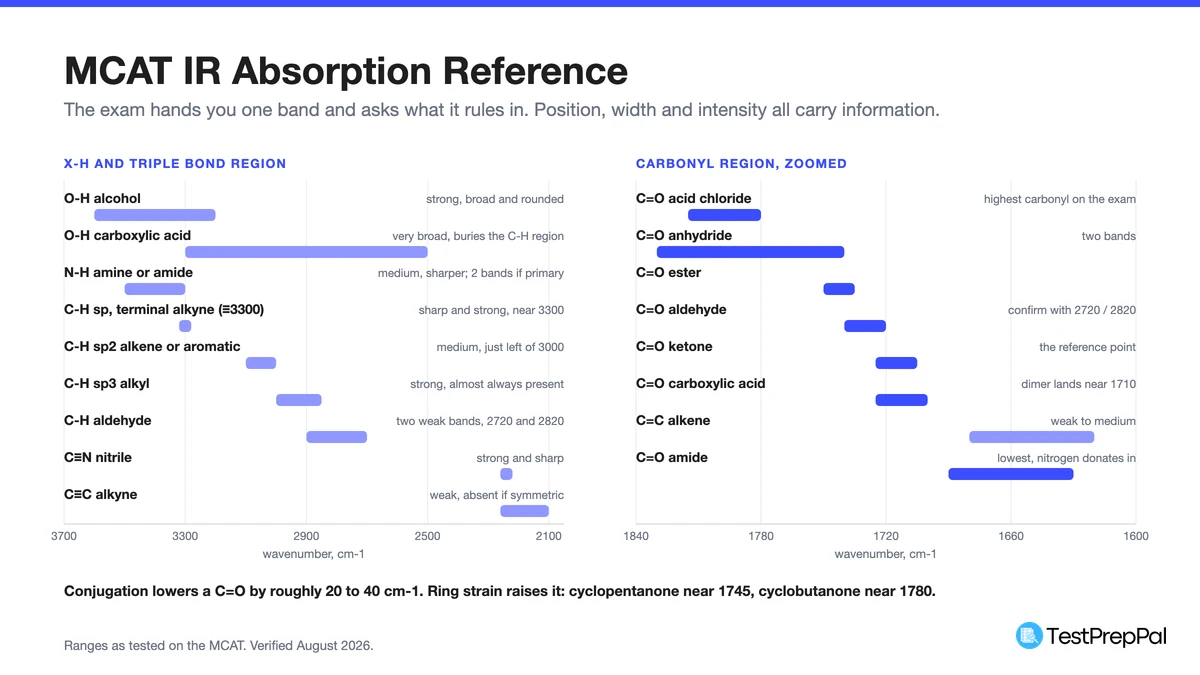 The carbonyl region is drawn on its own scale because the exam separates those bands by as little as 15 wavenumbers.
MCAT ¹H NMR Chemical Shift Reference
Chemical shift is set by shielding: electron density near a proton shields it and moves the signal upfield toward 0 ppm, while nearby electronegative atoms or π systems deshield it and move it downfield.
| Proton environment | δ (ppm) | Notes |
|---|---|---|
| Tetramethylsilane (TMS) | 0 | The internal reference standard |
| R–CH₃ | 0.8–1.0 | Most upfield of the ordinary alkyl signals |
| R–CH₂–R | 1.2–1.4 | |
| R₃C–H (methine) | 1.4–1.7 | |
| C=C–C–H (allylic) | 1.6–2.6 | Weakly deshielded by the adjacent π system |
| C≡C–H (alkyne) | 1.7–2.8 | Anomalously upfield for an sp C–H, due to ring-current shielding |
| O=C–C–H (α to a carbonyl) | 2.0–2.5 | The acetyl methyl of a ketone sits near 2.1 |
| Ar–C–H (benzylic) | 2.2–2.8 | |
| N–C–H (amine) | 2.2–2.9 | |
| R–NH₂ / R₂NH | 0.5–5.0 | Broad, variable, exchangeable with D₂O |
| R–CH₂–I | 3.1–3.3 | |
| R–CH₂–Br | 3.3–3.6 | |
| R–CH₂–Cl | 3.4–3.8 | Deshielding tracks halogen electronegativity |
| R–CH₂–O–R (ether, alcohol) | 3.3–4.0 | |
| R–CH₂–O–C=O (ester alkoxy) | 3.7–4.8 | Ethyl acetate's OCH₂ quartet sits at 4.12 |
| R–OH (alcohol) | 0.5–5.0 | Broad, concentration dependent, exchangeable |
| C=C–H (vinyl) | 4.6–6.0 | |
| Ar–OH (phenol) | 4.0–8.0 | Broad and highly variable, exchangeable |
| Ar–H (aromatic) | 6.5–8.0 | Strongly deshielded by the aromatic ring current |
| R–CONH–R (amide N–H) | 5.0–9.0 | Broad, exchangeable |
| R–CHO (aldehyde) | 9.0–10.0 | Unmistakable; nothing else appears there |
| R–COOH (carboxylic acid) | 10.0–13.0 | The most downfield common signal, broad and exchangeable |
Three rules turn a shift table into answers:
- Integration counts protons. The area under a signal is proportional to the number of hydrogens producing it, giving you a ratio, not an absolute count.
- Multiplicity counts neighbors. The n + 1 rule: a signal split into six lines has five protons on adjacent carbons. Forgetting the plus one is the most common NMR error on the exam.
- Exchangeable protons do not split their neighbors and vanish on a D₂O shake. O–H and N–H protons exchange too fast to couple, which is why a carboxylic acid proton appears as a broad singlet rather than a multiplet.
Worked Example: From a Formula, One IR Band, and a Splitting Pattern to a Structure
This is the shape an MCAT spectroscopy item takes: a molecular formula, one or two IR bands, a short NMR table, four candidate structures. Here is the order to attack it in.
The data. An unknown liquid has molecular formula C₄H₈O. Its IR shows a strong band at 1715 cm⁻¹, nothing between 3100 and 3600 cm⁻¹, and no bands between 2700 and 2900 cm⁻¹ beyond ordinary alkyl C–H. Its ¹H NMR shows δ 2.45 (2H, quartet), δ 2.13 (3H, singlet), δ 1.05 (3H, triplet).
Step 1. Count degrees of unsaturation. For C₄H₈O that is (2 × 4 + 2 − 8) / 2 = 1. Oxygen does not enter the formula. One degree means exactly one ring or one π bond and nothing more.
Step 2. Spend the degree using the IR. A strong band at 1715 cm⁻¹ is in the ketone window. A clean 3100–3600 region rules out an alcohol (3200–3600, broad), and the absence of a very broad 2500–3300 envelope rules out a carboxylic acid. No 2720/2820 pair rules out an aldehyde. So the single degree of unsaturation is a ketone carbonyl, not a ring and not an alkene.
Step 3. Check the integration closes. The 2:3:3 ratio sums to 8 protons, matching C₄H₈O exactly. Every hydrogen is accounted for, so there is no hidden exchangeable proton, which independently confirms there is no O–H.
Step 4. Read the splitting for connectivity. A 2H quartet needs three neighbors and a 3H triplet needs two, so those two are a CH₃CH₂ group coupled to each other. Place them by shift: the CH₂ at δ 2.45 sits in the 2.0–2.5 window for a proton α to a carbonyl, not at 3.3–4.0 where a CH₂ on oxygen would land. So the ethyl is bonded to the carbonyl carbon, not to an oxygen. The 3H singlet at δ 2.13 has no neighbors at all and sits in the same α window, so it is a methyl bonded straight to C=O.
Step 5. Assemble and verify. A carbonyl flanked by ethyl and methyl is CH₃COCH₂CH₃, butan-2-one. Four carbons, eight hydrogens, one oxygen. It closes.
Step 6. Kill the alternatives out loud.
| Candidate | Why the data exclude it |
|---|---|
| Butanal | Would show a 1H signal at δ 9.0–10.0 and the diagnostic 2720/2820 C–H doublet. Neither is present. |
| 2-Methylpropanal | Same aldehyde objections, and it would give a 6H doublet rather than a 3H singlet. |
| Tetrahydrofuran | Spends its one degree of unsaturation on a ring, leaving nothing to explain 1715 cm⁻¹. |
| But-3-en-1-ol | Needs a broad O–H near 3300 and vinyl protons at δ 4.6–6.0, and its exchangeable proton would break the 2:3:3 integration. |
No drawing, no arrow pushing. Degrees of unsaturation set the budget, IR spends it, integration confirms the formula, splitting supplies the connectivity. Run those four moves in that order and the timing takes care of itself.
What Spectroscopy Questions Actually Require
Worth being clear about the limits, because students overprepare this in one direction and underprepare it in another.
Every MCAT spectroscopy question is answerable from tabulated data and reasoning. You are never asked to draw a structure, propose a mechanism from a spectrum, or interpret ¹³C multiplicity, coupling constants, or a full fingerprint region. The passage hands you the bands and shifts it wants used.
What you do need is the ability to use a value as an exclusion. A very broad 2500–3300 absorption next to a band near 1710 does not merely suggest a carboxylic acid, it eliminates ketones, esters, and alcohols in one step. IR eliminates, NMR identifies, and the molecular formula keeps both honest. The tables above are ranges on purpose: real spectra shift with solvent, concentration, and hydrogen bonding, and the AAMC writes items so the answer sits comfortably inside a range. If you are deciding between two choices on a 5 cm⁻¹ difference, you have misread the question.
How to Drill This
Reading a reference sheet is not the same as recalling it under a 95-second clock. Once you can reproduce the carbonyl ordering and the handful of diagnostic IR bands from memory, put them under exam conditions with our free MCAT organic chemistry practice questions, which run 25 items in the AAMC interface with full worked solutions. The rest of that section is covered by our MCAT general chemistry practice questions and MCAT physics practice questions. For the wider picture, see how hard the MCAT is or our roundup of free MCAT resources.
Frequently Asked Questions
Which MCAT organic chemistry reactions do I actually need to know?
The ones in the sheet above and essentially nothing beyond them: SN1, SN2, E1, E2, alcohol oxidation and carbonyl reduction, Grignard addition, imine and enamine formation, acetal protection, keto-enol tautomerization, aldol addition and condensation, decarboxylation, and the acyl substitutions. The list is short because the AAMC specifies first-semester organic chemistry only.
What are the reactions to know if I only have a few days?
Triage to the carbonyl. Nucleophilic addition and nucleophilic acyl substitution, plus the reactivity ordering that governs both, account for more MCAT organic questions than any other topic, and they carry straight into biochemistry through aldolase, transamination, and thioester chemistry. Spectroscopy comes second because it pays back study time faster than anything else. Substitution and elimination come third.
Do I need to memorize IR wavenumbers exactly?
No. Learn a few anchors and two rules. Anchors: alcohol O–H broad at 3200–3600, carboxylic acid O–H very broad at 2500–3300, ketone C=O near 1715, ester near 1740, amide near 1650. Rules: conjugation lowers a C=O by roughly 20–40 cm⁻¹, ring strain raises it. You can reason to the rest.
Is second-semester organic chemistry tested?
No. Aromatic substitution mechanisms, pericyclic reactions, named multi-step syntheses, and retrosynthetic analysis fall outside the AAMC content outlines. If your course covered them, set them aside for this exam.
Do I have to draw or identify structures?
The exam does show structures, but much of the reasoning is verbal: comparing pKa values, choosing a mechanism family, ranking CIP priorities, reading tabulated spectra. You are never asked to produce a drawing.
MCAT Reference Sheets
The rest of the high-yield memorization set:
MCAT amino acid chart · MCAT equation sheet · MCAT hormone chart
Then test what stuck with our free MCAT practice questions — 25 questions per subject in the AAMC test interface, with full worked solutions.
We may earn commissions from some links on this page, but this does not affect our reviews or your experience.