


Leah4Sci MCAT Review
by Leah4Sci
Master MCAT math with calculator-free shortcuts
✓Pros
- ✓Math and calculations focus
- ✓Calculator-free shortcuts
- ✓300+ tutorial videos
- ✓General chemistry emphasis
- ✓68.8K subscribers
- ✓Practice materials available
✗Cons
- ✗Limited to math-heavy topics
- ✗Not comprehensive for all MCAT sections
Highlights
- ✓300+ tutorial videos
- ✓MCAT math equations and calculations
- ✓General chemistry and physics
- ✓Calculator-free problem solving
- ✓Equation balancing strategies
Price
✓Free
What Students Are Saying
Sign in to leave a review

Expert Rating
Leah4Sci MCAT is worth a weekend if you lose MCAT points to arithmetic rather than to science, because its free nine part math series is the clearest treatment of calculator-free calculation on the internet. It is not worth planning your prep around, because that series teaches three of the seven mathematical requirement groups the AAMC publishes in full, and the channel has posted two videos in the past year.
The channel is run by Leah Fisch at the handle @Leah4sciMCAT, and it has 68,800 subscribers and 317 videos as of September 2026. Fisch describes herself as a former pre-med student, EMT and US Navy combat veteran who has tutored science online for nearly a decade. The videos are free, and the written material sits on leah4sci.com.
Summary Table
| Feature | Leah4Sci MCAT |
|---|---|
| Price | Free |
| Paid options | Private tutoring from $249 an hour, MCAT Study Hall membership |
| Format | On-demand video on YouTube, plus written guides and cheat sheets |
| Library size | 317 videos |
| Flagship series | MCAT Math Without A Calculator, nine parts, with a worksheet |
| Science covered | General chemistry, organic chemistry, biochemistry, physics, biology guides |
| Psych/Soc content | None |
| CARS content | Timing and reading strategy only, no passage practice |
| Practice questions | Worksheets and quizzes on the site, no question bank |
| Full length exams | None |
| Newest 30 uploads | 3 posted within the last two years |
| Access | Unlimited, no account needed to watch |
| Guarantee | None |
| Subscribers | 68.8K |
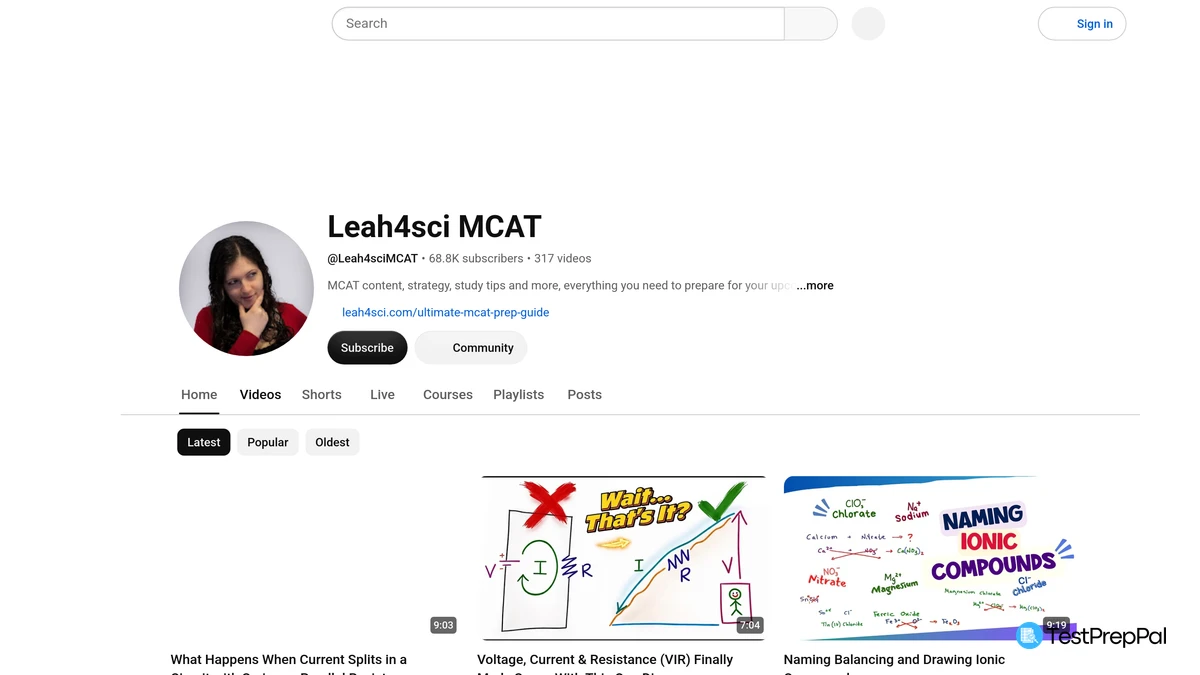 The Leah4sci MCAT channel on youtube.com, captured September 2026.
Leah4Sci MCAT Overview
Leah4Sci MCAT is one person teaching the parts of the MCAT that are mechanical rather than memorised. Fisch works through a calculation on a digital whiteboard, says out loud which step she is skipping and why, and ends with a number you could have reached in ten seconds. The channel describes itself as "MCAT content, strategy, study tips and more".
It is the second of two channels. The main Leah4sci channel is organic chemistry and has its own 300 plus videos, so a search for the name will land you on whichever one Google picks. The MCAT channel is the one reviewed here.
What the free material contains:
- MCAT Math Without A Calculator, nine video parts with a downloadable worksheet
- General chemistry: stoichiometry, quantum numbers, molecular geometry, acid base and pH
- Physics: translational motion and kinematics, forces, electrochemical cells, friction
- Biochemistry: amino acids, Fischer projections, hemoglobin and oxygen dissociation
- Biology cheat sheets: Punnett squares, mitosis and meiosis, glycolysis
- CARS strategy: passage timing and the newspaper reading method
- Study planning: a three month plan, a daily and weekly schedule, prerequisite advice
What it does not contain: psychology, sociology, CARS passages to practise on, a question bank, full length exams, or progress tracking. No account is needed and nothing free is gated.
The paid products are separate. Private tutoring runs at $249 an hour on weekdays, priced on the page linked under Pricing below, and there is a membership called MCAT Study Hall. Neither is required to use anything described above.
Leah4Sci MCAT Review For 2026
The math series against what the AAMC actually asks for
The AAMC publishes a list of the mathematical concepts and techniques its questions can require. It has seven groups, and it ends by noting that calculus is not required and a periodic table is provided. That list is the fair test of a resource that sells itself on MCAT math, and nobody appears to have run it.
Here is the result. The nine part series covers significant digits and estimation, metric conversion and dimensional analysis, and trigonometry in full. It covers two more in part: the arithmetic group, where fractions, ratios, percentages, proportions and square roots each get a lesson but probability gets none, and the algebra group, where scientific notation, exponents and logarithms are taught thoroughly but simultaneous equations are not taught at all. Two groups have no lesson anywhere in the series: reading linear, semilog and log-log scales and taking slopes off a graph, and vector addition and subtraction with the right-hand rule.
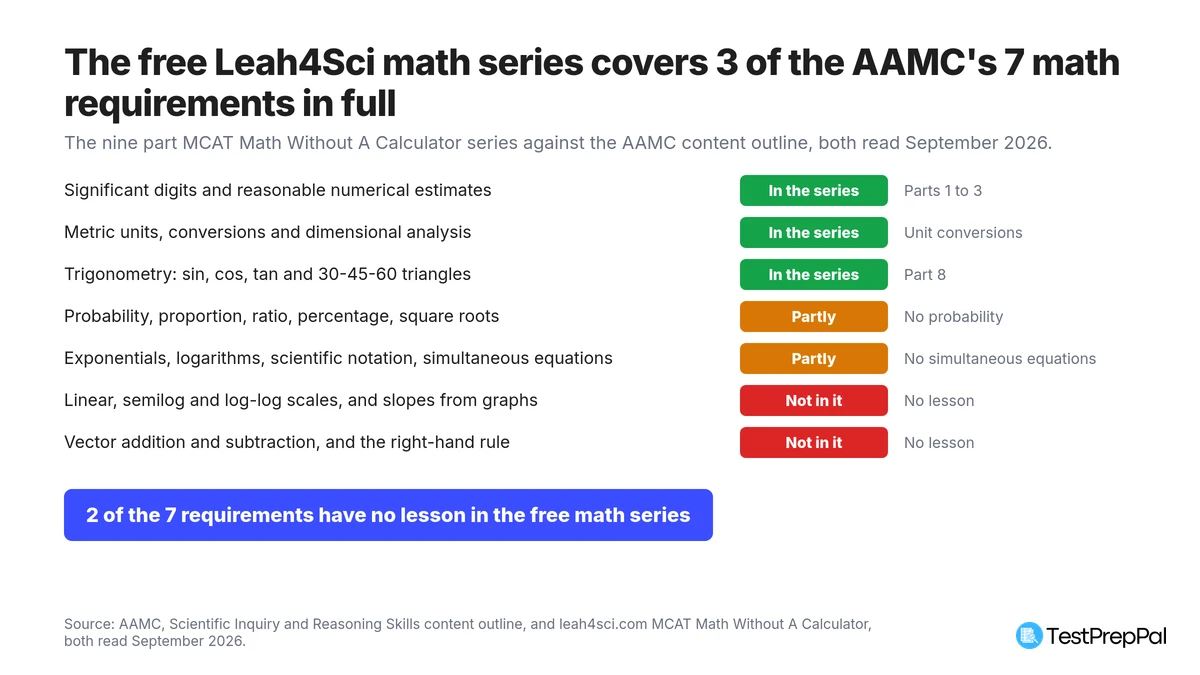 The AAMC mathematical requirements against the free Leah4Sci math series, both read September 2026.
Those two gaps are not small. Graph reading is where the exam hides its data questions, and vectors are the backbone of the physics in a section the AAMC weights at 25 percent introductory physics across 59 questions in 95 minutes. Leah4Sci teaches vectors inside its physics videos on motion and forces rather than in the math series, so the material is partly there, just not where a student following the math sequence would find it. Slopes and log scales you will need to get somewhere else.
What the series does teach, it teaches better than paid courses do. The method is stated up front: round, estimate, and stop when the answer choices are far enough apart, because "on the MCAT, close enough is good enough". Part 9 rewrites every log problem as an exponent problem, which turns pH questions into arithmetic. If you have been grinding out exact values on scratch paper, this is the fix, and our MCAT equation sheet is the natural companion for the formulas themselves. The series also has a printed reference card, and our Leah4Sci MCAT math cheat sheet review lists what is on both of its pages, including how far each rounded value sits from the exact one.
The library has largely stopped growing
This is the finding that changes how you should use the channel. Of the 30 most recent uploads, two are six months old, one is a year old, and the remaining 27 are two to six years old. Three videos in two years is not an active channel, whatever the community posts tab suggests.
The two newest videos, on current in series and parallel circuits and on the voltage-current-resistance relationship, have 873 and 1,300 views. The strongest videos in the same 30 are all two years old: the Fischer to Haworth shortcut at 299,000 views, How to Draw Fischer Projections at 186,000, and Memorize and Draw the 20 Amino Acids at 168,000. The featured video on the channel home page, on amino acid stereochemistry, has 350,710 views.
The site tells the same story in a different way. The MCAT hub still answers "when to test?" by linking a 2025 test dates page, and the physics section lists two series followed by "and more to come". None of this makes the existing videos wrong. Arithmetic, logarithms and Fischer projections do not expire. It does mean nothing here has been checked against how the exam looks now, so take the calculations and take your exam format and strategy from the AAMC directly.
Teaching style, and what is missing around it
Fisch teaches by working the problem rather than by narrating the rule. Videos run 5 to 20 minutes, the handwriting is legible, and each math part ends with a numbered section of a downloadable worksheet, so the sequence has actual practice attached. That is more than most free video offers.
The limit is that practice stops at the worksheet. There are quizzes on a few topics and no passages anywhere, and the MCAT tests calculation inside passages under time pressure, not in isolation. Learning the log shortcut on a clean worksheet and meeting it inside a 95 minute section are different skills. Pair the videos with passage-based questions from a question bank as soon as the arithmetic feels automatic, and use our free MCAT physics practice questions to find out whether it has actually stuck.
Pricing
Every video on the channel is free, with no account, no trial and no upsell gate, and the worksheets and cheat sheets on leah4sci.com are free downloads. For the thing most students come for, the math series, the price is zero and there is nothing to compare.
Two paid products sit behind it:
| Product | Price | Billing |
|---|---|---|
| Private tutoring, weekdays 9am to 5pm ET | $249 | Per hour |
| Private tutoring, limited nights and weekends | $279 | Per hour |
| MCAT Study Hall | No price shown on the pages that mention it | Membership |
Tutoring prices were read on the Leah4Sci MCAT tutoring page on September 26, 2026. Neither that page nor the MCAT hub gives a price for the Study Hall membership, so you have to go through its signup page to see one.
At $249 an hour, the tutoring is priced near the top of the MCAT market, and it buys the same person who made the free videos. That is a defensible reason to pay it if calculation is your specific failure and one session would fix it. It is a poor way to buy general MCAT help, where Blueprint MCAT tutoring gives you a course and a question bank alongside the hours.
Who Leah4Sci MCAT Is Best For
Leah4Sci MCAT is for the student whose practice review keeps reading "knew the concept, botched the math". If you are reaching for the calculator you will not have, or losing 30 seconds per quantitative item, the nine part series will pay for itself in a weekend.
It suits self-studiers who like written practice attached to video, and it is a strong free companion to a paid course that skims arithmetic. It is also genuinely good on amino acids, Fischer projections and electrochemistry, which is why those videos have six figure view counts. Students working through our MCAT amino acid chart will find the drawing videos a useful second pass.
It is a poor fit if you want a study plan, if your weak sections are Psych/Soc or CARS, or if you need current information about the exam itself. It is also the wrong tool if your problem is application rather than calculation.
When You Might Look Elsewhere
If you need coverage rather than a niche, Khan Academy MCAT is the free library that spans the most of the exam, including the psychology and sociology Leah4Sci does not touch. If you want deeper science explanation, AK Lectures goes further into mechanism, though it shares the Psych/Soc gap. For free mnemonics rather than method, MedSchoolCoach has 42 short MCAT videos, though it has no CARS content and has not touched its MCAT playlists in four years.
If the real problem is CARS, no video channel will fix it. Structured passage work such as Jack Westin CARS practice is the tool for that. And if you want the timetable that decides when video review is worth the hour, our MCAT study schedule guide sets the ratio. The rest of the free options are compared on our MCAT YouTube channels list, and the way we score every resource is set out in our review methodology.
Final Verdict
Leah4Sci MCAT earns 4.0 out of 5. The math series is a genuinely excellent free resource that solves a problem the AAMC creates and most courses treat as an afterthought, and the biochemistry and electrochemistry videos are strong on their own terms. The score is held down by scope and by age: two of the AAMC's seven math requirement groups have no lesson, there is no Psych/Soc and no CARS practice, and the channel has posted two videos in the past year.
Watch the nine part math series, do the worksheet, then leave. That sequence is worth a weekend of anyone's prep. Everything else on this channel is a bonus, and nothing on it should decide your study plan.
Leah4Sci MCAT FAQs
Is Leah4Sci free?
Yes. All 317 videos on the Leah4sci MCAT channel are free to watch with no account, and the worksheets and cheat sheets on leah4sci.com are free downloads. Leah Fisch also sells private tutoring, which starts at $249 an hour on weekdays, and a membership called MCAT Study Hall, but neither is needed to use the free material.
Does Leah4Sci cover all the MCAT math?
Not all of it. Against the AAMC's list of seven mathematical requirement groups, the nine part series covers estimation, unit conversion and trigonometry in full, and teaches scientific notation, exponents, logarithms, fractions, ratios, percentages and square roots. It has no lesson on reading slopes from linear, semilog or log-log graphs, and none on vector addition or the right-hand rule, though vectors appear in the separate physics videos.
Is Leah4Sci still making videos?
Barely. Of the 30 newest uploads on the MCAT channel, only three were posted in the past two years and only two in the past year. The channel is still active in its community posts, but the video library is effectively an archive. That matters for exam format and strategy, which change, and matters very little for arithmetic and biochemistry, which do not.
Is Leah4Sci enough to study for the MCAT on its own?
No. There are no full length exams, no question bank and no passage practice, and the channel has no psychology or sociology content at all, so an entire section of the exam goes uncovered. Treat it as the resource that fixes your calculation speed, and pair it with a question bank and official AAMC practice material.
Is Leah4Sci better than Khan Academy for the MCAT?
They solve different problems. Khan Academy covers far more of the exam, including Psych/Soc, so it is the better general free library. Leah4Sci is better at one thing: working MCAT calculations without a calculator, with a worksheet attached. Most students who use both use Khan Academy for content and Leah4Sci for the math.
We may earn commissions from some links on this page, but this does not affect our reviews or your experience.
Our Verdict
Leah4Sci MCAT is the best free explanation of no-calculator MCAT arithmetic anywhere, and the nine part math series is the reason to go. It is also narrow and mostly finished: it teaches three of the AAMC's seven mathematical requirement groups in full, and only three of the channel's newest 30 uploads are under two years old. Use it to fix your calculations, not to build a study plan.