


Yes, UWorld is harder than the real MCAT, but the blanket answer hides the part that actually matters: the difficulty gap is not the same in every section, and it depends entirely on which AAMC material you're comparing it to. UWorld's science sections run meaningfully harder than an AAMC full-length. Its Psych/Soc is roughly even or easier. Its CARS isn't harder so much as different, which is why so many students score well on one and badly on the other.
Most answers to this question stop at "yes, it's harder, don't panic." That's true and useless. Below is the section-by-section breakdown, what students report their UWorld percentage actually converted to on test day, and the one comparison mistake that makes UWorld look scarier than it is.
- UWorld is harder than an AAMC full-length, but roughly on par with the AAMC Section Bank. Most "UWorld is brutal" posts are comparing it to the wrong AAMC product.
- C/P and B/B are where the gap is real. Students consistently describe UWorld's chem/phys as more calculation-heavy and its bio/biochem as the single hardest thing in the QBank.
- Psych/Soc is the exception. Students repeatedly report UWorld P/S as equal to or easier than the AAMC Section Bank.
- CARS is a different test, not a harder one. Opinion splits almost evenly, and most students say Jack Westin or AAMC itself is more representative.
- Your UWorld percentage does not convert to a score. In self-reported pairs, students at ~60% scored 522 and 523 while a student at 71% scored 514.
- A 50–60% average mid-prep is normal and is not a signal that you're off track.
Is UWorld harder than the MCAT?
On balance, yes. The clearest single data point comes from a student who tracked both at once and reported 69% on UWorld against 80% on the AAMC Section Bank in the same stretch of prep. That roughly 10-point gap matches what students report over and over: same person, same week, double-digit spread.
But "harder" is doing a lot of work in that sentence. UWorld is harder in a specific, deliberate way. It is a teaching bank, so it asks about nearly everything in the content outline, including material the real exam is unlikely to test. As one r/MCAT commenter put it, UWorld's "purpose is to give you questions over virtually everything, so it has more low yield topics than the actual test."
That design choice produces three specific effects, and only the first one is really about difficulty:
- More detail per question. Students describe needing to "know much more detail than the test does."
- Denser passages. A recurring complaint is that UWorld science passages are "more convoluted and denser than the AAMC passages" with more questions attached to each one.
- Different question logic. UWorld tends to test content directly. AAMC buries the answer in the passage and tests whether you can find it.
The third one isn't difficulty at all. It's a style difference, and it's the reason a meaningful minority of students find AAMC material harder, not easier.
The mistake: harder than which AAMC material?
Almost every "is UWorld harder" thread collapses several very different AAMC products into one word. They are not equivalent, and the answer flips depending on which one you mean.
According to the AAMC's official practice product listings, official prep splits into distinct tiers:
| AAMC product | What it is | Questions |
|---|---|---|
| Practice Exams 1–6 | Full-lengths built from previously administered exam questions, with scaled score and percentile rank | 230 each |
| Unscored Sample Test | Same look and length as the real exam, no scaled score | 230 |
| Section Bank Vol. 1 and 2 | Science-only question banks, widely considered the hardest official material | 300 each |
| Question Packs | Subject-specific sets (biology, chemistry, physics) | 120 each |
| Independent Question Bank | Standalone questions, no passages | 150 |
The Section Bank contains 300 questions split evenly across the three science sections, and AAMC explicitly notes it "does NOT include practice questions from the Critical Analysis and Reasoning Skills (CARS) section."
That single detail resolves most of the confusion. When students say UWorld is "in line with the section banks," they're describing the science sections only, because the Section Bank has no CARS in it. And when students say UWorld is much harder than AAMC, they're usually comparing it to a full-length practice exam, which is calibrated to the real thing rather than to the hardest end of it.
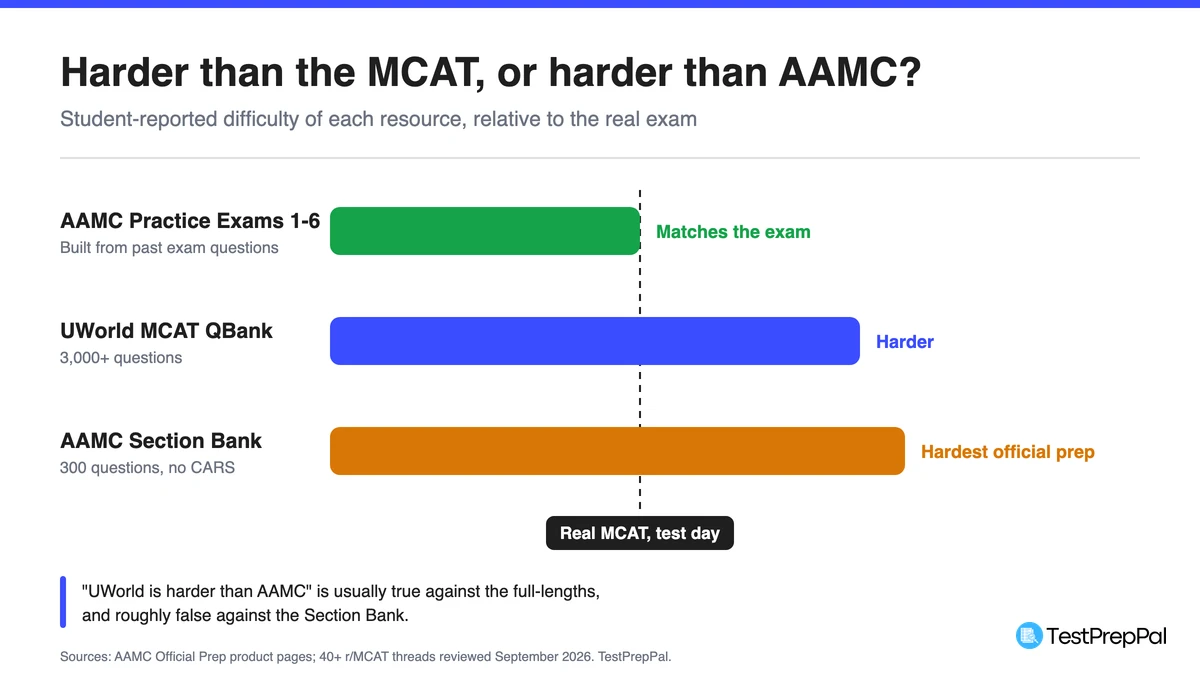 Where each resource sits relative to the real exam, based on student-reported experience across r/MCAT threads reviewed September 2026.
If you're comparing UWorld to an AAMC full-length, expect UWorld to feel harder. If you're comparing it to the Section Bank, expect them to feel similar. Both reactions are correct, and students arguing about it are usually just comparing different things.
UWorld difficulty by section
We pulled the r/MCAT and r/MCATprep threads Google surfaces for this question (40+ threads, reviewed September 2026) and sorted what students said by section. The consensus is clearly not uniform.
| Section | Student consensus | How strong |
|---|---|---|
| Bio/Biochem (B/B) | Harder on UWorld | Strong agreement |
| Chem/Phys (C/P) | Harder on UWorld, mostly on math volume | Strong agreement |
| Psych/Soc (P/S) | About the same, often easier than AAMC | Moderate agreement |
| CARS | Different, not clearly harder | Genuinely split |
Bio/Biochem is the hardest part of the QBank
This one draws the least disagreement. One thread is titled simply "UWorld Bio/Bio is SO MUCH HARDER than every other section," and the pattern in the replies is consistent: the questions go deeper into mechanism detail than the exam does.
Chem/Phys is harder because of arithmetic, not concepts
The specific complaint here is unusually consistent. Students describe UWorld C/P as "endless calculations, while AAMC seems way more conceptual and lighter on the math," and one commenter noted "uworld physics is much harder than aamc/actual mcat. this is why uworld percentages don't correlate exactly with your mcat percentages."
That distinction matters for how you respond. If you're missing UWorld C/P questions on setup and reasoning, that's a real content gap. If you're missing them because you ran out of time doing multi-step arithmetic, that gap may not exist on test day.
Psych/Soc is the exception
This is where the "UWorld is harder" rule breaks down. Students describe UWorld P/S as "about the same difficulty" and "a lot more straightforward than some of the hardest AAMC problems," and one thread reports scoring 82% on the P/S Section Bank while finding it harder than UWorld. The opposing view exists, but it's the minority position.
CARS is contested, and that's the real finding
Opinion here splits close to evenly, which is itself the useful answer. One student reported averaging "95-100% on every UWorld cars passage but around 75-85% on AAMC passages." Another thread asks why "UWorld CARS passages feel longer, harder, and just overall more disrespectful." A third states flatly that "no one writes cars like the AAMC."
All three can be true because UWorld CARS uses different reasoning patterns rather than harder ones. The practical takeaway most students land on: use UWorld CARS for volume and stamina, but calibrate against AAMC CARS, because the real exam is written by AAMC.
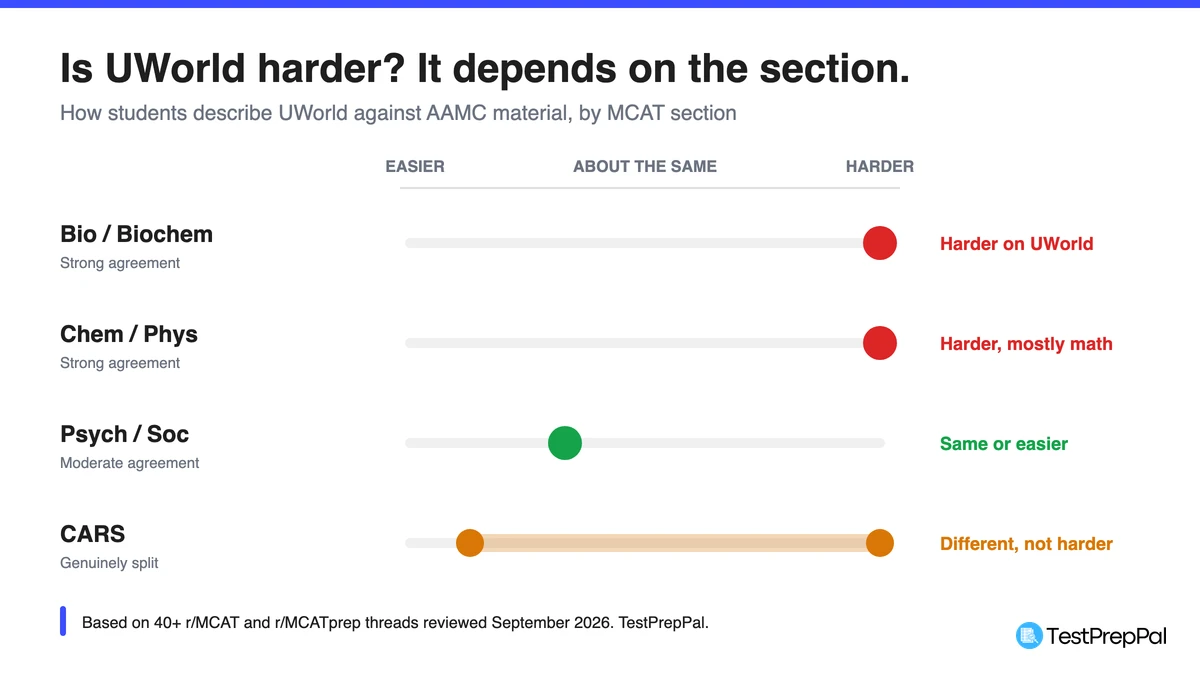 Student-reported difficulty of UWorld relative to AAMC material, by section. Based on 40+ r/MCAT and r/MCATprep threads reviewed September 2026.
What UWorld itself says
Worth noting, because it conflicts with the student consensus. UWorld's official MCAT QBank page describes its 3,000+ questions as built to "mirror the exam's logic, difficulty, and style, so test day feels like another UWorld practice session."
Students overwhelmingly do not report that experience. The company positions the bank as calibrated to the exam; test-takers describe it as harder. Neither side is lying. UWorld is calibrated to the hardest questions the exam can throw, which is a defensible way to build a teaching tool and a bad way to predict a score.
What your UWorld percentage actually means
Nothing precise, and the self-reported data is the best evidence of that. Here are score pairs students posted across several r/MCAT threads:
| Reported UWorld % | Reported MCAT score |
|---|---|
| ~60% | 523 |
| ~60% | 522 |
| 71% | 514 |
| 72% (37% of bank completed) | 515+ |
| 73% (23% completed) | 515+ |
| 74% (34% completed) | 524–528 |
| 80% (60% completed) | 525 |
| 80% (80% completed) | 524–528 |
| 87% | 524+ |
Look at the top three rows. Two students at roughly 60% scored 522 and 523, while a student at 71% scored 514. The relationship isn't even consistently ordered, let alone convertible. That happens because the percentage depends on how much of the bank you've done, whether you used tutor mode, whether you did the questions timed, and which sections you'd finished.
The rules of thumb students actually use are much looser, and more honest:
- Below 40%: worth worrying about
- 50–60% mid-prep: completely normal, described by one commenter as expected because "UWorld is a teaching tool and it's deliberately harder than the real exam"
- Above 80%: a good sign, though still not a predicted score
For an actual score estimate, use AAMC full-lengths. They're built from previously administered exam questions and return a scaled score and percentile rank, which is exactly what UWorld percentages cannot give you. Our guide to how many MCAT practice tests to take covers how to space them.
How to use UWorld knowing it's harder
The difficulty is a feature if you adjust how you read the output.
- Stop treating the percentage as a score. Track whether it's trending up, not where it sits.
- Do it timed and untutored once your content is solid. Tutor mode teaches well but inflates your percentage, which is a large part of why these numbers vary so wildly between students.
- Sort your misses into content gaps versus timing failures. UWorld's extra arithmetic in C/P creates timing failures that won't repeat on the real exam.
- Save AAMC full-lengths for calibration. Burn UWorld for learning, then use official material to find out where you actually stand.
- Don't over-index on low-yield misses. If a question tested something obscure, note it and move on rather than building an Anki card for it.
If you're still deciding whether the QBank is worth it at all, our UWorld MCAT question bank review breaks down pricing and what each tier includes, and our MCAT prep course roundup compares it against the full-course options.
Related offer:
UWorld MCAT Comprehensive Prep Course
Exclusive TestPrepPal code: $50 off the 180-day ($1,449) or 360-day ($1,549) Comprehensive Prep Course.
IMP4PREPPAL50180/360-day Comprehensive only
Pros
- Answer explanations are the most detailed and illustrated in MCAT prep.
- Includes the AAMC Online-Only Bundle and its 7 practice exams ($336.15 bought direct).
- 1,300+ video lessons and 8 print + digital books in the same platform.
Cons
- No live classes or tutoring at any tier; the course is fully self-paced.
Common mistakes
- Panicking at 55% two weeks in. That's the expected range while you're still filling content gaps.
- Comparing UWorld to the Section Bank and concluding you're doomed. Those are the two hardest resources available. Neither predicts your score.
- Using UWorld CARS as your calibration tool. Use it for reps, calibrate on AAMC.
- Doing everything in tutor mode, then wondering why your full-length score doesn't match. Tutor mode and untimed practice both inflate the number.
- Skipping UWorld because it's demoralizing. The difficulty is where the learning is. Just read the score differently.
Frequently asked questions
Is 60% on UWorld good for the MCAT?
It's normal, particularly mid-prep. Students who reported roughly 60% averages have gone on to score in the 520s, and others at 71% scored 514. Treat 60% as unremarkable rather than as good or bad, and look at your AAMC full-length scores for an actual read.
Is UWorld harder than the AAMC section bank?
Roughly equivalent for the science sections, according to student consensus. The Section Bank is widely considered the hardest official AAMC material, and it contains no CARS questions at all, so the comparison only applies to C/P, B/B, and P/S.
Which UWorld section is hardest?
Bio/Biochem draws the most complaints, with Chem/Phys close behind. The C/P difficulty is largely about calculation volume rather than concept difficulty.
Does UWorld predict my MCAT score?
No. There is no conversion between UWorld percentage and a scaled MCAT score, and the self-reported pairs students post are not consistently ordered. AAMC full-length practice exams return a scaled score and percentile rank, which is what you should use to estimate.
Should I do UWorld before or after AAMC material?
Most students recommend UWorld first, then AAMC. UWorld exposes content gaps efficiently, and finishing it before you start official material means your AAMC full-lengths stay useful as calibration instead of being spent as practice.
The bottom line
UWorld is harder than the MCAT in the sciences, about even in Psych/Soc, and simply different in CARS. If your percentage is in the 50s or 60s and climbing, you're where most students are. Take an AAMC full-length when you want to know your actual score, and let UWorld do the job it's built for, which is finding the things you don't know yet.
We may earn commissions from some links on this page, but this does not affect our reviews or your experience.