


A tip is only worth following if it changes the one number the NCLEX tracks, which is the computer's running estimate of your ability. That estimate ends your exam under one of three published rules, and the only rule that can fail you on the clock does it at a specific pace: answer fewer than 85 items before the five hours expire and you fail automatically, which puts your floor at 3 minutes 32 seconds per item.
Most tip lists for this exam never mention those rules. This page works backwards from them, so every suggestion below either moves the estimate, protects the clock, or gets cut.
- The computer re-estimates your ability after every answer and picks a next item you have roughly a 50 percent chance of getting right. Every item is supposed to feel hard.
- Three rules can end the exam: 95 percent confidence, the 150-item maximum, and running out of time.
- Answer fewer than 85 items before the five hours expire and it is an automatic fail, whatever those answers were.
- Your floor pace is 3 minutes 32 seconds per item. The 2025 average was 1 minute 18 seconds, and 86.7 percent of those candidates passed.
- Your item count tells you nothing: 59.1 percent of 2025 first-time candidates stopped at 85, passes and fails together.
- Any advice built on a 75 to 145 item exam is describing a test the current test plan no longer defines.
The three rules that end your exam
Every time you answer, the computer re-estimates your ability from all your previous answers and the difficulty of those items, then picks the next item that will tell it the most. The exam stops when one of three rules fires.
| Rule | What ends the exam | What it means for you |
|---|---|---|
| 95 percent confidence interval | The computer is 95 percent certain your ability is clearly above or clearly below the passing standard | It can fire at any item from 85 onward, in either direction |
| Maximum-length exam | You reach item 150 | The confidence rule is set aside and only your final estimate, built from every answer, decides |
| Run out of time | The five hours expire first | Under 85 items answered is an automatic fail. At 85 or more, the estimate so far decides |
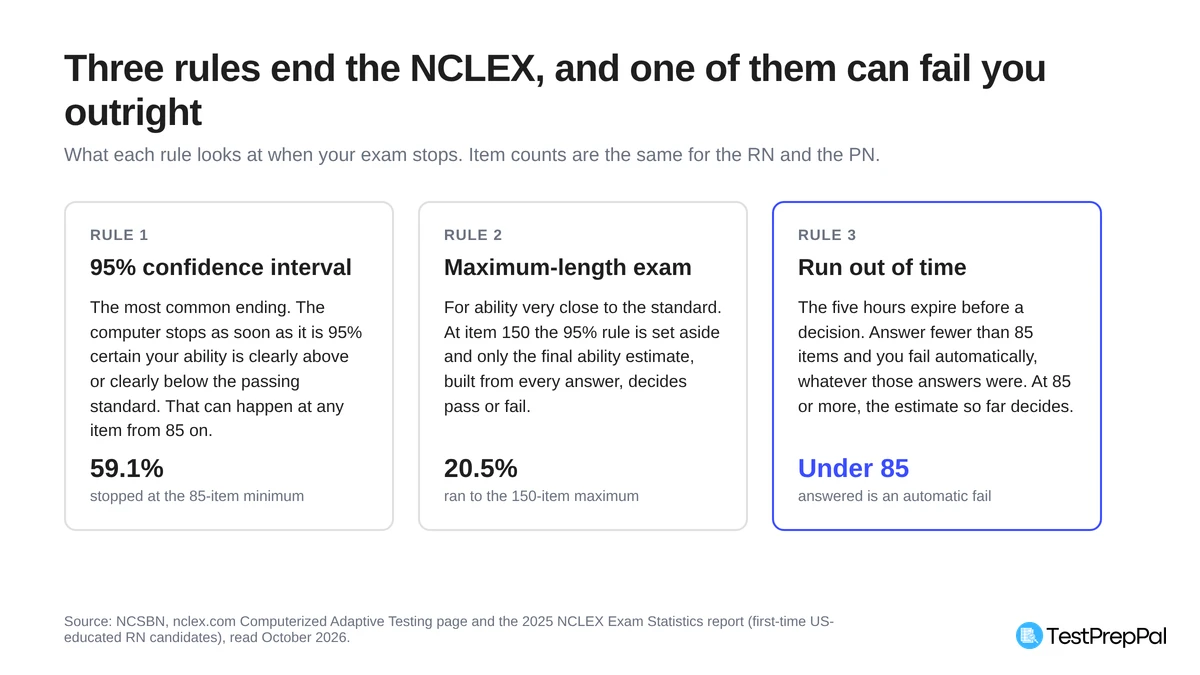 The three published pass and fail rules, with how often each ending happened in 2025. Source: NCSBN, nclex.com and the 2025 NCLEX Exam Statistics report.
The percentages come from NCSBN's 2025 exam statistics for first-time, US-educated RN candidates: 59.1 percent finished at the 85-item minimum and 20.5 percent ran all the way to 150. Both groups contain passes and fails.
Notice what is missing from that list. There is no rule about how fast the items get, no rule about how many select-all items you see, and no rule that rewards finishing early. The only thing any of your behaviour can touch is the estimate and the clock.
Your floor pace is 3 minutes 32 seconds, not one minute
The 2026 RN test plan gives every candidate a minimum of 85 items, a maximum of 150, and five hours. The PN exam uses the same three numbers. Those five hours are the whole appointment: NCSBN counts the introductory screen and every break, scheduled or not, against the same clock.
Divide the clock by the two item counts and you get the only two paces that exist on this exam.
- 300 minutes divided by 85 items is 3 minutes 32 seconds. Average slower than that and you risk hitting the time-out rule before item 85, which fails you outright.
- 300 minutes divided by 150 items is 2 minutes flat. That is the pace you need only if your exam runs the full distance.
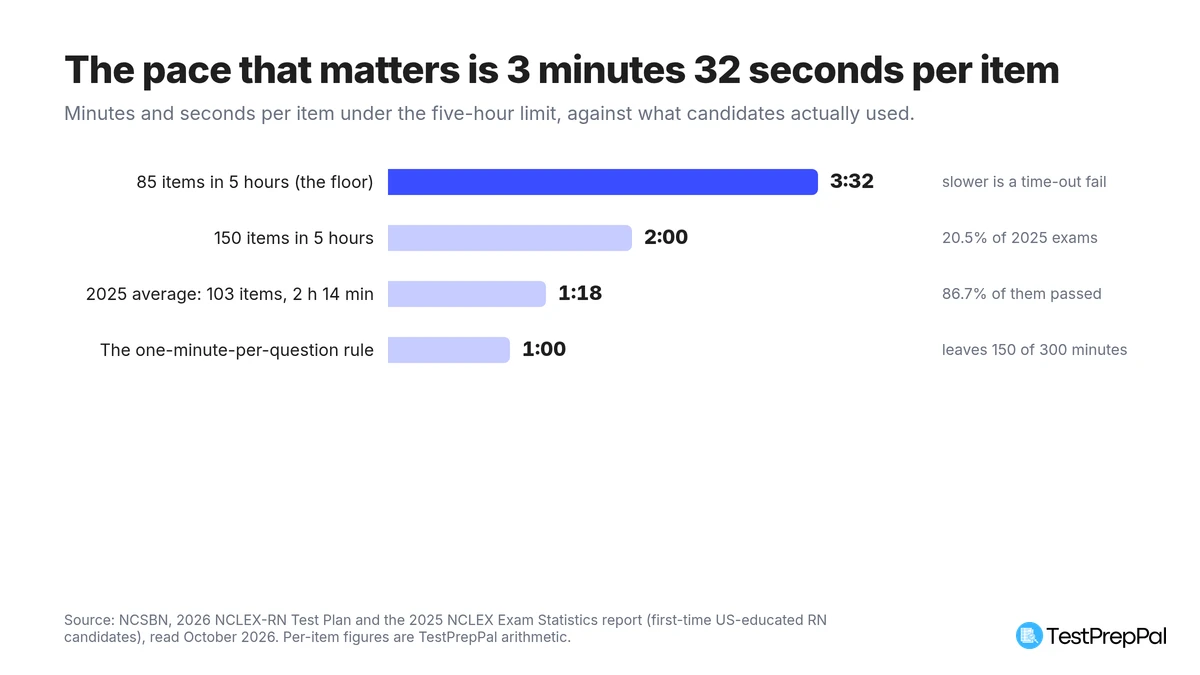 What the five-hour limit allows per item, against what candidates used. Source: NCSBN 2026 test plan and 2025 exam statistics, with TestPrepPal arithmetic.
Now compare that with what candidates really do. The average 2025 first-time RN candidate answered 103 items in 2 hours 14 minutes, which is 1 minute 18 seconds per item, and 86.7 percent of that group passed. The floor pace is about 2.7 times slower than the pace that produced those results. Only 0.5 percent of those candidates used the maximum amount of time, so for roughly 199 in 200 people the clock never became the binding constraint at all.
This matters because the most repeated pacing tip in nursing-school advice is wrong in the costly direction. The American Nurses Association tells candidates "Don't spend more than one minute on any question". Run a 150-item exam at that rate and you finish in 150 minutes, having left half of your five hours on the table. It is also faster than what the average passing candidate actually used. A rule that pushes you to rush on an exam where rushing lowers your estimate and saves you nothing is not a neutral piece of advice.
If you want one number in your head on test day, make it 3 minutes 32 seconds, and treat it as a floor rather than a target. At item 40 you should have used less than 2 hours 21 minutes. That is the only pacing check that maps onto a rule that can actually fail you.
Four tips the stopping rules support
Commit to your answer and move on
Once you submit a response you cannot return to that question. There is no review screen, no flagging, and no second pass at the end. Whatever a long deliberation buys you on one item, it buys once, and the cost comes out of a clock with an automatic-fail floor.
So decide, commit, and let the item go. Agonising over the item you just submitted is the single most expensive habit on this exam, because it spends the one resource you can run out of on the one thing you can no longer change.
Expect every item to feel hard, and read nothing into it
NCSBN states plainly that candidates should find each item challenging, because the computer targets each one to your current estimate. In practice that means roughly a 50 percent chance of a correct answer on every item you see, by design.
Two things follow. First, difficulty is not feedback, so "that felt brutal" and "that felt easy" are both noise. Second, NCSBN says candidates cannot reliably tell which items are easy or hard in the first place, so even your read on the difficulty is unreliable. Our guide to how the Next Generation NCLEX scores each item type covers the partial-credit methods, which is the one place where your impression of an item actually maps onto something real.
Answer item 140 as carefully as item 14
If your exam reaches the maximum, the confidence rule is discarded and your result comes from the final ability estimate built on every response you gave. There is no late-exam discount. A long exam is not a bad sign either, just a sign your ability sits close to the standard, which is exactly the situation where the last few items carry the most weight.
This is also why the stamina part of preparation is not filler. Working long question sets in one sitting is the only way to find out what your accuracy looks like at item 130. A good NCLEX question bank will let you run blocks at that length rather than in batches of 20.
Stop counting questions
Counting costs attention and returns nothing. NCSBN's own FAQ says the number of items alone does not determine or reveal whether you passed, and the 2025 data shows why: the most common single outcome is an exam that stops at 85, and that group contains both results.
If the screen going dark at 85 is the thing you dread, read how to know if you passed the NCLEX before test day rather than after it, and get the anxiety out of the way while it cannot cost you items.
Three tips the rules do not support, and one that costs you
"The questions got harder, so I must be doing well." The algorithm aims every item at roughly a coin flip for you, so difficulty tracks your estimate rather than your performance. A candidate heading for a fail and a candidate heading for a pass both report an exam that felt relentless.
"A run of select-all-that-apply items means the computer rates you highly." This one is still circulating from a 2015 tips page that ranks on the first page of Google, which claims the algorithm rolls several questions into one when you show a strong command of a topic. That is not how item selection works. Items are chosen by difficulty against your estimate, not by format as a reward, and the content mix is set by the test plan rather than by how you are doing.
"The first 10 to 15 questions set your level." Google's AI Overview for NCLEX tips currently says to expect the first 10 to 15 questions to feel difficult while the algorithm gauges your skill. There is no warm-up phase in NCSBN's description of the exam. The estimate is updated after every single item, and the 15 unscored pretest items on your exam are scattered where you cannot identify them, as the breakdown of what your 85 items are made of sets out.
And the one that costs you: a hard one-minute cap per question. Covered above. It is tighter than the floor pace by 2 minutes 32 seconds an item, tighter than what passing candidates actually used, and it buys you time you have no use for.
The advice that is written for an exam that stopped running
Here is the clearest signal that the tips SERP has gone stale. The ANA page that ranks first, and that Google's AI Overview cites first, carries an April 2023 date and describes an exam with "a range of 75 to 145 questions," a minimum of 75, and a maximum of 145. The current test plan says 85 and 150. The same page quotes a first-time pass rate of 79 percent from 2021, against the 86.7 percent NCSBN recorded for first-time US-educated RN candidates in 2025.
That is not a quibble about ten items. Every number in this article changes if the range is wrong. A 75-item floor would put the pace floor at 4 minutes per item. The folklore about the screen stopping at 75 is built on it. If a tips page still says 75, it has not been checked since before the current exam existed, and you have no way to know what else on it was never rechecked either.
Use the exam body for the rules and keep the blogs for the study habits. The NCLEX hub collects our exam-body-sourced pages in one place, how long the NCLEX takes has the full length and timing picture, and the free NCLEX resources list is a reasonable place to start if you are rebuilding a study plan from scratch. If you want a sense of where you stand before test day, our NCLEX pass probability calculator works from the published pass-rate tables rather than from a feeling about how the last practice block went.
NCLEX tips FAQs
What is the best way to pass the NCLEX?
Work from the mechanism rather than from a tip list. The computer updates its estimate of your ability after every item and stops when it is 95 percent certain you are above or below the standard, so the things that help are the ones that keep your accuracy steady over a long sitting: answer and move on, expect every item to be hard, and stay inside a pace of 3 minutes 32 seconds per item so the clock never decides for you.
How likely is it to fail the NCLEX at 85 questions?
The item count carries no information either way. In 2025, 59.1 percent of first-time US-educated RN candidates finished at the 85-item minimum, and that group includes everyone whose exam ended because the computer was 95 percent certain they were below the standard as well as everyone it was certain about in the other direction. A short exam is a confident decision, not a good one.
What is the trick for the NCLEX?
There is no trick that reads your result, and the best known one does not do what people think. The registration-screen check that circulates as the Pearson VUE trick reflects whether you hold an active registration, not whether you passed, and completing a duplicate registration to test it costs a fee NCSBN does not refund. The real answer comes from Quick Results or your nursing regulatory body.
How many questions do you need to answer right to pass the NCLEX?
There is no fixed number, because the standard is an ability level rather than a score. On a minimum-length exam, 15 of your 85 items are unscored pretest items that look identical to the rest, so even the denominator is hidden from you. The useful version of the question is whether your estimate sits clearly above the passing standard, and that is what the 95 percent confidence rule measures.
We may earn commissions from some links on this page, but this does not affect our reviews or your experience.