


The NCLEX is 85 to 150 questions, and the range is identical for the NCLEX-RN and the NCLEX-PN. The number that actually decides your result is smaller: 15 items on every exam are unscored, so between 70 and 135 of your questions count, according to the 2026 NCLEX-RN Test Plan.
Most pages stop at 85 to 150. The test plan goes further and says exactly what those items are, how many come from each content area, and which blocks stay the same size no matter how long your exam runs. That breakdown is below.
- The NCLEX runs 85 to 150 items. The RN and PN versions use the same minimum and maximum.
- 15 items on every examination are unscored pretest items, leaving 70 scored at minimum length and 135 at maximum.
- A minimum-length exam is 52 content-area items, 18 case study items and 15 pretest items.
- The three clinical judgment case studies are fixed at 18 items at any exam length, so they fall from 21 percent of an 85-item exam to 12 percent of a 150-item one.
- Only the content-area block grows: 52 items at 85, 117 items at 150.
- The percentage ranges quoted on most prep blogs are not the 2026 ranges. Management of care is now 15 to 21 percent, not 17 to 23.
What the 85 questions on a minimum-length NCLEX are made of
The test plan is specific about the shortest possible exam. Of those 85 items, 52 come from the eight content areas in their stated percentages, 18 are clinical judgment case studies, and the remaining 15 are unscored pretest items.
| Block | Items on an 85-item exam | Scored? |
|---|---|---|
| Content-area items | 52 | Yes |
| Clinical judgment case studies | 18 | Yes |
| Unscored pretest items | 15 | No |
| Total | 85 | 70 scored |
Each block works differently, and the differences matter more than the totals.
The case studies come in sets of six. A case study is an item set of six items measuring the six steps of the NCSBN Clinical Judgment Measurement Model: recognize cues, analyze cues, prioritize hypotheses, generate solutions, take action and evaluate outcomes. Three sets of six is where the 18 comes from. Because clinical judgment is an integrated process, those case studies span any number of content areas and are counted separately from the content-area items.
The pretest items are on every exam. NCSBN uses them to trial items for future use, and because their difficulty is not yet known, they are excluded from your ability estimate and from the pass-fail decision. They are written in the same formats as scored items, so you cannot pick them out while you test. Guessing which questions do not count is not a strategy available to you.
Case studies are not the only clinical judgment items. Alongside the 18 case study items, the test plan says roughly 10 percent of your exam is stand-alone clinical judgment items, selected depending on exam length. So clinical judgment reaches further into your exam than the three case studies alone suggest.
What changes when your exam runs past 85
Here is the part no one writes down. Two of the three blocks do not grow. Pretest is fixed at 15 items on every examination, and the three case studies are fixed at three sets of six. Everything beyond 85 items is content-area questions.
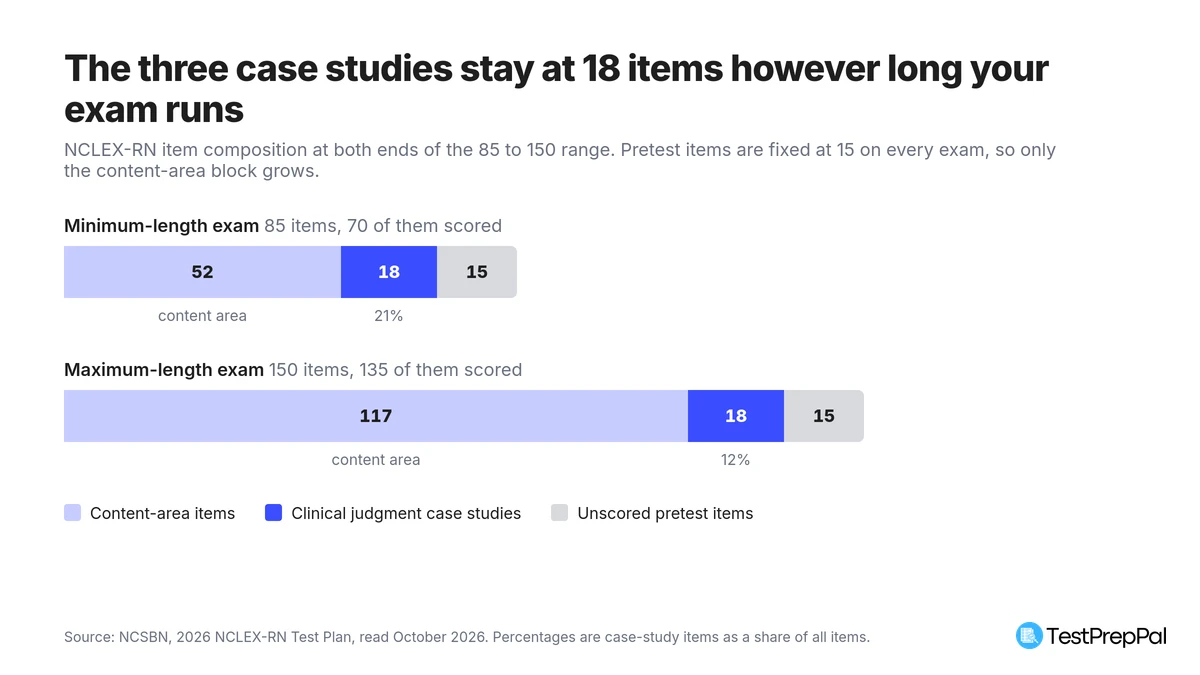 NCLEX-RN item composition at minimum and maximum length. Source: NCSBN, 2026 NCLEX-RN Test Plan.
| 85-item exam | 150-item exam | |
|---|---|---|
| Content-area items | 52 | 117 |
| Clinical judgment case studies | 18 | 18 |
| Unscored pretest items | 15 | 15 |
| Scored items | 70 | 135 |
The arithmetic is simple once the fixed blocks are known. Take 150 items, remove the 15 pretest items and the 18 case study items, and 117 content-area items are left. The content-area block grows by a factor of 2.25 while the case study block does not move at all.
That produces a result worth knowing before you sit down. Case study items are 21 percent of an 85-item exam and 12 percent of a 150-item exam. Measured against scored items only, they fall from 26 percent to 13 percent.
The unscored share moves the same way. Those 15 pretest items are 17.6 percent of a minimum-length exam and 10 percent of a maximum-length one, so candidates who run long have a higher proportion of their work counted.
How many questions you get in each content area
The test plan assigns a target percentage to each of the eight content areas, and those percentages apply to the content-area block rather than to the whole exam. Applying them to the 52 content-area items of a minimum-length NCLEX-RN gives the counts below.
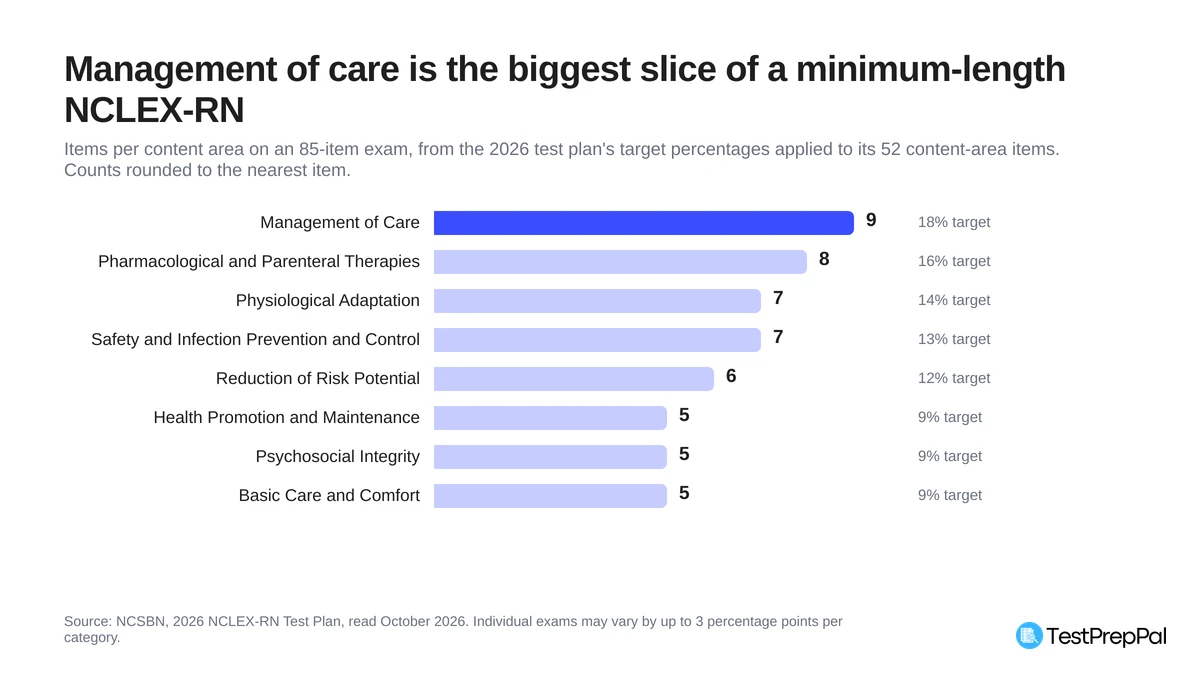 Items per content area on an 85-item NCLEX-RN. Source: NCSBN, 2026 NCLEX-RN Test Plan.
| Content area | 2026 target | Range | Items at 85 | Items at 150 |
|---|---|---|---|---|
| Management of Care | 18% | 15 to 21% | 9 | 21 |
| Pharmacological and Parenteral Therapies | 16% | 13 to 19% | 8 | 19 |
| Physiological Adaptation | 14% | 11 to 17% | 7 | 16 |
| Safety and Infection Prevention and Control | 13% | 10 to 16% | 7 | 15 |
| Reduction of Risk Potential | 12% | 9 to 15% | 6 | 14 |
| Health Promotion and Maintenance | 9% | 6 to 12% | 5 | 11 |
| Psychosocial Integrity | 9% | 6 to 12% | 5 | 11 |
| Basic Care and Comfort | 9% | 6 to 12% | 5 | 11 |
Counts are the target percentage applied to 52 and to 117 content-area items, rounded to the nearest item. The 85-item column sums to 52 exactly. The 150-item column sums to 118 rather than 117, because three categories land just over the half-item line, and we would rather show that than quietly shave a cell.
Two cautions on reading this table. The test plan allows individual exams to differ by up to 3 percentage points in each category, which is worth about 2 items either way on a short exam and about 4 on a long one. And physiological adaptation and safety both show 7 items despite different targets, because 7.28 and 6.76 round to the same number.
The practical use is proportion rather than precision. The four physiological integrity subcategories together take roughly half your content-area items, which is the single most useful thing this table says about where to spend study time. A question bank that reports performance by content area lets you check your own split against these weights, and our NCLEX study guide turns that into a schedule.
The percentage ranges you will see quoted are out of date
Several pages ranking for this question publish content-area ranges that do not match the 2026 test plan. The common set gives management of care as 17 to 23 percent, safety and infection control as 9 to 15 percent, and pharmacological and parenteral therapies as 12 to 18 percent. The 2026 NCLEX-RN Test Plan gives 15 to 21 percent, 10 to 16 percent and 13 to 19 percent, and the subcategory is now named safety and infection prevention and control.
The shifts are small in isolation and they point the same way: management of care down, pharmacology and safety up. NCSBN rebuilds the distribution from a practice analysis conducted every three years, and the 2026 plan is based on the 2024 RN Practice Analysis. If your study materials still carry the older ranges, the weights you are revising to are a cycle behind.
How many questions is the NCLEX-PN?
The same 85 to 150, with the same composition. The 2026 NCLEX-PN Test Plan sets an 85-item minimum, a 150-item maximum, the same five-hour period, and the identical 52 content-area, 18 case study, 15 pretest split. Anyone who tells you the PN is shorter is working from an older format.
What differs is the weighting, and it differs enough to matter.
| Content area | PN target | Items at 85 | RN target |
|---|---|---|---|
| Coordinated Care | 21% | 11 | 18% (Management of Care) |
| Safety and Infection Prevention and Control | 13% | 7 | 13% |
| Pharmacological Therapies | 13% | 7 | 16% |
| Psychosocial Integrity | 12% | 6 | 9% |
| Reduction of Risk Potential | 12% | 6 | 12% |
| Basic Care and Comfort | 10% | 5 | 9% |
| Physiological Adaptation | 10% | 5 | 14% |
| Health Promotion and Maintenance | 9% | 5 | 9% |
Coordinated care is the PN equivalent of management of care and carries a heavier weight, 21 percent against 18. The PN leans less on physiological adaptation and pharmacology and more on psychosocial integrity. PN candidates can practise against these weights with our free NCLEX-PN practice questions, which report a score per content area.
Does your question count tell you anything about passing?
No, and the test plan says so directly: the length of your examination is not an indication of a pass or fail result, and a candidate may pass or fail regardless of length.
The reason sits in the stopping rules. NCSBN uses three of them, and the common one ends your exam as soon as the computer is 95 percent certain your ability is clearly above or clearly below the passing standard. Certainty in either direction ends the exam equally fast, so an 85-item shutoff is consistent with a clear pass and with a clear fail. It tells you the computer made up its mind early, not which way.
There is a second reason your own tally cannot help you. Every item is chosen to be challenging and aligned with your current ability estimate, so a strong candidate and a weak one each get items pitched at their own level and each answer roughly half correctly. Counting wrong answers measures nothing when the difficulty moved underneath you, and you do not know which 15 items were unscored anyway. Our guide to the NCLEX passing score works through why percent correct is not a quantity the NCLEX uses.
For what it is worth, the minimum is also the common outcome. In 2025, 59.1 percent of first-time US-educated RN candidates answered exactly 85 items and 20.5 percent ran to 150, with the PN at 64.6 percent and 17.7 percent. The 85-item composition above is the exam most candidates actually sit. Where those exams end and how much of the five hours they use is covered in how long the NCLEX takes, and the outcomes by candidate type are in our NCLEX pass rate breakdown.
If you have already tested and you are counting items for clues, that is a different question, and we answer it in how to know if you passed the NCLEX. If you have not tested yet, the NCLEX pass probability calculator gives a read from your practice performance instead. For format, fees and registration, start from our NCLEX exam guide or the NCLEX hub.
How many questions are on the NCLEX FAQs
How many NCLEX questions are scored?
Seventy on a minimum-length exam and 135 on a maximum-length one. Every NCLEX carries 15 unscored pretest items that NCSBN is trialling for future use, and because their difficulty is not yet calibrated they are left out of your ability estimate and the pass-fail decision. They look exactly like scored items, so you cannot identify them while testing.
Can I pass the NCLEX with 150 questions?
Yes. Reaching the maximum triggers the maximum-length exam rule, under which the computer sets the 95 percent confidence requirement aside and decides on your final ability estimate alone. At or above the passing standard, you pass. Candidates who run to 150 are those whose ability sits very close to the standard, so a full-length exam means the decision was narrow rather than negative. About 1 in 5 first-time RN candidates finished there in 2025.
How many case study questions are on the NCLEX?
Eighteen, at any exam length. Clinical judgment is measured by three case studies, and each is an item set of six items covering the six steps of the NCSBN Clinical Judgment Measurement Model. That block does not grow with your exam, so it is 21 percent of an 85-item exam and 12 percent of a 150-item one. Roughly 10 percent of your exam is stand-alone clinical judgment items on top of those sets.
How many questions is the NCLEX-PN compared with the NCLEX-RN?
Identical counts. Both run 85 to 150 items in a five-hour appointment, and both use the same 52 content-area, 18 case study and 15 pretest composition at minimum length. Only the content weighting differs: the PN puts 21 percent on coordinated care against the RN's 18 percent on management of care, and leans less on physiological adaptation and pharmacology.
We may earn commissions from some links on this page, but this does not affect our reviews or your experience.