


Pharmacology is 13 to 19 percent of the content questions on the NCLEX-RN, which is 7 to 10 questions on a minimum-length 85-item exam and 15 to 22 on a maximum-length one. That number is the point of this page. It tells you how much of your review the subject is worth before you memorise a single drug name.
Most pharmacology cheat sheets print 101 medications and never say how many questions are at stake. This one is built the other way round: the share first, then the classes, and every threshold linked to the FDA-approved label it came from.
- Pharmacology is 7 to 10 questions on a short exam, 15 to 22 on a long one, out of 52 and 117 content items.
- Because the 18 clinical judgment case study items are scored but sit outside the content percentages, pharmacology is only 10 to 14 percent of the questions that actually count.
- The official test plan names no drug and no drug class. It asks about administration, monitoring and client response.
- Dosage calculation is its own content bucket, so a drug list alone leaves part of the category untouched.
- Several thresholds that cheat sheets print as fact, including the digoxin pulse rule, do not appear in the drug label at all.
How many pharmacology questions are on the NCLEX
Start with what a percentage is a percentage of. The 2026 NCLEX-RN Test Plan sets a minimum of 85 items and a maximum of 150 in a five-hour window. On the minimum-length exam, 52 items come from the eight content areas, 18 are three clinical judgment case studies, and the remaining 15 are unscored pretest items.
Pharmacological and Parenteral Therapies is 13 to 19 percent of the content items, with a target share of 16 percent. Apply that to both ends of the exam length range.
| Exam length | Items delivered | Content-area items | Pharmacology at 13 to 19% | At the 16% target |
|---|---|---|---|---|
| Minimum | 85 | 52 | 7 to 10 | 8 |
| Maximum | 150 | 117 | 15 to 22 | 19 |
The 117 is ours rather than NCSBN's: 150 items, minus 15 pretest, minus the 18 case study items. NCSBN publishes percentages, never a question count, so the conversion is the useful work.
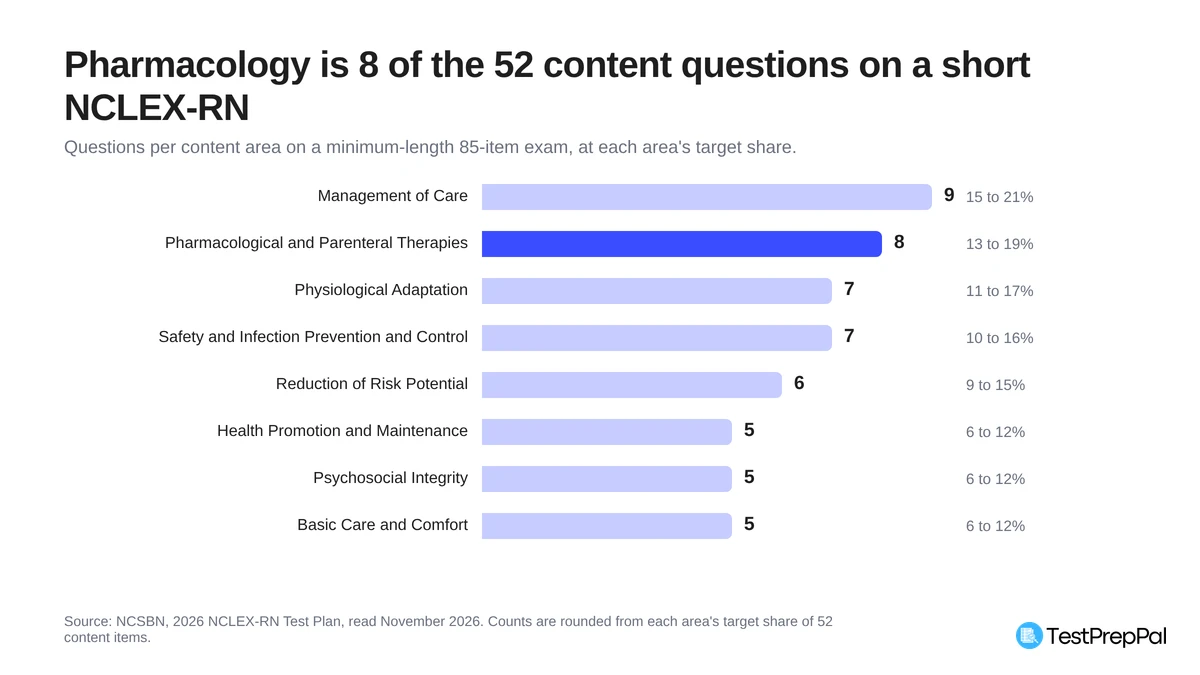 Pharmacology against the other seven content areas on a short exam. Source: NCSBN, 2026 NCLEX-RN Test Plan.
Now the part nobody converts. Fifteen pretest items are unscored, so 70 of 85 questions count, and 135 of 150. The 18 case study items are scored, but the test plan counts them independently of the content percentages. So pharmacology is 7 to 10 of the 70 questions that decide your result, which is 10 to 14 percent, not 13 to 19. On a maximum-length exam it is 15 to 22 of 135, or 11 to 16 percent.
Two caveats before you plan around this. Individual exams may differ by up to 3 percentage points in each category, so a real exam can land outside the table. And the test plan allows about 10 percent stand-alone clinical judgment items on top of the case studies. Our NCLEX study guide does the same conversion for all eight content areas, and how many questions are on the NCLEX covers the adaptive stopping rules behind the 85 to 150 range.
What the test plan actually asks about pharmacology
Open the pharmacology section of the test plan and look for a drug name. There is not one. There is no drug list, no class list, and no "must-know 101". The category is defined by what a nurse does, across nine groups of related content: adverse effects and interactions, blood and blood products, central venous access devices, dosage calculations, expected actions and outcomes, medication administration, parenteral and intravenous therapies, pharmacological pain management, and total parenteral nutrition.
Read that list again and the shape of the category changes. Only two of the nine groups, expected actions and adverse effects, are drug knowledge in the sense a cheat sheet means. Dosage calculation is its own bucket. Central line care and parenteral nutrition are procedures. Medication administration is the rights, the pre-administration data check and the reconciliation process.
A drug list is therefore a partial answer to a category that is mostly about process. The activity statements include evaluating the accuracy of an order, reviewing lab results and allergies before giving a drug, titrating to ordered parameters, and evaluating the client's response afterwards. Those are the verbs that become questions, and they are also why pharmacology items show up as clinical judgment case studies, covered in our guide to the Next Generation NCLEX.
The suffix shortcut, and where it breaks
Suffixes are the one memorisation trick worth keeping, because they are reliable about class membership. They are silent about everything else.
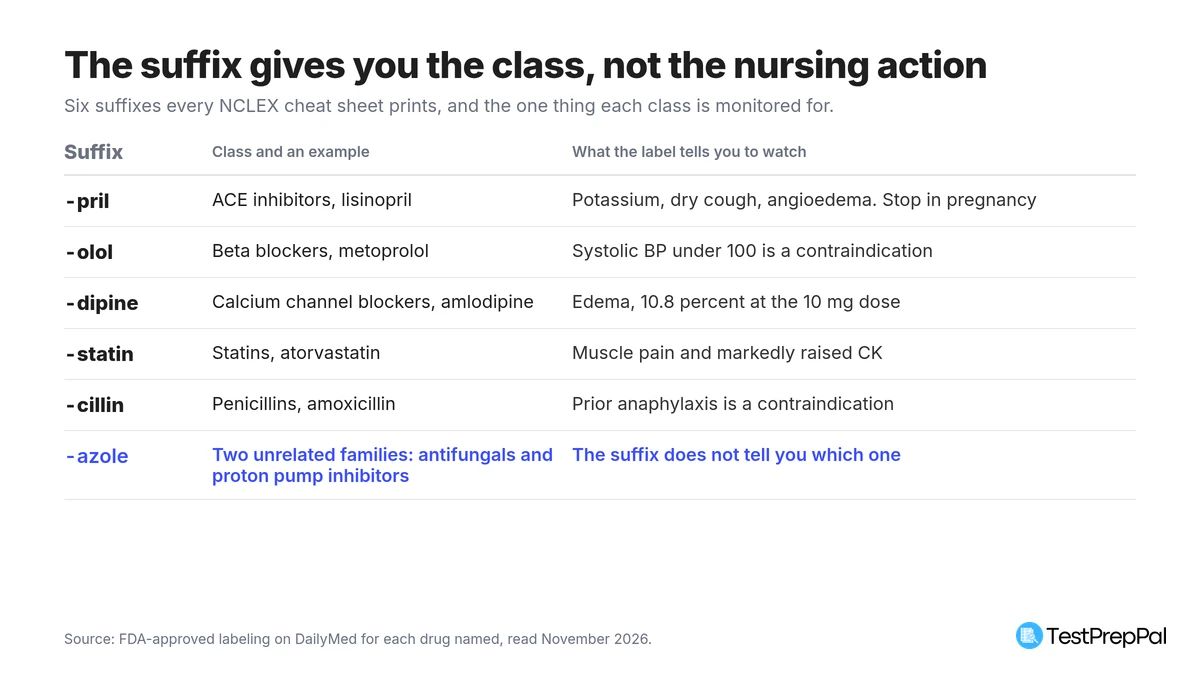 The suffix gives you the class, not the nursing action. Source: FDA labeling on DailyMed.
| Suffix | Class and example | What the label says to watch |
|---|---|---|
| -pril | ACE inhibitors, lisinopril | Monitor serum potassium. Boxed warning for fetal toxicity: stop as soon as pregnancy is detected |
| -olol | Beta blockers, metoprolol | Contraindicated in severe bradycardia and systolic blood pressure under 100 mmHg |
| -dipine | Calcium channel blockers, amlodipine | Edema, dose related: 1.8 percent at 2.5 mg, 10.8 percent at 10 mg, 0.6 percent on placebo |
| -statin | Statins, atorvastatin | Myopathy and rhabdomyolysis. Discontinue if CK is markedly raised |
| -cillin | Penicillins, amoxicillin | Prior anaphylaxis or Stevens-Johnson syndrome is a contraindication |
| -azole | Antifungals and proton pump inhibitors | The suffix does not tell you which family you are looking at |
Three places the shortcut fails. First, "-azole" is two unrelated groups: fluconazole is an antifungal and omeprazole is a proton pump inhibitor, and metronidazole is neither. Second, "-mycin" and "-micin" cover drugs with different toxicity profiles, so gentamicin, which is nephrotoxic and causes vestibular and auditory ototoxicity, sits near names it shares no monitoring plan with. Third, and most important on an exam that asks what you would do, no suffix carries the monitoring parameter. You still have to learn that separately.
The ACE inhibitor side effects are the clearest example of why the class matters more than the drug. Persistent nonproductive cough is reported with all ACE inhibitors and resolves after the drug is stopped, and a history of angioedema on a previous ACE inhibitor is a contraindication to the whole class.
Hold parameters, and which ones the label supports
This is where cheat sheets quietly invent things, so it is worth separating two kinds of statement.
A hold parameter written into the label is a fact about the drug. Metoprolol, linked in the table above, is contraindicated in severe bradycardia, in heart block greater than first degree, in cardiogenic shock, in decompensated heart failure and at a systolic blood pressure under 100. That is the label. It also notes two things most sheets omit: beta blockers may hide the early warning signs of hypoglycemia such as tachycardia, and abrupt cessation may worsen myocardial ischemia.
A hold parameter that comes from nursing practice is a different thing. The widely printed digoxin rule, check the apical pulse for a full minute and hold if it is under 60, is not in the digoxin label. The label warns that digoxin may cause severe sinus bradycardia or sinoatrial block, and it leaves the threshold to the prescriber and the facility. On the exam, treat a stated parameter in the question stem as the authority, because the test plan asks you to titrate to ordered parameters rather than to a rule you memorised.
What the digoxin label does give you is sharper than the pulse rule. Toxicity is usually associated with levels above 2 ng/mL, and levels under 0.5 ng/mL are linked to reduced effect. Hypokalemia, hypercalcemia, hypomagnesemia, low body weight, advanced age and renal impairment all predispose to toxicity, and in treating it the label says to keep serum potassium between 4.0 and 5.5 mmol/L. That is why a potassium result sits next to a digoxin question so often, and why furosemide, which can produce profound diuresis with electrolyte depletion and hypokalemia, is the classic pairing.
The monitoring numbers worth memorising
Six values, each with the label that states it. These are the ones a question can turn on. They are drug levels rather than panel results, which matters because NCSBN supplies the normal reference range on any item showing a number, as our guide to lab values on the NCLEX sets out.
| Drug | Number to know | What it governs |
|---|---|---|
| Heparin | aPTT 1.5 to 2 times normal, checked about every 4 hours on a continuous infusion | Dose adequacy |
| Warfarin | Target INR 2.5, range 2 to 3, for venous thromboembolism and non-valvular atrial fibrillation | Dose adequacy |
| Lithium | 0.8 to 1.2 mEq/L for acute episodes, 0.8 to 1.0 for maintenance, drawn 12 hours after the last dose | Therapeutic window |
| Magnesium sulfate | Deep tendon reflexes diminish above 4 mEq/L and may be absent at 10 mEq/L, where respiratory paralysis is a hazard | When to stop the infusion |
| Digoxin | Toxicity usually above 2 ng/mL | When to withhold and call |
| Vancomycin | Give diluted over a period, never as a rapid bolus | Infusion-related hypotension and upper body flushing |
Two of these are worth checking against whatever sheet you downloaded. Many print the heparin target as 1.5 to 2.5 times normal and the lithium range as 0.6 to 1.2 mEq/L. The current labels say 1.5 to 2 and 0.8 to 1.2. The lithium boxed warning also makes the point no range can: toxicity is closely related to serum concentration and can occur at doses close to therapeutic ones, which is why the 12-hour draw time matters as much as the number.
Warfarin adds the one patient-teaching fact that turns up constantly. It is a vitamin K antagonist, its effect is altered by dietary vitamin K, and increased vitamin K intake lowers the INR response. The teaching point is consistency of intake, not avoidance of green vegetables.
Antidote pairs
Short list, high yield, and each one is an indication printed on the reversal agent's own label.
| Drug or toxin | Reversal agent | What the label says |
|---|---|---|
| Acetaminophen | Acetylcysteine | Prevents or lessens liver injury after a potentially hepatotoxic quantity |
| Opioids | Naloxone | Complete or partial reversal of opioid depression, including respiratory depression |
| Benzodiazepines | Flumazenil | Give the smallest effective amount. Reversal can complicate care in dependent patients |
| Heparin | Protamine sulfate | 1 mg neutralizes about 100 USP heparin units. No more than 50 mg in any 10-minute period |
| Warfarin | Vitamin K | Counteracts a vitamin K antagonist |
| Digoxin | Digoxin Immune Fab | Named in the digoxin label as the treatment for serious overdose |
| Magnesium sulfate | An injectable calcium salt | Must be immediately available during magnesium infusion for preeclampsia and eclampsia |
The flumazenil entry is the one to read twice. Reversal is not automatically the right answer, because flumazenil can complicate the management of a patient who is physically dependent on benzodiazepines or relying on them to suppress seizures.
How to study this without memorising 101 drugs
The test plan tells you the category is about administration and response, so build your review the same way.
- Learn classes with one monitoring number each. The number is what a question can be written around. A drug name without a parameter is trivia.
- Practise dosage calculation separately. It is its own content bucket, and no cheat sheet trains it. The NCLEX study plan generator is a reasonable way to give it a fixed slot.
- Do mixed question sets, not pharmacology sets. The exam never labels the category. Our free NCLEX practice questions are mixed to the blueprint weights.
- Check reporting before you pay. A bank that reports performance by client needs category tells you whether pharmacology is actually your weak area. The NCLEX question bank roundup compares the options, and our Archer Review question bank review covers how its reporting works.
- Date every free download. A sheet written to an older test plan still teaches nursing, but it will not match your score report. The free SimpleNursing lab values cheat sheet is current and still prints one abnormal result as a normal range, which is the general problem in miniature. The NCLEX cheat sheets roundup compares what is on offer.
If visual recall is the gap rather than the content, Picmonic builds mnemonics for drug classes. The NCLEX free resources page lists what is genuinely free, and the NCLEX hub has everything else in one place.
NCLEX pharmacology FAQs
How many pharmacology questions are on the NCLEX?
Seven to 10 on a minimum-length 85-item exam and 15 to 22 on a maximum-length 150-item one, from the test plan's 13 to 19 percent share of content items. Individual exams may vary by up to 3 percentage points per category. As a share of the questions that actually count toward your result, pharmacology is closer to 10 to 14 percent, because the 18 scored case study items sit outside the content percentages.
How do I memorize NCLEX pharmacology?
By class and monitoring parameter rather than by individual drug. Suffixes give you class membership reliably, but they carry no information about what to watch, so pair each class with one number: an aPTT ratio, an INR target, a serum level, a blood pressure threshold. The test plan asks what you would do before and after giving a drug, not what its mechanism is.
What drugs should I know for the NCLEX?
NCSBN publishes no drug list, and any sheet claiming to hold the official 101 is not quoting a real document. The defensible starting point is the high-risk classes that carry a monitoring number or a reversal agent: anticoagulants, digoxin, lithium, magnesium sulfate, insulin, opioids and the common antihypertensive classes.
Is a free pharmacology cheat sheet enough to pass the NCLEX?
No, and the reason is structural. Drug knowledge is two of the nine content groups NCSBN lists in this category, and the others include dosage calculation, central line care and parenteral nutrition, which a drug table does not teach. A sheet is a recall aid for about one question in nine, not a study plan.
We may earn commissions from some links on this page, but this does not affect our reviews or your experience.