


SimpleNursing Lab Values Cheat Sheet Review
by SimpleNursing
Free downloadable lab values PDF cheat sheet for NCLEX and nursing exam preparation.
✓Pros
- ✓Free downloadable PDF format for offline study
- ✓Covers essential lab values commonly tested on the NCLEX
- ✓Concise and well-organized for quick reference
- ✓The same page prints all 16 ranges in full, so you can read them without downloading anything
✗Cons
- ✗Email signup required to access the download
- ✗Focused exclusively on lab values and does not cover other topics
Highlights
- ✓Normal ranges for the core NCLEX lab values, 16 of them printed on the page itself
- ✓Quick and easy reference format for on-the-go studying
- ✓Tips and tricks for remembering key information
- ✓A free companion lab values video
- ✓Printable PDF sent by email, no card needed
Price
✓Free
What Students Are Saying
Sign in to leave a review

Expert Rating
SimpleNursing's free lab values cheat sheet prints 16 normal ranges, and 14 of them match or sit inside the reference ranges the NIH publishes. Two do not, and one of those, creatinine, is given as "Over 1.3 mg/dL", which is an abnormal result rather than a normal range.
The card costs an email address and nothing else, and the landing page reproduces every range in it as plain text, so you can read the whole thing without downloading anything. That makes it one of the easiest free references in NCLEX prep to check before you trust it, which is what we did: we opened the page on 2 October 2026, pulled all 16 values, and compared each one with MedlinePlus, the National Institutes of Health's reference database, and with the American Diabetes Association's diagnostic cut points.
Summary table
| Feature | SimpleNursing lab values cheat sheet |
|---|---|
| Price | Free |
| What it costs you | One email address, submitted through the form on the page |
| Lab values on the page | 16, grouped into 6 study areas |
| Values SimpleNursing advertises | 17 |
| Format | One page printable card, three columns: lab, normal range, memory hook |
| Ranges matching or inside NIH figures | 14 of 16 |
| Ranges that do not | Fasting glucose and creatinine |
| Extras | A free companion lab values video |
| Account or card needed | No |
| Guarantee | None |
| Our rating | 3.3 out of 5 |
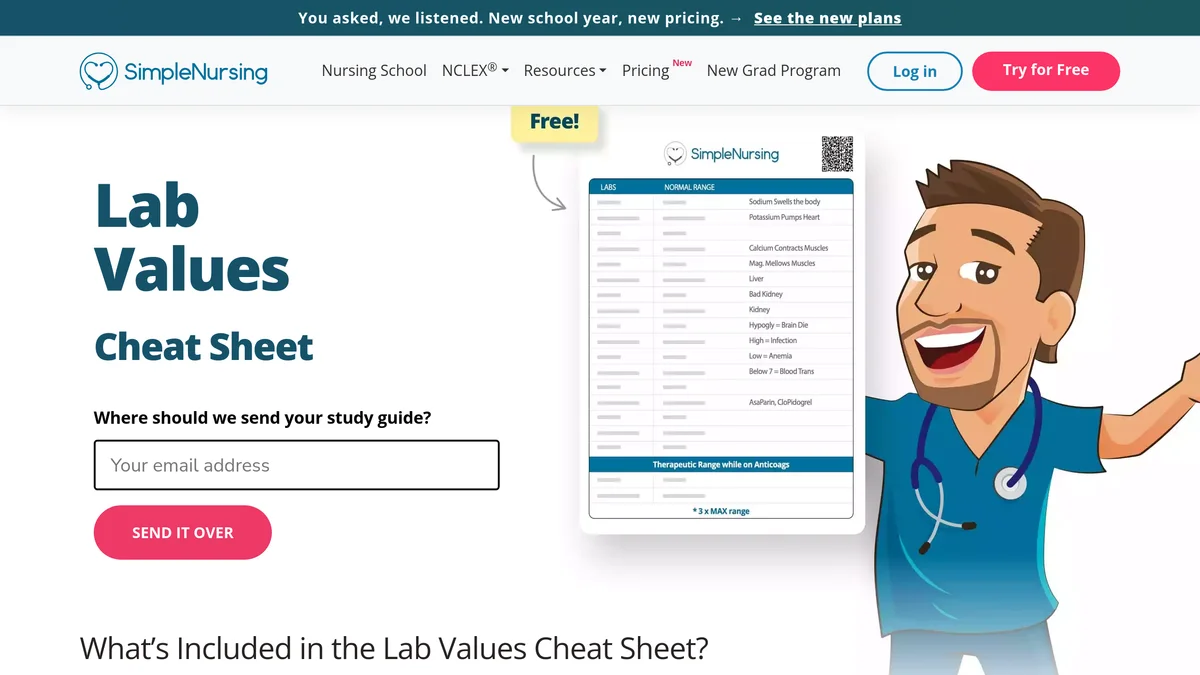 The download page on simplenursing.com, captured October 2026. The preview on the right is the card itself: lab name, normal range, memory hook.
SimpleNursing lab values cheat sheet overview
The card is one page. The preview on the landing page shows its shape clearly: three columns, with the lab name on the left, the normal range in the middle, and a short memory hook on the right. The hooks near the top are alliterative, such as "Sodium Swells the body" and "Mag. Mellows Muscles". Further down the column they switch to interpretation: "High = Infection", "Low = Anemia", "Below 7 = Blood Trans". A separate block at the bottom carries therapeutic ranges for clients on anticoagulants.
The unusual part is that the landing page does not just sell the card. It reproduces the content. Every value in the card is written out on the page in full, grouped under six headings, with an indication line explaining what the test is for and a normal range underneath.
What you get:
- Sixteen lab values across six study areas: electrolytes, renal function, glucose, erythrocytes, leukocytes and coagulation
- A normal range for each one, plus a one line note on why a nurse would order the test
- Memory hooks on the printable card, one per lab
- Therapeutic ranges for clients on warfarin and heparin, not just the off-treatment numbers
- A free companion video walking through the same values
- No account, no card, no trial
The email gate is real but shallow. The form is a single field, it goes to SimpleNursing's mailing list, and the card arrives by email. If you do not want the email, the page itself is the reference.
SimpleNursing lab values cheat sheet review for 2026
Fourteen of the 16 ranges hold up
Lab values are the one piece of NCLEX content where a resource is either accurate or useless, so we checked all 16 rather than spot-checking.
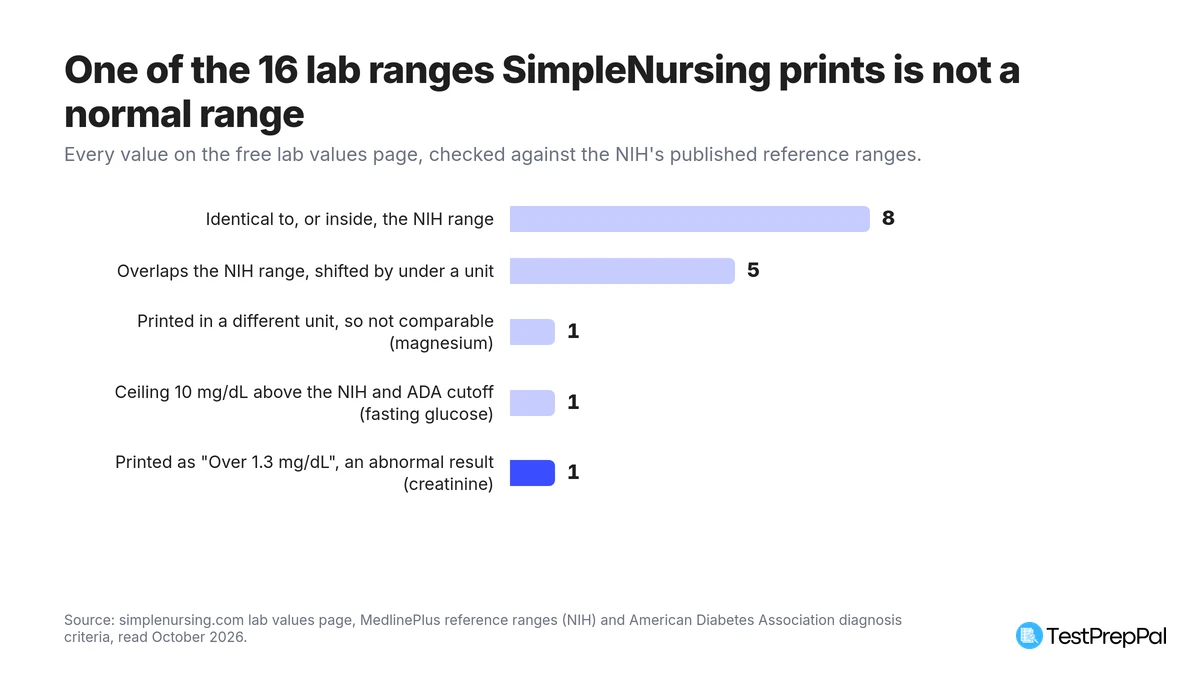 All 16 values on SimpleNursing's lab values page, compared with MedlinePlus reference ranges, 2 October 2026.
Eight are identical to the NIH figure or sit inside it. Sodium is 135 to 145 mEq/L in both. Platelets are 150,000 to 400,000 in both. Where SimpleNursing differs, it mostly differs by narrowing: white cells are given as 5,000 to 10,000 cells per microlitre against the NIH's 4,500 to 11,000, and prothrombin time as 11 to 12.5 seconds against 11 to 13.5. A narrower range is the standard nursing school teaching convention, and it costs you nothing on an exam that asks whether a value is normal or not.
Five overlap and sit a fraction out: chloride is given as 97 to 107 mEq/L against 96 to 106, calcium as 9.0 to 10.5 mg/dL against 8.5 to 10.2, INR as 0.9 to 1.2 against 0.8 to 1.1. Those gaps are smaller than the variation between two real hospital labs, and MedlinePlus says as much on every page. Magnesium is the odd one out of the comparison rather than the content: SimpleNursing gives 1.3 to 2.1 mEq/L and the NIH gives 1.7 to 2.2 mg/dL, which are two different units for the same thing.
One small presentation slip is worth knowing before you print: potassium is written as "3.5 to 5.0 mEq", with the per litre missing. Every other row carries its unit.
The creatinine entry is the one to fix by hand
Under renal function, creatinine's normal value is printed as "Over 1.3 mg/dL".
That is not a normal range. It is the definition of an abnormal one. The NIH's creatinine blood test page puts normal at 0.7 to 1.3 mg/dL for men and 0.5 to 0.95 mg/dL for women, and its metabolic panel page gives 0.6 to 1.3 mg/dL overall. A result above 1.3 is the one that should make a nurse look at kidney function, which is the opposite of what the card tells you.
The likely explanation is an editing accident, a lost lower bound on a 0.6 to 1.3 range. The effect on a student is the same either way. If you are revising from this page and you meet an exam item giving a client a creatinine of 2.4 mg/dL, the card as written says that is fine.
The second correction is smaller but worth making. Fasting glucose is given as 70 to 110 mg/dL. The NIH puts the same test at 70 to 100, and the American Diabetes Association calls a fasting plasma glucose of 100 to 125 mg/dL prediabetes and 126 or above diabetes. So SimpleNursing's top 10 mg/dL of "normal" is the ADA's prediabetes band. The 110 figure is an older teaching number that a lot of nursing material still carries, which makes it easy to miss, and an NCLEX item written to current guidance will not use it.
The page promises 17 values and prints 16
The What's Included copy says "normal ranges for the top 17 lab values you need to know". Counting the headings on the page gives 16: five electrolytes, two renal, one glucose, three erythrocyte, one leukocyte and four coagulation.
The gap is probably a count of rows rather than tests, since several values split into male and female figures, and the printed card may well show 17 lines. Nothing is being hidden. It is worth saying only because a student scanning the page for 17 topics will find 16, and because a resource built on precision should count itself accurately.
What is not here matters more than the missing seventeenth. There are no arterial blood gases, no liver enzymes, no thyroid studies, no digoxin or lithium therapeutic levels. The therapeutic ranges that are included cover anticoagulation only. Those omissions are reasonable for a one page card and they are the reason this is a supplement rather than a reference.
The exam gives this content real weight. Under the NCSBN's 2026 NCLEX-RN test plan, effective April 2026, Laboratory Values is a named section of Reduction of Risk Potential, which carries 9 to 15 percent of the exam and is charted at 12 percent. The first activity statement under it is to compare client laboratory values to normal laboratory values. A card of normal values is exactly the right tool for that job, which is why the two wrong numbers matter.
Pricing
The cheat sheet is free, and free here means free: no trial, no card, no upsell page between you and the download. The cost is an email address, and the page itself gives you the content even if you never submit it.
SimpleNursing uses the card as a lead magnet for its paid plans, which is worth seeing before the emails start arriving. From its pricing page:
| Plan | Price | Per month | Pass guarantee |
|---|---|---|---|
| Nursing School, monthly | $20 a month | $20.00 | No |
| Nursing School, semester | $105 every 6 months | $17.50 | No |
| Nursing School, annual | $180 once a year | $15.00 | No |
| NCLEX-RN or PN, monthly | $60 a month | $60.00 | No |
| NCLEX-RN or PN, 90-day pass | $139 once | $46.33 | No |
| NCLEX-RN Pass Guarantee | $189 once | $63.00 | Yes |
| Full Journey Pass | $312 once, 24 months | $13.00 | Yes |
Nothing on that list is sold for the lab values card, and nobody should buy a plan to get it. The refund window is 48 hours on the one-time memberships, with a processing fee of 10 percent, a minimum of $10 and a maximum of $25. Our SimpleNursing NCLEX course review works through which plan carries the guarantee and which two look like NCLEX prep without being it.
Who the SimpleNursing lab values cheat sheet is best for
Students who want one page, not a chapter. Sixteen values, one sheet, a memory hook per row. That is a realistic thing to tape inside a folder and read in the five minutes before a shift.
Anyone who hates email gates. You do not need to pass this one. The page prints every range it is selling, which is rarer than it should be, and makes this the free lab values resource you can check fastest.
Students already using SimpleNursing. If the app is your content source, the card is a revision layer that sits on top of it at no extra cost, and our SimpleNursing app review covers what the paid subscription adds.
Students revising anticoagulation. The card gives both the off-treatment and the on-treatment ranges for INR and aPTT, which is the distinction most free lab lists skip and the one that turns up in questions about warfarin and heparin.
When you might look elsewhere
- You want coverage rather than a card. Sixteen values will not carry a content review. Nurseslabs' normal lab values reference is the broader free list, and the rest of what we have checked sits on the NCLEX cheat sheets page.
- You want clinical topics, not numbers. Bootcamp's free NCLEX cheat sheets are seven multi-page PDFs on prioritization, infection control and diabetes, written by a nurse educator and free with no email at all. They have no lab value sheet, which is exactly the hole this card fills.
- You want mnemonics as the whole approach. The Matus Nursing Review mnemonics PDF is 98 slides of memory hooks, including a run of 11 on fluids and electrolytes, though it was built in 2019.
- You want to find your weak areas first. Memorising ranges before you know whether lab values are your problem is wasted time. Our free NCLEX practice questions and the NCLEX study guide both sort by content area, how we assess every resource is on our review methodology page, and the rest of the exam is covered on our NCLEX hub.
Final verdict
SimpleNursing lab values cheat sheet FAQs
Is the SimpleNursing lab values cheat sheet free?
Yes. There is no trial, no card and no paid tier behind it. The form asks for an email address and nothing else, and the card is sent to that address. You can also skip the form entirely: the landing page prints all 16 normal ranges in full, grouped by study area, so the content is readable without signing up.
Are the lab values on it accurate?
Mostly. We checked all 16 against the NIH's MedlinePlus reference ranges on 2 October 2026 and 14 matched or sat inside them. Two did not. Creatinine is printed as "Over 1.3 mg/dL", which is an abnormal result rather than a normal range, and fasting glucose is given as 70 to 110 mg/dL against the NIH's 70 to 100. Correct both by hand.
How many lab values does it cover?
Sixteen, across six study areas: five electrolytes, two renal function tests, glucose, three erythrocyte measures, white cells, and four coagulation values. SimpleNursing's own copy says 17, probably counting rows rather than tests, since several values are split into male and female figures.
What is not on it?
Arterial blood gases, liver enzymes, thyroid studies and drug levels such as digoxin and lithium. The only therapeutic ranges included are for warfarin and heparin. It is a one page card, so treat the gaps as scope rather than oversight and fill them from a content source.
Do I have to give SimpleNursing my email address?
Only if you want the printable card. The ranges themselves are published on the page as text. Submitting the form adds you to SimpleNursing's mailing list, which is how the company markets its $60 a month NCLEX plans and the $139 90-day pass.
We may earn commissions from some links on this page, but this does not affect our reviews or your experience.
Our Verdict
A genuinely free one page lab values card, and the same page prints all 16 ranges in HTML, so you can use it without handing over an email address. Fourteen of the 16 sit inside or within a unit of the NIH's published reference ranges, which is better than most free downloads manage. Two do not: fasting glucose is capped at 110 mg/dL, 10 above the NIH figure and inside the prediabetes band, and creatinine is printed as 'Over 1.3 mg/dL', which is an abnormal result rather than a normal range. Fix those two by hand and the card is worth printing.