


The NCLEX does not come with a syllabus, but it does come with a blueprint, and the current one is the 2026 NCLEX-RN Test Plan. It splits the exam into eight content areas, and on a minimum-length 85-item exam only 52 of your questions are both scored and assigned to one of those areas.
That gap is why most study guides feel vague. They tell you to study pharmacology and prioritization without ever saying that pharmacology is worth roughly eight questions on a short exam and prioritization sits inside the single largest content area on the test. This page does the conversion, category by category, from the official percentages to real question counts.
- The current blueprint is the 2026 NCLEX-RN Test Plan, effective April 1, 2026 through March 31, 2029.
- Eight content areas carry fixed percentage ranges. Management of Care is the largest at 15 to 21 percent.
- Every exam contains 15 pretest items that do not count, so 70 of 85 questions are scored, or 135 of 150.
- Three clinical judgment case studies (18 questions) appear on every exam and sit outside the content percentages.
- Physiological Integrity is about half the content, so about half your review time belongs to its four subcategories.
What the 2026 NCLEX test plan is, and what changed
The test plan is NCSBN's public description of what the exam measures and in what proportion. NCSBN rewrites it every three years, and the current NCLEX test plans took effect on April 1, 2026 and run through March 31, 2029. The percentages in the 2026 NCLEX-RN Test Plan come from the 2024 RN Practice Analysis, a survey of what newly licensed nurses actually do.
If you are studying from material written a year or two ago, here is the useful part: the eight percentage ranges did not move. Compare the 2026 plan with the 2023 NCLEX-RN Test Plan and every range is identical. One subcategory was renamed, from "Safety and Infection Control" to "Safety and Infection Prevention and Control", and the underlying practice analysis moved from 2021 to 2024.
So an older content outline is not wrong about the split. It is just quoting a document that is no longer the one your exam is built from, and it will not match the language in your score report. If you want the exam rules around the blueprint, our NCLEX exam guide covers format, fees, eligibility, and retakes.
How many of your NCLEX questions actually count
Before any percentage means anything, you need to know what it is a percentage of. Two subtractions matter.
First, pretest items. The test plan states there are 15 pretest items on every examination. They look exactly like real questions, they are being trialled for future exams, and they are excluded when the computer estimates your ability. You cannot spot them, and you should not try.
Second, clinical judgment case studies. Every exam includes three case studies of six questions each, 18 questions in total, built on the six steps of the NCSBN Clinical Judgment Measurement Model: recognize cues, analyze cues, prioritize hypotheses, generate solutions, take action, and evaluate outcomes. Those 18 count toward your result, but because clinical judgment cuts across every content area, NCSBN counts them independently of the content percentages. The plan also notes roughly 10 percent stand-alone clinical judgment items on top of that.
The exam itself runs from 85 to 150 items in a five-hour window, per the 2026 NCLEX Candidate Bulletin. Put the two subtractions together and the item budget looks like this:
| Exam length | Items delivered | Pretest, not scored | Scored items | Case study items | Assigned to a content area |
|---|---|---|---|---|---|
| Minimum | 85 | 15 | 70 | 18 | 52 |
| Maximum | 150 | 15 | 135 | 18 | 117 |
Those last two numbers, 52 and 117, are ours rather than NCSBN's. NCSBN publishes percentages and item minimums, never a question count per category, so the arithmetic above is what turns one into the other.
The eight content areas, in questions instead of percentages
Here is the whole blueprint, with each official percentage range converted into questions at both ends of the exam length range. Round numbers to the nearest question.
| Content area | Share of content | On an 85-item exam | On a 150-item exam |
|---|---|---|---|
| Management of Care | 15 to 21% | 8 to 11 | 18 to 25 |
| Pharmacological and Parenteral Therapies | 13 to 19% | 7 to 10 | 15 to 22 |
| Physiological Adaptation | 11 to 17% | 6 to 9 | 13 to 20 |
| Safety and Infection Prevention and Control | 10 to 16% | 5 to 8 | 12 to 19 |
| Reduction of Risk Potential | 9 to 15% | 5 to 8 | 11 to 18 |
| Health Promotion and Maintenance | 6 to 12% | 3 to 6 | 7 to 14 |
| Psychosocial Integrity | 6 to 12% | 3 to 6 | 7 to 14 |
| Basic Care and Comfort | 6 to 12% | 3 to 6 | 7 to 14 |
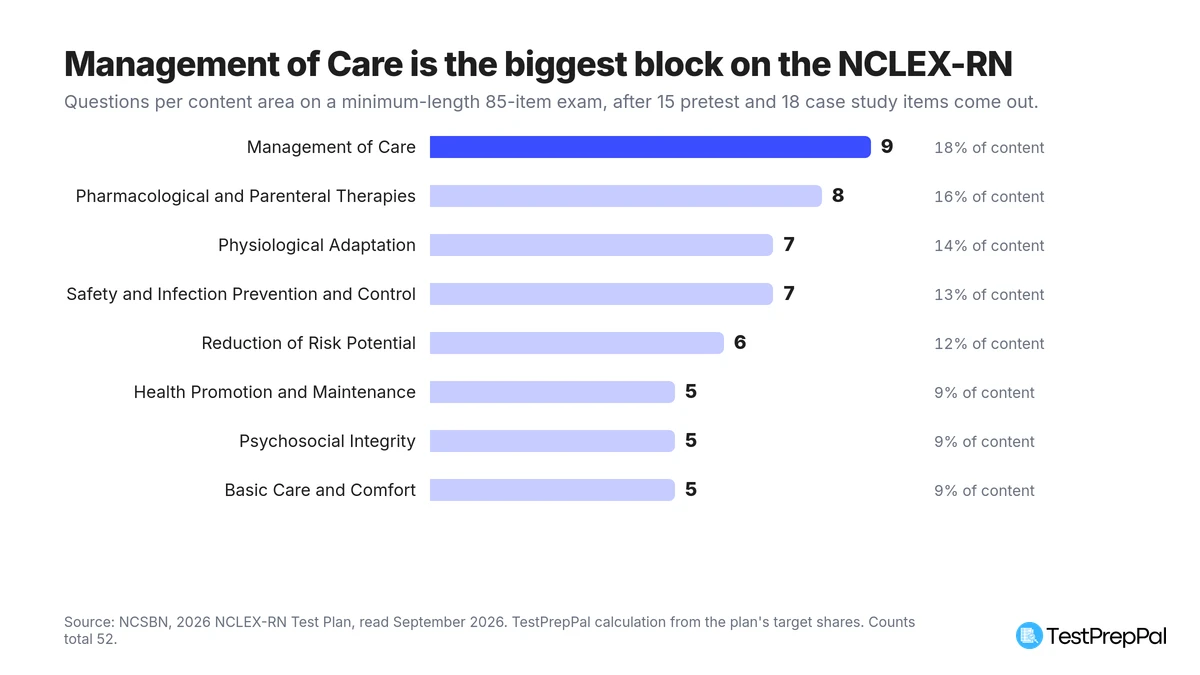 Questions per content area on a minimum-length NCLEX-RN, using the test plan's target shares. Source: NCSBN, 2026 NCLEX-RN Test Plan.
Two things to keep in mind before you build a plan around these numbers. The test plan allows individual exams to differ by up to 3 percentage points in each category, so a real exam can land outside the counts above. And the shortest possible exam is the smallest sample, which is exactly why a single weak area hurts more on an 85-item exam than on a 150-item one.
What each content area covers
The category names are not self-explanatory, and guessing at them is how people end up studying the wrong thing. These are NCSBN's own descriptions, condensed.
| Content area | What it covers | Typical questions at 85 items |
|---|---|---|
| Management of Care | Directing care so that clients and health care staff are protected: delegation, prioritization, handoff, advance directives, referrals, client rights | 9 |
| Pharmacological and Parenteral Therapies | Administering medications and parenteral therapies, including checking orders, dosage, and safe disposal | 8 |
| Physiological Adaptation | Acute, chronic, or life-threatening conditions: emergency care, drains and devices, pathophysiology | 7 |
| Safety and Infection Prevention and Control | Protecting people from health and environmental hazards, including hand hygiene, isolation, and sterile technique | 7 |
| Reduction of Risk Potential | Reducing complications tied to existing conditions, treatments, or procedures: vital sign trends, post-procedure care, tubes | 6 |
| Health Promotion and Maintenance | Growth and development, prenatal care and education, screening, prevention, and early detection | 5 |
| Psychosocial Integrity | Emotional, mental, and social well-being: coping, grief, therapeutic communication, sensory and cognitive alterations | 5 |
| Basic Care and Comfort | Comfort and assistance with activities of daily living, including nutrition, mobility, and rest | 5 |
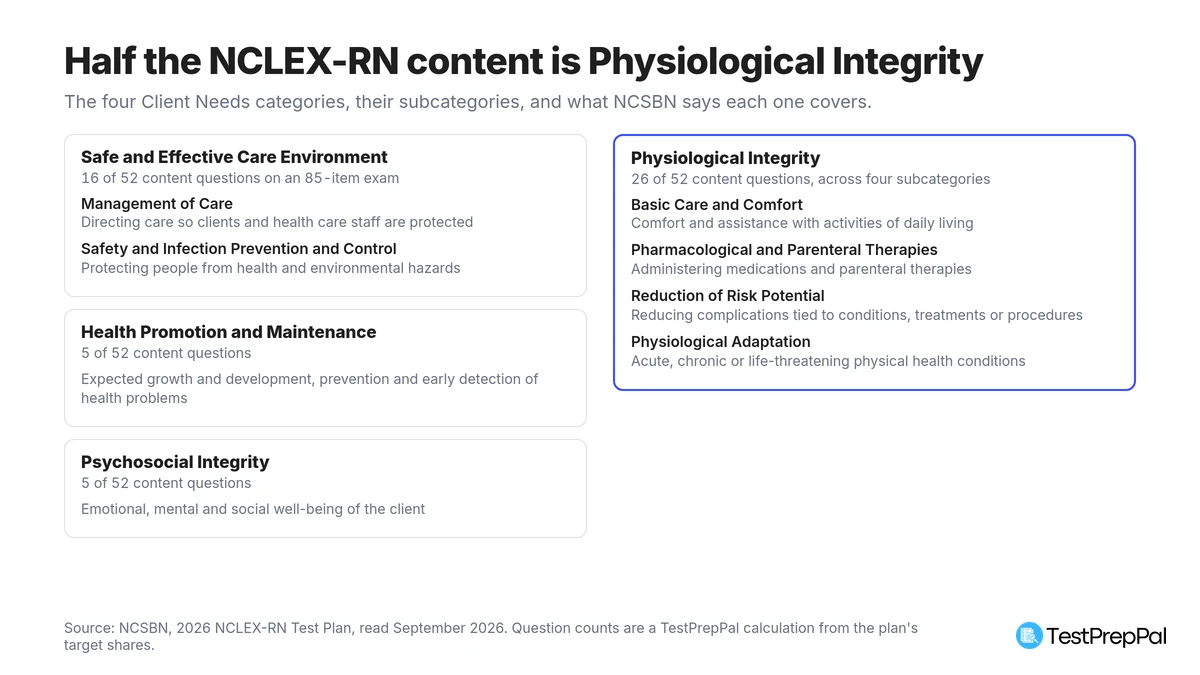 The four Client Needs categories and what sits inside each. Source: NCSBN, 2026 NCLEX-RN Test Plan.
Those eight areas roll up into four parent categories, and that rollup is the single most useful fact in the blueprint. Physiological Integrity holds four of the eight subcategories and about half the content questions, 26 of 52 on a short exam. Safe and Effective Care Environment holds 16. Health Promotion and Maintenance and Psychosocial Integrity are 5 each.
Five integrated processes run through all of it rather than sitting in one box: clinical judgment, communication and documentation, culture and spirituality, the nursing process, and teaching and learning. You cannot study them as topics. They show up in how questions are asked.
How the NCLEX-PN blueprint differs
If you are sitting the NCLEX-PN, do not use the RN percentages. The 2026 NCLEX-PN Test Plan has the same structure and the same 85-item minimum with 15 pretest items, but different weights and two different subcategory names.
| Content area | PN share | RN share |
|---|---|---|
| Coordinated Care | 18 to 24% | 15 to 21% (Management of Care) |
| Pharmacological Therapies | 10 to 16% | 13 to 19% (and Parenteral) |
| Psychosocial Integrity | 9 to 15% | 6 to 12% |
| Basic Care and Comfort | 7 to 13% | 6 to 12% |
| Physiological Adaptation | 7 to 13% | 11 to 17% |
| Safety and Infection Prevention and Control | 10 to 16% | 10 to 16% |
| Health Promotion and Maintenance | 6 to 12% | 6 to 12% |
| Reduction of Risk Potential | 9 to 15% | 9 to 15% |
The pattern is what you would expect from scope of practice. Coordinated Care is a bigger share for LPN and LVN candidates than Management of Care is for RN candidates, and Psychosocial Integrity is heavier too. Physiological Adaptation, the acute and life-threatening end of the exam, is lighter.
Those percentages turn into question counts the same way the RN ones do, and our NCLEX-PN study guide does that conversion for all eight PN areas, sets each against its RN counterpart, and adds the PN-only exam length and pass rate data.
To practise against those weights rather than the RN ones, our free NCLEX-PN practice questions are mixed to this table and score you by content area, 52 questions matching the 52 scored content items on a minimum-length PN exam.
How to turn the blueprint into a study order
The blueprint tells you what to weight. It does not tell you when to study, and mixing those two questions is why so many plans collapse in week two.
A defensible order looks like this:
- Start with the four Physiological Integrity subcategories. They are half the content. If your time is short, this is where the return is. If the gap is the content itself rather than the practice, a video-led app such as SimpleNursing gets you back into it faster than rereading a textbook.
- Treat Management of Care as its own project. It is the largest single subcategory, it is mostly delegation, prioritization, and scope questions, and it is the area where knowing the content does not automatically get you the right answer.
- Do questions in mixed sets, not by topic. The exam never tells you which category a question belongs to. Our free NCLEX practice questions are a reasonable place to start before you commit money, and Nurse Plus Academy adds free category sets with rationales, though its Next Generation items are paid.
- Read rationales for questions you got right. On an adaptive test, a lucky guess is a weak area you have not found yet. This is the one job worth paying for, and our UWorld NCLEX app review explains what its explanations cover and what every plan actually contains.
- Check your question bank against the blueprint. A bank that reports performance by client needs category is worth more than one that only reports a percentage. Our Archer Review question bank review covers how its reporting works, and the NCLEX question bank roundup compares the main options on coverage and price. Few providers publish how their bank splits across the blueprint before you buy; Pocket Prep is the exception, and its per-subject counts are in our review.
- Check the edition date on anything printed. A book written to an older test plan still teaches nursing, but it will not reflect the current blueprint. NCLEX-RN Q and A Made Incredibly Easy is the clearest example: it is still sold in a 2016 edition, and the NCLEX prep book roundup lists the publication date of all five books we cover.
- Apply the same test to free downloads. A shared flashcard deck carries a date too, and nobody is obliged to update it. The Nursing High-Yield ATI Anki deck was last touched in May 2019, before clinical judgment items existed, which is fine for recall practice and useless for the case studies. The NCLEX-RN 400+ flashcards deck is the better free option on that one test, updated in September 2025, though it still predates this test plan. The biggest free deck, Debase27's 2,479 card Anki deck, fails the date test hardest: we opened the file and every card in it was written in 2022. Dates are not the only thing to check on a free download. The SimpleNursing lab values cheat sheet is current and free, and it still prints creatinine as "Over 1.3 mg/dL", which is an abnormal result rather than a normal range.
- Check the gap against the blueprint before you book the date. A readiness test scored against the real passing standard tells you more than another practice percentage. UWorld's NCLEX Self-Assessments return a probability of passing plus a client needs breakdown for $25 a test, which is the same breakdown this guide is organised around.
For the calendar side, the NCLEX study plan generator builds a schedule around your test date, Bootcamp's free printable study schedules show what a course-shaped plan looks like day by day, and the NCLEX free resources page lists what is genuinely free before you pay for anything. If you want the exam hub with everything in one place, start at NCLEX prep.
NCLEX study guide FAQs
What is the best NCLEX study guide?
The official test plan is the only guide that is authoritative about content, and it is free. Everything else, including this page, is a way of making it usable. A paid guide earns its price through practice questions with rationales, performance reporting by content area, and explanations of clinical judgment items, not through a content list you can download from NCSBN.
How many NCLEX questions actually count toward your result?
Seventy of 85 on a minimum-length exam, and 135 of 150 on a maximum-length one, because 15 items on every exam are unscored pretest items. Of the scored questions, 18 come from three clinical judgment case studies that count toward your result but are not counted against the content percentages.
Can you study for the NCLEX in one week?
Only as a review of material you already know. The blueprint covers eight content areas, half of them under Physiological Integrity, and a week is not enough to build that from scratch. A week is enough to do mixed question sets, read rationales, and fix the two or three areas where your accuracy is worst.
Is the NCLEX hard to pass?
For first-time, U.S.-educated candidates the pass rate is above 90 percent, and the headline all-candidate rate is much lower because it blends in repeat and internationally educated testers. Our NCLEX pass rate breakdown has the current NCSBN figures by candidate type.
We may earn commissions from some links on this page, but this does not affect our reviews or your experience.