

UWorld NCLEX Self-Assessments Review
by UWorld
Validated probability of passing from a 100-question predictor exam
✓Pros
- ✓Cheapest credible readiness check in the category at $25 for a single 100-question exam
- ✓Scores map to a validated probability of passing built on Item Response Theory and NCSBN partial credit rules
- ✓Every Next Generation NCLEX item type is included, case studies and bow-tie items among them
- ✓The performance report breaks results down by NCSBN Client Needs category, subject and system
- ✓Six distinct assessments holding 600 unique questions, so nothing repeats across a full study plan
✗Cons
- ✗Each package is valid for only two weeks from activation, and the page does not say whether that clock runs per test or per package
- ✗A fixed 100-item, 206-minute exam does not reproduce the real NCLEX's variable-length adaptive format of 85 to 150 items over five hours
- ✗No refund, money-back or pass guarantee is offered on any self-assessment package
- ✗Rationales stay locked until the exam ends, and the assessment cannot be paused once it starts
Highlights
- ✓100 unique questions per assessment
- ✓Up to 6 distinct assessments, 600 unique questions in total
- ✓All Next Generation NCLEX item types, including case studies and bow-tie items
- ✓Probability of passing score from an Item Response Theory model
- ✓Performance report by NCSBN Client Needs category, subject and system
- ✓Pearson VUE style exam interface and enforced timing
- ✓Answer rationales with clinical illustrations, released after submission
- ✓NCLEX-RN and NCLEX-PN versions
Price
$25 - $100
What Students Are Saying
Sign in to leave a review

Expert Rating
A UWorld NCLEX Self-Assessment costs $25 for one 100-question predictor exam, or $100 for all six, and each package is valid for two weeks from activation. Buy one if you want a defensible answer to "am I ready", and buy it inside the fortnight you plan to use it.
That two-week window is the thing to plan around, and it is the thing nobody else writing about this product mentions. Everything else here is very good: this is the most statistically serious readiness check in NCLEX prep, and the cheapest way into it is less than the price of a textbook.
Summary table
| Feature | UWorld NCLEX Self-Assessments |
|---|---|
| Price | $25 per assessment, or $100 for 6 (listed at $150) |
| Cost per exam | $25.00 single, $16.67 in the six-pack |
| Questions per assessment | 100 unique |
| Assessments available | Up to 6, no repeated questions |
| Total unique questions | 600 across the six-pack |
| Time limit | 3 hours and 26 minutes per assessment |
| Format | Fixed length, not adaptive |
| Next Gen NCLEX item types | Yes, including case studies and bow-tie items |
| Score output | Probability of passing band plus a Client Needs breakdown |
| Access period | 2 weeks from activation |
| Versions | NCLEX-RN and NCLEX-PN |
| Guarantee | None. No refund or pass guarantee stated |
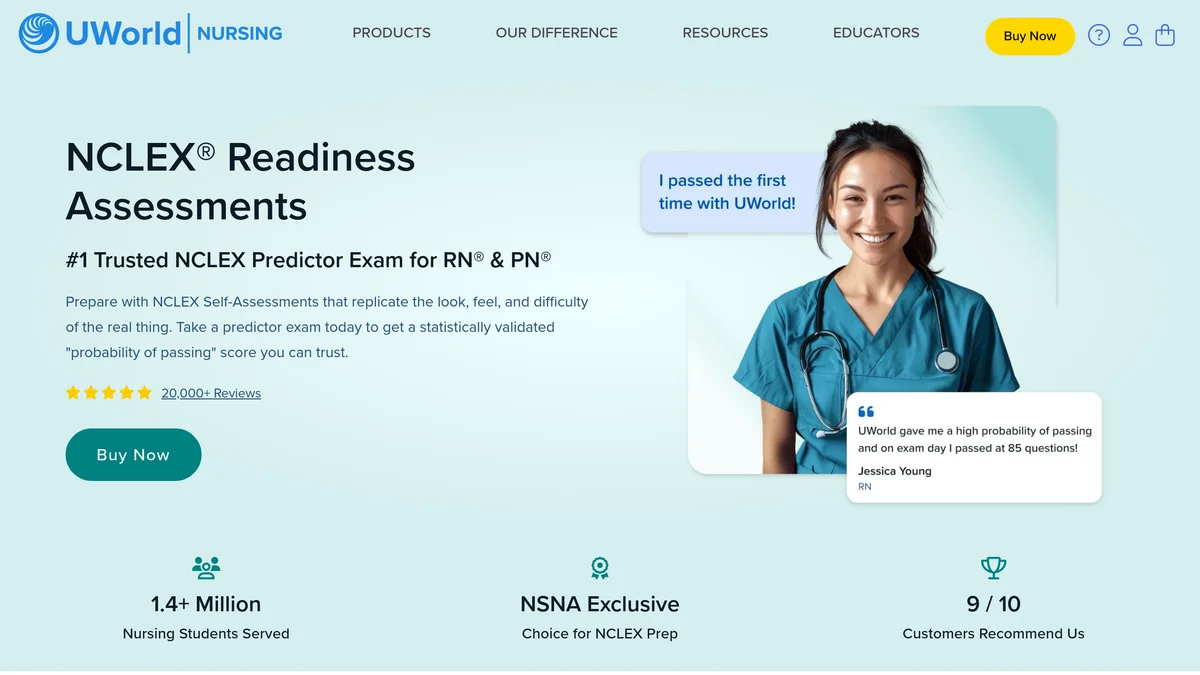 The UWorld NCLEX Self-Assessments product page. Source: nursing.uworld.com (captured September 2026).
What UWorld NCLEX Self-Assessments are
They are standalone predictor exams, sold separately from the UWorld question bank. Each one is a 100-question simulation built to the NCSBN test plan percentages, delivered in a Pearson VUE style interface, and scored against a model that returns a probability of passing rather than a percentage you have to interpret yourself.
This is worth stating plainly because the two UWorld NCLEX products get confused constantly. The UWorld NCLEX question bank is for learning: tutor mode, immediate rationales, thousands of questions. The Self-Assessments are for measuring. UWorld's own FAQ draws the same line, noting that the assessment disables rationales during the test and enforces strict timing so that you get "a dedicated space to test your knowledge application without the safety net of immediate feedback".
What a package includes, from UWorld's product page:
- 100 unique questions per assessment, up to 6 distinct assessments
- 600 unique questions in total across the six-pack, with nothing repeated
- Every Next Generation NCLEX item type, case studies and bow-tie items included
- A probability of passing score from an Item Response Theory model
- A performance report mapped to NCSBN Client Needs categories, by subject and by system
- Answer rationales with clinical illustrations, released after you submit
- Separate NCLEX-RN and NCLEX-PN versions
The questions are written by a team UWorld describes as 40 plus registered nurses and nurse educators. Two weeks of access starts when you activate a package.
UWorld NCLEX Self-Assessments review for 2026
The scoring is the product
Most NCLEX practice tests hand you a percentage and leave you to guess what it means. Passing the NCLEX is not a percentage question: the exam decides pass or fail using a confidence interval around a fixed ability standard, which is why two candidates can answer very different numbers of questions and both pass.
UWorld's assessments are scored to match that logic. The model uses Item Response Theory to place your ability on a scale and convert it to a probability of passing, and it applies the same partial credit rules NCSBN uses for Next Gen item types. The output is a band, from low up to very high, rather than a raw score you have to translate.
That is the single best reason to buy one. A 68 percent on a generic practice test tells you almost nothing about a pass-fail exam. A "high probability of passing" from a model calibrated against the real passing standard tells you something you can act on.
The diagnostic report is the other half. Results break down by NCSBN Client Needs category and then by subject and system, so a weak result points at pharmacology or at cardiovascular rather than at "questions". If you are working through a question bank afterwards, that is a ready-made list of what to drill.
It is a fixed test, and the real one is not
Here is the honest limit, and it is the one the marketing copy walks around. UWorld says the assessments "replicate the look, feel, and difficulty of the real thing". On interface, item types and topic weighting, that holds up. On format, it does not.
The real NCLEX is a variable-length computerized adaptive test. NCSBN explains that the computer re-estimates your ability after every item and picks the next question from that estimate, stopping as soon as it is 95 percent certain you are above or below the standard. The 2026 NCLEX Candidate Bulletin puts the range at 85 to 150 items, and NCSBN gives candidates five hours including breaks.
A UWorld Self-Assessment is 100 items for everybody, with a fixed 3 hour 26 minute limit. It does not get harder when you are doing well, it does not stop early, and it cannot rehearse the specific dread of watching the screen go dark at question 85 without knowing which way it went. For predicting your ability, a fixed-length test is arguably the better instrument, because everyone answers the same 100 questions. For rehearsing exam day, it is not the real thing, and if adaptive rehearsal is what you are shopping for then Archer Review sells unlimited computer-adaptive exams from $129.
One small correction while we are on the numbers. Several summaries of this product, Google's AI Overview among them, give the time limit as roughly 207 minutes. UWorld's own FAQ says exactly 3 hours and 26 minutes, which is 206.
The two-week clock does not fit the plan UWorld recommends
All four pricing cards, RN and PN, single and six-pack, carry the same line: "Valid for 2-Weeks From Activation".
Read that next to the schedule UWorld publishes further down the same page. It tells you to take a baseline assessment at the start of your studies, take further assessments at milestones through the middle, and take a final one a week before your exam date. That is a plan measured in months. The package you would buy to follow it is valid for a fortnight.
We are not going to resolve that for you by guessing. What we can say is that the page as written offers no reading under which buying the six-pack at the start of a three-month study plan is safe, and that a single $25 assessment carries almost no risk either way. The page also states no refund and no pass guarantee anywhere, so nothing on it suggests an expired package can be reinstated.
Pricing
Verified on the UWorld NCLEX Self-Assessments page on 27 September 2026.
| Package | Price | Per exam | Access |
|---|---|---|---|
| Individual Self-Assessment | $25 | $25.00 | 2 weeks from activation |
| 6 Self-Assessments | $100 (listed at $150) | $16.67 | 2 weeks from activation |
| Full NCLEX-RN Review | From $139 | Bundled | Varies by plan |
| Full NCLEX-PN Review | From $129 | Bundled | Varies by plan |
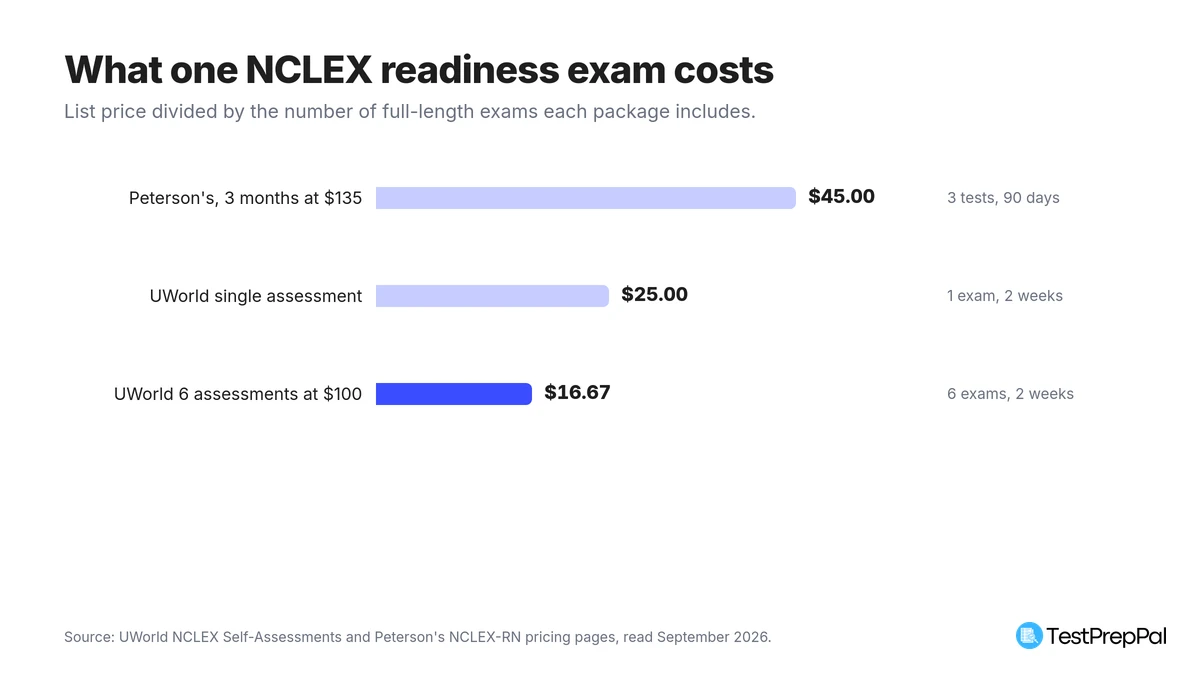 Cost per full-length readiness exam. Source: UWorld and Peterson's pricing pages, read September 2026.
The six-pack is the better arithmetic by a wide margin: $16.67 an exam against $25, and well under the $45 a Peterson's full-length test works out at. UWorld shows the $150 struck through with a "Save $50" badge, so $100 is what you pay at checkout.
The two full review courses are a different purchase. Both bundle up to 6 readiness exams alongside the question bank, videos, flashcards and study planner, and if you were already going to buy UWorld's NCLEX course then the assessments come with it and you should not buy them twice. The self-assessment packages exist for the candidate who is preparing with something else and wants UWorld's predictor anyway.
Every price here is a one-time purchase, not a subscription, so nothing auto-renews.
Who UWorld NCLEX Self-Assessments are best for
Best for the candidate deciding whether to schedule or move a test date. This is the question the product answers better than anything else on the market, and $25 to answer it is cheap next to the NCLEX registration fee and another month of studying.
Best for candidates preparing with a non-UWorld question bank. If you are working through Kaplan's NCLEX course or Archer, a UWorld predictor gives you a second opinion from a different author on a different scale, which is worth more than another few hundred questions from the bank you already own.
Best for repeat candidates. After a failed attempt, the Client Needs breakdown tells you where the ability gap actually sits, which is a far better basis for a study plan than starting the whole syllabus again.
Skip them if you have not finished content review. A readiness assessment taken with half the material unlearned returns a low band and a bill, and you already knew the answer.
When you might look elsewhere
Buy Archer Review instead if you want adaptive rehearsal rather than a prediction. Unlimited computer-adaptive exams from $129 is the closest thing on the market to sitting the real format repeatedly, which is exactly what a fixed 100-item test cannot give you.
Buy Peterson's NCLEX-RN practice tests instead if you want volume on a budget. Three full-length tests and about 1,200 questions for $135 over three months is more raw practice material, and the three-month window is far more forgiving than a fortnight. The trade is that you get no calibrated readiness score at the end of it.
Buy the full UWorld NCLEX package instead if you have not yet chosen a question bank. From $139 you get the assessments, the bank and the rest, and buying the pieces separately costs more.
If you are still working out what the exam demands before you spend anything, start with the NCLEX hub, and the rest of the category sits on our NCLEX practice tests listing. How we score and verify these products is set out in our review methodology.
Final verdict
UWorld NCLEX Self-Assessments earn 4.0 out of 5. The scoring model is the most defensible in NCLEX prep, the Client Needs report turns a bad result into a study plan, and $25 for a single calibrated readiness check is the best value in the category. Points come off for terms rather than for quality: two weeks of access sits badly against the multi-month schedule UWorld itself recommends, the page states no refund or guarantee of any kind, and a fixed 100-item exam is not the variable-length adaptive test you will actually sit.
Buy a single assessment first. If the band comes back where you hoped, you have your answer for $25, and you never needed the other five.
UWorld NCLEX Self-Assessment FAQs
How accurate is the UWorld NCLEX self-assessment?
UWorld scores the assessments with an Item Response Theory model and applies the same partial credit rules NCSBN uses for Next Gen items, then reports a probability of passing rather than a percentage. That is a more defensible instrument than a raw practice-test score. It is still a prediction from 100 questions, so treat a band as evidence about your readiness, not as a result.
What is a good UWorld self-assessment score?
UWorld reports a probability of passing band rather than a target percentage, so the thing to look for is a high or very high band rather than a number. If your band comes back low, the performance report breaks the result down by NCSBN Client Needs category and by system, which is the list of topics to work through before you retest.
How many UWorld NCLEX self-assessments are there?
Six, each holding 100 unique questions, for 600 questions in total. UWorld states that no question repeats across the six, so you can take one as a baseline and keep the rest for checkpoints without seeing the same items twice.
How long do you get to complete a UWorld NCLEX self-assessment?
Exactly 3 hours and 26 minutes for the 100 questions, and the assessment cannot be paused once it starts. UWorld enforces this to mirror testing centre conditions, where the clock keeps running through breaks. The real NCLEX gives you five hours in total for 85 to 150 items.
Do UWorld NCLEX self-assessments expire?
Yes. Every package, single or six-pack, is valid for two weeks from activation according to the pricing cards on UWorld's product page. The page does not state whether that clock runs per assessment or per package, so confirm with UWorld support before buying the six-pack ahead of a long study plan.
We may earn commissions from some links on this page, but this does not affect our reviews or your experience.
Our Verdict
UWorld's NCLEX Self-Assessments are the most defensibly scored readiness check in NCLEX prep, and at $25 for a single 100-question exam they are also the cheapest credible one. The probability of passing score is built on Item Response Theory and NCSBN partial credit rules, and the report breaks your result down by Client Needs category. The catch is the terms: every package expires two weeks after activation, and a fixed 100-item exam is not the variable-length adaptive test you will actually sit.