


The NCLEX-PN has its own blueprint, and on a minimum-length 85-item exam only 52 of your questions are both scored and assigned to one of its eight content areas. Coordinated Care is the largest of the eight at about 11 of those 52 questions, while Physiological Adaptation is worth about 5.
Most free NCLEX-PN study guides never get that far. They hand you the RN categories, or a list of nursing topics with no weights at all, and leave you to guess how much of your review each one deserves. This page does the conversion from the official PN percentages into real question counts, then shows the four places where studying for the PN should not look like studying for the RN.
- The current blueprint is the 2026 NCLEX-PN Test Plan, effective April 1, 2026 through March 31, 2029.
- An 85-item PN exam is 52 content questions, 18 clinical judgment case study questions, and 15 unscored pretest items.
- Coordinated Care is the single largest area, about 11 of those 52 questions, against 9 for its RN counterpart.
- The PN plan moves 7 percentage points off pharmacology and acute care and onto coordinated care and psychosocial integrity.
- In 2025 the average PN exam ran 100 items in 2 hours 18 minutes, and 64.6% of first-time candidates stopped at 85 items.
What the 2026 NCLEX-PN test plan actually weights
The test plan is NCSBN's own description of what the exam measures and in what proportion, and it is free. NCSBN rewrites it every three years, and the current NCLEX test plans took effect on April 1, 2026 and run through March 31, 2029. The percentages in the 2026 NCLEX-PN Test Plan come from the 2024 PN Practice Analysis, a survey of what newly licensed practical and vocational nurses actually do.
Before any percentage means anything, you need to know what it is a percentage of. The plan states that all LPN and LVN candidates answer at least 85 items and at most 150, inside a five-hour limit that includes every break. Of a minimum-length exam, 52 items come from the eight content areas, 18 are three clinical judgment case studies of six questions each, and the remaining 15 are unscored pretest items that look identical to the real ones.
So the percentages apply to 52 questions, not 85. Here is the whole blueprint with the official range, NCSBN's own target share for each area, and what that share works out to in questions.
| Content area | Official range | Target share | Questions at 85 items |
|---|---|---|---|
| Coordinated Care | 18 to 24% | 21% | 11 |
| Safety and Infection Prevention and Control | 10 to 16% | 13% | 7 |
| Pharmacological Therapies | 10 to 16% | 13% | 7 |
| Psychosocial Integrity | 9 to 15% | 12% | 6 |
| Reduction of Risk Potential | 9 to 15% | 12% | 6 |
| Basic Care and Comfort | 7 to 13% | 10% | 5 |
| Physiological Adaptation | 7 to 13% | 10% | 5 |
| Health Promotion and Maintenance | 6 to 12% | 9% | 5 |
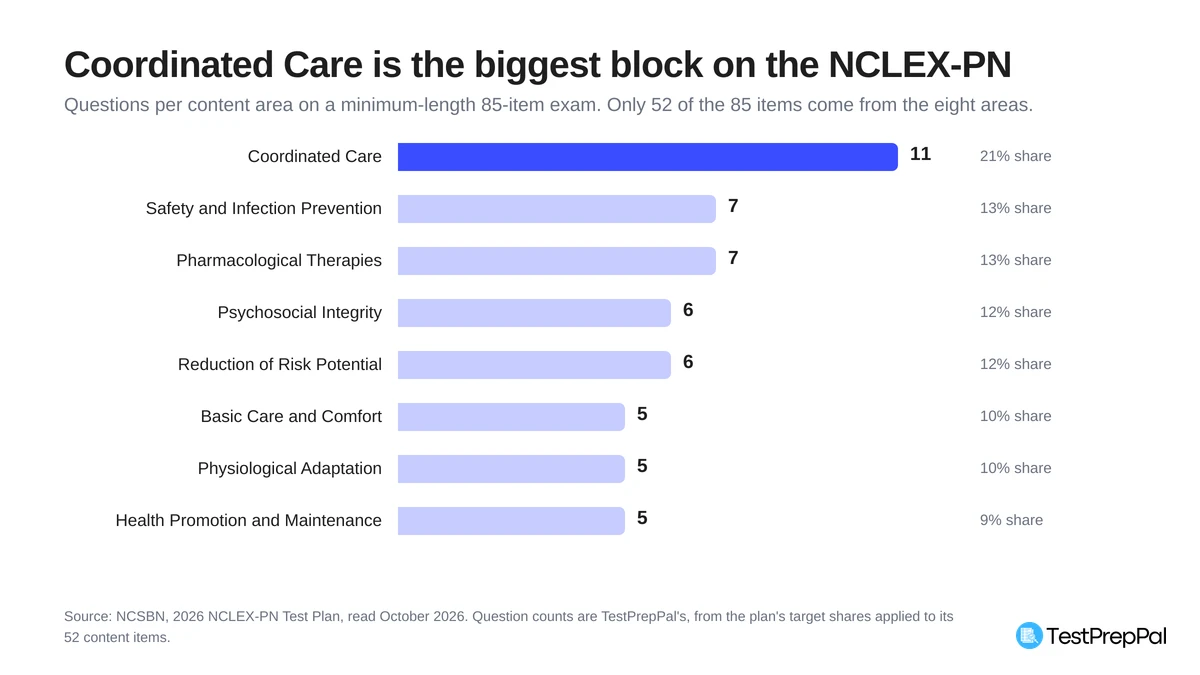 Questions per content area on a minimum-length NCLEX-PN, from the test plan's target shares. Source: NCSBN, 2026 NCLEX-PN Test Plan.
That last column is ours rather than NCSBN's. NCSBN publishes shares and an item budget, never a question count per category, so the arithmetic that turns one into the other is the part most guides skip. The eight rounded counts add up to exactly 52, which is the check that matters.
Two caveats before you build a plan on them. The plan allows an individual exam to differ by up to 3 percentage points in each category, so a real exam can land outside these counts. And the shortest exam is the smallest sample, which is why one weak area costs more on an 85-item test than on a 150-item one. At the maximum length the same shares apply to 117 content questions, so Coordinated Care becomes roughly 25 questions and Physiological Adaptation roughly 12.
Where PN preparation parts company with RN preparation
If you are sitting the NCLEX-PN and studying from RN material, this is the section that matters. The two exams now share every structural rule. The 2026 NCLEX-RN Test Plan sets the same 85 to 150 item range, the same five-hour limit, the same 15 pretest items, and the same 52 content questions at minimum length. Nothing about format, timing or item types separates them.
The weights are a different story. Four of the eight areas carry a different share on the PN, and they move in a consistent direction.
| Content area | PN target | RN target | Questions at 85 items |
|---|---|---|---|
| Coordinated Care, called Management of Care on the RN | 21% | 18% | 11 PN, 9 RN |
| Psychosocial Integrity | 12% | 9% | 6 PN, 5 RN |
| Basic Care and Comfort | 10% | 9% | 5 PN, 5 RN |
| Safety and Infection Prevention and Control | 13% | 13% | 7 PN, 7 RN |
| Health Promotion and Maintenance | 9% | 9% | 5 PN, 5 RN |
| Reduction of Risk Potential | 12% | 12% | 6 PN, 6 RN |
| Pharmacological Therapies, and Parenteral on the RN | 13% | 16% | 7 PN, 8 RN |
| Physiological Adaptation | 10% | 14% | 5 PN, 7 RN |
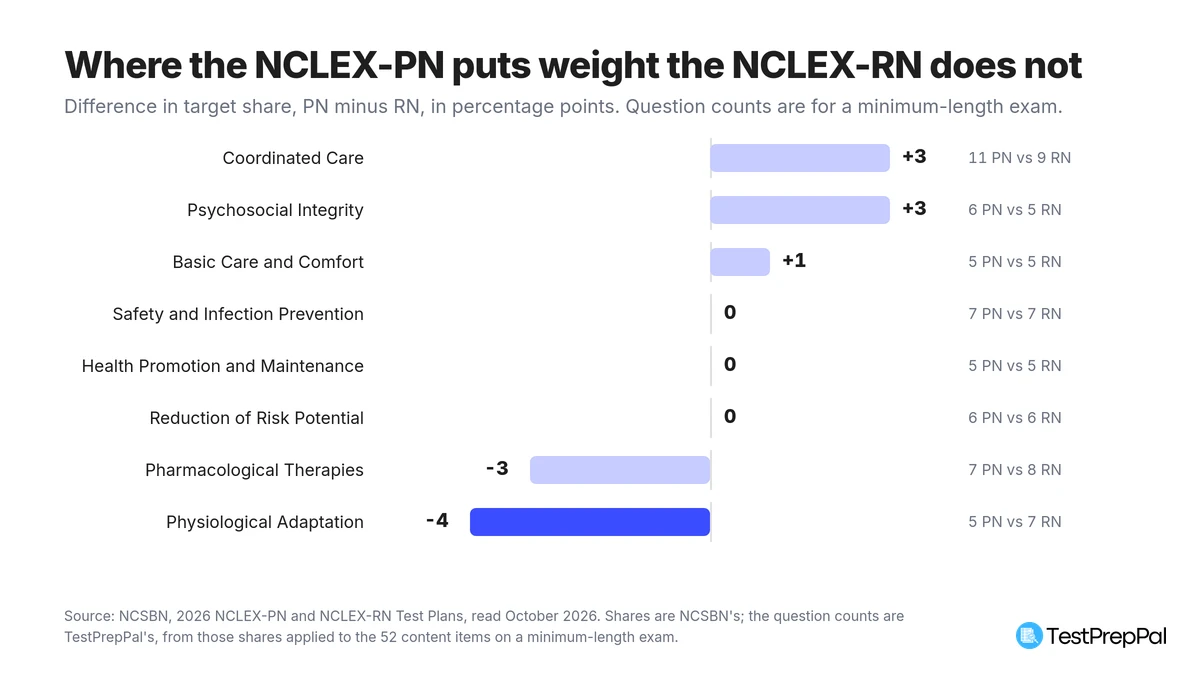 The four areas where the PN and RN blueprints disagree, in percentage points. Source: NCSBN, 2026 NCLEX-PN and NCLEX-RN Test Plans.
Seven percentage points move off pharmacology and acute physiological adaptation, and the same seven land on coordinated care and psychosocial integrity. That tracks scope of practice: an LPN or LVN spends more of the job on care coordination, supervision and the psychosocial side, and less of it on the unstable, life-threatening end that drives the RN exam.
The rollup makes the same point more bluntly. Group the eight areas into their parent categories and Physiological Integrity is about half the RN content exam, 26 of 52 questions, but 23 of 52 on the PN. Safe and Effective Care Environment runs the other way: 18 of 52 on the PN against 16 on the RN. On the PN exam, the biggest single block of questions is about how care is organised and delegated, not about pathophysiology.
Our NCLEX study guide covers the RN blueprint in the same detail if you are sitting both, and the free NCLEX-PN practice questions are mixed to the PN table above rather than the RN one, with 52 questions matching the 52 scored content items.
How long an NCLEX-PN actually runs
The 85 to 150 range is the rule. What candidates actually experience is in NCSBN's 2025 NCLEX Examination Statistics, published in June 2026, and almost nobody quotes the PN half of it.
| What happened in 2025 | NCLEX-PN | NCLEX-RN |
|---|---|---|
| Average exam length | 100 items | 103 items |
| Stopped at the 85-item minimum | 64.6% | 59.1% |
| Ran to the 150-item maximum | 17.7% | 20.5% |
| Average testing time | 2 hours 18 min | 2 hours 14 min |
| Used the full five hours | 0.7% | 0.5% |
Read those figures together and the five-hour limit stops being the thing to plan around. The average PN candidate finished in 2 hours 18 minutes, which is 46% of the time allowed, at a pace of about 1 minute 23 seconds per question. Two thirds stopped at 85 items. Running out of time is not the realistic failure mode on this exam, and building your practice around speed drills is solving a problem most candidates do not have.
The other number worth internalising is that a short exam is not a bad sign. Nearly 65% of first-time PN candidates saw exactly 85 items, and 86.6% of first-time candidates passed overall, so even if every single failure came from that group, at least three in four of the people who stopped at 85 still passed. If you want the mechanics of why the computer stops when it does, we cover them in the NCLEX exam guide and the NCLEX pass probability calculator walks through what your own exam length does and does not tell you.
How hard the NCLEX-PN is to pass
In 2025, 86.6% of first-time, US-educated candidates passed the NCLEX-PN, out of 54,818 who tested. The all-candidate rate across all 68,996 PN testers was 77.3%. Those two numbers describe very different people, and the gap between them is where the useful advice lives.
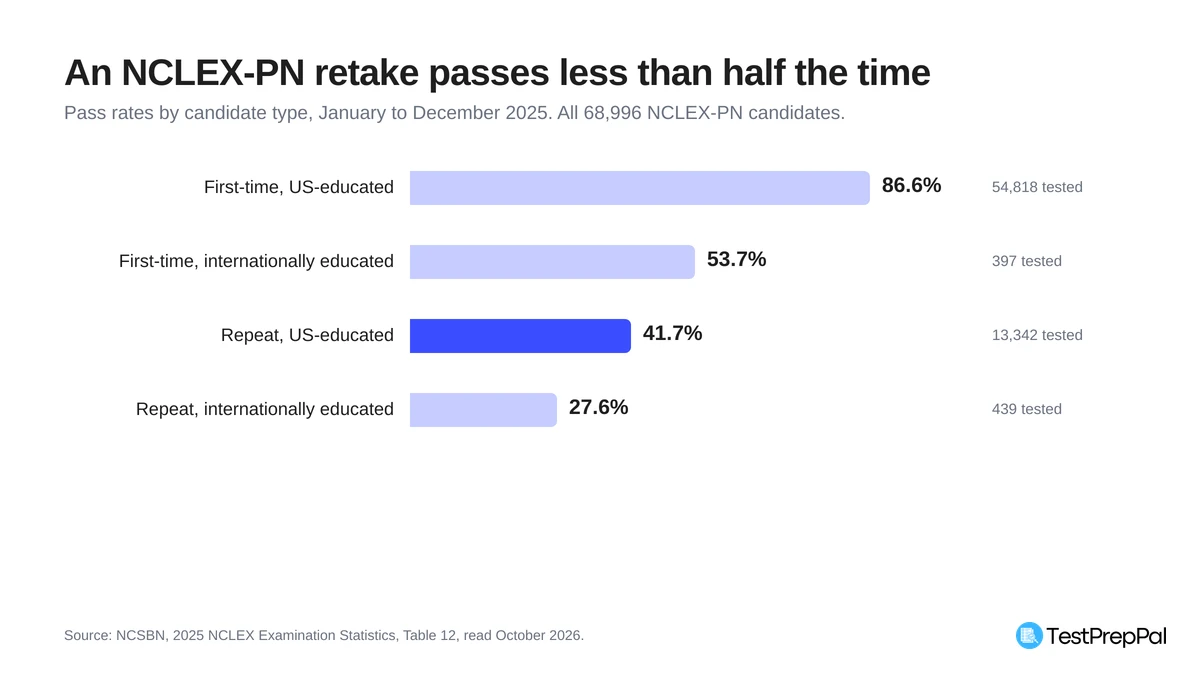 NCLEX-PN pass rates by candidate type, 2025. Source: NCSBN, 2025 NCLEX Examination Statistics.
Repeat US-educated candidates passed at 41.7%, which is 44.9 points below the first-time rate. That is the strongest argument there is for over-preparing the first attempt rather than booking early and treating attempt one as a diagnostic. Retakes were 13,342 of the 68,996 PN candidates in 2025, so roughly one in five people sitting the exam had sat it before.
Within the year, the first-time rate moved more than you might expect: 86.3% in the first quarter, 86.5% in the second, 88.8% in the third and 83.5% in the fourth, a spread of 5.3 points. Quarterly cohorts differ in who is in them, so treat any single quarter as noise rather than a trend. Our NCLEX pass rate article has the full RN and PN tables by candidate type, degree and state.
One thing the pass rate does not mean: the bar did not move. The PN passing standard has sat at -0.18 logits since March 2020 and NCSBN retained it in April 2026. There is no percentage you need to score, which is why the NCLEX has no passing score in the usual sense.
A study order built from the PN weights
The blueprint tells you what to weight. It does not tell you what to do first. A defensible order for a PN candidate looks like this.
- Start with Coordinated Care, not pharmacology. It is the largest area on your exam at about 11 of 52 questions, it is mostly delegation, supervision, scope of practice, client rights and prioritization, and it is the area where knowing the content does not automatically produce the right answer. LPN scope questions are also the ones RN material will teach you wrong.
- Give Psychosocial Integrity real time. At 12% it carries a third more weight on the PN than on the RN. Therapeutic communication, coping, grief and behavioural interventions are easy to leave until last and are worth about 6 questions.
- Do not cut pharmacology, but do not let it eat the plan. It is 13% on the PN, worth about 7 questions, the same as safety and infection control. Candidates routinely give it a third of their study time.
- Practise in mixed sets rather than by topic. The exam never tells you which category a question belongs to, and sorting is part of the skill being tested. Our free NCLEX-PN practice questions score you by content area so you can see which of the eight is actually weak.
- Read the rationale on questions you got right. On an adaptive exam a lucky guess is a weak area you have not found yet, and this is the single job worth paying a question bank for. The NCLEX question bank roundup compares the main options on coverage, reporting and price.
- Build the calendar last. Once you know the weights, the NCLEX study plan generator turns your test date into a weekly schedule, and it handles PN as well as RN.
For everything else in one place, start at the NCLEX hub, and check the NCLEX free resources page before you pay for anything.
What to check before you pay for a PN study guide
Three questions sort the useful PN material from the rest.
Does it name the PN categories? If a guide says "Management of Care", it is RN material. The PN plan calls that area Coordinated Care, and Pharmacological Therapies drops the word Parenteral. The category names are the quickest tell.
Does it carry a date after April 2026? The current plan took effect on April 1, 2026. An older guide is not wrong about nursing, but it is quoting a document your exam is no longer built from, and it will not match the language on your candidate performance report. Edition dates are the main thing we check in the NCLEX prep book roundup, where several widely sold titles are years old.
Does it report performance by content area? A bank that gives you one percentage is telling you almost nothing. A bank that tells you how you did on Coordinated Care against Psychosocial Integrity is the only kind that lets you act on the table at the top of this page.
NCLEX-PN study guide FAQs
What is the best way to study for the NCLEX-PN?
Weight your review by the PN shares rather than the RN ones, which means starting with Coordinated Care at about 11 of the 52 content questions and giving Psychosocial Integrity more time than RN material suggests. After that, practise in mixed sets instead of by topic and read the rationale on every question, including the ones you answered correctly. The official test plan is free and is the only authoritative description of what is on the exam.
Is the NCLEX-PN hard to pass?
In 2025, 86.6% of first-time, US-educated candidates passed, so most well-prepared first-time candidates do pass. The number that should shape your planning is the repeat rate of 41.7%, nearly 45 points lower, which is why the first attempt is worth preparing properly for rather than using as a trial run.
How many questions are on the NCLEX-PN?
Between 85 and 150, inside a five-hour limit. On a minimum-length exam, 52 of those questions come from the eight content areas, 18 are clinical judgment case study questions, and 15 are unscored pretest items. In 2025 the average PN exam was 100 items long and took 2 hours 18 minutes.
Can I use an NCLEX-RN study guide for the NCLEX-PN?
Partly. The two exams share format, length, timing and item types, so anything about test mechanics transfers. The weights do not: compared with the RN, the PN puts 3 more percentage points on Coordinated Care and 3 more on Psychosocial Integrity, and 3 fewer on pharmacology and 4 fewer on Physiological Adaptation. Using RN percentages means misallocating roughly three questions of study in each direction.
We may earn commissions from some links on this page, but this does not affect our reviews or your experience.