


There is no NCLEX passing score, and that is not a dodge. The NCLEX-RN and NCLEX-PN are pass/fail exams measured against an ability standard rather than a point total: 0.00 logits on the NCLEX-RN and -0.18 logits on the NCLEX-PN, both held by NCSBN through March 31, 2029.
The question most people are really asking is what percentage they need to get right. That question has an answer too, and it is more useful than the usual "it depends": on a computer-adaptive test almost everyone sits near 50 percent correct, whether they pass or fail, because the software picks items you are expected to find hard. This page explains the standard, the unit it is measured in, and why no percentage can be the cutoff.
- The passing standard is an ability level, not a score: 0.00 logits (RN) and -0.18 logits (PN).
- NCSBN reevaluates the standard every three years. The current values run through March 31, 2029.
- A minimum-length exam is 85 items, of which only 70 are scored. The other 15 are unscored pretest items.
- Percent correct is not a passing criterion. The algorithm targets items to your ability, so most candidates hover near half correct regardless of outcome.
- Three rules end the exam: the 95 percent confidence rule, the maximum-length rule at 150 items, and the run-out-of-time rule.
- The number of items you get is not a signal. You can pass or fail at 85 items and at 150.
What the NCLEX passing standard actually is
The passing standard is the amount of nursing ability needed to practice safely at entry level. NCSBN's Board of Directors sets it, and reevaluates it once every three years when the test plans are reviewed. The board last acted to hold both standards where they are, and they now run through March 31, 2029.
| Exam | Passing standard | Effective through |
|---|---|---|
| NCLEX-RN | 0.00 logits | March 31, 2029 |
| NCLEX-PN | -0.18 logits | March 31, 2029 |
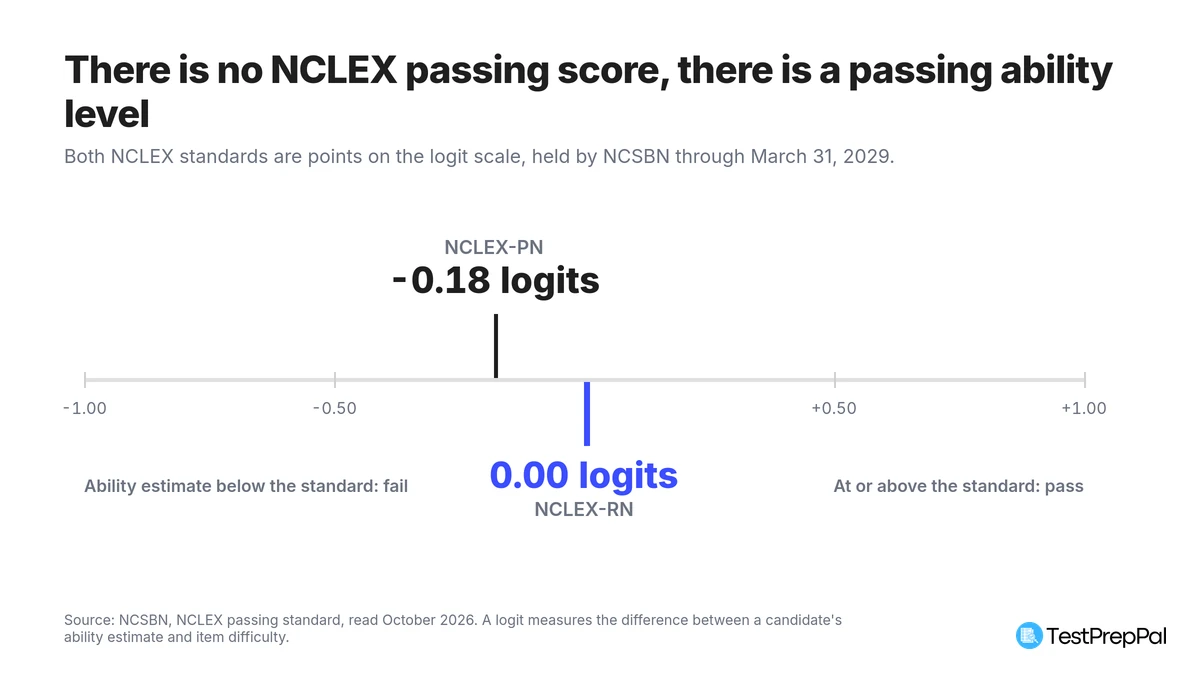 The two NCLEX passing standards on the logit scale. Source: NCSBN, NCLEX passing standard.
Notice what is missing from that table. There is no raw score, no scaled score, no percentage and no number of items you have to answer correctly. The 2026 NCLEX-RN Test Plan describes the criterion in words, not points: the minimum level of ability required for safe and effective entry-level nursing practice. Your result is a comparison between two quantities on one scale, and nothing else.
What a logit is, in plain terms
A logit is a unit of distance on an ability scale. NCSBN defines it as a unit of measurement to report relative differences between candidate ability estimates and item difficulties. The important word is relative: the same scale measures how able you are and how hard an item is, so the two can be subtracted.
That subtraction is the whole model. In the measurement framework the NCLEX uses, the probability that you answer an item correctly is a function of the difference between your ability and the item's difficulty, and an item sits at the point where the expected score is 0.5. Put plainly: an item is "at your level" when you have about a 50 percent chance of getting it right. Items below your level you will usually get right, items above it you will usually get wrong.
So 0.00 logits on the NCLEX-RN is not zero knowledge. It is a fixed reference point on that scale, chosen to mark entry-level competence. The NCLEX-PN standard of -0.18 logits sits a short distance below it on the same kind of scale, because it certifies a different scope of practice against a different test plan.
Two terms are worth separating, because NCSBN separates them. Your candidate ability is what you actually know. Your ability estimate is what the computer has worked out about you from the items you have answered. Only the estimate can be measured, and it gets more precise with every item.
Can you pass the NCLEX with 60 percent?
The honest answer is that percent correct is not a quantity the NCLEX uses, and two separate facts stop you from converting your result into one.
First, you do not know the denominator. Every exam includes 15 unscored pretest items, in the test plan's own words items being trialled for future use whose difficulty is not yet known. They are excluded from your ability estimate and from the pass-fail decision, and they are written in the same formats as scored items, so you cannot tell them apart while testing. On a minimum-length exam that leaves 70 scored items out of the 85 you answered.
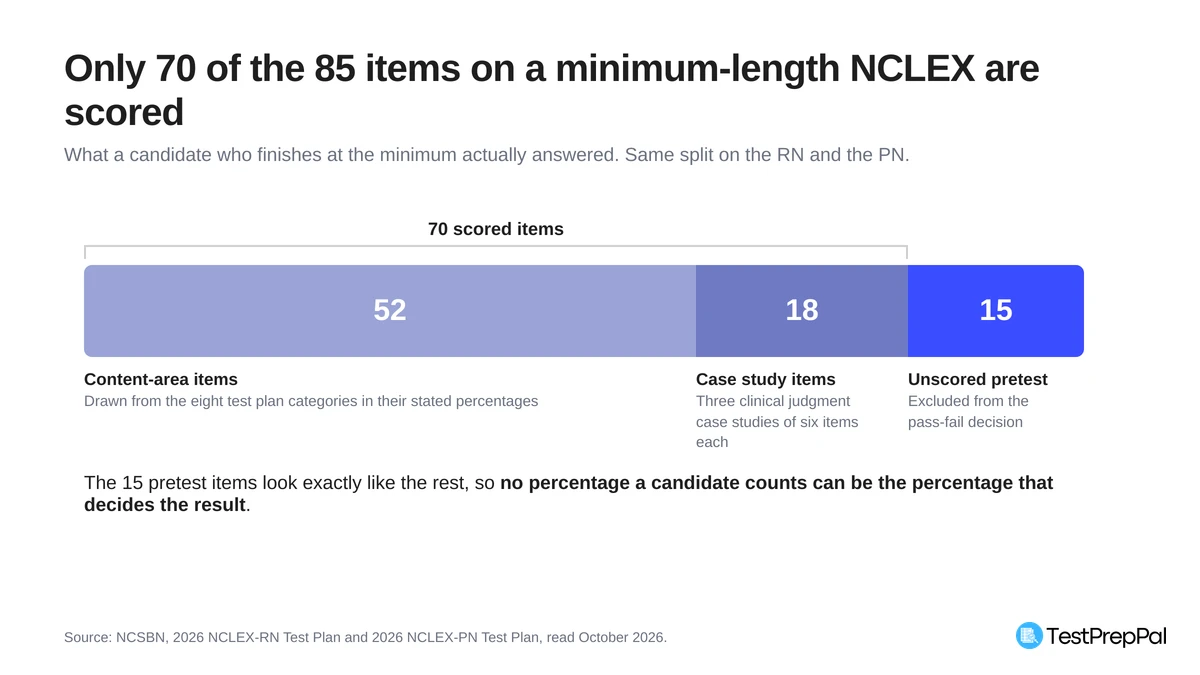 The composition of a minimum-length NCLEX. Source: NCSBN, 2026 NCLEX-RN and NCLEX-PN Test Plans.
Second, and more decisively, the items are not a fixed set. Each item you receive is chosen, in NCSBN's words, to be challenging and aligned with your current ability estimate, neither too easy nor too hard. Combine that with the 50 percent property above and the consequence is unavoidable: a strong candidate and a weak candidate both answer roughly half of their own items correctly, because each of them was fed items at their own level. The two percentages look identical. The difficulty of the items behind them does not.
That is why percent correct carries no information about who passed. It is a number that converges to about the same value for nearly everyone, which makes it useless as a cutoff. What separates a pass from a fail is how hard the items were that you were answering by the end, not how many of them you got right.
There is a third wrinkle. Many NCLEX items have more than one correct option, and NCSBN uses three partial-credit scoring methods: plus/minus, zero/one and rationale scoring. Under the plus/minus method you earn points for correct options and lose them for incorrect ones, with a floor of zero. An item is not always a clean right or wrong, so even your own tally of "questions I got right" is not well defined.
If you take one thing from this page: on an adaptive exam, a percentage correct near 50 is the expected result for everyone, passing and failing alike. It is evidence that the software was working, not evidence about your result.
How the computer decides: the three pass-fail rules
The NCLEX ends in one of three ways. All three compare your final ability estimate to the standard; they differ only in when the exam stops.
| Rule | When it applies | How it decides |
|---|---|---|
| 95 percent confidence interval | The most common outcome | The exam stops once the computer is 95 percent certain your ability is clearly above or clearly below the standard, after the minimum items |
| Maximum-length exam | Your ability sits very close to the standard | At 150 items the confidence rule is set aside and only the final ability estimate counts. At or above the standard, you pass |
| Run-out-of-time (R.O.O.T.) | Time expires with no 95 percent decision | Below the minimum number of items, an automatic fail. At or above it, the final ability estimate decides |
The run-out-of-time rule is worth dwelling on, because an outdated version of it is still repeated across the web and in AI-generated summaries. You will see claims that if you run out of time, you pass based on your performance on the last 60 items. That is not what NCSBN's current documents say. Both 2026 test plans and the official CAT page give the same rule: if you did not reach the minimum number of items you fail, and if you did, the exam is scored on the final ability estimate computed from all completed items. There is no 60-item window in the current rule.
For context on timing, RN and LPN/VN candidates both get a five-hour appointment that includes all breaks, and both exams run from 85 to 150 items. The full format, item types and content categories are covered in our guide to the NCLEX exam.
Does finishing at 85 items mean anything?
No. NCSBN is direct about this in the same FAQ: the number of items alone does not determine or reveal pass-fail results. The exam stops when the algorithm has enough information, and it can reach that point quickly in either direction. Shutting off at the minimum means the computer became 95 percent certain about you early, and it does not say which way.
The data makes the same point. In 2024, the average NCLEX-RN candidate answered about 100 items, 65.4 percent stopped at the minimum and 16.7 percent went all the way to the maximum, with an average testing time of two hours and 14 minutes. On the PN the average was 99 items, with 67.8 percent stopping at the minimum. Those minimum-length groups contain both passing and failing candidates. Our NCLEX pass rate breakdown has the full outcome data by candidate type if you want to see where you sit.
If you have already tested and you are trying to read the tea leaves, that is a different question with a different answer, and we cover it properly in how to know if you passed the NCLEX. Counting your items is not a method.
What you can control is the ability estimate itself, which means answering harder items correctly. That is a preparation problem rather than a test-day tactic: work through a question bank that pushes past recall into clinical judgment, since case study items are 18 of the 70 scored items on a minimum-length exam, and build a schedule with our NCLEX study guide. If you want a rough read on where you stand before test day, the NCLEX pass probability calculator estimates it from your practice performance. Everything else about the exam, including dates and registration, starts from the NCLEX hub. How we evaluate the prep products we recommend is set out in our review methodology.
NCLEX passing score FAQs
What are the 3 NCLEX pass or fail decision rules?
The 95 percent confidence interval rule, the maximum-length exam rule and the run-out-of-time rule. The first stops the exam once the computer is 95 percent certain you are clearly above or clearly below the standard. The second applies when your ability sits so close to the standard that the exam runs to 150 items, at which point only the final ability estimate counts. The third applies when time expires: you fail automatically if you did not answer the minimum number of items, and otherwise your final ability estimate from all completed items decides.
Can you pass the NCLEX with 85 questions?
Yes, and most people finish there. In 2024, 65.4 percent of NCLEX-RN candidates stopped at the minimum number of items. Stopping at 85 means the algorithm reached 95 percent certainty about your ability as early as it is allowed to, which can be certainty in either direction. The 75-item figure you may have seen belongs to an older version of the exam; the current minimum under both 2026 test plans is 85.
Is 50 percent passing for the NCLEX?
No percentage passes or fails, so 50 percent is neither a cutoff nor a target. It is simply close to what the adaptive algorithm produces for most candidates, because it selects items you have roughly an even chance of answering correctly. Your result depends on the difficulty of the items you were handling at the end, not on the share you got right.
Is the NCLEX-PN easier to pass than the NCLEX-RN?
The PN standard is numerically lower, -0.18 logits against 0.00 for the RN, but that is not a discount. Each standard is set against its own test plan for its own scope of practice, so the two numbers are not measuring the same candidates against the same content. A PN candidate is not being asked to clear a lower bar on the RN exam.
We may earn commissions from some links on this page, but this does not affect our reviews or your experience.