


In 2025, the most recent full year NCSBN has published, 86.7% of first-time, U.S.-educated candidates passed the NCLEX-RN and 86.6% passed the NCLEX-PN. The all-candidate NCLEX-RN pass rate was far lower at 69.1%, because that number blends in repeat testers and internationally educated candidates.
Both headline rates fell from 2024, when the first-time RN rate hit a record 91.2%. Below is the current NCLEX pass rate data straight from NCSBN's 2025 NCLEX Examination Statistics, published in June 2026, broken down by candidate type, by RN versus PN, by nursing degree, by state and over time, so you can see the number that actually applies to you.
If you have already sat the exam and are waiting, the odds matter less than the calendar: how to know if you passed the NCLEX covers the Quick Results fee, the two-business-day window and which boards take part.
- First-time, U.S.-educated candidates passed at 86.7% (RN) and 86.6% (PN) in 2025, per NCSBN.
- Both rates fell from 2024, when the RN rate was 91.2% and the PN rate 88.4%.
- The all-candidate NCLEX-RN pass rate was 69.1%, pulled down by repeat and internationally educated testers.
- Repeat testers pass at roughly 6 in 10 of the first-time rate: 52.7% for U.S.-educated RN repeaters.
- NCSBN retained the passing standard in April 2026, so a moving bar does not explain the drop.
- 2025 is the latest complete-year dataset. NCSBN has not published a 2026 annual report.
What is the current NCLEX pass rate?
The single number most people mean by "the NCLEX pass rate" is the first-time, U.S.-educated rate, because that describes the typical new graduate taking the test for the first time. For 2025 that was 86.7% on the NCLEX-RN and 86.6% on the NCLEX-PN.
Here is how every candidate group compares for both exams in 2025:
| Candidate group | NCLEX-RN pass rate | NCLEX-PN pass rate |
|---|---|---|
| First-time, U.S.-educated | 86.7% | 86.6% |
| Repeat, U.S.-educated | 52.7% | 41.7% |
| First-time, internationally educated | 47.3% | 53.7% |
| Repeat, internationally educated | 30.5% | 27.6% |
| All candidates | 69.1% | 77.3% |
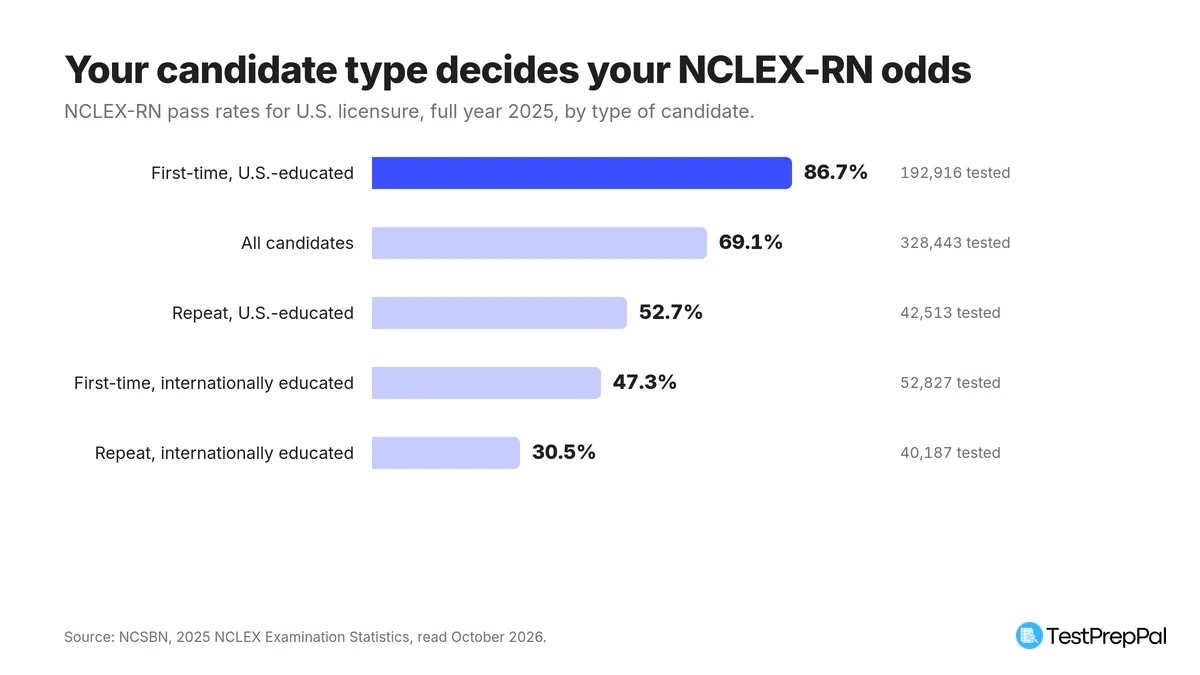 NCLEX-RN pass rates by candidate type, 2025. Source: NCSBN, 2025 NCLEX Examination Statistics.
The takeaway: if you trained in a U.S. program and this is your first attempt, your realistic reference point is around 87%, not the high-60s figure that circulates online.
NCLEX-RN pass rates by candidate type (2025)
The NCLEX-RN is the licensing exam for registered nurses. In 2025, more than 328,000 candidates sat for it under U.S. licensure, up from 317,867 the year before. The full breakdown, with the actual number tested and passing, looks like this:
| Candidate type | Number tested | Number passing | Pass rate |
|---|---|---|---|
| First-time, U.S.-educated | 192,916 | 167,272 | 86.7% |
| Repeat, U.S.-educated | 42,513 | 22,404 | 52.7% |
| First-time, internationally educated | 52,827 | 24,999 | 47.3% |
| Repeat, internationally educated | 40,187 | 12,271 | 30.5% |
| All candidates | 328,443 | 226,946 | 69.1% |
Two things stand out. First, the first-time U.S. group is by far the largest, so it drives most of the passes. Second, the "all candidates" rate is not a measure of how hard the exam is for you. It is an average across four very different groups, and the low repeat and international rates drag it down.
NCSBN also reports each quarter, and the newest quarter it has published is the fourth quarter of 2025:
| 2025 quarter | First-time, U.S.-educated | All candidates |
|---|---|---|
| Q1 (Jan to Mar) | 88.4% | 71.6% |
| Q2 (Apr to Jun) | 89.1% | 73.7% |
| Q3 (Jul to Sep) | 84.0% | 68.7% |
| Q4 (Oct to Dec) | 81.2% | 57.6% |
Do not read the Q4 figure as a collapse. Fourth quarter is the weakest quarter of every recent year, because the candidates who test in October to December skew toward people who delayed, and the 2024 statistics show the same shape: 94.2%, 92.7%, 89.2%, then 82.2%. What is new in 2025 is that every single quarter came in below its 2024 counterpart.
NCLEX-PN pass rates by candidate type (2025)
The NCLEX-PN is the exam for practical and vocational nurses (LPN or LVN). It has a smaller candidate pool, about 69,000 testers in 2025, and the same pattern by candidate type:
| Candidate type | Number tested | Number passing | Pass rate |
|---|---|---|---|
| First-time, U.S.-educated | 54,818 | 47,470 | 86.6% |
| Repeat, U.S.-educated | 13,342 | 5,558 | 41.7% |
| First-time, internationally educated | 397 | 213 | 53.7% |
| Repeat, internationally educated | 439 | 121 | 27.6% |
| All candidates | 68,996 | 53,362 | 77.3% |
The all-candidate PN rate (77.3%) is higher than the all-candidate RN rate (69.1%), even though first-time candidates on the two exams now pass at almost the same rate. The reason is mix: the RN pool has a much larger share of internationally educated candidates, who pass at lower rates, so their weight pulls the RN average down further. Only 836 internationally educated candidates sat the PN in 2025, against 93,014 on the RN.
How NCLEX pass rates have changed over time
NCLEX pass rates are not static. First-time, U.S.-educated NCLEX-RN pass rates slid through the early 2020s, bottomed out in 2022, jumped when the exam changed in 2023, peaked in 2024, and have now given back about half of that gain. Here is the recent trend, using NCSBN's annual figures:
| Year | First-time, U.S.-educated RN pass rate | Context |
|---|---|---|
| 2019 | 88.2% | Pre-decline reference point |
| 2021 | 82.5% | Multi-year slide |
| 2022 | 79.9% | Lowest point, final full pre-NGN year |
| 2023 | 88.6% | Next Generation NCLEX launched in April |
| 2024 | 91.2% | Highest year on record |
| 2025 | 86.7% | Latest full year |
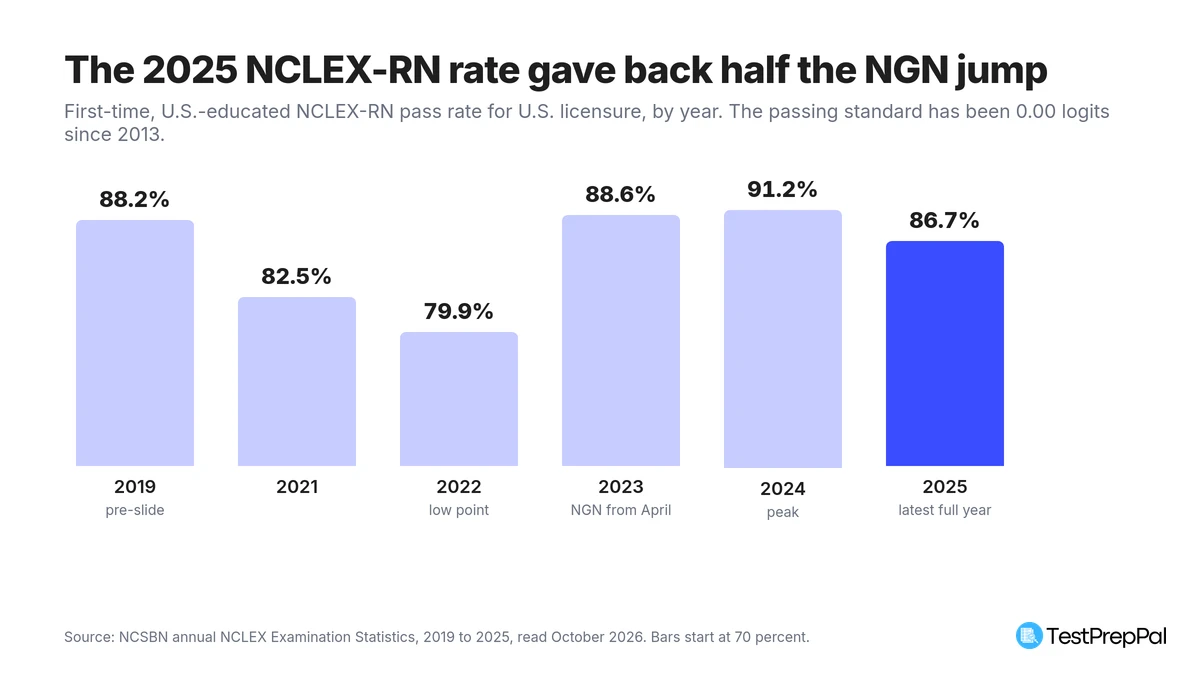 First-time, U.S.-educated NCLEX-RN annual pass rate, 2019 to 2025. Source: NCSBN annual NCLEX Examination Statistics.
Read across the whole table rather than the last two rows. The 2025 rate is still nearly 7 points above the 2022 low, and it sits between the 2019 and 2023 figures. What 2024 looks like, with another year of data behind it, is a peak rather than a new normal.
The Next Generation NCLEX effect
The clearest signal in the data is what happened inside 2023. The Next Generation NCLEX (NGN) launched on April 1, 2023, which fell right at the start of the second quarter. If you split 2023 by quarter for first-time, U.S.-educated NCLEX-RN candidates, the jump is hard to miss:
| 2023 quarter | Pass rate | Exam version |
|---|---|---|
| Q1 (Jan to Mar) | 80.5% | Old format |
| Q2 (Apr to Jun) | 94.3% | Next Generation NCLEX |
| Q3 (Jul to Sep) | 90.7% | Next Generation NCLEX |
| Q4 (Oct to Dec) | 88.6% | Next Generation NCLEX |
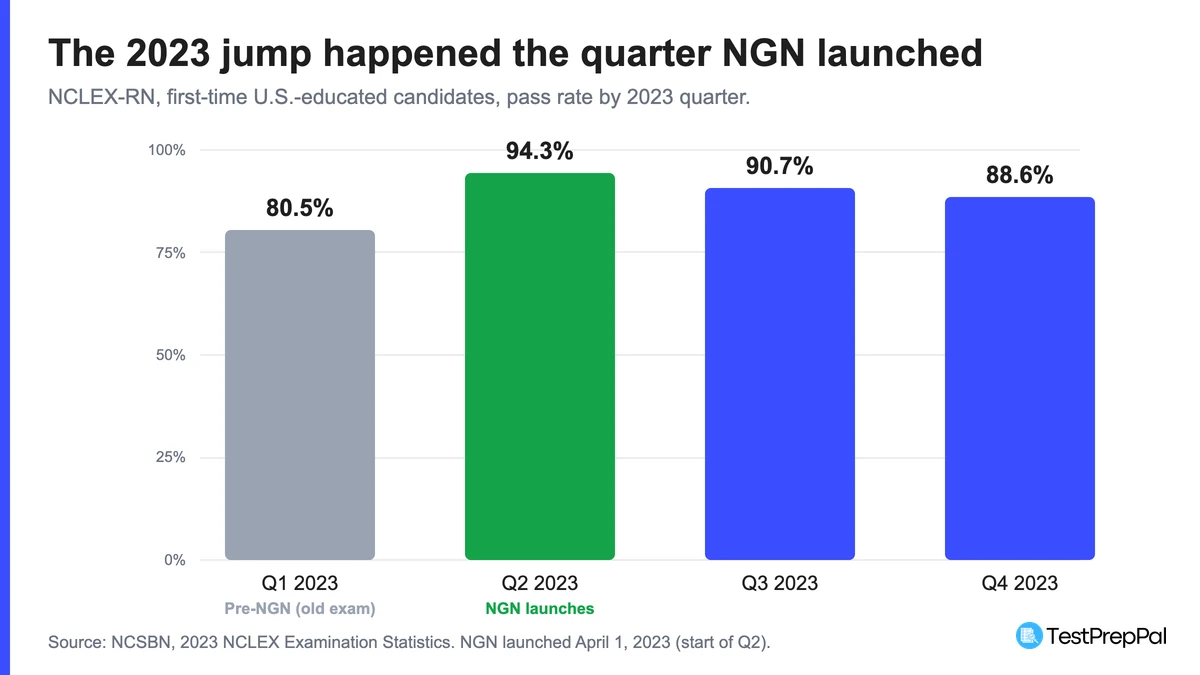 NCLEX-RN, first-time U.S.-educated pass rate by 2023 quarter. Source: NCSBN, 2023 NCLEX Examination Statistics.
The pass rate climbed from 80.5% in the final quarter of the old exam to 94.3% in the first quarter of NGN, a swing of nearly 14 points in one quarter. Three years of data later, here is the honest read:
- NCSBN did not lower the bar, and still has not. The RN passing standard has been 0.00 logits since 2013, and NCSBN retained it in April 2019, again in April 2023, and again in April 2026. The PN standard has been -0.18 logits since March 2020 and was likewise retained in April 2026. The exam changed format and content; the standard to pass did not get easier. What that standard actually measures, and why there is no NCLEX passing score in the usual sense, is a topic of its own.
- Cohort timing matters. Strong candidates who were ready in early 2023 often waited to test under the new format, and the mix of who tests in each quarter shifts. Quarter-to-quarter comparisons within a year always carry some of this noise.
- The spike did not last, but the gain did. The rate settled at 88.6% by Q4 2023, rose to 91.2% for full-year 2024, then fell to 86.7% in 2025. That is still well above every pre-NGN year since 2019.
The NGN adds question types built around clinical judgment (case studies, bow-tie items, matrix and drag-and-drop formats) and uses partial-credit scoring on some items. For a fuller explanation of the format and scoring, see our complete NCLEX exam guide.
RN and PN first-time rates both fell in 2025
Both exams moved the same way from 2024 to 2025 for first-time, U.S.-educated candidates. The NCLEX-RN fell from 91.2% to 86.7%, a drop of 4.5 points. The NCLEX-PN fell from 88.4% to 86.6%, a drop of 1.8 points. The two exams now sit within a tenth of a point of each other.
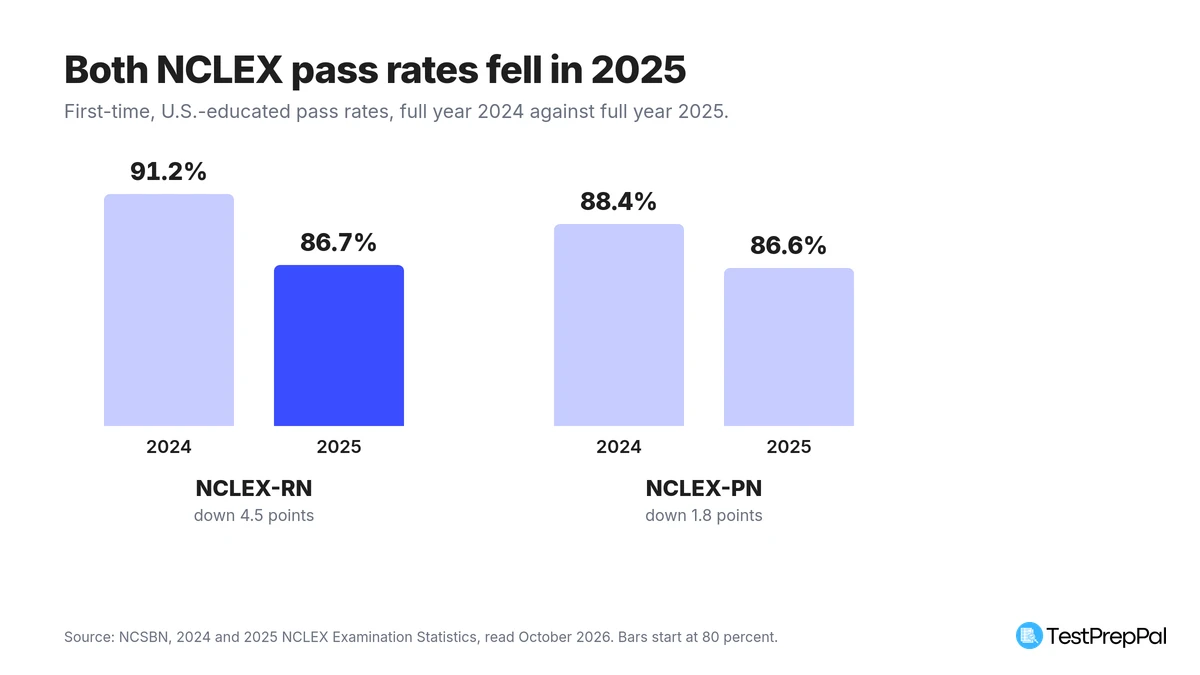 First-time, U.S.-educated pass rates, 2024 against 2025. Source: NCSBN, 2024 and 2025 NCLEX Examination Statistics.
NCLEX pass rates by nursing degree
For first-time, U.S.-educated NCLEX-RN candidates in 2025, the pass rate moves a little more between degree types than it did in 2024, but the spread is still small next to the gap between candidate types:
| Nursing program | Number tested (2025) | Pass rate | 2024 pass rate |
|---|---|---|---|
| Baccalaureate (BSN) | 100,258 | 87.6% | 91.9% |
| Associate degree (ADN) | 89,549 | 86.1% | 90.6% |
| Diploma | 2,671 | 83.3% | 90.8% |
BSN graduates kept a 1.5 point edge over ADN graduates. Diploma programs, which test only about 2,700 candidates a year, slipped furthest, though a group that small moves around more year to year. The degree you hold has a small effect on your first-time NCLEX odds. What matters far more is which of the four candidate groups you fall into, first-time or repeat, U.S.-educated or internationally educated.
The biggest driver of NCLEX pass rates is not the exam or your degree. It is whether it is your first attempt. First-time U.S.-educated candidates passed at 86.7% in 2025, while U.S.-educated repeat testers passed at 52.7%.
Do NCLEX pass rates vary by state?
Yes, and by more than most candidates expect. NCSBN reports first-time, U.S.-educated results by the jurisdiction a candidate applied to for licensure. Here are the ten jurisdictions with the most first-time candidates in 2025, against the 86.7% national figure:
| Jurisdiction | First-time candidates (2025) | Pass rate |
|---|---|---|
| Florida | 17,403 | 81.8% |
| Texas | 16,454 | 88.6% |
| California | 16,255 | 89.0% |
| New York | 11,418 | 82.3% |
| Ohio | 8,529 | 84.0% |
| Pennsylvania | 7,742 | 90.4% |
| Illinois | 6,351 | 84.8% |
| Georgia | 5,468 | 86.0% |
| North Carolina | 5,236 | 89.7% |
| Arizona | 5,020 | 89.9% |
Across every jurisdiction with at least 1,000 first-time candidates, South Carolina was highest at 91.6% and Utah lowest at 79.1%, a spread of 12.5 points. That gap says more about the mix of programs in each state than about the exam, which is identical everywhere: the NCLEX is one national test with one passing standard, and no state board can make it easier or harder. If you are comparing schools, the per-program numbers your state board publishes are the ones worth reading.
Why repeat and international pass rates are so much lower
The low repeat and international numbers can be alarming if you do not know what is behind them. A few honest explanations:
- Repeat testers are, by definition, a filtered group. Everyone in the repeat pool already did not pass once. That group skews toward candidates with real content or test-taking gaps, so a rate near 50% is expected, not a sign the exam is unbeatable on a second try. The repeat RN rate actually rose in 2025, from 50.9% to 52.7%.
- Internationally educated candidates face extra hurdles. Differences in nursing curricula, English-language testing, and unfamiliarity with the U.S. clinical-judgment style all weigh on first-attempt scores. This group fell the furthest in 2025, from 53.8% to 47.3% on the RN.
- These are averages, not your ceiling. A pass rate is a snapshot of a population. It does not predict any single person's result, and it says nothing about how prepared you personally are on test day.
What the NCLEX pass rate does and does not tell you
Use the pass rate for context, not as a prediction. Here is the practical read:
- Find your group first. The number that matters is the one for your candidate type. For most readers of this page, that is the first-time, U.S.-educated rate near 87%.
- Ignore the all-candidate number for personal planning. It is useful for tracking national trends, but it mixes in repeat and international testers, so it understates a typical new graduate's odds.
- A pass rate is not a curve. The NCLEX has no preassigned percentage that passes or fails. Your result depends on whether your ability estimate clears the passing standard, not on how other candidates did.
- School-level pass rates can mislead. A program with 40 graduates and a 95% rate and one with 300 graduates and an 88% rate are not directly comparable. Look at the volume behind the percentage.
- Watch the year on any number you read. Plenty of pages still quote the 2024 peak of 91.2% as current. NCSBN's latest annual report covers 2025.
How to give yourself the best shot at passing
The candidates who pass on the first try tend to do the same handful of things. None of this is about talent; it is about preparing for the exam that actually exists in 2026.
- Study the current format, not old advice. The NGN rewards clinical judgment: recognizing cues, prioritizing, and evaluating outcomes. Practice with case studies and the newer item types, not just standalone recall questions.
- Work from one strong question bank. Depth beats variety. Pick a primary NCLEX question bank with NGN case studies, detailed rationales, and readiness assessments, and actually finish it rather than sampling five platforms.
- Review rationales, not just scores. For every missed question, identify whether it was a content gap or a judgment error, and what cue you missed. That review is where most of the improvement happens. Our free NCLEX practice questions include a rationale for every item, so you can practice that review habit at no cost.
- Consider structure if self-study stalls. If you have failed once or have large content gaps, a structured NCLEX prep course adds a study plan and accountability. You can also start with the free NCLEX resources and official NCSBN materials before spending anything.
Every resource we point to is rated against a documented review methodology, so you can see why we recommend it. To gauge your own readiness, or to make sense of how your exam ended, try our NCLEX pass probability calculator. For a full walkthrough of format, fees, eligibility, and a study timeline, read our NCLEX exam guide, and browse everything in one place at our NCLEX prep hub.
Frequently asked questions
What is the NCLEX pass rate in 2026?
The most recent full-year data comes from NCSBN's 2025 statistics, published in June 2026. In 2025, 86.7% of first-time, U.S.-educated candidates passed the NCLEX-RN and 86.6% passed the NCLEX-PN. The all-candidate NCLEX-RN pass rate, which includes repeat and internationally educated testers, was 69.1%. NCSBN has not published a 2026 annual report; in-year figures appear on its NCLEX pass rates dashboard, which it updates during the year.
Is the NCLEX getting harder in 2026?
The bar has not moved. NCSBN sets the passing standard for a three-year term, and in April 2026 it retained both standards: 0.00 logits on the NCLEX-RN, where it has sat since 2013, and -0.18 logits on the NCLEX-PN. Pass rates fell in 2025 against a fixed standard, which points to candidate preparation and cohort mix rather than a tougher exam. The format has not changed either; the Next Generation item types have been in place since April 2023.
What is the first-time NCLEX-RN pass rate?
For first-time, U.S.-educated candidates, the NCLEX-RN pass rate was 86.7% in 2025, down from 91.2% in 2024. This is the number that best reflects a typical new U.S. nursing graduate taking the exam for the first time.
Why is the overall NCLEX pass rate so much lower than the first-time rate?
The overall or "all candidate" rate averages together four groups: first-time and repeat testers, and U.S.-educated and internationally educated candidates. Repeat testers (52.7% for U.S.-educated RN candidates) and internationally educated candidates (47.3% first-time) pass at much lower rates, which pulls the combined NCLEX-RN average down to 69.1%.
Did the Next Generation NCLEX make the exam harder to pass?
No. First-time, U.S.-educated NCLEX-RN pass rates went from 80.5% in the final pre-NGN quarter to 94.3% in the first NGN quarter of 2023, and every year since has been above the 79.9% pre-NGN low. NCSBN retained the passing standard through the transition rather than lowering it, and retained it again in April 2026.
What is the NCLEX-PN pass rate?
In 2025, the first-time, U.S.-educated NCLEX-PN pass rate was 86.6%, and the all-candidate rate was 77.3%, according to NCSBN. Both are down from 2024, when the figures were 88.4% and 79.1%.
Does my nursing degree affect my NCLEX pass rate?
Only a little. In 2025, first-time, U.S.-educated NCLEX-RN pass rates were 87.6% for BSN graduates, 86.1% for ADN graduates, and 83.3% for diploma graduates. Whether it is your first attempt matters far more than which degree you hold.
What happens if I fail the NCLEX?
You can retake it. The 2026 NCLEX Candidate Bulletin allows up to eight attempts per year with at least 45 test-free days between each examination, though individual nursing boards can set stricter limits. Repeat pass rates are lower as a group, but that reflects who ends up retaking, not a cap on your ability to pass on a later attempt. See our NCLEX exam guide for the full retake policy. A retake is also a fresh registration fee rather than a discounted second attempt, which our NCLEX cost guide works through board by board.
We may earn commissions from some links on this page, but this does not affect our reviews or your experience.