

The earliest you can find out is two business days after your exam, through the NCLEX Quick Results Service, and it costs $7.95. Your official result is separate: only your nursing regulatory body can send it, and NCSBN says it arrives within six weeks of your test date.
Everything else you have read about is a guess. This page covers the two routes that give you a real answer, in the order they arrive, and then takes the "Pearson VUE trick" seriously enough to check it against the rules it actually depends on.
- Quick Results costs $7.95 and is available two business days after your exam, if your board takes part.
- Your board lists 52 participating jurisdictions. Delaware is the only US state that is not one of them.
- Quick Results is unofficial. It does not authorize you to work as a nurse.
- The official result comes only from your nursing regulatory body, within six weeks.
- The "Pearson VUE trick" reads your registration status, not your result, and NCSBN states plainly that Pearson does not provide exam results.
- Stopping at 85 questions tells you nothing. NCSBN says a minimum-length exam can end in a fail.
The three ways people try to find out
Two of these are real services. One is folklore. Here is how they line up on the only thing that matters, which is whether they can actually tell you your result.
| Route | Cost | When | What it is |
|---|---|---|---|
| Quick Results Service | $7.95 | 2 business days | Unofficial result |
| Your nursing regulatory body | Included in licensure | Within 6 weeks | Official result |
| The "Pearson VUE trick" | $0 to look | Any time | Not a result |
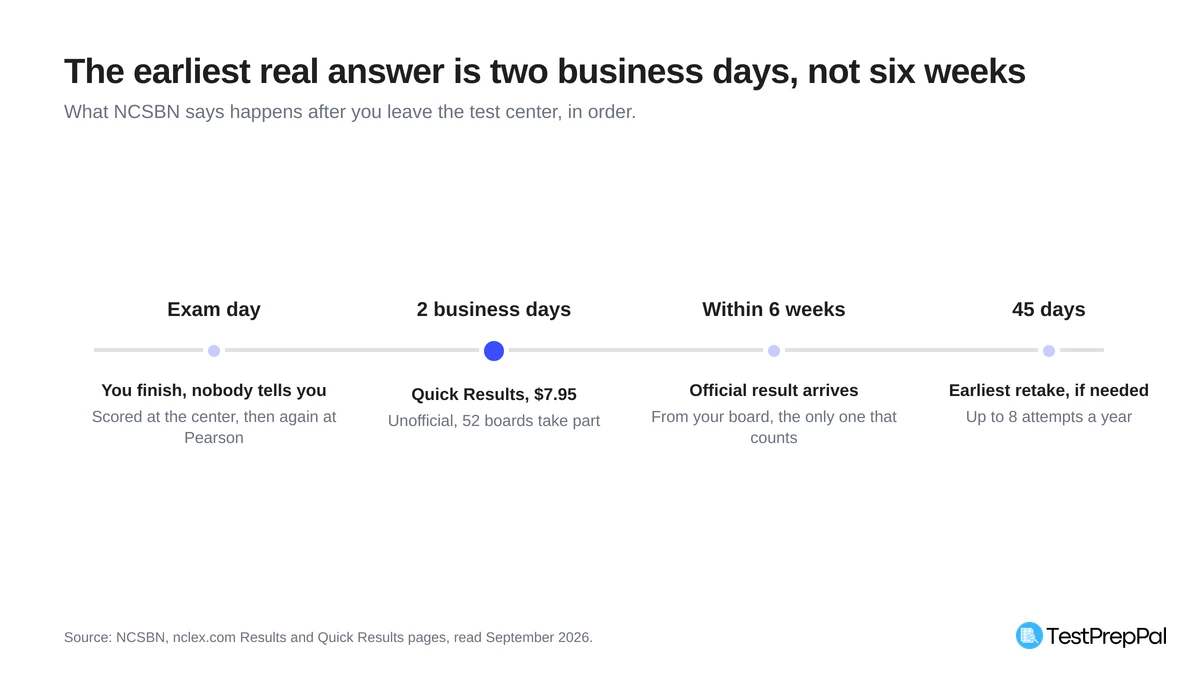 What happens after you leave the test center. Source: NCSBN, nclex.com Results and Quick Results pages.
Nobody at the test center knows your result, and neither does the person who checked your ID. NCSBN scores every NCLEX twice, once by the computer at the test center and again after your exam record reaches Pearson. That is why there is a wait at all, and it is why the same page tells candidates not to call NCSBN, Pearson Candidate Services or the test center asking for results.
Quick Results: what it costs and who can use it
Quick Results is the only early answer that comes from the people who run the exam. You buy it inside your own Pearson account: sign in, open "My Account," select "Quick Results," and pay. NCSBN sets the fee at $7.95 and notes that your card is only charged if your results are actually available, so an early attempt does not cost you anything.
Two details are worth knowing before you sit refreshing the page.
The timing wording is inconsistent on NCSBN's own site. The Results and Quick Results pages both say "two business days." The NCLEX FAQ page says "48 hours after their exam date and time." Over a weekend those are not the same thing. Plan on two business days, because that is the wording on the service's own page, and a Friday afternoon exam can mean a Tuesday answer.
Your board has to participate. Quick Results is not nationwide. NCSBN lists 52 participating jurisdictions, and counted against the 50 states, 49 appear. Delaware is the only US state missing from the list. The District of Columbia, the Northern Mariana Islands and the US Virgin Islands are included; Guam, Puerto Rico and American Samoa are not. If you are seeking licensure in one of those places, the six-week official notice is your only route, and no amount of refreshing changes that.
One thing Quick Results is not: permission to start work. NCSBN is explicit that the service does not authorize you to practice as a licensed or registered nurse. That comes from your board, with your license, and not before.
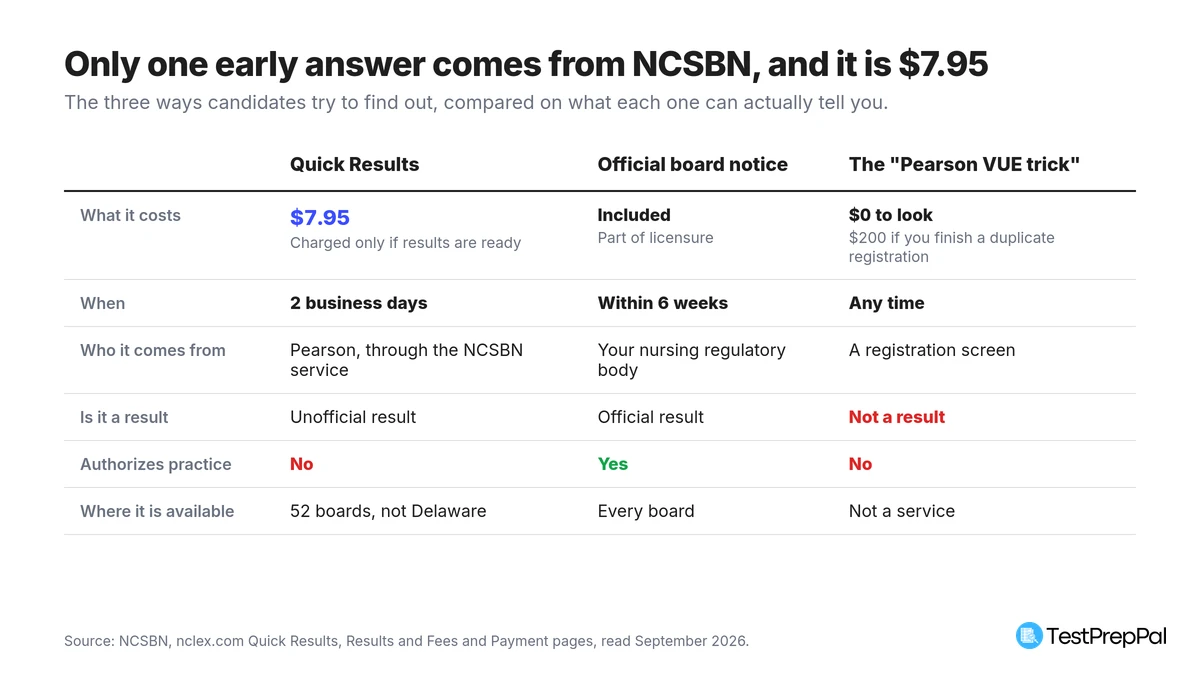 What each route costs and what it can tell you. Source: NCSBN, nclex.com Quick Results, Results and Fees and Payment pages.
The "Pearson VUE trick," checked against the rules it relies on
The trick works like this. Some hours after your exam, you go back into the Pearson system and start a new NCLEX registration. If you are stopped before the payment screen, the story goes, you passed. If you are allowed through to payment, you failed. Google's AI Overview for this search currently repeats it as something that "often means you passed," sourcing it to a Reddit thread and a Facebook group rather than to Pearson or NCSBN.
Here is the part the folklore pages leave out. NCSBN publishes the rule that produces the block. On its fees page, listing the situations in which registration fees are never refunded, NCSBN states that candidates cannot have more than one active registration for the same exam. That is a registration rule. It answers the question "do you already have a live registration for this exam," which is not the question "did you pass."
Two further facts from NCSBN settle what the screen can and cannot be. The FAQ states that Pearson and NCSBN do not provide exam results. And the same fees page warns candidates not to submit an additional registration without first contacting Pearson, and to stop payment on the original if they do.
The registration fee for US licensure is $200, rising to $350 on February 1, 2027, and NCSBN does not refund it for any reason. If a check for a $7.95 result ends in a completed duplicate registration, you have spent about 25 times the price of the real answer to get something that was never a result.
So the honest verdict: the trick is not a results service, it is an inference drawn from a payment screen, and NCSBN has published neither a validation of it nor any acknowledgement that it works. Wait the two business days and pay the $7.95, or wait for your board. If you want something to do with the anxiety in the meantime, our NCLEX pass probability calculator at least works from the published pass-rate data rather than from a checkout page.
The signs that genuinely mean nothing
Three of these circulate constantly, and NCSBN contradicts all three in its own words.
"It shut off at 85 questions, so I passed." No. NCSBN's FAQ states that the number of items alone does not determine or reveal pass or fail, and it explains what a short fail looks like: the exam stopped early because the algorithm was 95 percent certain the candidate's ability was below the passing standard. A minimum-length exam is simply a confident decision, in either direction. If you want the mechanics, the three stopping rules are covered in our guide to how the NCLEX works and on NCSBN's page on computerized adaptive testing.
"The questions got really hard at the end, so I was doing well." Also no. Because the test adapts, every candidate is steered toward items they have roughly a 50 percent chance of answering correctly. NCSBN says candidates cannot reliably tell which items are easy or hard, and that both high-ability and low-ability candidates find the end of the exam challenging. Feeling destroyed is the designed experience.
"I have not received a new Authorization to Test, so I passed." This one is repeated by a widely shared Princeton Review listicle, which calls the absence of a new ATT a "surefire sign" you passed. NCSBN's own retake steps say otherwise. A new ATT is issued only after you contact your board, are made eligible again, re-register with Pearson and pay the fee. In the days after your exam, nobody is sending you an ATT whether you passed or failed, so its absence carries no information at all.
One thing that does tell you, before the letter
If you failed, NCSBN sends a Candidate Performance Report. It is an individualized two-page document that goes only to candidates who do not pass, breaking your performance down by test plan content area and clinical judgment into "Below," "Near" and "Above the Passing Standard."
That makes the CPR the one piece of mail with an unambiguous meaning. Nobody who passed receives one. It arrives with or near your official result rather than ahead of it, so it is not a shortcut, but if a CPR turns up you already know what the letter says.
The CPR is also the most useful thing you will get from a failed attempt, because it tells you where to put the next round of study. Our NCLEX study guide maps those content areas to a revision plan, and the NCLEX question bank roundup covers the practice tools that report by the same categories.
What to do while you wait
Check whether your board is on the Quick Results list, and if it is, set a reminder for two business days after your exam rather than checking hourly. If it is not, find your board's license verification lookup through NCSBN's board contact directory; many boards post a new license number before the paper notice arrives, which is a real signal because it comes from the body that issues the result.
Do not start a new registration to see what happens. Do not call the test center. And keep the odds in proportion: if you are a first-time, US-educated candidate, the pass rate is around 91 percent, so the most likely explanation for the silence is simply that results take time.
If it does go the other way, the retake rules are straightforward. NCSBN allows a retake 45 days after your exam, up to eight attempts a year, and some boards impose longer waits. The free NCLEX resources collected on our NCLEX hub are a reasonable place to restart while you wait for your CPR.
NCLEX results FAQs
How do I check my NCLEX results online?
Sign in to your Pearson account, open "My Account," and select "Quick Results." If your board participates and your result is ready, you can buy the unofficial result for $7.95 starting two business days after your exam. Your official result is not online at Pearson at all: it comes from your nursing regulatory body, which is also where a new license number would appear.
Is it possible to get NCLEX results in 24 hours?
No. Two business days is the earliest anyone can tell you, and that is through Quick Results. NCSBN's FAQ page phrases the same window as 48 hours after your exam date and time, but the Quick Results page itself says two business days, so a weekend or a holiday can push the answer out further. There is no 24-hour route.
Does the exam shutting off at 85 questions mean I passed?
No. NCSBN states that the number of items alone does not determine or reveal your result. An exam can stop at the minimum length because the scoring algorithm reached 95 percent certainty that you were above the passing standard, or because it reached the same certainty that you were below it. A short exam is a confident result, not a good one.
Is the Pearson VUE trick accurate?
It is not a result, so accuracy is the wrong question to ask of it. What the registration screen reflects is whether you currently hold an active registration for that exam, a rule NCSBN publishes on its fees page. NCSBN also states that Pearson does not provide exam results. Neither organization has ever validated the trick, and a registration you actually complete costs $200 that is not refunded.
We may earn commissions from some links on this page, but this does not affect our reviews or your experience.