


You can retake the NCLEX 45 test-free days after your last attempt, and candidates applying through a participating nursing regulatory body can test eight times a year. Those two numbers come from NCSBN's retake policy, and they are the floor, not the rule that decides your date.
The rule that decides your date belongs to your board of nursing. A board can make you wait longer, make you take a remedial course, or pull the permit you have been working under. This page carries the national baseline first, then the board rules themselves, quoted from the statutes and administrative rules rather than summarized from another blog.
- The NCSBN baseline is 45 test-free days between attempts and 8 attempts a year.
- Those are the same constraint in practice: eight attempts at the minimum spacing already fills 315 days.
- No state caps attempts outright. What boards add are remediation triggers and deadlines.
- Florida and Hawaii require a board-approved remedial course after three failures, counted in any jurisdiction.
- A missed appointment or an expired Authorization to Test does not start the 45-day wait.
- A retake is a full fresh registration fee, never a discounted second attempt.
How soon can you retake the NCLEX?
Forty-five test-free days after the day you tested. NCSBN states the policy plainly: a candidate may retake the exam 45 days after administration, and some regulatory bodies require a longer gap, which shows up in the validity dates on the new Authorization to Test (ATT).
That is the waiting period. It is not the whole timeline, because the paperwork has to move in parallel.
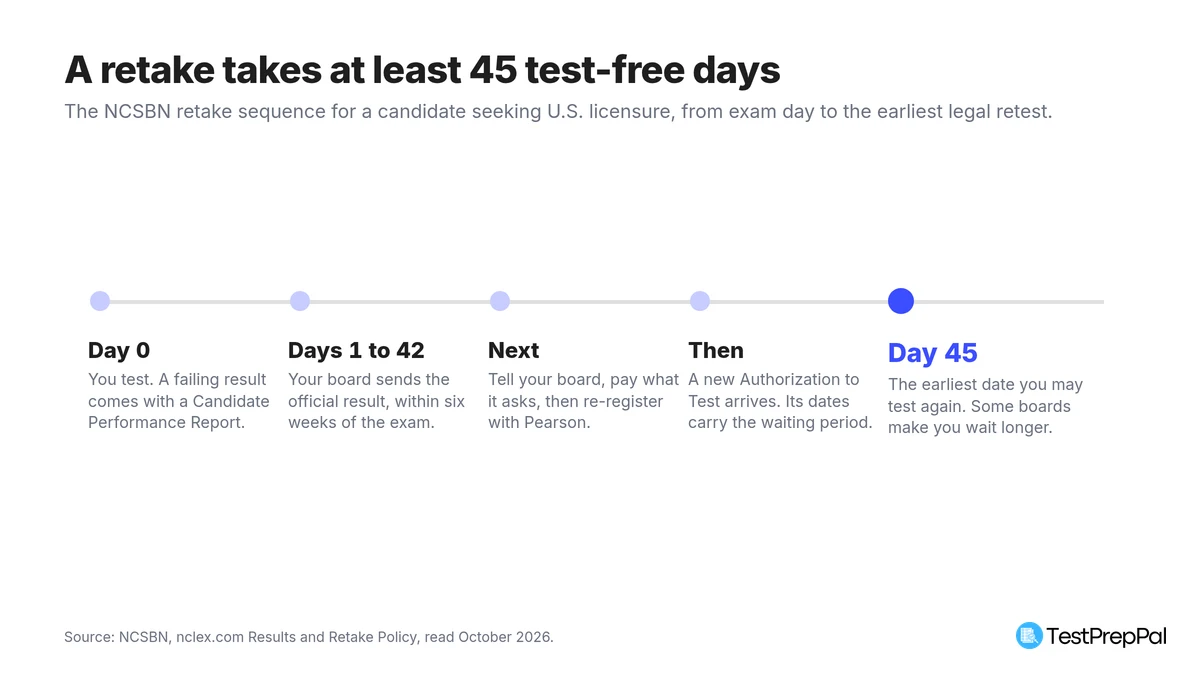 The NCSBN retake sequence, exam day to earliest retest. Source: NCSBN, nclex.com.
Your official result comes from your board, not from NCSBN or Pearson, and NCSBN allows it up to six weeks. So the results window and the waiting period run out at roughly the same time. If you want to start studying sooner than that, the unofficial route and which boards take part are covered in how to know if you passed the NCLEX.
One exception matters and almost nobody publishes it. The 45 days counts test-free days, so it only starts when you actually sat the exam. NCSBN's own help centre is explicit that if you missed an exam appointment or your ATT expired, you do not have to wait 45 days before you can retest. A no-show costs you the registration fee, not a month and a half.
How many times can you take the NCLEX?
Eight times in a year through a participating regulatory body, with the 45 test-free days between each one.
Read those two limits together and the second one mostly disappears. Seven gaps of 45 days is 315 days, so a candidate testing at the absolute minimum spacing reaches an eighth attempt on day 315 and would reach a ninth on day 360. The annual cap removes exactly one attempt that the waiting period would otherwise have allowed. For anyone taking a normal amount of time to prepare, the 45-day rule is the only one that binds.
There is no national lifetime limit on NCLEX attempts. The eight-a-year cap is an annual rate, not a total, and it resets. What can stop you permanently is a state condition you have not met, not a number of failures.
The practical ceiling is money and eligibility rather than attempts. Repeat candidates also pass at well under the first-time rate, which is the real argument for making the next attempt the last one: our NCLEX pass rate breakdown has the figures by candidate type, and the pass probability calculator gives you a readout on where you currently stand.
The state rules that override the baseline
Every page on this topic tells you to check your board. Few of them tell you what the boards actually say. Here are six, read this month from each state's own statute, rule or board page.
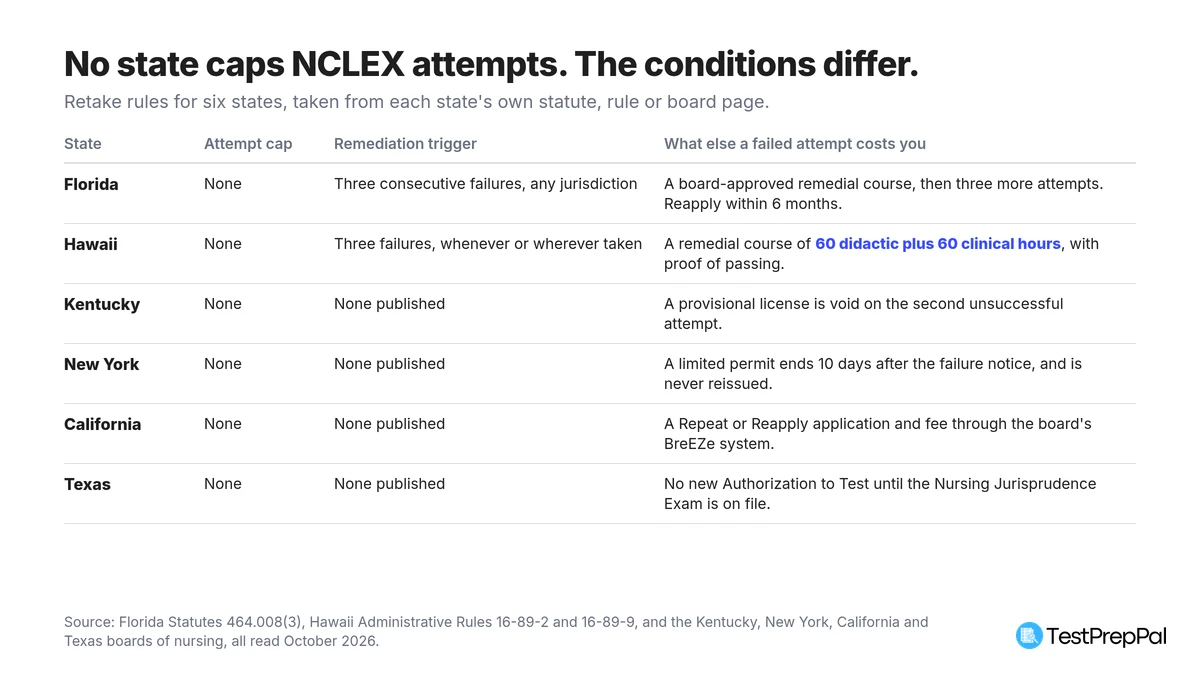 Retake conditions in six states. Source: state statutes, administrative rules and boards of nursing.
| State | Attempt cap | Remediation trigger | What else a failed attempt costs you |
|---|---|---|---|
| Florida | None | Three consecutive failures, any jurisdiction | Board-approved remedial course, then three more attempts |
| Hawaii | None | Three failures, whenever or wherever taken | Remedial course of 60 didactic plus 60 clinical hours |
| Kentucky | None | None published | Provisional license void on the second unsuccessful attempt |
| New York | None | None published | Limited permit ends 10 days after the failure notice |
| California | None | None published | A Repeat or Reapply application and its fee |
| Texas | None | None published | No new ATT until the Nursing Jurisprudence Exam is on file |
Florida and Hawaii: the remediation states
Florida sets the rule in statute, not in board guidance. Section 464.008(3) of the Florida Statutes requires any applicant who fails the examination three consecutive times to complete a board-approved remedial course before being approved for reexamination. Two details in that sentence get lost everywhere else. The failures count regardless of the jurisdiction in which the examination is taken, so moving states does not reset the counter. And after the remedial course, the applicant may be approved for up to three additional attempts before remediation is required again, with the reexamination application due within 6 months of finishing the course.
Hawaii's rule is almost word for word the same, and it adds the number that makes the requirement concrete. Under Hawaii Administrative Rules chapter 16-89, a candidate who fails three times, regardless of when or where the exam was taken and regardless of which jurisdiction made them eligible, must complete a board-approved remedial course and submit proof of passing it. The same chapter defines a remedial course as a minimum of 60 hours of didactic instruction and 60 hours of clinical instruction. That is 120 hours of coursework, which is a semester of your life, not a weekend review.
Note how far away that trigger actually is. Reaching a third attempt takes two waiting periods, so at least 90 test-free days pass before remediation can even apply, before any board processing time on top.
Kentucky, New York, California and Texas: the conditions that bite instead
The other four states set no attempt limit and no remediation trigger. They attach conditions elsewhere, and in two cases the condition is your ability to keep working.
Kentucky publishes a step-by-step retake page confirming the 45-day gap and no cap. It also states that a provisional license is valid for six months or is invalidated upon the second unsuccessful attempt, whichever comes first. Two more things on that page catch retakers out: an application is valid for one year, after which the whole process restarts, and a background check older than six months has to be redone.
New York has no attempt cap and no deadline to pass. Its cost sits in the limited permit. The state's RN license requirements say a limited permit is valid for up to one year or until 10 days after the graduate nurse is notified that they failed the NCLEX-RN, whichever happens first, and that anyone who has ever taken the NCLEX-RN is not eligible for a limited permit at all. In practice a New York graduate who fails has ten days of practice left and cannot get another permit while retaking.
California runs retakes through a Repeat or Reapply application in its BreEZe system. The Board of Registered Nursing publishes no lifetime attempt cap and no refresher-course requirement after three failures, which is worth saying out loud, because Google's AI answer for this query currently claims California has both.
Texas adds a step rather than a limit. The Board's examination information page states that the Nursing Jurisprudence Exam and the Pearson registration must both be complete before you can receive an ATT, and that a criminal background check already on file with the Board does not have to be repeated.
Everything above is what each source says as of October 2026. For a state not listed here, go to your board directly rather than to a list of states on a prep site. Those lists almost never link the rule they are describing.
The retake sequence, step by step
NCSBN sets out five steps, and the order is not optional. Register with Pearson before your board has made you eligible and you are paying to wait.
- Tell your board you intend to retest. It will tell you which forms, fees and materials it needs to make you eligible again.
- Submit what the board asks for. This is where background checks, transcripts and remediation proof land, and it is the step that sets your real timeline.
- Re-register with Pearson and pay the registration fee. The fee is $200 for U.S. licensure and rises to $350 on February 1, 2027. There is no reduced rate for a repeat attempt.
- Wait for the new ATT. Only the board can trigger it, and its validity dates already have the waiting period built in.
- Schedule the exam for a date inside the ATT window and no earlier than your 45th test-free day.
Two rules in NCSBN's registration terms cost retakers real money. A registration stays open for 365 days waiting on board eligibility, and if the board does not make you eligible inside that year, you forfeit both the registration and the fee. And you may not hold two open registrations for the same exam type: a second one is processed, denied, and the fee is not refunded. If your first registration is still open, do not start another to speed things up. The full picture of registration fees, board application fees and what a retake adds up to is on our NCLEX cost breakdown.
What your Candidate Performance Report is for
Every candidate who does not pass receives a Candidate Performance Report, and it is the only personalized feedback the NCLEX ever gives you. It shows how you performed in each content area of the test plan, which turns a pass or fail result into a study list.
Use it before you book anything. The exam is pass or fail with no score to improve on, so the only thing you can act on is the content breakdown and the clinical judgment skills behind it. Work from the weakest areas it names, through a question bank with rationales rather than a new set of lecture videos, and read the rationale on every item you answer, not only the ones you miss. If self-study already failed once, a structured NCLEX prep course buys you a plan and a deadline, and the free NCLEX resources are worth exhausting first. Every resource we point to is scored against a published review methodology.
One more scenario worth knowing about. If NCSBN cancels or invalidates a result without finding that the candidate engaged in irregular behavior, the candidate may appeal and will be offered a free retest. That is the one circumstance in which a second attempt costs nothing.
For the format, the item types and how the computerized adaptive test decides when to stop, start with our full NCLEX exam guide, and everything else we publish on the exam sits on the NCLEX hub.
NCLEX retake FAQs
How soon can I retake the NCLEX if I fail?
Forty-five test-free days after your last attempt, under NCSBN's national policy, and some boards require longer. The exact date is on your new Authorization to Test, because the waiting period is built into the ATT's validity dates. The calendar usually runs longer than 45 days anyway, since your board has to make you eligible again before Pearson can issue that ATT.
What happens if I fail the NCLEX 3 times?
Nationally, nothing changes: you re-register and keep going. In Florida and Hawaii the third failure triggers a board-approved remedial course before you can be approved to retest, and both states count failures taken in any jurisdiction, so testing in another state does not reset the count. Hawaii defines that course as at least 60 hours of didactic and 60 hours of clinical instruction.
How many times can you take the NCLEX in a year?
Eight, for candidates applying through a participating nursing regulatory body, with 45 test-free days between each attempt. There is no national lifetime cap. In practice the waiting period is the binding constraint, because eight attempts at the minimum spacing already covers 315 days of the year.
Do I have to wait 45 days if I missed my exam appointment?
No. The waiting period counts test-free days, so it only starts once you have actually sat the exam. NCSBN states that a missed appointment or an expired ATT does not require a 45-day wait before you retest. You will still lose the registration fee for the missed appointment, since NCLEX registration fees are never refunded.
Does a retake cost less than the first attempt?
No. A retake is a fresh registration at the full fee, currently $200 for U.S. licensure and $350 from February 1, 2027, plus whatever your board charges to reapply. Boards vary widely on that second figure, so check yours before you budget.
We may earn commissions from some links on this page, but this does not affect our reviews or your experience.