


The NCLEX has no fixed length. It runs between 85 and 150 items with a five-hour limit, but the exam most people actually sit is far shorter: in 2025 the average first-time RN candidate answered 103 items in 2 hours 14 minutes, according to NCSBN's 2025 NCLEX Examination Statistics.
That gap between the limit and the average is the whole answer. Five hours is the wall you plan around, not the day you should expect. Below is where exams actually end, how much of the clock candidates really use, and the three rules that decide when your screen goes blank.
- The NCLEX runs 85 to 150 items with a five-hour maximum. The RN and PN versions use identical limits.
- In 2025 the average first-time RN exam was 103 items in 2 hours 14 minutes, under half the allowance.
- 59.1 percent of first-time RN candidates stopped at the 85-item minimum. 20.5 percent ran to 150.
- Only 0.5 percent used the full five hours, so stamina for hour five is not the common failure mode.
- Those five hours cover the introductory screen, the exam and every break. Nothing pauses the clock.
- Exam length is not a result signal. You can pass or fail at 85 items and at 150.
Where the NCLEX actually ends
NCSBN publishes the distribution every year, and it is the data the search results almost never show. For first-time, US-educated candidates taking the NCLEX-RN between January and December 2025:
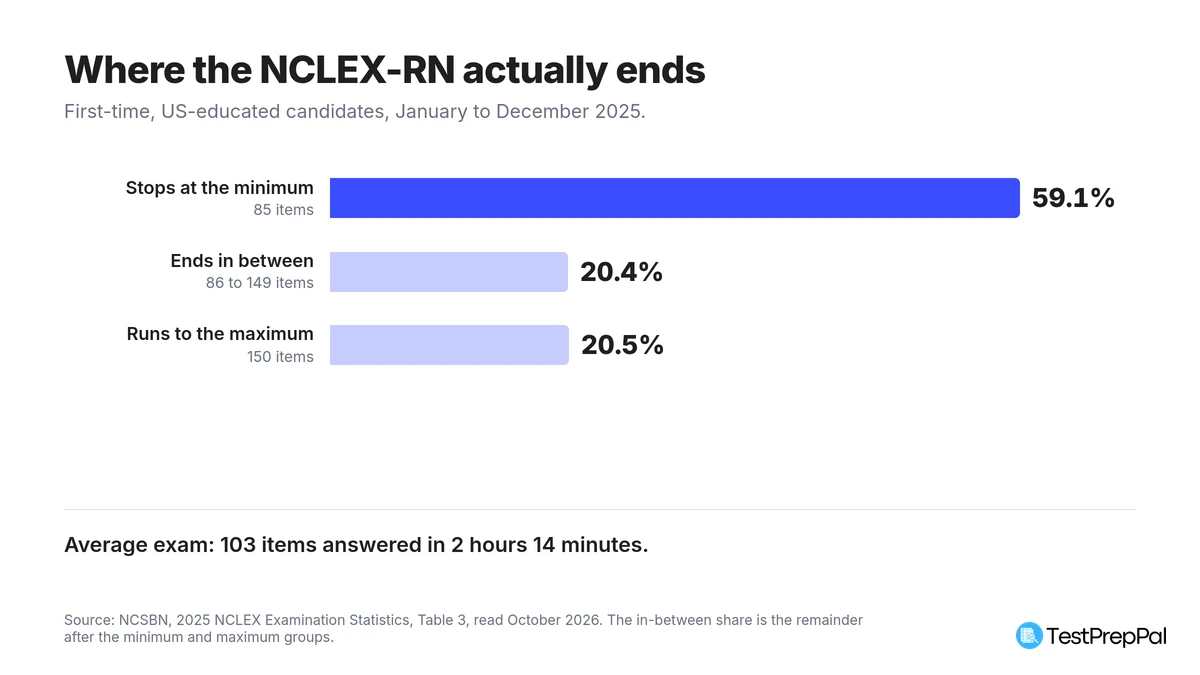 Where the NCLEX-RN ends, 2025. Source: NCSBN, 2025 NCLEX Examination Statistics.
| Where the exam ended | Share of first-time RN candidates |
|---|---|
| At the 85-item minimum | 59.1% |
| Somewhere between 86 and 149 items | 20.4% |
| At the 150-item maximum | 20.5% |
The middle figure is ours, the remainder once the minimum and maximum groups are taken out. The shape is worth reading properly: the NCLEX is not a bell curve. It piles up at both ends, with a clear majority finishing as early as the rules allow and a fifth going the whole way.
The PN picture has the same shape, with a shade fewer items and a shade more time. First-time, US-educated NCLEX-PN candidates averaged 100 items in 2 hours 18 minutes in 2025, with 64.6 percent stopping at the minimum and 17.7 percent reaching the maximum.
| 2025, first-time US-educated | NCLEX-RN | NCLEX-PN |
|---|---|---|
| Average test length | 103 items | 100 items |
| Average testing time | 2 h 14 min | 2 h 18 min |
| Stopped at the minimum | 59.1% | 64.6% |
| Ran to the maximum | 20.5% | 17.7% |
| Used the full five hours | 0.5% | 0.7% |
The limits that do not move
Three numbers are fixed, and everything else about your exam is an outcome. The 2026 NCLEX-RN Test Plan sets a minimum of 85 items and a maximum of 150, inside one allotted five-hour period. The 2026 NCLEX-PN Test Plan sets exactly the same three numbers for LPN and VN candidates, so if you are preparing for the PN from older material, check the limits you were given.
| Exam | Minimum items | Maximum items | Time limit |
|---|---|---|---|
| NCLEX-RN | 85 | 150 | 5 hours |
| NCLEX-PN | 85 | 150 | 5 hours |
One detail changes how you should read any item count: not every item you answer is scored. Every NCLEX carries 15 unscored pretest items, so a minimum-length exam is 85 items with only 70 behind your result. Our guide to the NCLEX passing score breaks down that composition and what the ability estimate is measured against.
Almost nobody uses the full five hours
Five hours is 300 minutes. The average first-time RN candidate used 134 of them, which is under 45 percent of the allowance and leaves 2 hours 46 minutes on the table. Half a percent of candidates used all of it.
Those averages also tell you the real working pace. Dividing average testing time by average test length, first-time RN candidates moved at roughly 1 minute 18 seconds per item in 2025, and PN candidates at about 1 minute 23 seconds. That is a good deal faster than the budget the limits allow, which is where pacing advice usually goes wrong.
| If your exam ends at | Time per item if you used all 300 minutes |
|---|---|
| 85 items | 3 min 32 s |
| 103 items (the 2025 average) | 2 min 55 s |
| 150 items | 2 min 0 s |
The worst case is the one to train for. A 150-item exam leaves two minutes an item if you use every available minute, so building the habit at around two minutes means a long exam cannot hurt you. A question bank used with a timer on, in blocks long enough that the third hour feels familiar, is the practical version of that.
More candidates ran long in 2025 than in 2024
The distribution moved, and it moved in one direction. Comparing the 2025 figures with NCSBN's 2024 statistics for the same first-time, US-educated RN group:
| First-time US-educated RN candidates | 2024 | 2025 | Change |
|---|---|---|---|
| Average test length | 100 items | 103 items | +3 items |
| Stopped at the minimum | 65.4% | 59.1% | -6.3 points |
| Ran to the maximum | 16.7% | 20.5% | +3.8 points |
| Average testing time | 2 h 14 min | 2 h 14 min | No change |
Six points moved out of the minimum-length group in a single year, and most of them landed at the maximum. The striking part is the bottom row: average test length rose by three items while average testing time did not move at all, so candidates are answering more items in the same seat time rather than sitting longer.
One year is not a trend, and NCSBN does not explain the shift. Read it as a reason to expect a longer exam than last year's cohort did, not as a sign the test got harder. Our NCLEX pass rate breakdown has the outcome data by candidate type if you want to see whether results moved with it.
Why your exam stops when it stops
NCSBN names three rules that can end an NCLEX, and only one of them is the one students talk about.
| Rule | What triggers it | What decides your result |
|---|---|---|
| 95 percent confidence | The computer is 95 percent certain your ability is clearly above or clearly below the passing standard | Your ability estimate at that moment |
| Maximum-length exam | You reach 150 items with no 95 percent decision | Final ability estimate, with the 95 percent requirement set aside |
| Run out of time | The five hours expires first | Under 85 items answered means an automatic fail. At 85 or more, your final ability estimate on everything you answered |
The 95 percent rule is the common one, and it is indifferent to direction. It ends a clear pass and a clear fail with the same speed, which is why 59.1 percent of candidates stopping at 85 items tells you nothing about how many of them passed.
The maximum-length rule is routinely read backwards. NCSBN's description is that some candidates' ability levels sit very close to the passing standard, and when that happens the computer keeps asking until it hits 150. Running the full length means the exam could not separate you from the line, which is not the same as failing.
That same report explains why no NCLEX feels easy: each item is selected at a difficulty giving you roughly a 50 percent chance of answering correctly. Walking out convinced it was brutal is the design working, not a verdict.
The run-out-of-time rule is the one almost nobody mentions, and it is the only rule where the clock itself can fail you. If time expires before you have answered 85 items, you fail automatically, whatever those answers looked like. Past 85, you are scored on what you managed. At 0.5 percent of candidates, this is rare, but it is the reason a long unscheduled break is more expensive than it feels.
The clock does not stop when you take a break
Breaks are offered, and they are expensive. The 2026 NCSBN Examination Candidate Rules state that you get the opportunity to take a scheduled break after approximately two hours of testing time, and again after approximately three and a half hours. Both are optional, and both count.
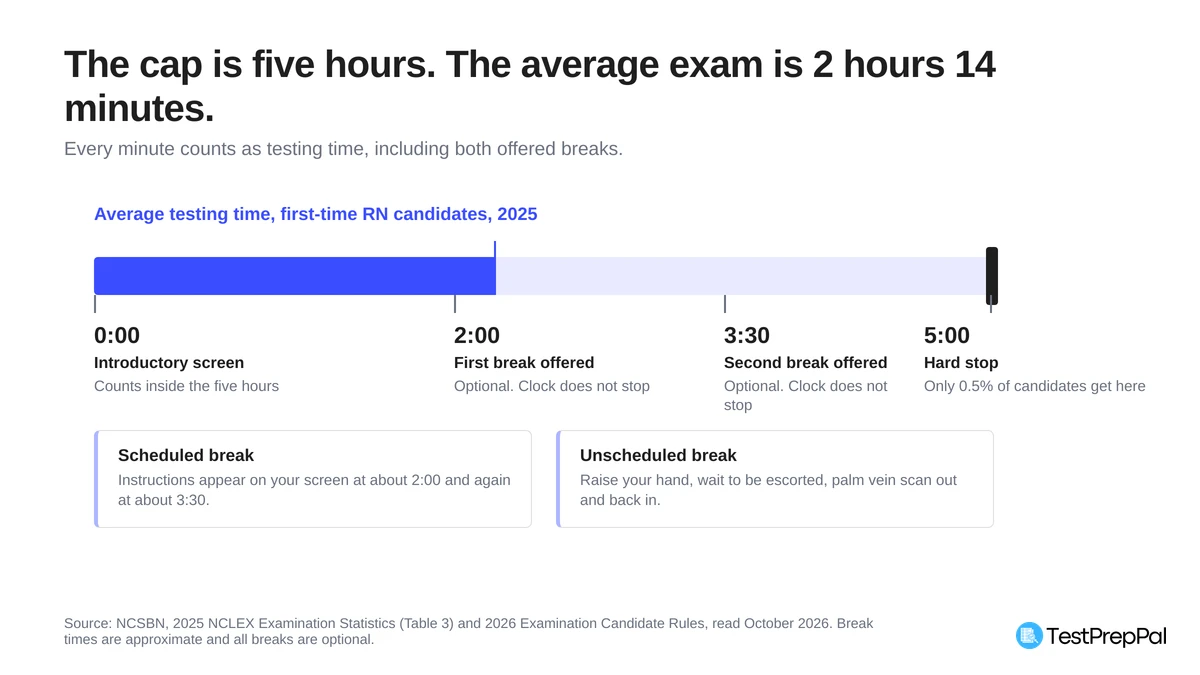 The five-hour cap against the 2025 average. Source: NCSBN 2025 Examination Statistics and 2026 Examination Candidate Rules.
The wording in the rules leaves no room: all breaks count against testing time, and the exam clock will not stop while you are on a scheduled or unscheduled break. NCSBN says the same five hours covers the introductory screen as well.
An unscheduled break costs more than the minutes you are away. You raise your hand, wait to be escorted out, and give a palm vein scan on the way out and again on the way back in, all while the clock runs. NCSBN does not publish how long that takes, which is itself a reason to treat an unplanned exit as expensive.
Two details from NCSBN's exam day page change how you pace. You cannot return to a question once you have submitted it, so there is no review pass to save time for. And you should arrive at the test center at least 30 minutes before your appointment, which sits outside the five hours but inside your day. For the format, item types and content categories, start with our NCLEX exam overview.
Does stopping at 85 mean you passed?
No, and the 2025 numbers make the point better than any explanation. Nearly 6 in 10 first-time RN candidates stopped at the minimum in 2025, a year when 86.7 percent of that group passed. The minimum-length group holds both outcomes.
The 95 percent confidence rule ends an exam as soon as the result is clear in either direction. A candidate well above the passing standard and a candidate well below it both get a short exam. A short exam means the computer was sure, not that it was pleased.
The mirror-image myth dies the same way. Running to 150 does not mean you failed, because the candidates who reach the maximum are the ones sitting closest to the line, and a fifth of all candidates get there.
If you want a read on your odds, base it on how you have been performing rather than on the length of your exam. Our NCLEX pass probability calculator works from your practice performance. For what happens between your exam and your result, see how to know if you passed the NCLEX. Everything else we publish on the exam sits on the NCLEX hub.
How long is the NCLEX FAQs
How many hours does the NCLEX exam last?
The maximum is five hours for both the NCLEX-RN and the NCLEX-PN, covering the introductory screen, the exam itself and every break. Most candidates finish well inside it. In 2025 the average first-time RN exam took 2 hours 14 minutes, and only 0.5 percent of candidates used the full five hours. Book the day for five hours, but do not expect to need them.
Does finishing the NCLEX early mean you passed?
No. The exam ends early whenever the computer is 95 percent certain of your result, and that certainty cuts both ways. In 2025, 59.1 percent of first-time RN candidates stopped at the 85-item minimum, a group that contains both passes and fails. The length of your exam tells you how quickly the computer made up its mind, not what it decided.
Can you pass the NCLEX at 150 questions?
Yes. Once you reach the maximum, the computer sets the 95 percent requirement aside and decides on your final ability estimate. If that estimate is at or above the passing standard, you pass. NCSBN states that candidates who run to the maximum are those whose ability is very close to the passing standard, so a full-length exam means the decision was narrow, not that it went against you. Around 1 in 5 first-time RN candidates finished there in 2025.
Do NCLEX breaks count against your time?
Yes, all of them. The 2026 candidate rules say plainly that the exam clock does not stop during a scheduled or an unscheduled break. You are offered a break after about two hours and again after about three and a half hours, and both come out of the same five-hour budget, as does the time spent being escorted out and scanned back in.
We may earn commissions from some links on this page, but this does not affect our reviews or your experience.