


Matus Nursing Review NCLEX Mnemonics PDF Review
by Matus Nursing Review
Free 98 slide PDF of NCLEX mnemonics, heaviest on pharmacology, fluids and electrolytes.
✓Pros
- ✓All 98 slides are free, and the direct PDF link needs no signup
- ✓Covers the memory hooks students most often want, including the heparin and warfarin antidotes
- ✓Unusually strong on fluids and electrolytes, with 11 slides across potassium, sodium and calcium
- ✓One mnemonic per slide, so it prints and annotates cleanly
✗Cons
- ✗Built in PowerPoint in April 2019, so it predates the Next Generation NCLEX launch
- ✗No case study or clinical judgment practice, which is 18 of the 85 items on a minimum length exam
- ✗Mnemonics only, with no explanation of why an answer is right
- ✗Several spelling errors, including goggles written as Google on both PPE slides
- ✗The official download page asks for your name, email and location
Highlights
- ✓98 slides of NCLEX mnemonics in a single PDF
- ✓29 pharmacology and drug safety slides
- ✓11 fluid, electrolyte and acid-base slides
- ✓9 maternal newborn slides
- ✓9 management of care and infection control slides
- ✓One mnemonic per slide, printable for offline study
Price
✓Free
What Students Are Saying
Sign in to leave a review

Expert Rating
The Matus Nursing Review NCLEX mnemonics PDF is 98 slides, one memory hook per slide, and it costs nothing. It is worth downloading if you already know the content and want hooks to hang it on, and it is the wrong tool if you are trying to learn the content in the first place.
We downloaded the file on 28 September 2026, read all 98 slides, tagged every one of them to a topic, and read the file's own metadata. That metadata is the part nobody mentions: this is a PowerPoint deck, exported to PDF on 28 April 2019. Everything below comes from that count.
Summary table
| Feature | Matus Nursing Review NCLEX mnemonics PDF |
|---|---|
| Price | Free |
| Slides | 98, one mnemonic per slide |
| File | 765 KB PDF, exported from PowerPoint |
| Authored | 28 April 2019, reuploaded April 2024 |
| Heaviest topic | Pharmacology and drug safety, 29 slides |
| Second heaviest | Fluids, electrolytes and acid-base, 11 slides |
| Case study or clinical judgment practice | None |
| Practice questions | None |
| Explanations | None, the mnemonic is the whole slide |
| Account needed | No on the direct file link, yes on the official page |
| Guarantee | None |
| Our rating | 3.4 out of 5 |
 The official download page on matusnursingreview.com, captured September 2026. The file is sent by email after the form, not linked on the page.
Matus NCLEX mnemonics overview
Each slide does one thing. It names a topic, gives an acronym, and expands the letters. Traction care is "TRACTION", osteoporosis risk is "ACCESS", the anti-tuberculosis drugs are "STRIPE". The fetal heart rate slide is the standard "VEAL CHOP", pairing variable decelerations with cord compression and late decelerations with placental insufficiency.
The best-known slide in the set is the anticoagulant antidote pair, which drops the acronym format entirely: in heaven (heparin) there is peace (protamine sulfate), in war (warfarin) there are killings (vitamin K). That is the kind of hook that survives a five-hour exam, and it is why this file circulates.
What you get:
- 98 slides, one mnemonic each, in a single PDF
- 29 slides on pharmacology and drug safety, the largest block by far
- 11 slides on fluids, electrolytes and acid-base
- 9 slides on maternal newborn care and 9 on management of care and infection control
- A 4:3 slide shape that prints one mnemonic to a page
- No questions, no rationales, no index and no page numbers
Every slide carries the same footer advertising the company's live and online review, so the file is a lead magnet. That is fair enough at this price, but it explains the absence of anything that would take real work to maintain.
Matus NCLEX mnemonics review for 2026
Nearly a third of the file is pharmacology
Tagging all 98 slides gives the set a clear shape, and it is lopsided in a way that happens to be useful.
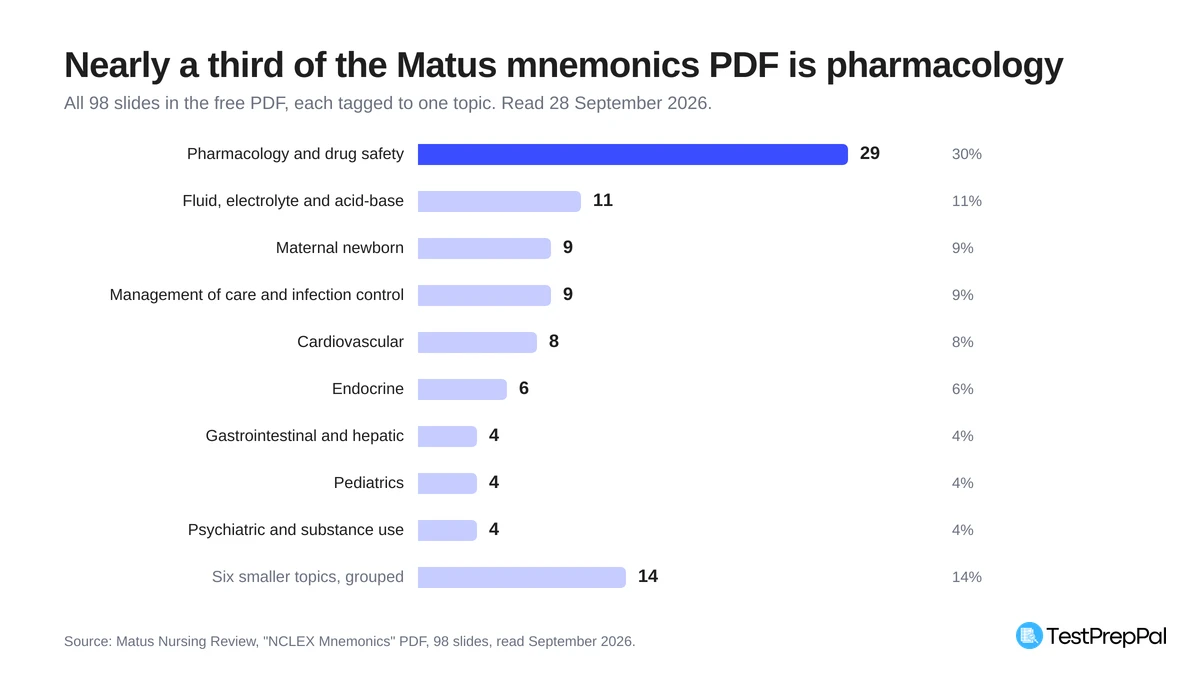 Every slide in the PDF, tagged to one topic, counted 28 September 2026.
Thirty percent of the file is drugs: antidotes, side effects, contraindications, interactions, therapeutic ranges, and lists of drugs that cause a given problem. The NCSBN's 2026 RN test plan gives Pharmacological and Parenteral Therapies 13 to 19 percent of the exam, so the file weighs that category roughly twice as heavily as the exam does.
That is not the criticism it sounds like. Pharmacology is the content students most often fail to recall under time pressure, and it is the content that rewards a hook rather than reasoning. Weighting a mnemonic deck toward it is the right call. Just do not read the mix as a study plan.
The electrolyte run is the other strength. Eleven consecutive slides work through hyperkalemia causes, signs, treatment and the drugs that cause it, then move to sodium and calcium. Hypernatremia gets two different mnemonics, "FRIED" and "SALT", on separate slides. Two hooks for one condition is better than one, because the one that sticks is the one you happen to like.
The thin spots follow from the same logic. Psychosocial integrity is 6 to 12 percent of the exam and gets four slides here. Basic care and comfort, another 6 to 12 percent, is barely present. This is a supplement to a content source, not a substitute.
The file was built in 2019, and the exam moved in 2023
The PDF reports its own creator as Microsoft PowerPoint and its creation date as 28 April 2019. The copy on the server was last modified in April 2024, but that is a reupload, not a revision: the slides are the 2019 slides.
The Next Generation NCLEX launched on 1 April 2023, four years after this deck was made. The change was not cosmetic. On a minimum-length exam of 85 items, the 2026 test plan puts 52 items on the eight content categories, 15 unscored pretest items, and 18 items in three clinical judgment case studies, each a set of six items walking the steps of recognizing cues, analyzing cues, prioritizing hypotheses, generating solutions, taking action and evaluating outcomes.
A mnemonic deck was never going to teach clinical judgment, and it would be unfair to mark it down for not being a case study bank. What is fair to say is that a student who studies from a 2019 file has no way of knowing from the file that a fifth of their exam now takes a form the file does not contain. The NCLEX study guide covers what the current plan weights, and our NCLEX pass rate data tracks how candidates have done since the format changed.
There is a second consequence of the file's age. Clinical content does drift. The slides give no reference for any value on them, and there is no update date printed anywhere, so a student cannot check a therapeutic range against the year it was written. Treat every number here as something to confirm in a current source before you memorize it.
Small errors, on slides where errors matter
Two slides cover personal protective equipment. The donning order is gown, mask, goggles, gloves; the removal order is gloves, goggles, gown, mask. Both are correct, and both spell goggles as "Google".
It is a funny typo on a page about infection control, which the test plan weights at 10 to 16 percent. It is also not the only one. Charcot's triad is printed "Charcoat's", flumazenil is "Flumanezil", the opioid slide is headed "OPIOD", the antiparkinsonian slide reads "Antiparkinsoninan", and the temperature conversion slide says "substract" twice.
None of these change the clinical answer. The PPE sequences are right, the conversion formulas work, and the triad is the right triad. But a file you are using to burn phrases into memory is exactly the file where spelling matters, because the misspelling is what you will memorize. Proofreading is also the cheapest possible maintenance, and seven years on, it has not happened.
The deeper limitation is structural: the mnemonic is the entire slide. The hyperkalemia treatment slide lists the interventions and never says why calcium gluconate comes first. If you already understand the mechanism, the hook is all you need. If you do not, the hook gives you a list you cannot reason from, and the case study items are built to punish exactly that.
Pricing
It is free, in both of the ways that matter and one that does not.
| Route | What it costs | What it asks for |
|---|---|---|
| Direct PDF link | Free | Nothing, the file downloads on click |
| Official mnemonics page | Free | Email address, first name, last name, city, state and country, plus whether you are RN or PN |
The official free mnemonics page does not link the PDF at all. It carries a mailing list form with four required fields and sends the file by email, which also subscribes you to the company's NCLEX updates. The file itself sits at a public address on the same server, so the direct link skips all of that.
Both routes cost nothing. There is no plan, no trial, no upsell inside the document beyond the footer, and no guarantee, because there is nothing to guarantee. The company sells live and self-study NCLEX review courses separately, and this PDF is how it introduces itself.
Who the Matus NCLEX mnemonics PDF is best for
Students in the last two weeks who have already done the content. Ninety-eight hooks for material you have met before is a good use of a final revision week. Print it, keep the 30 or so that stick, throw away the rest.
Anyone who keeps losing pharmacology details. This is the file's real strength, and 29 slides is a substantial set. The antidotes, the toxicity signs and the interaction lists are the ones worth keeping.
Students weak on fluids and electrolytes. Eleven slides in sequence, with two competing mnemonics for hypernatremia, is better coverage than most free sheets manage on this topic.
Repeat test takers rebuilding recall. If you have sat the exam before and know the gap is recall rather than reasoning, hooks are the efficient fix.
When you might look elsewhere
- You need lab values or a drug reference, not hooks. The SimpleNursing lab values cheat sheet is the dedicated reference for ranges, and Nurseslabs' 101 must-know NCLEX medications is the broader free pharmacology list with actual nursing considerations attached.
- You want explanations, not assertions. The NCLEX Bootcamp cheat sheets run four to six pages per topic and carry a 2026 update date on the free set, so they reason where this file only asserts.
- You need practice, not memory aids. No mnemonic deck will get you ready for case study items. Start with our free NCLEX practice questions, then a full NCLEX question bank once you know your weak categories.
- You want the whole free shortlist. Every free option we have checked is on the free NCLEX resources page, and the rest of the sheets sit on the NCLEX cheat sheets page. How we assess each one is on our review methodology page, and the exam itself is covered from the NCLEX hub.
Final verdict
Matus NCLEX mnemonics FAQs
Is the Matus NCLEX mnemonics PDF free?
Yes, by both routes. The direct file link downloads the whole 98 slide PDF on click with no account, no email and no payment. The official free mnemonics page on matusnursingreview.com instead asks for your email address, first name, last name and location before it sends the file, and subscribes you to the company's NCLEX mailing list.
How many mnemonics are in the Matus PDF?
The file is 98 slides with one mnemonic on each, though the landing page advertises 100. A few slides carry two related hooks, such as the cane and walker slide holding both "COAL" and "WWAL", so the total depends on how you count. Ninety-eight is the page count we measured on 28 September 2026.
Is the Matus mnemonics PDF updated for the Next Generation NCLEX?
No. The PDF's own metadata gives a creation date of 28 April 2019 and names PowerPoint as the tool that made it, and the Next Generation NCLEX launched on 1 April 2023. The file contains no case studies, no unfolding client scenarios and nothing built around the clinical judgment steps that 18 items on a minimum-length exam now measure.
What topics does the Matus mnemonics PDF cover best?
Pharmacology, at 29 of the 98 slides, and fluids and electrolytes at 11. Between them those two blocks are 41 percent of the file, and they are the areas where a memory hook does the most work. Maternal newborn care and management of care get nine slides each. Psychosocial content and basic care and comfort are thin, at four slides and almost none.
Is a mnemonic PDF enough to pass the NCLEX?
No, and nothing free is. Mnemonics retrieve facts you already understand; they do not build the reasoning that case study items test. Use this file alongside a content source and a question bank, and treat its unreferenced numbers as things to confirm in a current source rather than memorize on sight.
We may earn commissions from some links on this page, but this does not affect our reviews or your experience.
Our Verdict
Ninety-eight one-mnemonic slides, free, and the direct file link opens without a signup. The set is genuinely strong where students want memory hooks most: 29 slides of pharmacology and 11 on fluids and electrolytes. The catch is its age. The file was built in PowerPoint in April 2019, so nothing in it was written for the case studies that have been on the NCLEX since April 2023, and it explains nothing it asserts.