


The Next Generation NCLEX decides how to score an item from the way the item asks you to answer, not from what the item type is called. There are three partial credit methods, and on one of them a wrong selection actively subtracts points while on another it costs you nothing beyond the point you missed.
That difference is the single most useful thing to know about NGN scoring, and almost nobody writes it down. Most guides give you the list of item types and leave partial credit as a one-line feature.
- NCSBN scores items by response pattern, not by item type name. Three methods: plus/minus, zero/one and rationale scoring.
- On a plus/minus item, which is any "select all that apply", extra wrong picks are deducted. Guessing wide costs you.
- On a zero/one item, where you are told to pick a set number, a wrong pick earns nothing but takes nothing away.
- Rationale scoring is all or nothing on a linked pair, so a half-right cause and effect answer earns zero.
- There is no fixed percentage of item formats on your exam, but clinical judgment is a fixed block of 18 case study items.
What the Next Generation NCLEX actually changed
The NGN launched on April 1, 2023. NCSBN built it after its 2013-2014 Strategic Practice Analysis found that newly licensed nurses are increasingly expected to make complex decisions at the bedside, which a four-option recall question measures badly.
Two things changed. New item formats appeared, and scoring stopped being purely right or wrong. The exam structure around them did not change: it is still a computerized adaptive test of 85 to 150 items in five hours, and our complete NCLEX exam guide covers that format end to end.
What this page owns is the second change. Once an item can be partly right, the question "did I get it right" stops having a clean answer, and that affects how you should answer under pressure.
The three scoring methods, in NCSBN's words
NCSBN publishes partial credit scoring on that same FAQ page as three named methods. Partial credit applies to any item for which more than one key exists. Here is what each one does.
| Method | When NCSBN uses it | What a correct pick earns | What a wrong pick costs |
|---|---|---|---|
| Plus/minus | You may select an unspecified number of options | One point | Points are deducted |
| Zero/one | You are told to choose a specific number of responses | One point | Nothing, you just miss the point |
| Rationale scoring | You evaluate closely associated information, usually a pair | Points only if both halves are right | The whole item, it is all or nothing |
Under plus/minus, the maximum score equals the number of correct options and the minimum is set at zero. You cannot go negative on an item, but you can wipe out the credit you earned on it.
Under zero/one, a multipoint item totals the sum of all your correct responses. Four correct boxes out of six means four points out of six.
Rationale scoring is the strict one. NCSBN describes it as paired information related through a rationale, for instance the cause and effect of a set of symptoms, and says both components of the pair must be correct to earn points.
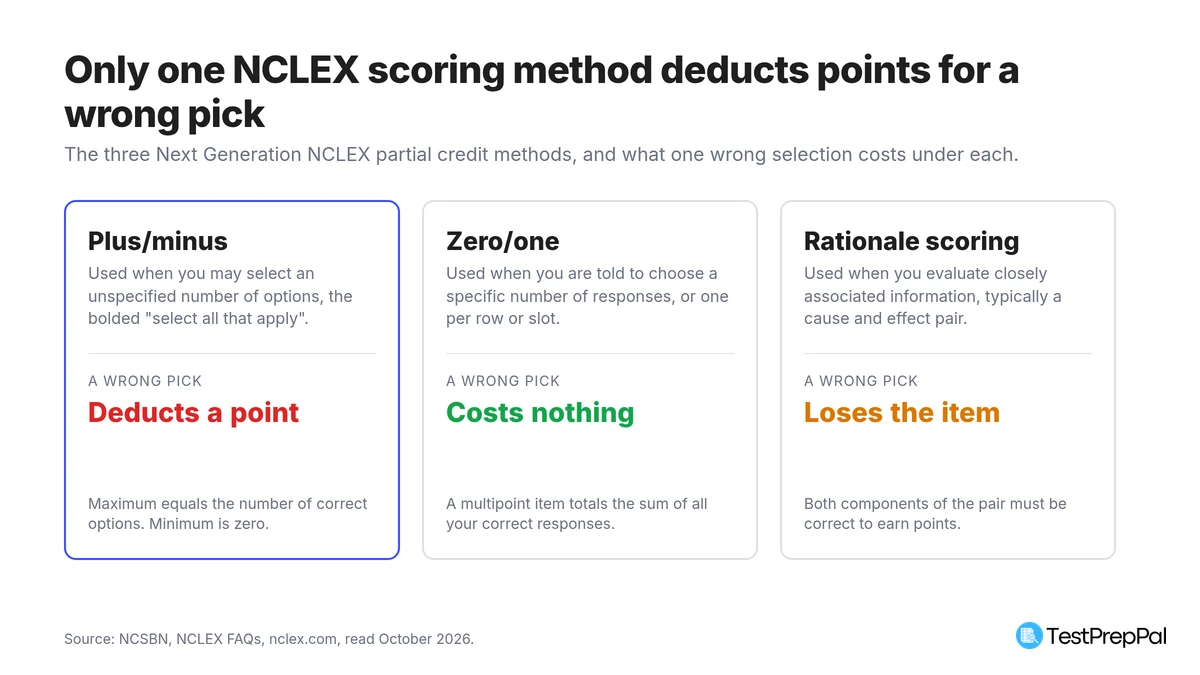 The three NGN partial credit methods and what a wrong selection costs under each. Source: NCSBN, NCLEX FAQs, read October 2026.
How to tell which method your item is using
NCSBN does not publish a table that maps item type names to scoring methods. It defines each method by the response the item asks for, which is better news than it sounds, because the prompt tells you which one you are in.
| What the prompt tells you to do | Method | Common item names |
|---|---|---|
| Select an unspecified number, the bolded "select all that apply" | Plus/minus | Select all that apply, extended multiple response, highlight items |
| Select a set number, or one response per row, slot or column | Zero/one | Matrix or grid, bow-tie, drag-and-drop ordering, extended drag-and-drop |
| Complete a linked pair, usually cause and effect | Rationale scoring | Paired drop-downs in one sentence, matrix items built as cause and effect |
| Pick one correct option out of four | Single key, no partial credit | Traditional multiple choice |
Read that middle column as our reading of NCSBN's definitions, not as an official NCSBN list. The names in the right-hand column are what students and prep companies call these items, and the name is not what decides the scoring.
The practical rule is short. If the item gives you a number, or a row, or a slot to fill, wrong answers are free and you should fill every one. If the item does not give you a number, wrong answers are not free and you should select only what you can defend.
On a "select all that apply" item, picking a fifth option you are unsure about can cost you a point you already earned. On a matrix item where you must mark one box per row, leaving a row blank can only lose, so answer every row.
NCSBN also confirms on the same page that the phrase "select all that apply" appears in bold, and that one or more of the options will be correct. That bold qualifier is your signal that you are in the deducting method.
A worked bow-tie item
A bow-tie gives you one client scenario and three columns: actions to take, the condition the client is most likely experiencing, and parameters to monitor. It tells you exactly how many boxes to fill in each column, which puts it in the zero/one pattern.
Say a bow-tie asks for two actions, one condition and two parameters. That is five selections and five available points.
| Column | Boxes to fill | You got right | Points |
|---|---|---|---|
| Actions to take | 2 | 2 | 2 |
| Condition most likely | 1 | 0 | 0 |
| Parameters to monitor | 2 | 1 | 1 |
| Total | 5 | 3 | 3 of 5 |
Three of five. On the pre-2023 exam that item would have been a single wrong answer worth zero. That is what partial credit changes, and it is why a half-understood item is no longer a total loss.
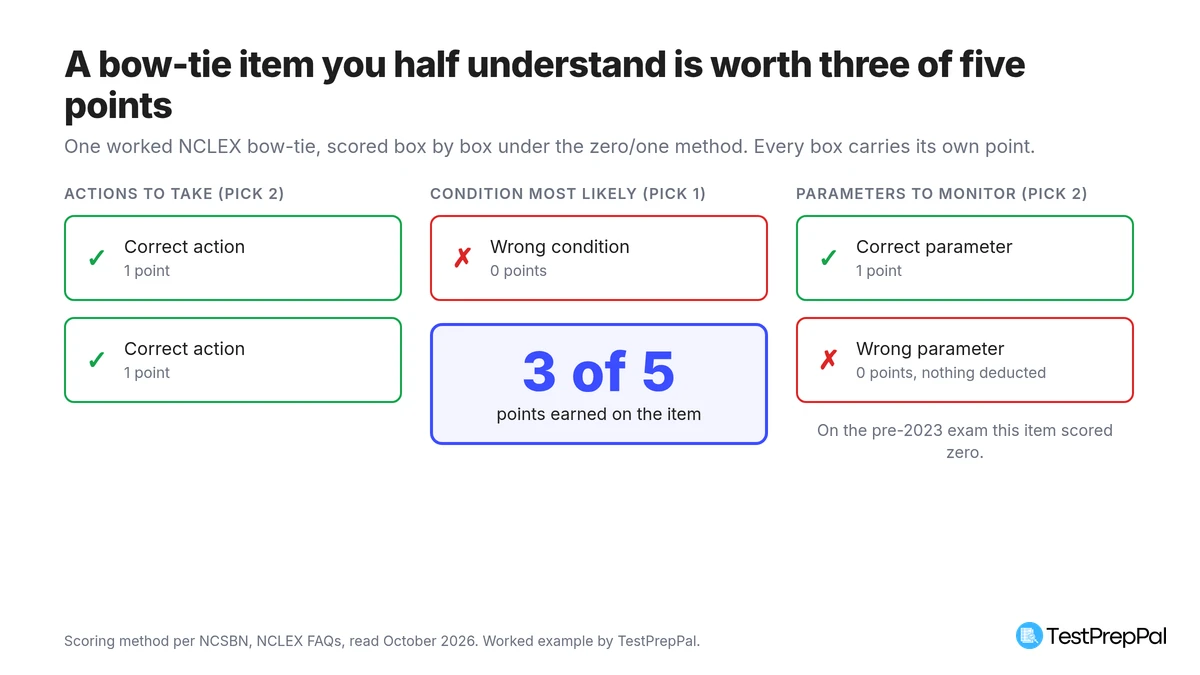 A five-point bow-tie item earning three points. Each box is scored on its own under the zero/one method.
Compare that with a rationale-scored pair. An item that reads "the client is at risk for ___ as evidenced by ___", with a drop-down in each blank, gives you two blanks and one point. Get the risk right and the evidence wrong and you earn nothing, because NCSBN treats the pair as one idea.
What partial credit does to an exam that stops between 85 and 150 items
The NCLEX is adaptive. The 2026 NCLEX-RN Test Plan describes the machine recomputing an ability estimate from all your previous answers and their difficulty, then choosing the next item from that estimate.
Partial credit means the number feeding that estimate is no longer a one or a zero. A bow-tie worth three of five points moves your ability estimate differently than a traditional item you simply got wrong.
Three rules end the exam, and none of them is a percentage correct:
- The 95 percent confidence interval rule. The computer stops once it is 95 percent certain you are clearly above or clearly below the passing standard, after you have reached the minimum number of items. This is the common case.
- Maximum length. If your ability sits very close to the standard, the exam runs to the maximum and the confidence rule is disregarded. Only the final ability estimate counts.
- Run out of time. Below the minimum number of items is a fail. At or above it, the final ability estimate from your completed items decides.
Note what is missing from all three: any count of questions you answered correctly. Because items carry different point totals and different difficulties, your own tally of "ones I got right" is not a meaningful number. Our guide to the NCLEX passing score explains why percent correct sits near 50 percent for almost everyone, pass or fail.
How much of your exam is clinical judgment
Here the official numbers are more specific than the exam-length range suggests, and they cut against a claim you will see repeated as a single percentage.
The test plan fixes clinical judgment content at 18 case study items, which is three sets of six items sharing one unfolding client presentation, plus approximately 10 percent stand-alone clinical judgment items selected depending on exam length.
The 18 is a fixed block. The exam is not. Every NCLEX also carries 15 pretest items that are not included when estimating your ability, so your scored item count is the total minus 15:
| Exam length | Total items | Pretest items | Scored items | 18 case study items as a share of scored items |
|---|---|---|---|---|
| Minimum | 85 | 15 | 70 | about 26 percent |
| Maximum | 150 | 15 | 135 | about 13 percent |
Those shares are our calculation from the test plan's own figures: 18 divided by 70 is 0.257, and 18 divided by 135 is 0.133. The shorter your exam stops, the bigger a share of your scored exam the three case studies represent. There is no single percentage.
One more official line worth holding onto, from the same FAQ page: there is no predetermined percentage of item formats administered to candidates. Items are selected on your ability and the item difficulty, regardless of format. Anyone promising you a set number of bow-tie or matrix questions is guessing. For how the item count itself varies, see how many questions are on the NCLEX.
What this changes about how you practice
Four things follow from the scoring rules, and they are all things you can act on this week.
Answer every box on a numbered item. Rows, slots and columns are zero/one. A blank row is a guaranteed zero and a guess is a free shot.
Be disciplined on "select all that apply". This is the one place where adding an option you cannot defend is worse than leaving it out. Pick what you can justify from the data in the scenario and stop.
Practice the pair, not the halves. Rationale-scored items ask for cause and effect together. Drilling signs without the mechanism behind them trains exactly the half-answer that earns zero.
Use the bolded words. NCSBN bolds the key words in its items, including best, most, essential, first, priority, immediately, highest, initial, next, refute, increased, decreased and support. It also includes the normal reference range on any item carrying a numeric lab value, so you are not being tested on memorised ranges.
You can try these formats for free with our NCLEX practice questions, and the NCLEX study guide sets out a sequence for working through them. If you want volume with rationales attached, compare the options in our NCLEX question bank roundup. For case studies inside timed full-length sittings rather than as standalone drills, the Mometrix NCLEX-RN course puts three of them in each of its 12 practice tests. Start from the NCLEX hub if you are still mapping out the whole exam.
Next Generation NCLEX FAQs
What is the Next Generation NCLEX?
It is the current version of the NCLEX-RN and NCLEX-PN, launched April 1, 2023. It added item formats built around clinical judgment, such as case studies, bow-tie, matrix and drop-down items, and it introduced partial credit scoring on items with more than one correct element. The exam length, the five-hour limit and the adaptive format did not change.
Will the NCLEX shut off at 85 if you fail?
Yes. The 95 percent confidence rule works in both directions, so the exam stops at the minimum length once the computer is 95 percent certain your ability is clearly above or clearly below the passing standard. A short exam is not by itself good news or bad news, and the number of items you saw tells you nothing reliable about your result.
Does partial credit mean I can pass with half the options right?
No. Partial credit changes what a single item contributes, not what the exam requires. Your result comes from a final ability estimate built from every scored item and its difficulty, compared against a fixed passing standard. Consistently earning half the points on multipoint items places your ability estimate below candidates who earn most of them.
Where can I find a preview of the NCLEX exam?
NCSBN publishes a free sample pack and an exam preview on its Prepare page. The sample pack includes three RN case studies and two PN case studies, and the exam preview shows how the item types sit inside a full exam. Both are the official versions of these formats, which makes them worth working through before any third-party imitation.
We may earn commissions from some links on this page, but this does not affect our reviews or your experience.