


NCSBN answers this one directly in its own candidate FAQ: "items that contain a numeric lab value will include the corresponding normal reference range." So you will not fail a question because you could not recall the normal range for potassium. The exam prints it next to the number.
That changes what studying lab values should look like. The memorizing that still pays off is the part the item will never show you: what a nurse does when the value is wrong.
- NCSBN states that any item showing a numeric lab value also shows the matching normal reference range.
- The whole test plan category that contains lab values is 5 to 8 questions on a minimum-length exam, and lab values is one of eight content headings inside it.
- The official blueprint lists six activity statements under Laboratory Values. Only one is about comparing a value to normal.
- What is never supplied: the nursing action, the priority when two values are abnormal, and the link between one lab and another.
- Six values carry a real action threshold: potassium, digoxin, lithium, INR, aPTT and magnesium. Every one of them comes from a drug label, not a reference chart.
Does the NCLEX give you the lab values?
Yes, when the item shows a number. The relevant question in NCSBN's NCLEX candidate FAQ is "Do items provide the candidate with normal reference ranges?" and the published answer is one sentence: "Yes, items that contain a numeric lab value will include the corresponding normal reference range."
Two neighboring answers in the same FAQ matter just as much. On units, NCSBN says items use a combination of international system (SI) and imperial measurements, and that "the unit of measurement presented in the item will be familiar to the NCLEX candidate." So you are not expected to convert between mmol/L and mg/dL under time pressure. And on drugs, asked whether there is a need-to-know list, NCSBN says plainly that it "does not specify a list of medications that are on the exam."
That is worth holding against what the search results do. Google's AI Overview for this query currently reproduces 25 reference ranges by panel, from WBC through to HbA1c, and hedges only that ranges "vary slightly by textbook and clinical lab". It never mentions that NCSBN has already answered the question.
Put those three together and the standard advice collapses. There is no official list of drugs, no conversion trick to practice, and no range to recall when a number is on the screen.
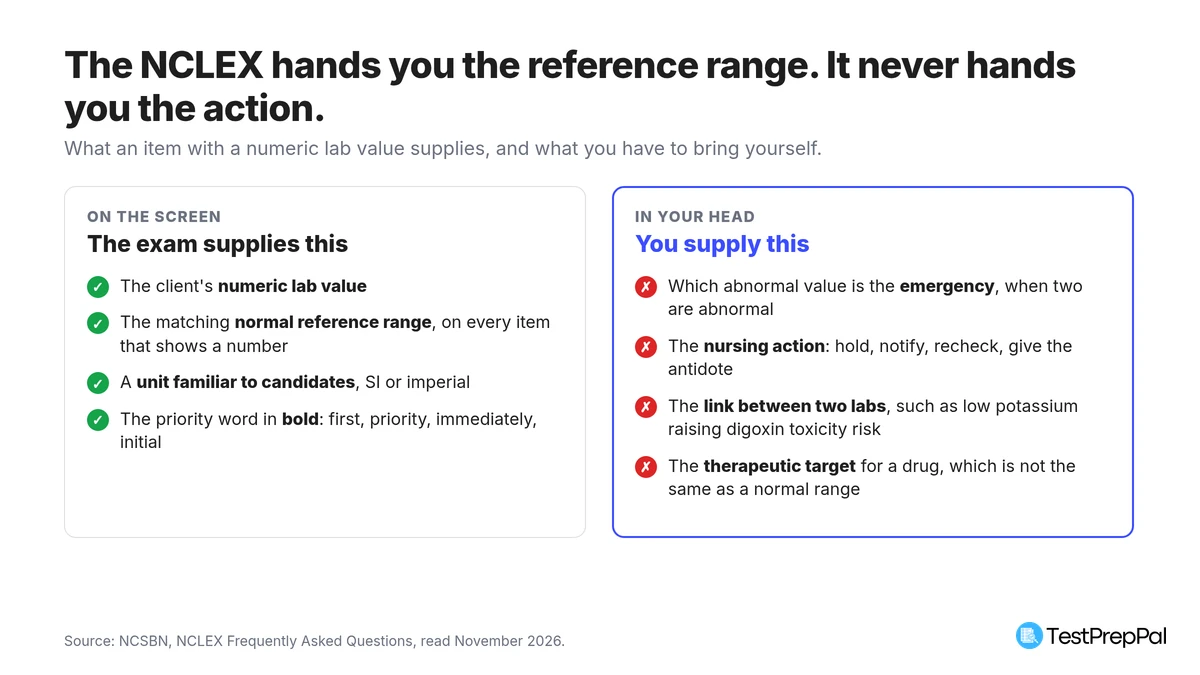 What an NCLEX item with a lab value gives you, and what it expects you to bring. Source: NCSBN NCLEX Frequently Asked Questions.
How many lab value questions are on the NCLEX?
Fewer than the cheat sheets imply. Lab values sit inside Reduction of Risk Potential, which the 2026 NCLEX-RN Test Plan sets at 9 to 15 percent of content items, with a 12 percent target in its distribution chart.
Convert that into questions. A minimum-length exam is 85 items: 52 from the eight content areas, 18 from three clinical judgment case studies, and 15 unscored pretest items. A maximum-length exam is 150 items in five hours, which leaves 117 content items once the pretest and case study items are removed.
| Exam length | Items delivered | Content-area items | Reduction of Risk Potential at 9 to 15% | At the 12% target |
|---|---|---|---|---|
| Minimum | 85 | 52 | 5 to 8 | 6 |
| Maximum | 150 | 117 | 11 to 18 | 14 |
The 117 is our arithmetic, not NCSBN's, for the same reason as in our NCLEX pharmacology cheat sheet: the test plan publishes percentages and never a question count. Our guide to how many questions are on the NCLEX covers the adaptive rules behind the 85 to 150 range.
Now narrow it further. Reduction of Risk Potential has eight content headings, and Laboratory Values is one of them, sitting beside vital signs, diagnostic tests, system-specific assessments and four others. "Laboratory Values" appears exactly once in the entire test plan, and underneath it are six activity statements:
- Compare client laboratory values to normal laboratory values
- Educate client about the purpose and procedure of ordered laboratory tests
- Obtain blood specimens
- Obtain specimens other than blood for diagnostic testing
- Monitor client laboratory values
- Notify primary health care provider about laboratory test results
Read that list slowly. One statement in six is recall of a range, and the exam supplies the range for that one. The other five are education, specimen collection, trend monitoring and escalation. A chart of 25 numbers prepares you for none of them.
What the reference range does not tell you
The range tells you a number is abnormal. It stops there, and four things it leaves out are exactly where items are won.
Priority. When two values are outside their range, the range cannot rank them. NCSBN notes that it bolds key words such as best, most, essential, first, priority, immediately, highest, initial and next. A bolded "first" is the exam telling you two reasonable actions exist and only one comes first.
The action. Hold the dose, draw a level, call the provider, start cardiac monitoring, give the antidote. None of that is printed.
The link between two labs. This is the most reliable trap. The digoxin label names hypokalemia, hypercalcemia and hypomagnesemia as conditions that predispose to toxicity. An item can show you a normal-looking digoxin level and a low potassium, give you both reference ranges, and still expect you to see the danger.
The therapeutic target. For a patient on warfarin, an INR of 2.5 is the goal, not an abnormality. A normal reference range would flag it as high.
NCSBN also says most items are written at the application level or higher, which is the same point in testing language. Recall is not what is being measured.
Six values that carry an action, and what each one triggers
These are the values where a threshold changes nursing behavior. Every number below comes from FDA-approved prescribing information, so each one is checkable rather than copied between cheat sheets.
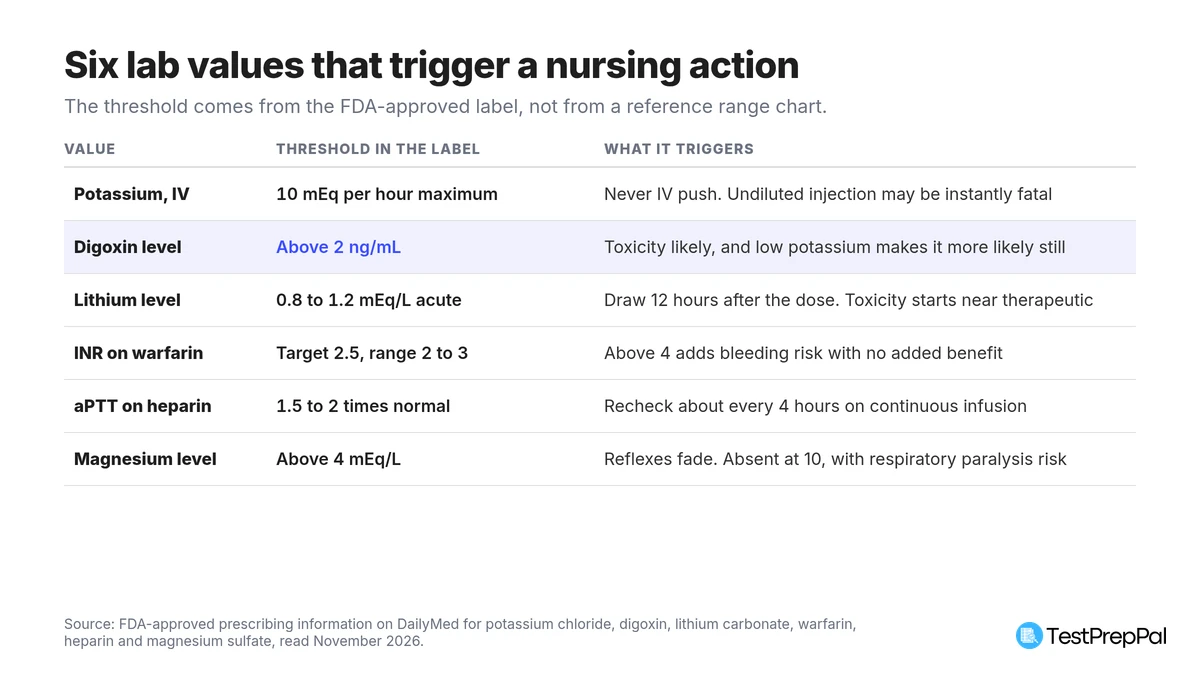 The six values worth knowing cold. Source: FDA-approved prescribing information on DailyMed.
Potassium. The number to carry is not the normal range but the infusion rule. The potassium chloride concentrate label is headed "FOR INTRAVENOUS INFUSION ONLY. MUST BE DILUTED PRIOR TO INJECTION," and warns that direct injection at that concentration "may be instantaneously fatal." Where serum potassium is above 2.5 mEq/L, the rate should not exceed 10 mEq per hour at a concentration up to 40 mEq/L, with a 24-hour ceiling of 200 mEq. Only when potassium is under 2 mEq/L with ECG changes or muscle paralysis does the label allow up to 40 mEq per hour, and then continuous cardiac monitoring is called essential.
Digoxin. The digoxin label says toxicity is usually associated with levels greater than 2 ng/mL, while adding that symptoms may also occur at lower levels. When toxicity is being corrected, the label directs that potassium be given to maintain serum potassium between 4.0 and 5.5 mmol/L.
Lithium. The lithium carbonate label targets 0.8 to 1.2 mEq/L for acute manic or mixed episodes and 0.8 to 1.0 mEq/L for maintenance, with the sample drawn 12 hours after the last oral dose. Its boxed warning is the detail that makes it an exam favorite: toxicity "is closely related to serum lithium concentrations, and can occur at doses close to therapeutic concentrations." Above 3 mEq/L, the label describes seizures, coma and irreversible brain damage.
INR on warfarin. The warfarin label sets a target INR of 2.5, range 2 to 3, for venous thromboembolism and for non-valvular atrial fibrillation. It also gives you a ceiling worth remembering: an INR above 4 "appears to provide no additional therapeutic benefit in most patients and is associated with a higher risk of bleeding."
aPTT on heparin. Dosing is adequate when the aPTT is 1.5 to 2 times normal, according to the heparin sodium label. On a continuous infusion it directs that the aPTT be followed about every 4 hours at the start of treatment.
Magnesium. The magnesium sulfate label gives the clearest ladder on this list. Concentrations usually sufficient to control convulsions are 2.5 to 5 mEq/L. Deep tendon reflexes begin to diminish above 4 mEq/L. At about 10 mEq/L reflexes may be absent and respiratory paralysis becomes a hazard. The bedside checks it names are the patellar reflex and a respiratory rate of roughly 16 breaths a minute or more, and it says an injectable calcium salt should be immediately available.
That last one is the whole argument in miniature. An item can hand you a magnesium level and its normal range and still be asking whether you check a knee jerk, count respirations, or reach for calcium gluconate.
When the number is not on the screen
The FAQ answer is precise, and precision cuts both ways. It covers items that contain a numeric lab value. It does not promise a range when the item never prints a number.
Three situations where you are on your own. An item can name the condition instead of the value, as in a client "admitted with hyperkalemia," and expect you to know what that does to the heart. An item can give a symptom picture, such as a client on furosemide with muscle weakness and a flat affect, and let you infer the electrolyte. And the 18 clinical judgment case study items spread one client across six questions, where the lab report is one tab among several and the work is integrating it with the vital signs and the nursing notes. Our guide to the Next Generation NCLEX walks through how those sets are built.
How to study lab values without memorizing 25 ranges
Work backwards from the action. For each value you meet in practice questions, write one line: what it is, what makes it move, and the single thing a nurse does first when it is wrong. That line is the testable unit, and it is the one the exam will not supply.
Then drill the six above until the action is automatic, because those are attached to drugs where the wrong move harms someone. Everything else can stay recognition-level knowledge.
Practice is where this gets tested properly. Our free NCLEX practice questions run on the same Client Needs structure as the real exam, and a question bank that explains why the other three options are wrong will teach you more about priority than any chart will. If you want printable material to review from, our roundup of NCLEX cheat sheets covers what the free and paid sets actually include, and our NCLEX study guide puts lab values in context against the other seven content areas.
One last piece of perspective: lab values are a slice of one category, and the exam is pass or fail. Our NCLEX pass rate page shows how candidates actually perform, and the NCLEX exam hub collects the registration, format and scoring basics in one place.
NCLEX lab values FAQs
Do you have to memorize lab values for the NCLEX?
Not the normal ranges. NCSBN states that items containing a numeric lab value include the corresponding normal reference range, so recall of a number is not what the item measures. What you do need is the action attached to a value, particularly for potassium, digoxin, lithium, INR, aPTT and magnesium, where a threshold changes what a nurse does next.
Does the NCLEX use SI or conventional units?
Both. NCSBN says items currently use a combination of international system (SI) and imperial measurement options used in the nursing profession, and that the unit presented will be familiar to the candidate. You are not expected to convert between unit systems during the exam.
Are lab values on the Next Generation NCLEX case studies?
Yes, and they are harder there. Every exam includes 18 case study items in three sets of six, counted independently of the content-area percentages. The same FAQ rule applies to any item showing a numeric value, but a case study spreads the client across tabs, so the task is combining the lab report with the vital signs and nursing notes rather than reading one number.
What is the most commonly tested lab value on the NCLEX?
NCSBN publishes no ranking of lab values and specifies no list of medications that appear on the exam, so any page claiming a definitive top 10 is guessing. The defensible answer is that the values worth knowing cold are the ones tied to a drug with a monitoring threshold in its label, which is where the six on this page come from.
We may earn commissions from some links on this page, but this does not affect our reviews or your experience.