


The MCAT has four sections: Chemical and Physical Foundations, Critical Analysis and Reasoning Skills, Biological and Biochemical Foundations, and Psychological, Social, and Biological Foundations. Together they run 230 questions across 6 hours and 15 minutes of testing, always in that order.
Those are the numbers every page gives you. The one that changes how you practice is further down AAMC's own section table: 185 of those 230 questions are attached to a passage, and each section tells you how many passages carry them. Divide one by the other and you get the only pacing rule that survives contact with a real section.
- Four sections, 230 questions, 6 hours 15 minutes. Three sections are 59 questions in 95 minutes. CARS is 53 in 90.
- About 80 percent of the exam is passage-based. 185 passage questions against 45 standalone ones.
- CARS is the only section with zero standalone questions. All 53 belong to one of its nine passages.
- A CARS passage is worth exactly 10 minutes. 90 minutes divided by nine passages, reading included.
- Each section is scored 118 to 132, and the four combine into a 472 to 528 total.
The four MCAT sections at a glance
The three science sections are identical in shape: 59 questions, 95 minutes, the same mix of passages and standalone questions. CARS is the one that breaks the pattern, with six fewer questions and five fewer minutes.
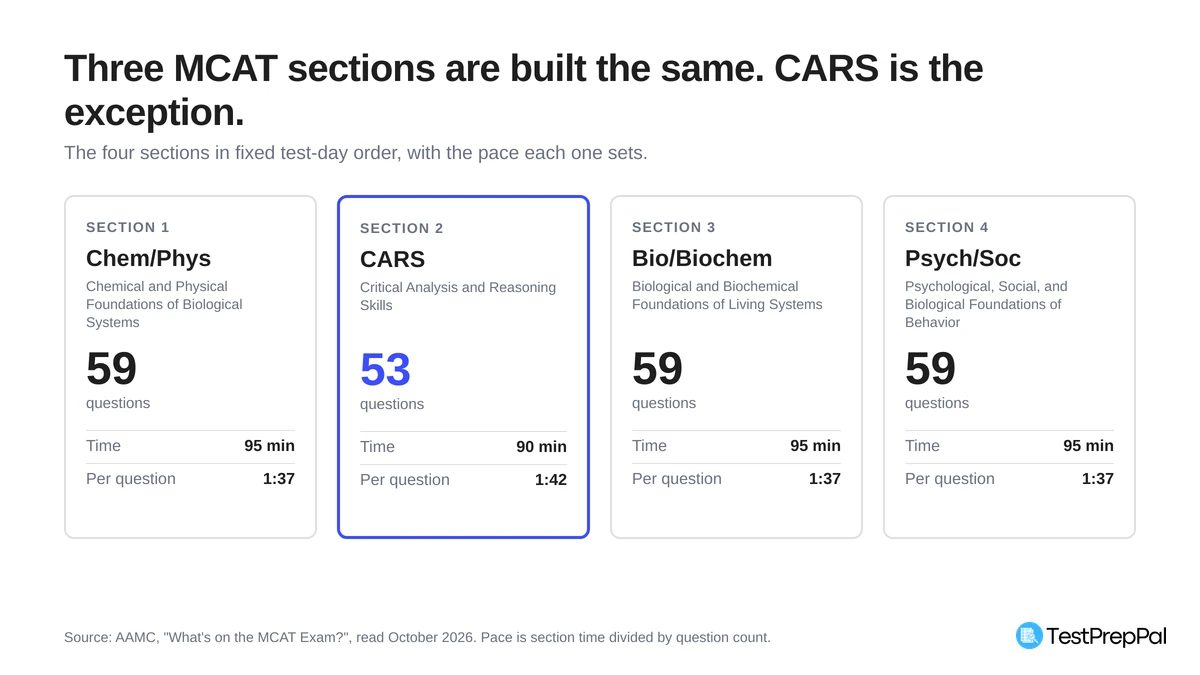 The four MCAT sections in fixed test-day order. Source: AAMC, "What's on the MCAT Exam?".
| Section | Questions | Time | Passages | Standalone | Per question |
|---|---|---|---|---|---|
| Chemical and Physical Foundations | 59 | 95 min | 10 | 15 | 1 min 37 sec |
| Critical Analysis and Reasoning Skills | 53 | 90 min | 9 | 0 | 1 min 42 sec |
| Biological and Biochemical Foundations | 59 | 95 min | 10 | 15 | 1 min 37 sec |
| Psychological, Social, and Biological Foundations | 59 | 95 min | 10 | 15 | 1 min 37 sec |
Add the four section times and you get 375 minutes, which is the 6 hours and 15 minutes of content time AAMC publishes. The rest of the day is tutorial screens, breaks and admin, and it brings seated time to about 7 hours and 30 minutes. We put the whole day on a clock in how long the MCAT takes, including when you actually walk out.
The per-question column is honest but close to useless on its own. Nobody sits down and spends 97 seconds on question one. You spend six or seven minutes on a passage and the questions attached to it, then move. That is why the passage count matters more than the question count.
How many questions ride on each passage
Here is the part no ranking page publishes. AAMC gives you two numbers per section, the passage count and the standalone count, and leaves the division to you.
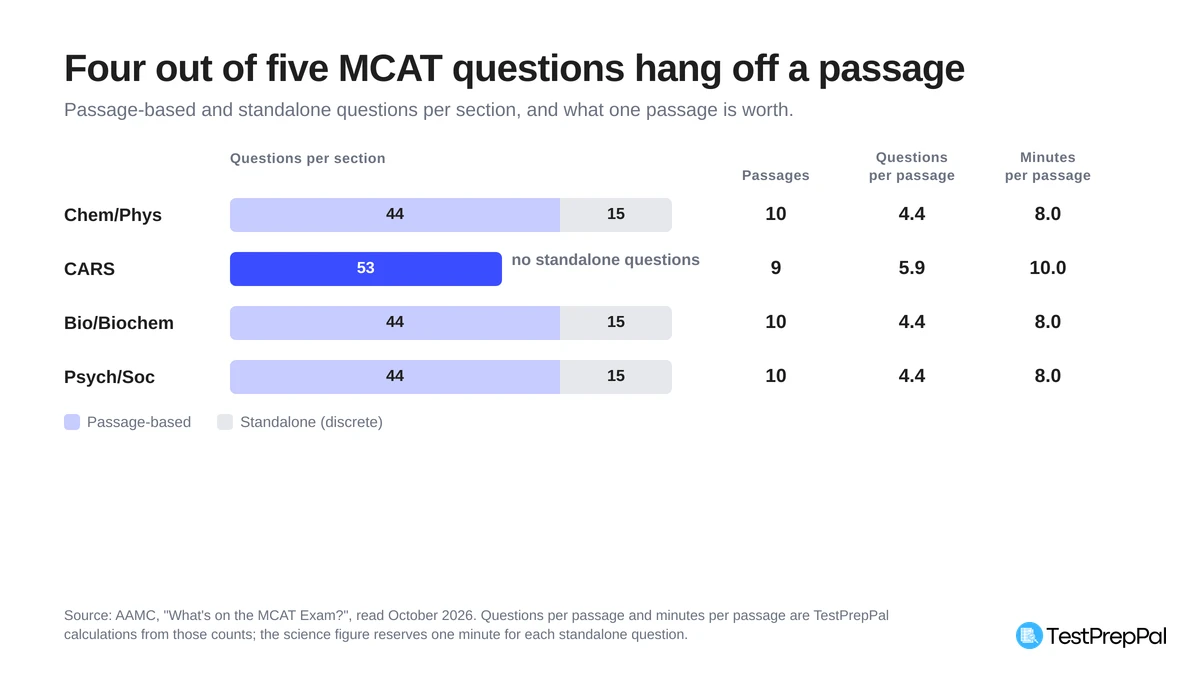 Passage-based and standalone questions per section, with the derived per-passage figures. Source: AAMC section table, TestPrepPal calculation.
Each science section has 10 passages and 15 standalone questions, so 59 minus 15 leaves 44 questions spread over those 10 passages. That is 4.4 questions per passage. CARS has nine passages and no standalone questions at all, so all 53 sit on nine passages, which is 5.9 questions each. Both figures land inside the ranges AAMC states for each format, 4 to 6 questions per science set and 5 to 7 per CARS set, which is a decent check that the arithmetic is right.
Turn that into minutes and you get something you can actually rehearse with. CARS gives you 90 minutes for nine passages, so a CARS passage is worth exactly 10 minutes including the time you spend reading it. For a science section, reserve one minute for each of the 15 standalone questions and you have 80 minutes left for 10 passages, which is 8 minutes each.
The one-minute reservation for standalone questions is a planning choice, not an AAMC rule. Standalone questions need no reading, so they genuinely run faster than passage questions, and reserving a minute each is a conservative way to protect the passage budget. If you are faster than that on discretes, the extra time flows back to the passages where you need it.
CARS is the only section with no standalone questions
This is the single most useful structural fact about the exam, and it is the reason CARS behaves so differently from everything around it.
In the three science sections, 15 of your 59 questions arrive with no passage attached. They test recall directly: a fact, an equation, a definition. They are the questions content review is good at preparing you for, and they are roughly a quarter of each science section.
CARS has none of these. Every one of its 53 questions depends on a passage you have just read, and the passages require no outside knowledge at all. There is nothing to memorize and no recall question to pick up points on. That is why students who improve their science scores through content review often watch their CARS score sit still, and why a dedicated CARS practice resource tends to be a separate purchase from a content course.
It also explains the denser passages. A CARS passage carries 5.9 questions on average against 4.4 for a science passage, so misreading one CARS passage costs you more questions than misreading one science passage. If pacing is the part that keeps slipping, our CARS pacing checkpoints and triage rule turn that 10-minute budget into the clock reading you should see after each of the nine passages.
What each section actually tests
AAMC organizes the three science sections around foundational concepts drawn from year-long courses in general chemistry, organic chemistry, introductory physics and introductory biology, plus introductory biochemistry, psychology and sociology. Each section pulls from several of those disciplines at once rather than one.
- Chemical and Physical Foundations asks you to apply chemistry and physics to living systems rather than to abstract problems.
- Critical Analysis and Reasoning Skills uses passages from the social sciences and humanities and requires no specific content knowledge.
- Biological and Biochemical Foundations covers the processes that keep an organism running, leaning on biology and biochemistry.
- Psychological, Social, and Biological Foundations covers how psychological, social and biological factors shape behavior and health.
Across all four, the questions ask you to combine knowledge with scientific reasoning, which is why a section can feel unfamiliar even when you know the underlying material. If you are weighing how much of a jump that is from your coursework, how hard the MCAT is covers it with the score data attached.
How the four sections are scored
Every section is scored the same way, which keeps the four weighted equally no matter how many questions each one holds.
AAMC scores each section from 118 to 132 with a midpoint of 125. The four combine into a total from 472 to 528, midpoint 500, and you receive five scores in all: one per section plus the total. The arithmetic is straightforward, since 118 times four is 472 and 132 times four is 528. A 132 is the maximum on any one section, and reaching it in all four on the same day is what produces the highest MCAT score, which far fewer people manage than reach a single 132.
Note what that does to CARS. It holds 53 questions against 59 in each science section, but it is worth exactly as many scale points. Every CARS question is therefore worth slightly more of your total score than every science question, which is another argument against treating it as the section you will get to later.
There is no curve. AAMC scales and equates every form so that a 124 in CARS means the same thing whichever form you sat and whoever tested beside you. The conversion from raw correct answers to a scaled score is specific to your form: AAMC's own example notes that 35 to 37 correct might convert to a 123 on one form. That is why no honest raw-to-scaled table exists. If you want to see how section scores combine, our MCAT score calculator does the totals, and what the 472 to 528 range means puts percentiles against them.
The order is fixed, and it shapes your practice
The sections always run Chem/Phys, CARS, Bio/Biochem, Psych/Soc. You cannot reorder them, and there is no version of the exam where CARS comes first or last.
That order puts CARS second, about two hours into the day, before the 30-minute mid-exam break. It is the most reading-heavy section on the exam and it arrives while you are still fresh enough to not notice fatigue building. Psych/Soc, by contrast, is section four, after five hours in the chair.
The practical consequence is about full-length practice rather than content. Taking sections in isolation at whatever time of day suits you trains you for an exam that does not exist. Sitting them in the real order, with the real breaks, is what tells you whether your Psych/Soc accuracy holds up at hour six. Our MCAT study schedule builds full-lengths in at the right spacing, and the rest of our MCAT guides cover the individual sections in more depth.
MCAT section FAQs
How many questions are on the MCAT?
230 questions in total. Chem/Phys, Bio/Biochem and Psych/Soc have 59 each, and CARS has 53. Of those 230, 185 are attached to a passage and 45 are standalone questions, which appear only in the three science sections.
What is the MCAT section order on test day?
Chemical and Physical Foundations, then Critical Analysis and Reasoning Skills, then Biological and Biochemical Foundations, then Psychological, Social, and Biological Foundations. The order is fixed and cannot be changed. Breaks fall between sections, with the longest one, 30 minutes, after CARS.
Is the MCAT scored on a curve?
No. AAMC scales and equates the exam instead, so your score does not depend on who tested with you or when you sat. Small differences in difficulty between forms are corrected during scoring, which means a given scaled score carries the same meaning on every form.
Which MCAT section is the hardest?
AAMC does not designate one, and the honest answer depends on your background. Structurally, CARS is the section with the least to study: no content outline to review, no standalone recall questions, and the densest passages at 5.9 questions each. That combination is why most students name it, even though it is the shortest section.
Does CARS really have no discrete questions?
Yes. AAMC's section table lists nine passage-based sets of five to seven questions for CARS and nothing else, so all 53 questions belong to a passage. The three science sections each list 10 passage-based sets plus 15 independent questions.
We may earn commissions from some links on this page, but this does not affect our reviews or your experience.