


Critical Analysis and Reasoning Skills gives you 90 minutes for nine passages and 53 questions, which works out to exactly 10 minutes per passage with the reading included. The useful version of that number is not a target, it is a clock reading: when you finish passage four, the countdown should say 50:00.
Almost every CARS guide stops at "about 10 minutes a passage" and leaves you to do the rest in your head while the section is running. That is the worst possible moment to do arithmetic. Below are the nine checkpoints written out, what each minute of over-run costs in questions, and a triage rule with a price attached to it.
- Every checkpoint is a round ten. Finish passage one and the clock reads 80:00. Passage four, 50:00. Passage eight, 10:00.
- One minute 42 seconds is the price of a question. 90 minutes split across 53 questions. Run eight and a half minutes over and you have spent five questions' worth of clock.
- The popular 90-second question cap cannot be an average. Applied to all 53 questions it leaves 70 seconds to read a 500 to 600 word passage.
- Defer at most one passage. Coming back means re-reading, and the re-read costs roughly two questions of budget.
- Reasoning Beyond the Text is the biggest question family, about 21 of the 53, and none of them can be answered by finding a sentence.
The checkpoint clock: what the timer should read after each passage
AAMC's section table gives CARS nine passage-based sets and 90 minutes. Divide and each passage is worth 10 minutes flat. Because the on-screen timer counts down rather than up, that division produces something you can check at a glance without subtracting anything: after passage number n, the clock should read nine minus n, times ten.
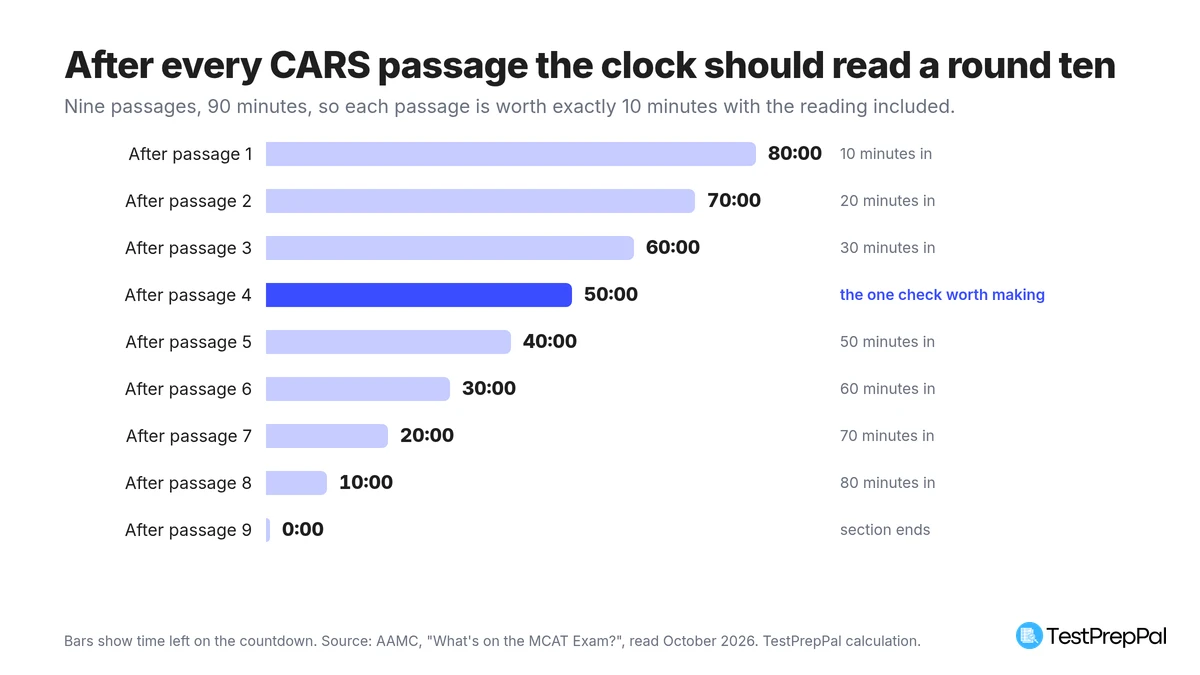 The CARS countdown after each passage. Source: AAMC section table, TestPrepPal calculation.
| Passage finished | Clock should read | Elapsed |
|---|---|---|
| 1 | 80:00 | 10 min |
| 2 | 70:00 | 20 min |
| 3 | 60:00 | 30 min |
| 4 | 50:00 | 40 min |
| 5 | 40:00 | 50 min |
| 6 | 30:00 | 60 min |
| 7 | 20:00 | 70 min |
| 8 | 10:00 | 80 min |
| 9 | 0:00 | 90 min |
Every row is a multiple of ten, which is the whole reason this is worth memorizing. You do not need to recall nine separate numbers, only that the clock loses a round ten each time you finish a passage.
Do not check all nine. Glancing at the timer costs attention, and attention is the thing CARS is actually testing. Check once, after passage four, when the clock should read 50:00 and five passages remain. That single reading tells you whether the second half needs adjusting while there is still enough left to adjust.
What falling behind actually costs
Here is the number no ranking page publishes. Take 90 minutes, divide by 53 questions, and every question on the section is worth 1 minute 42 seconds of clock, its share of the reading included. That converts over-runs from a vague worry into a count.
| You run over by | And you have spent |
|---|---|
| 1:42 | 1 question of budget |
| 3:24 | 2 questions |
| 5:06 | 3 questions |
| 6:48 | 4 questions |
| 8:29 | 5 questions |
| 10:11 | 6 questions |
The reason this matters more in CARS than anywhere else is that nothing on the section is quick. The three science sections each carry 15 independent questions that need no passage at all, so a science section has 15 genuinely fast questions in it. CARS, as AAMC notes in its own table, has questions that are all passage-based. There is no fast lane to make the time back in. We lay the four sections side by side in our breakdown of the MCAT sections.
If you are already behind when you hit the passage four checkpoint, the recovery arithmetic is fixed and worth knowing before test day rather than during it.
| At the passage 4 checkpoint | Left for the last 5 passages | New per-passage budget |
|---|---|---|
| On time, 50:00 | 50 min | 10:00 |
| 2 min behind, 48:00 | 48 min | 9:36 |
| 4 min behind, 46:00 | 46 min | 9:12 |
| 6 min behind, 44:00 | 44 min | 8:48 |
| 8 min behind, 42:00 | 42 min | 8:24 |
| 10 min behind, 40:00 | 40 min | 8:00 |
Being four minutes down costs you 48 seconds a passage for the rest of the section, which is survivable. Being ten minutes down means working at 8:00 a passage for the entire second half, which in practice means one passage gets guessed. Catch it at 40 minutes and you choose which one. Catch it at 80 minutes and the section chooses for you.
The 90-second rule does not survive the arithmetic
Search for CARS tips and you will be told to cap any single question at 90 seconds. That advice is fine as a ceiling and badly wrong as a target, and the arithmetic shows why in one line.
Spend 90 seconds on each of the 53 questions and you have used 79.5 minutes. That leaves 10.5 minutes for nine passages, or 1 minute 10 seconds of reading each. AAMC describes CARS passages as typically between 500 and 600 words, so a 70-second read demands somewhere between 429 and 514 words per minute, on dense prose you have to reason about afterwards. It is not a realistic plan.
Work out the real average instead. Nine passages at 10 minutes, minus the time you spend reading, divided by the 5.9 questions an average passage carries:
- Read in 3 minutes and you have 7:00 for the questions, about 1:11 each.
- Read in 3 and a half minutes and you have 6:30, about 1:06 each.
- Read in 4 minutes and you have 6:00, about 1:01 each.
So your working average is roughly 65 seconds a question, not 90. The 90-second figure is what an outlier is allowed to cost before you cut it loose, and each one you spend has to be paid back by questions that run under a minute. Treat it as a ceiling and it protects you. Treat it as a pace and you will finish passage seven with the clock already gone.
Which passage to leave for last
The standard advice is to scan the opening lines and save the ugly passages for the end. It is worth knowing that this is contested by people who score well. The counter-argument, made bluntly in MCAT Bootcamp's CARS guide, is that you cannot tell from 15 seconds of skimming whether a passage and its questions will be hard, and you have to answer all nine regardless.
The honest position sits between the two. Triage is real, but it is a response to the clock, not a prediction about the passage.
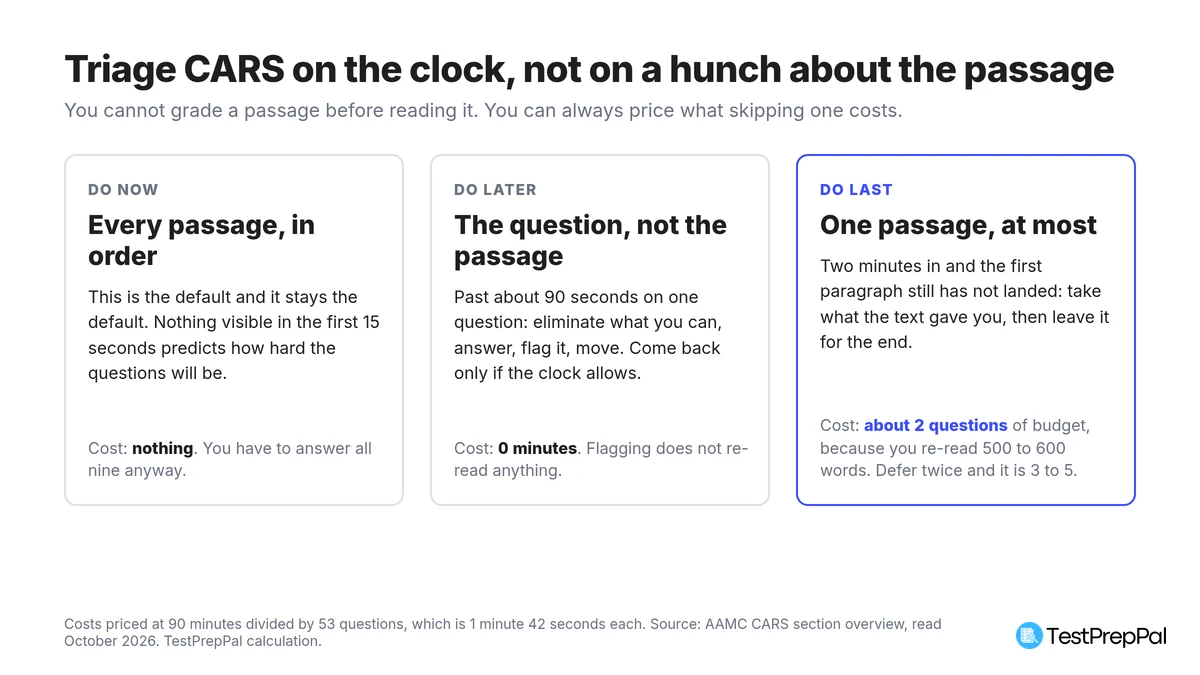 Triage priced in questions, using the 1 minute 42 seconds a CARS question is worth.
Do now. Passages in order is the default and it stays the default. There is no reliable signal in the first 15 seconds, and you owe all nine an attempt anyway.
Do later. This is a question-level move, not a passage-level one. Past roughly 90 seconds on one question, eliminate what you can, commit to an answer, flag it, and move. Flagging costs nothing, because you are not re-reading anything to do it.
Do last. This is the passage-level move, and it has a real price. Deferring a passage means coming back and re-reading 500 to 600 words, which is 3 to 4 minutes you already spent once. At 1 minute 42 seconds a question, that re-read costs you about two questions of budget. Defer two passages and the bill is somewhere between three and five questions, which is close to an entire passage's worth of marks.
So the cap is one. If two minutes into a passage the first paragraph still has not landed, take whatever the text has given you, answer what you can support, and leave it for the end. Do that a second time and you are no longer triaging, you are just paying to read the same words twice.
Where your CARS questions actually come from
Pacing buys you nothing if you spend the time on the wrong habit. AAMC publishes the mix, and it is not the one most study plans optimize for.
| Skill | Share of the section | Questions, about |
|---|---|---|
| Foundations of Comprehension | 30% | 16 |
| Reasoning Within the Text | 30% | 16 |
| Reasoning Beyond the Text | 40% | 21 |
AAMC notes these are approximated to the nearest 5 percent and vary from one test form to another, so treat them as proportions rather than a guarantee. Even so, the shape is stable: Reasoning Beyond the Text is the largest single family at roughly 21 of the 53 questions, around 2.4 per passage.
That family asks you to take what the passage established and apply it somewhere the passage never went. None of those questions can be answered by locating a sentence. This is why highlighting-heavy strategies plateau. They are excellent preparation for the 30 percent that tests comprehension and close to useless for the 40 percent that does not.
The passage content split is deliberately even, 50 percent humanities and 50 percent social sciences, drawing on ethics, philosophy, studies of diverse cultures and population health. Everything you need is in the passage, so unfamiliar subject matter is not the obstacle it feels like. Reading more philosophy will not raise your score. Practicing the jump from what the author said to what the author would say will.
How to practice against the clock
Timed practice only teaches you something if it reproduces the constraint. Three things make it reproduce:
Run full nine-passage blocks, not single passages. Passage one is never the problem. Passage seven, after an hour of dense prose, is where pacing actually breaks, and you cannot rehearse that in a 10-minute drill. The sets in our CARS practice resource roundup are built for full-section work, and the full-length practice tests put CARS where it really sits, second, after 95 minutes of chemistry and physics.
Build those blocks into the calendar rather than fitting them in where a day allows. Every plan in our week-by-week MCAT study schedule carries a daily CARS slot for exactly this reason, because CARS rewards consistency over intensity more than any other section.
Write down the clock reading at passage four every time. One number per session. Over a few weeks it tells you whether you have a pacing problem or an accuracy problem, and those need completely different fixes. If you are hitting 50:00 and still scoring low, more speed work is wasted effort.
Review the questions you got right but ran long on. They are invisible in a score report and they are where your time is actually going. Our guide to studying for the MCAT covers how to fold that review into a full schedule, and you can see what a given CARS score does to your total in the MCAT score calculator.
MCAT CARS FAQs
Is CARS the hardest MCAT section?
By the only measure AAMC publishes, it is the lowest scoring. The current percentile tables, in force from May 1 2026 to April 30 2027, put the CARS mean at 124.6 against 125.1 for Bio/Biochem and 125.9 for Psych/Soc. It also has the tightest spread of the four sections, a standard deviation of 2.9, so a single scaled point moves you further up the percentile table in CARS than anywhere else on the exam.
What is a 90 percent on CARS?
A 128. In the current window a CARS score of 128 sits at the 90th percentile, 130 reaches the 98th, and 125 is already the 62nd. Those cutoffs are specific to CARS, because the same scaled score is worth a different percentile in each section. We break the four sections down point by point in what the MCAT score range means.
What is the average CARS score?
124.6, which sits just below the 125 midpoint of the 118 to 132 section scale. Scoring 125 in CARS therefore puts you above average, at the 62nd percentile, even though it looks like a dead center result on the scale itself.
What are CARS passages?
Nine pieces of writing, typically 500 to 600 words each, split evenly between humanities and social sciences. They require no outside coursework, because everything needed to answer the questions is contained in the passage and the questions themselves. All 53 CARS questions hang off one of those nine passages, which is why the section has no quick questions and why the full CARS block runs 90 minutes with no natural breathing room. Start from our MCAT hub if you are still mapping out which sections need the most work.
We may earn commissions from some links on this page, but this does not affect our reviews or your experience.