


The MCAT is 6 hours and 15 minutes of actual testing, and about 7 hours and 30 minutes of seated time once the tutorial, breaks, and admin screens are counted. Most US test centers start at 8:00 a.m., which puts your dismissal at roughly 3:27 p.m.
That second number is the one nobody gives you. Every page that answers "how long is the MCAT exam" stops at the seated-time total, so you still cannot tell your family when to pick you up. Below is the whole day on a clock, built from AAMC's own test-day schedule, plus the 65 minutes of it you actually control.
- Testing time is 6 hours 15 minutes. Four sections, 230 questions, no way around it.
- Seated time is about 7 hours 30 minutes. AAMC's own segments add up to 7 hours 27 minutes.
- The standard US start time is 8:00 a.m., so a normal day ends at about 3:27 p.m.
- You must report 30 minutes early. Check-in sits outside seated time, making the day about 8 hours door to dismissal.
- 65 of those minutes are optional. Skip all of them and the seated day drops to 6 hours 22 minutes.
The MCAT test-day clock, hour by hour
AAMC publishes the length of every segment but never puts clock times on them. Here is the same schedule with the times filled in, starting from the 8:00 a.m. slot that AAMC's US testing calendar calls the standard start time.
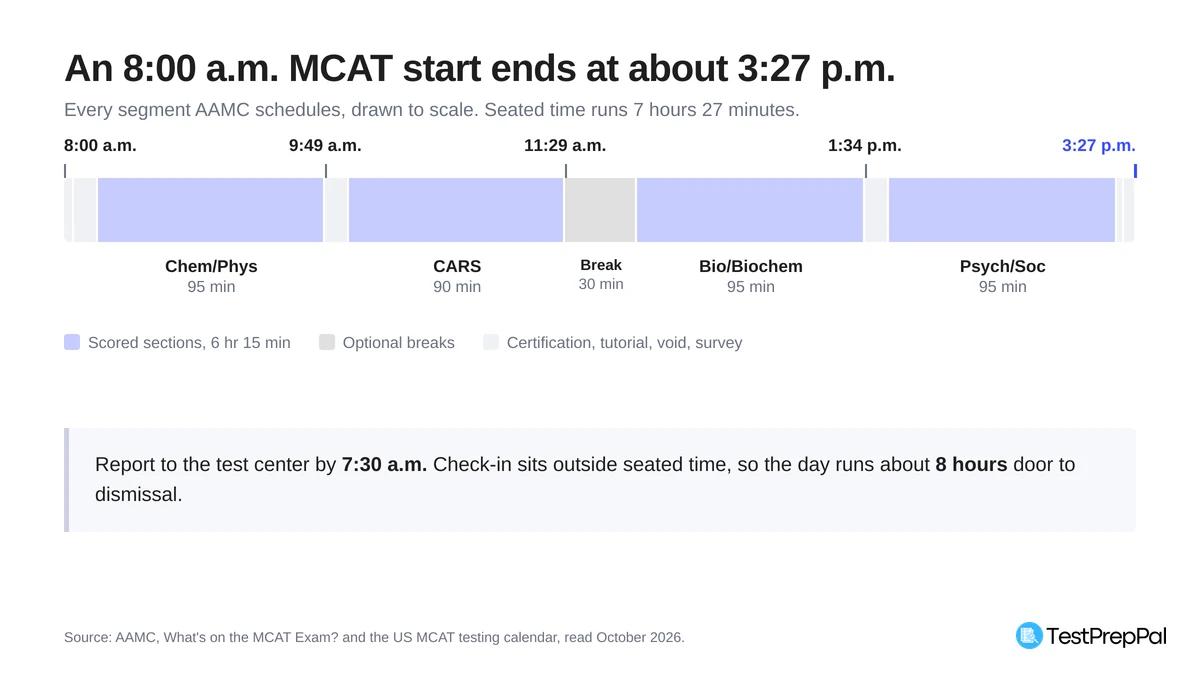 A full MCAT day from the standard 8:00 a.m. start. Source: AAMC test-day schedule and US testing calendar.
| Segment | Length | Starts | Ends |
|---|---|---|---|
| Report to the test center | 30 min before | 7:30 a.m. | 8:00 a.m. |
| Test-day certification | 4 min | 8:00 a.m. | 8:04 a.m. |
| Tutorial (optional) | 10 min | 8:04 a.m. | 8:14 a.m. |
| Chemical and Physical Foundations | 95 min | 8:14 a.m. | 9:49 a.m. |
| Break (optional) | 10 min | 9:49 a.m. | 9:59 a.m. |
| Critical Analysis and Reasoning Skills | 90 min | 9:59 a.m. | 11:29 a.m. |
| Mid-exam break (optional) | 30 min | 11:29 a.m. | 11:59 a.m. |
| Biological and Biochemical Foundations | 95 min | 11:59 a.m. | 1:34 p.m. |
| Break (optional) | 10 min | 1:34 p.m. | 1:44 p.m. |
| Psychological, Social, and Biological Foundations | 95 min | 1:44 p.m. | 3:19 p.m. |
| Void question | 3 min | 3:19 p.m. | 3:22 p.m. |
| End-of-day survey (optional) | 5 min | 3:22 p.m. | 3:27 p.m. |
Two things to notice. The lunch-shaped gap at 11:29 a.m. is your only real meal window, and it is 30 minutes long. And the exam is not over when the last section ends at 3:19 p.m.: the void decision and the survey keep you in the chair for another eight minutes.
If your center starts you at a different time, the span does not change. Add 7 hours and 27 minutes to your start and you have your dismissal time.
Testing time, seated time, and the day you actually lose
These three numbers get used interchangeably, and they are not the same thing.
Testing time is 6 hours and 15 minutes. That is the four scored sections only: 95 + 90 + 95 + 95 minutes. Nothing else counts toward it.
Seated time is about 7 hours and 30 minutes. AAMC uses the word "about" deliberately. Add up the eleven segments it lists and you get 447 minutes, which is 7 hours and 27 minutes. The three-minute difference is rounding, not a segment somebody forgot.
The day itself is about 8 hours. Seated time explicitly excludes check-in. AAMC's footnote is blunt about it: total seated time does not include check-in time upon arrival at the test center. Report at 7:30 a.m., walk out at 3:27 p.m., and you have spent 7 hours and 57 minutes there before you count parking or the drive.
| What you are measuring | Length |
|---|---|
| Scored testing time | 6 hr 15 min |
| Seated time, every optional segment taken | 7 hr 27 min |
| Report time through dismissal | about 7 hr 57 min |
This is why MCAT endurance is its own skill, and why a full-length under real conditions is worth more than two untimed section sets. If you have not built that into your plan yet, our MCAT study schedule guide covers where full-lengths belong, and the MCAT practice test roundup compares the exams that actually run the full 6 hours 15 minutes.
Why your day can be 65 minutes shorter
Five of AAMC's eleven segments carry the word "optional". Nobody adds them up, so here they are.
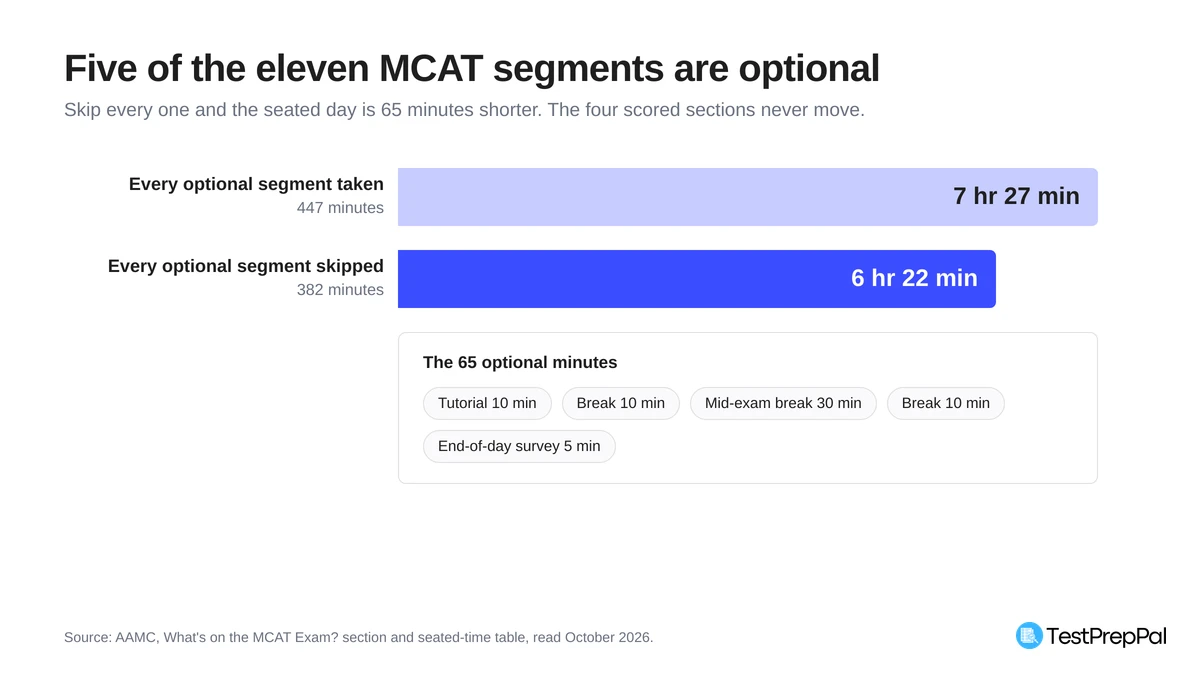 The five optional segments total 65 minutes. Source: AAMC test-day schedule.
The tutorial is 10 minutes, the two short breaks are 10 minutes each, the mid-exam break is 30 minutes, and the end-of-day survey is 5 minutes. Together that is 65 minutes. Strip all of it out and what remains is test-day certification (4 minutes), the four sections (375 minutes), and the void question (3 minutes): 382 minutes, or 6 hours and 22 minutes.
So the real answer to how long the MCAT takes is a range you partly control: 6 hours 22 minutes to 7 hours 27 minutes of seated time.
Do not actually skip the breaks. The 30-minute mid-exam break is the only time you can eat, and sitting through CARS and Bio/Biochem back to back on an empty stomach is a worse trade than 30 minutes. The point of the number is planning, not strategy: if you tell someone the exam ends at 3:30 p.m. and you skip two breaks, you will be standing outside at 3:00 p.m. instead.
One segment is worth skipping for most people: the tutorial. It teaches you the interface. If you have taken an AAMC practice exam you already know the interface, and that is 10 minutes of sitting you can convert into going home earlier.
What happens before the clock starts
Your 8:00 a.m. start time is when the exam begins, not when you arrive. AAMC's check-in rules set the window precisely: report at least 30 minutes before your start time, but not much more than that, because the center may not be open yet.
Check-in is five steps, all of them in person:
- Review and acceptance of the AAMC Candidate Rules Agreement
- Verification of your MCAT-accepted ID, which the administrator may scan
- A digital signature
- A palm scan, used to detect anyone testing under an assumed identity
- A passport-style photo
On top of that, every examinee is scanned with an infrared and metal detection wand designed to find small cameras and hidden electronics. You repeat the ID and palm scan every single time you enter or exit the testing room, which is the part that surprises people on break three.
Arriving late is not a small problem. AAMC says you might not be allowed to test, there is no refund, and a no-show counts as one of your attempts regardless of the reason.
Examinees are checked in and seated one at a time, so AAMC notes that actual start times vary by individual. That does not shorten your exam. Your 7 hours and 27 minutes begins when your exam begins, so a slow check-in pushes your dismissal later, not your sections shorter.
The three breaks, and the rules that cost people time
The MCAT has three optional scheduled breaks: 10 minutes, 30 minutes, 10 minutes. AAMC's rules on breaks, food, and drink contain four details worth knowing before test day.
Overruns are taken out of your next section. If a break runs long, the overage may be subtracted from the time in the section that follows. There is no grace built in.
You have to time yourself. Test center staff are not responsible for tracking your break. You use the clock in the waiting area, and if you cannot see one, you ask where to find it.
Returning from a break means checking in again. AAMC tells examinees to allow time for check-in procedures on the way back. The palm scan and the pat-down are part of every re-entry, so a 10-minute break is not 10 minutes of rest.
An unscheduled break does not stop the clock. Step out at any other point and your testing time keeps running.
Two more rules shape the day. You cannot leave the building for food, and nothing can be delivered to the center, so whatever you want to eat during that 30-minute window has to arrive in your locker with you. And if you finish a section early you may move on, but the unused time never carries over to a later section or a break.
How the length should change your prep
The length is the reason MCAT prep looks different from prep for shorter exams. Three practical consequences:
Schedule full-lengths at the real start time. If you test at 8:00 a.m., a practice exam that starts at noon trains you for a test you are not taking. Our guide to how many MCAT practice tests to take covers the count; the timing is just as important.
Treat the back half as its own skill. Bio/Biochem begins at 11:59 a.m. and Psych/Soc runs until 3:19 p.m. Most score drops live in that stretch, which is part of what makes the MCAT hard in a way that content review alone does not fix.
Budget the total hours honestly. A full-length costs you well over 7 hours once review is counted. The MCAT study hours calculator is a quick way to see whether your timeline has room for the number of full exams you are planning, and the MCAT hub collects the rest of the prep resources.
After the exam, the waiting starts: scores are released by 5:00 p.m. ET on the scheduled release date, which our MCAT score release dates guide tracks for the current testing year.
MCAT test-day length FAQs
How long is the MCAT with all the breaks?
About 7 hours and 30 minutes of seated time. AAMC's individual segments add up to 7 hours and 27 minutes, which includes the 4-minute certification, the 10-minute tutorial, all three breaks totaling 50 minutes, the void question, and the end-of-day survey. The scored sections themselves account for 6 hours and 15 minutes of that.
If my MCAT starts at 8 a.m., when will it end?
At about 3:27 p.m. if you take every optional segment, and about 2:22 p.m. if you skip all of them. Add the 30-minute report time and your day at the test center starts at 7:30 a.m. A slow check-in can push the whole schedule later, because your section timers do not start until your exam does.
What is the shortest the MCAT can be?
6 hours and 22 minutes of seated time. That is what remains when you skip the tutorial, both 10-minute breaks, the 30-minute mid-exam break, and the end-of-day survey: 4 minutes of certification, 375 minutes of testing, and the 3-minute void question. Skipping the mid-exam break is a bad idea in practice, since it is your only chance to eat.
How many questions are on the MCAT, and how long do I get for each?
230 questions across four sections. Chem/Phys, Bio/Biochem, and Psych/Soc have 59 questions in 95 minutes, which is about 1 minute 37 seconds per question. CARS has 53 questions in 90 minutes, or about 1 minute 42 seconds each. CARS gives you slightly more time per question because the passages carry more of the work.
What time should I arrive at the test center?
Thirty minutes before your start time, and not much earlier. AAMC asks you to report at least 30 minutes ahead so there is time for check-in, storing your belongings, and getting settled. Arrive more than 30 minutes early and the center may not be open yet, so you will be waiting outside rather than getting ahead.
We may earn commissions from some links on this page, but this does not affect our reviews or your experience.