


The MCAT score range is 472 to 528 for your total score, and 118 to 132 for each of the four sections. The midpoint of the total scale is 500, but a 500 sits at only the 48th percentile, which means the median MCAT score is actually 501.
- Total scores run from 472 to 528, which gives 57 possible total scores.
- Each of the four sections is scored 118 to 132 with a midpoint of 125, which gives 15 possible section scores.
- Your total is the four section scores added together. That is why 4 x 118 = 472 and 4 x 132 = 528.
- The mean total score is 500.6 across the 2023 to 2025 testing years, and the median is 501.
- The same section score is worth a different percentile in each section. A 125 is the 62nd percentile in CARS but the 44th in Psych/Soc.
What is the MCAT score range?
You receive five scores from the MCAT, according to the AAMC: one for each of the four sections, and one combined total.
Each section is scored on a 15 point scale from a low of 118 to a high of 132, with a midpoint of 125. The four sections are Chemical and Physical Foundations of Biological Systems, Critical Analysis and Reasoning Skills (CARS), Biological and Biochemical Foundations of Living Systems, and Psychological, Social, and Biological Foundations of Behavior.
The total is those four section scores added together. That addition is the entire reason the total range looks the way it does. Four sections at the floor of 118 give you 472. Four at the ceiling of 132 give you 528. Four at the midpoint of 125 give you 500. That 472 is the floor of the scale, but it is not the floor for admissions: the lowest MCAT score that actually gets in is a separate question with its own data.
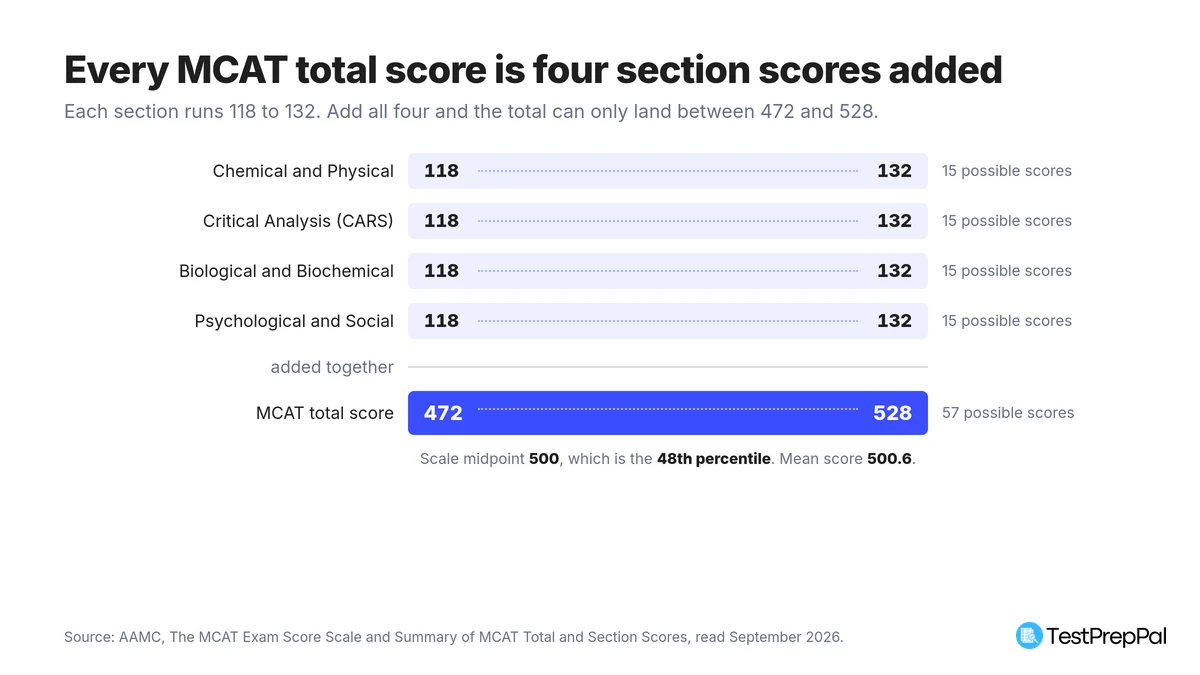 The total scale is not a separate scale. It is the four section scales added together.
So there are 57 possible total scores and 15 possible section scores. There is no separate total scale to learn: if you know your four section scores, you already know your total. The AAMC's own worked example is a 128, a 125, a 129 and a 127, which add to a total of 509.
If you are working backward from a practice test instead, the MCAT score calculator converts raw correct answers into scaled section scores and a total. If you have no score to work from yet, a free MCAT diagnostic will give you one in about three hours.
What percentile is each MCAT total score?
The range on its own does not tell you much. What makes a number mean something is the percentile attached to it, and the AAMC republishes those every year.
The current percentile ranks are in effect from May 1, 2026 through April 30, 2027. They are built from every MCAT result across the 2023, 2024 and 2025 testing years combined, a sample of 305,494 scores. The mean total score in that sample is 500.6 and the standard deviation is 11.2. Percentile rank here means the percentage of scores equal to or lower than yours.
| Total score | Percentile rank |
|---|---|
| 472 | <1 |
| 480 | 4 |
| 490 | 20 |
| 495 | 33 |
| 500 | 48 |
| 501 | 52 |
| 505 | 64 |
| 508 | 74 |
| 510 | 79 |
| 511 | 82 |
| 515 | 91 |
| 518 | 95 |
| 520 | 97 |
| 522 | 99 |
| 525 | 100 |
| 528 | 100 |
Two things in that table are worth slowing down for.
The first is that the midpoint of the scale is not the middle of the pack. A 500 is the arithmetic center of a 472 to 528 range, but it is the 48th percentile. The 50th percentile falls at 501. People describe a 500 as "average" constantly, and on the scale it is, but against actual test takers it is a point below the median.
The second is how tightly scores bunch in the middle. Differencing the full percentile table gives you this:
| Score band | Share of all scores |
|---|---|
| 472 to 490 | 20% |
| 491 to 500 | 28% |
| 501 to 510 | 31% |
| 511 to 520 | 18% |
| 521 to 528 | 3% |
A 20 point window from 491 to 510 holds 59 percent of every score reported. The top of the scale is the mirror image: 522 through 528 are seven of the 57 possible totals, and all seven sit at the 99th percentile or above. Above 524 the table simply prints 100. Moving from 510 to 515 buys you 12 percentile points. Moving from 520 to 525 buys you three.
For the full year by year picture, including how these distributions have shifted, see our MCAT statistics page.
Why the same section score is not worth the same percentile
Here is the part that almost nothing else on this topic publishes. Because the four sections have different score distributions, an identical section score buys you a different percentile depending on which section it came from.
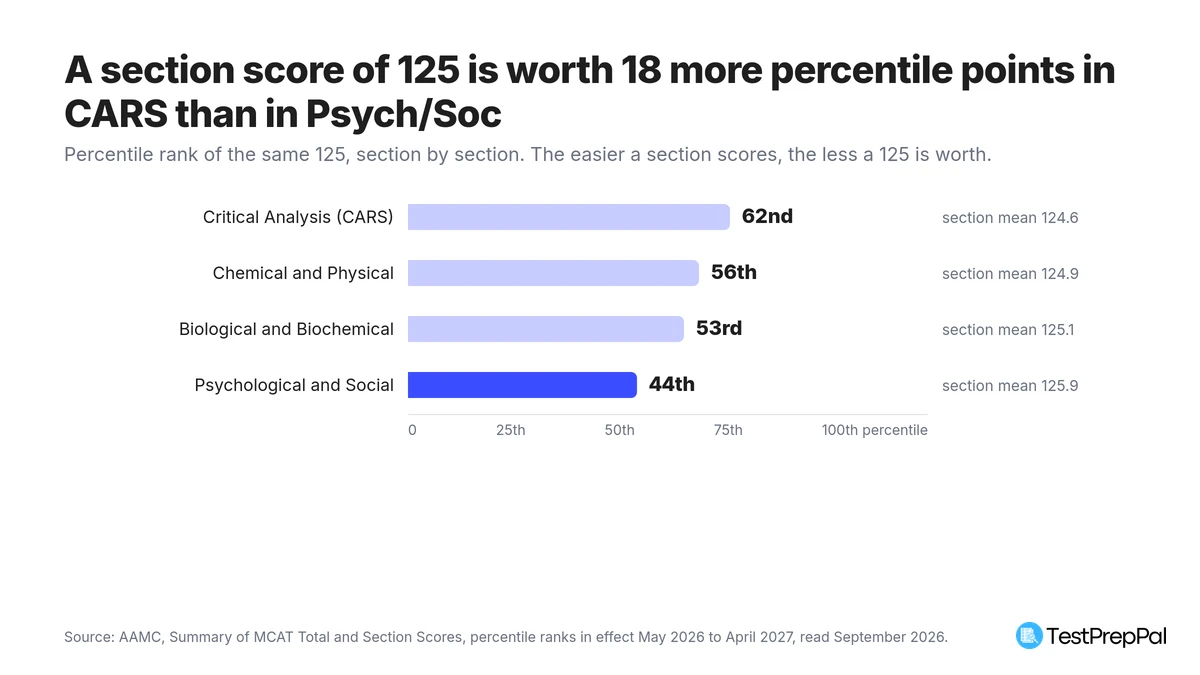 The same 125 ranges from the 44th to the 62nd percentile depending on the section.
The full comparison, from the same AAMC percentile document:
| Section score | Chem/Phys | CARS | Bio/Biochem | Psych/Soc | Gap |
|---|---|---|---|---|---|
| 118 | 2nd | 1st | 1st | 1st | 1 |
| 120 | 9th | 8th | 8th | 6th | 3 |
| 122 | 25th | 25th | 23rd | 17th | 8 |
| 124 | 46th | 50th | 43rd | 34th | 16 |
| 125 | 56th | 62nd | 53rd | 44th | 18 |
| 126 | 67th | 74th | 64th | 54th | 20 |
| 127 | 77th | 84th | 75th | 65th | 19 |
| 128 | 85th | 90th | 84th | 76th | 14 |
| 130 | 96th | 98th | 96th | 92nd | 6 |
| 132 | 100th | 100th | 100th | 100th | 0 |
The gap peaks at a section score of 126, where the same number is the 74th percentile in CARS and the 54th in Psych/Soc. That is a 20 percentile point difference for one identical score.
The cause is the section means. CARS has the lowest mean of the four at 124.6, with the tightest spread at 2.9 points. Chem/Phys is next at 124.9, then Bio/Biochem at 125.1, then Psych/Soc highest at 125.9 with a spread of 3.3. Test takers as a group score highest on Psych/Soc, so any given score there clears fewer people. They score lowest on CARS, so the same score there clears more.
A 125 in CARS and a 125 in Psych/Soc are worth the same single point toward your total, but they are not the same accomplishment. The CARS 125 beat 62 percent of test takers. The Psych/Soc 125 beat 44 percent.
This matters in two practical places. When you are reading a practice test breakdown, a lopsided 128 in Psych/Soc and 124 in CARS is a weaker profile than the raw numbers suggest, because the 128 is only the 76th percentile there while the 124 is the 50th in CARS. And when you are deciding where to put study time, the sections where the gap is widest are the sections where a single point moves your percentile the most. That is the calculation behind our guide to improving an MCAT score.
Note that all four sections converge at the extremes. At 120 the spread between sections is three percentile points, and at 132 there is none at all. The differences only bite through the middle of the scale, which is where most scores actually land.
How your answers turn into a score in that range
Nothing about the 472 to 528 range involves a curve. The AAMC is explicit about this: the exam is scaled and equated rather than curved, so a 124 in CARS means the same thing on any form and any test date. You are not competing against the people who tested the same day as you.
The mechanics are straightforward:
- Your raw score is just the number of questions you answered correctly. Wrong answers are scored exactly the same as blanks, and there is no penalty for guessing, so never leave a question empty.
- That raw count converts to a scaled score between 118 and 132. The conversion is specific to your test form, which is how equating compensates for one form being slightly harder than another.
- The AAMC illustrates it this way: a raw score somewhere between 35 and 37 correct might convert to a 123, and a raw score between 46 and 48 might convert to a 128. Those are illustrations, not a fixed table.
- The scaling and equating work is why scores are not available the day you test. The AAMC quotes 30 to 35 days, but every published MCAT score release date actually lands 31 to 33 days after the exam.
The practical consequence of form specific conversion is that you cannot count raw questions on a practice test and assume the same conversion will hold on test day. Treat a practice total as an estimate with a few points of slack around it.
Once you have a real score in hand and are weighing whether to sit again, the MCAT retake calculator works through the arithmetic, and our breakdown of whether a 508 is a good MCAT score covers what admissions committees do with a number in the upper middle of this range. If you are still at the start and trying to gauge the climb, how hard the MCAT is is the honest version, and the MCAT hub collects the rest.
MCAT score range FAQs
Is a 520 MCAT score good?
A 520 is the 97th percentile, so it beats 97 percent of everyone who tested across the 2023 to 2025 testing years. It sits near the top of a compressed stretch of the scale: only eight of the 57 possible total scores are higher, and the difference between a 520 and a 525 is three percentile points. In practical terms a 520 is competitive anywhere, and additional points above it return very little.
Is a 500 a bad MCAT score?
A 500 is not bad, but it is slightly below the middle. It is the exact midpoint of the 472 to 528 scale, which is why it gets called average, yet it is the 48th percentile and the median score is 501. About 28 percent of all test takers score between 491 and 500. Whether it is good enough depends entirely on the school list, and a well chosen prep course is the usual next step if you plan to retake. Closing a gap from there has a price in hours: our guide to how to study for the MCAT puts a 12-point climb from a 500 baseline at 520 hours over 26 weeks.
What MCAT score is the 95th percentile?
A total score of 518 is the 95th percentile in the ranks currently in effect. A 515 is the 91st and a 520 is the 97th, so the 95th percentile band is narrow. These cutoffs shift slightly each May 1, when the AAMC rebuilds the percentile ranks using the three most recent testing years.
What are the highest and lowest possible MCAT scores?
The highest possible total is 528 and the lowest is 472. Neither is reachable any other way than a perfect run or a floor run across all four sections, because a 528 requires a 132 in each section and a 472 requires a 118 in each. A 472, 473 or 474 all report as below the 1st percentile, and every score from 525 up reports as the 100th. Our guide to the highest MCAT score works out how few people are actually up there.
We may earn commissions from some links on this page, but this does not affect our reviews or your experience.