


A good MCAT score is whichever score clears the benchmark you are actually measured against, and there are three of them. The mean across everyone who tested is 500.6, the mean for students who matriculated at a US MD program is 512.1, and the mean for DO matriculants is 502.97.
Those three numbers land at the 48th, 84th and 58th percentile. That spread is why a single band table cannot answer this question, and why the number you need depends on which door you are walking through.
- The mean total score across everyone who tested in 2023, 2024 and 2025 is 500.6, and the median is 501.
- The mean for students who matriculated at a US MD program in 2025-2026 is 512.1, the 84th percentile.
- The mean for DO matriculants is 502.97 for the 2024 entering class, the 58th percentile.
- A point is not worth the same everywhere. One scaled point buys 3.2 percentile places between 500 and 505, but only 1.2 between 515 and 520.
- On the AAMC acceptance grid, a 506 to 509 with a GPA above 3.79 is accepted more often (57.1 percent) than a 514 to 517 with a GPA of 3.20 to 3.39 (45.5 percent).
What is a good MCAT score?
Three benchmarks matter, and every one of them is published. Here they are side by side, each with the percentile the current AAMC table assigns it.
| Benchmark | Mean total score | Percentile | Data year |
|---|---|---|---|
| Everyone who takes the MCAT | 500.6 | 48th at 500 | 2023 to 2025 testing years |
| DO matriculants | 502.97 | 58th at 503 | 2024 entering class |
| MD applicants | 506.3 | 67th at 506 | 2025-2026 cycle |
| MD matriculants | 512.1 | 84th at 512 | 2025-2026 cycle |
The all test taker mean of 500.6 comes from the AAMC percentile table in effect May 1, 2026, which is built on 305,494 exams from the 2023, 2024 and 2025 testing years. The MD figures come from AAMC Table A-16, covering 23,440 matriculants in the 2025-2026 cycle. The DO figure comes from AACOM's applicant and matriculant MCAT report, which is the most recent one the association has published.
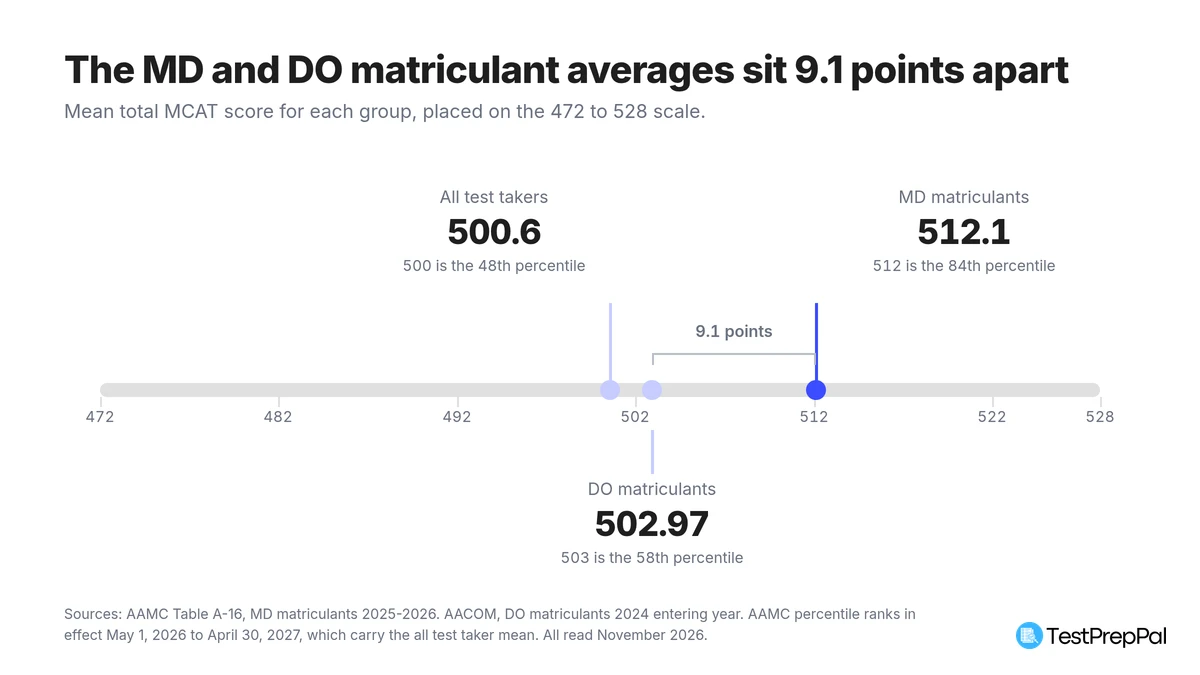 The MD and DO matriculant averages are 9.1 points apart, which is 26 percentile places.
Two things in that chart get flattened everywhere else. The first is the size of the MD to DO gap: 9.1 scaled points, or 26 percentile places, is not a rounding difference. The second is that the DO average has been falling. It was 504.73 for the 2021 entering class and 502.97 for 2024, a drop of 1.76 points in three years, which is why the "504 to 505" figure still repeated across prep sites is out of date.
If you want the full 57 row table rather than these four anchors, the MCAT score range guide has every total score and its percentile.
What one MCAT point is actually worth
Here is the part no ranking page publishes. The MCAT scale is not linear in percentile terms, so "one more point" means something different at 502 than it does at 519.
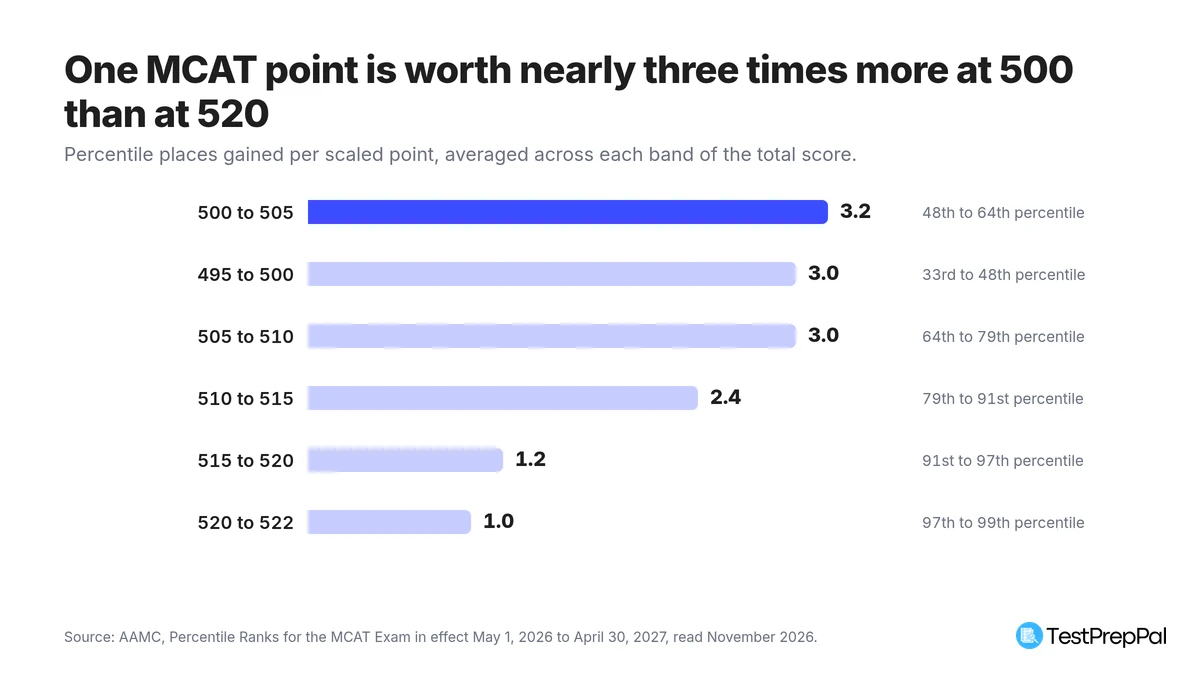 Percentile places bought per scaled point, computed from the AAMC table in effect May 2026.
| Score band | Percentile range | Places gained per point |
|---|---|---|
| 495 to 500 | 33rd to 48th | 3.0 |
| 500 to 505 | 48th to 64th | 3.2 |
| 505 to 510 | 64th to 79th | 3.0 |
| 510 to 515 | 79th to 91st | 2.4 |
| 515 to 520 | 91st to 97th | 1.2 |
| 520 to 522 | 97th to 99th | 1.0 |
A point in the low 500s is worth about 2.7 times as much, in percentile terms, as a point in the high 510s. Going from 507 to 508 moves you from the 71st percentile to the 74th, three places. Going from 520 to 521 moves you from the 97th to the 98th, one place.
That is the arithmetic behind most retake decisions. A student sitting at 504 who adds four points lands at 508 and gains 13 percentile places. A student sitting at 518 who adds the same four points gains four. The effort is similar. The payoff is not.
The reason is that scores cluster near the middle. The exam is scaled and equated rather than curved, so your score does not depend on who sat with you, but the distribution of all those scores is still bunched around 500. More people are packed into each point near the middle of the scale, so passing one point there means passing more people.
One caveat on timing. The percentile ranks are reissued every May 1 using the most recent three testing years, so a percentile you read in April is not necessarily the one attached to your score in May. The numbers on this page are the table in force from May 1, 2026 through April 30, 2027.
Good compared to test takers is not good compared to applicants
The three means in the first table are three different populations, and sliding between them is where most confusion starts.
Everyone who sits the exam averages 500.6. The people who go on to apply to MD schools average 506.3, because students who score poorly often do not apply at all. The people who actually matriculate average 512.1. Each filter lifts the number by about six points.
So a 506 is above average for a test taker (67th percentile) and dead average for an MD applicant, while sitting six points below the matriculant average. All three statements are true at once. When a prep site tells you a 506 is "solid," it has quietly chosen one of those comparison groups and not told you which.
Matriculant GPA moves with it. MD matriculants in 2025-2026 averaged a 3.81 total GPA, well above the 3.67 applicant average, so the score you need is never separable from the transcript it sits next to.
What the acceptance grid says about a good score
The AAMC also publishes the outcome directly. Its MCAT and GPA grid aggregates 155,940 applicants across the 2023-2024 through 2025-2026 cycles and reports the acceptance rate in every score and GPA cell. Overall, 45.1 percent of applicants were accepted somewhere.
By MCAT band alone:
| Total MCAT | Acceptance rate |
|---|---|
| 498 to 501 | 22.2 percent |
| 502 to 505 | 35.4 percent |
| 506 to 509 | 47.1 percent |
| 510 to 513 | 62.4 percent |
| 514 to 517 | 71.2 percent |
| Above 517 | 79.9 percent |
Split those same bands by GPA and the picture changes shape.
| Total MCAT | GPA above 3.79 | GPA 3.40 to 3.59 | GPA 3.20 to 3.39 |
|---|---|---|---|
| 502 to 505 | 44.9 percent | 30.3 percent | 24.7 percent |
| 506 to 509 | 57.1 percent | 36.7 percent | 31.8 percent |
| 510 to 513 | 70.5 percent | 48.7 percent | 42.3 percent |
| 514 to 517 | 77.2 percent | 56.5 percent | 45.5 percent |
A 506 to 509 with a GPA above 3.79 is accepted 57.1 percent of the time. A 514 to 517 with a GPA of 3.20 to 3.39 is accepted 45.5 percent of the time. Eight MCAT points lose to roughly half a GPA point, so "is my score good" is not a question your score can answer by itself.
You can run your own combination through the MCAT acceptance calculator, which works from these grid cells rather than from a rule of thumb.
Is your section spread good?
Your total hides a lot. The four sections are each scored 118 to 132, and the same section score is worth a very different percentile depending on which section it is in.
| Section | Mean | Percentile of a 127 |
|---|---|---|
| Critical Analysis and Reasoning Skills | 124.6 | 84th |
| Chemical and Physical Foundations | 124.9 | 77th |
| Biological and Biochemical Foundations | 125.1 | 75th |
| Psychological, Social, and Biological Foundations | 125.9 | 65th |
A 127 in CARS is the 84th percentile. The identical 127 in Psych/Soc is the 65th. CARS scores are packed into a narrower range, so each point there separates you from more people. This is why two students with the same 508 total can look quite different on a screen, and why an even spread is usually read as a cleaner result than a lopsided one.
If you are converting practice test results rather than a real score report, the MCAT score calculator turns raw correct answers into scaled section scores and a total.
What is a good MCAT score for you?
Put the benchmarks together and the practical reading is fairly short.
Below 500. You are under the median of all test takers and in the 22 percent acceptance band or lower. A retake is usually worth it, partly because this is the range where points are cheapest: three percentile places each.
500 to 507. Above the test taker median, below both matriculant averages, and squarely in DO range. A strong GPA does real work here, and the grid shows it. If you are at 508 specifically, the 508 breakdown goes through the school list question in detail.
508 to 513. The band that contains both matriculant averages and most of the agonising. Whether to retake turns on your GPA, your section spread and your timeline rather than on the score alone. The MCAT retake calculator will estimate the odds of actually gaining the points.
514 and up. You are at the 89th percentile or better and in the 71 percent acceptance band. Additional points still help at the most selective programs, but they now cost roughly one percentile place each. Chasing a 528 is almost never the best use of the months it would take, and the floor for admission is far lower than most applicants assume.
The last step is specific rather than general. Pull the matriculant range for the schools you are actually applying to with the MCAT school comparison tool, because a score that is average nationally can be above the median at one school and below it at another. If you decide to retake, treat it as a change of method rather than more hours: the guide on improving an MCAT score covers what actually moves, and the MCAT prep course comparison covers the structured option. Everything else for the exam starts from the MCAT hub.
Good MCAT score FAQs
What is the average MCAT score?
The mean total score is 500.6 across everyone who tested in the 2023, 2024 and 2025 testing years, with a standard deviation of 11.2. The median is 501, since a 500 sits at the 48th percentile and a 501 at the 52nd. Those figures come from the AAMC percentile table in force from May 1, 2026 through April 30, 2027.
Is a 500 a good MCAT score?
A 500 is the 48th percentile, so it is just below the middle of all test takers and below both the MD and DO matriculant averages. Applicants in the 498 to 501 band are accepted to an MD program 22.2 percent of the time. It is a workable score with a high GPA and a DO focused list, but it is the range where a retake buys the most percentile movement per point.
Is a 512 MCAT competitive?
Yes. A 512 is the 84th percentile and sits essentially at the MD matriculant average of 512.1. Applicants scoring 510 to 513 are accepted 62.4 percent of the time overall, rising to 70.5 percent with a GPA above 3.79. It is below the typical range at the most selective programs, where matriculant averages run several points higher.
Is a 505 MCAT competitive?
A 505 is the 64th percentile. That is above the all test taker mean and close to the DO matriculant average, but seven points below the MD matriculant average. Applicants in the 502 to 505 band are accepted 35.4 percent of the time, and 44.9 percent with a GPA above 3.79. It is competitive for DO programs and a stretch for most MD programs without a strong transcript.
What is a good MCAT percentile?
If the goal is a US MD program, the honest answer is the 84th percentile, because that is where the matriculant average of 512.1 falls. For DO programs it is the 58th percentile, matching the 502.97 average. Percentile is the more stable way to think about it, since the scaled score that corresponds to a given percentile shifts slightly each May when the AAMC refreshes the table.
We may earn commissions from some links on this page, but this does not affect our reviews or your experience.