


The lowest possible MCAT score is 472, which is a 118 on each of the four sections. The lowest score that has actually got someone into a US MD program is a different number, and the AAMC answers it directly: 122 applicants with a total under 490 were accepted across the three most recent application cycles.
Two questions hide inside this one search. The first is about the scale and takes one line to answer. The second is about the admissions floor, and almost every page that ranks for it answers with a school's average MCAT, which tells you where the middle of a class sits and nothing at all about its bottom edge.
- 472 is the lowest possible total score: 118 on all four sections. You cannot score below it.
- The lowest score that gets in has no official floor. AAMC reports a bottom band of "under 486", and 37 of those 6,116 applicants were accepted over three cycles.
- Counting everyone under 490, 122 of 10,852 applicants were accepted, about 41 a year, or roughly 1 in every 576 acceptees.
- Odds collapse below 494. Each four-point band from 486 to 501 at least doubles your acceptance rate.
- A near-perfect GPA does not rescue a very low score: 2.8 percent with a 3.8+ GPA and a sub-486 MCAT, against 4.0 percent for a 490 to 493 MCAT at any GPA.
What is the lowest possible MCAT score?
The lowest possible total is 472. Each of the four sections is scored from 118 to 132, according to the AAMC, and your total is simply those four section scores added together. Four sections at the floor of 118 give you 472, which is why the scale starts there and not at zero.
You cannot score below 472 by answering badly. There is no negative marking and no sub-472 result: blank and wrong answers are treated the same way, so a test taker who answers nothing still receives a 472. The only way to end a test day without a score is to void the exam, and a void is recorded as no score rather than a low one. If you want the full picture of how the 472 to 528 scale is built and what every point is worth in percentile terms, that is covered in our guide to the MCAT score range. At the other end, the highest MCAT score is 528.
A 472 sits below the 1st percentile on the current AAMC percentile ranks, which run from May 1, 2026 through April 30, 2027 and are built from 305,494 scores across the 2023, 2024 and 2025 testing years. In practice almost nobody submits one. The interesting question is what happens a little further up the scale.
What is the lowest MCAT score that actually gets into medical school?
There is no published minimum. No US MD school advertises a cutoff, and the AAMC does not name a floor. What it does publish is better: the acceptance rate at every MCAT band, crossed with every GPA band, aggregated across three cycles.
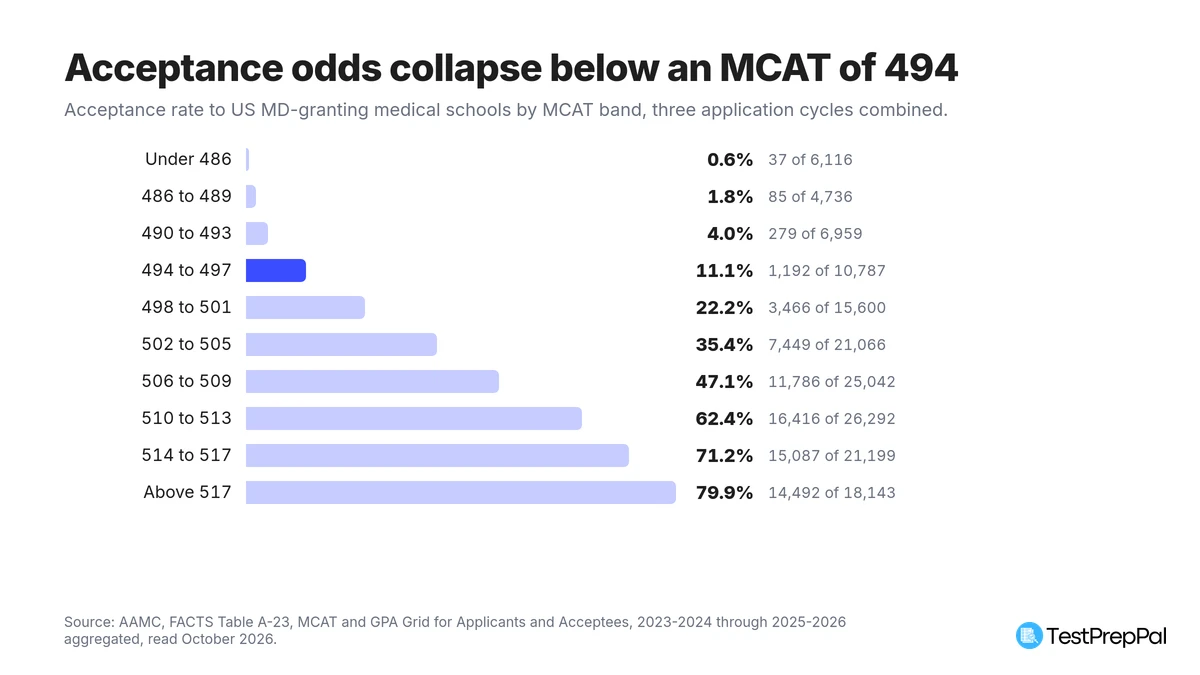 Acceptance rate by MCAT band, 2023-2024 through 2025-2026 combined. Source: AAMC FACTS Table A-23.
The numbers come from Table A-23, which covers 155,940 applicants and 70,289 acceptees over the 2023-2024, 2024-2025 and 2025-2026 cycles. The overall acceptance rate across all of them is 45.1 percent.
| MCAT band | Percentile | Applicants | Accepted | Acceptance rate |
|---|---|---|---|---|
| Under 486 | Below 12th | 6,116 | 37 | 0.6% |
| 486 to 489 | 12th to 18th | 4,736 | 85 | 1.8% |
| 490 to 493 | 20th to 28th | 6,959 | 279 | 4.0% |
| 494 to 497 | 31st to 39th | 10,787 | 1,192 | 11.1% |
| 498 to 501 | 42nd to 52nd | 15,600 | 3,466 | 22.2% |
| 502 to 505 | 55th to 64th | 21,066 | 7,449 | 35.4% |
| 506 to 509 | 67th to 76th | 25,042 | 11,786 | 47.1% |
| 510 to 513 | 79th to 86th | 26,292 | 16,416 | 62.4% |
| 514 to 517 | 89th to 94th | 21,199 | 15,087 | 71.2% |
| Above 517 | 95th and above | 18,143 | 14,492 | 79.9% |
So the honest answer to "what is the lowest score that gets in" is that people get in from the very bottom band, but hardly any of them do. Thirty-seven applicants scoring under 486 were accepted in three years, about twelve a year across every MD school in the country. Add the 486 to 489 band and you get 122 people, roughly 41 a year. Set against 70,289 total acceptees, that is about one in every 576.
Two patterns matter more than any single threshold. First, the odds climb steeply and evenly: every four-point band between 486 and 501 at least doubles the acceptance rate below it, and the jump from 490 to 493 up to 494 to 497 nearly triples it. Four points is a realistic improvement on a retake, and down here four points is worth more than anywhere else on the scale. Second, the coin-flip line sits inside the 506 to 509 band, where the rate crosses from 47.1 percent to 62.4 percent in the band above.
One caveat on reading the table down to a single number. AAMC suppresses any cell with fewer than ten applicants, so the very sparse corners of the grid are not shown, and a band being non-empty does not tell you what else those applicants had. Thirty-seven people cleared a 0.6 percent rate. They were not typical applicants with a low score; they were applicants with something else that carried the file.
Does a high GPA make up for a low MCAT score?
Less than most applicants hope, and almost not at all at the bottom of the scale.
Table A-23 crosses score against GPA, so this is measurable rather than a matter of opinion. An applicant with a sub-486 MCAT and a GPA above 3.79 was accepted 2.8 percent of the time, from 9 acceptances out of 320 applicants. That is the single best GPA bracket paired with the single worst score bracket, and it still comes out below the 4.0 percent that a 490 to 493 MCAT gets across every GPA band. Four extra MCAT points beat a near-perfect transcript.
Drop the GPA and the floor falls away fast. With a sub-486 score, a 3.60 to 3.79 GPA gives 1.6 percent and a 3.40 to 3.59 GPA gives 0.5 percent.
What changes higher up the scale is that GPA starts to do real work. At 498 to 501, a GPA above 3.79 gives 30.6 percent and a 3.20 to 3.39 GPA gives 17.5 percent, a spread of 13.1 points between the same two brackets that were worth barely two points apart at the bottom. GPA is a lever, but it only engages once your score clears roughly 494. If your score is in that range and you are trying to work out where you stand, the medical school acceptance calculator runs your own GPA and MCAT against this data.
What about DO schools?
This is the part the listicles get closest to and still miss. Osteopathic programs do accept lower scores, but the useful fact is not that their average is lower. It is how little the MCAT moves their decisions at all.
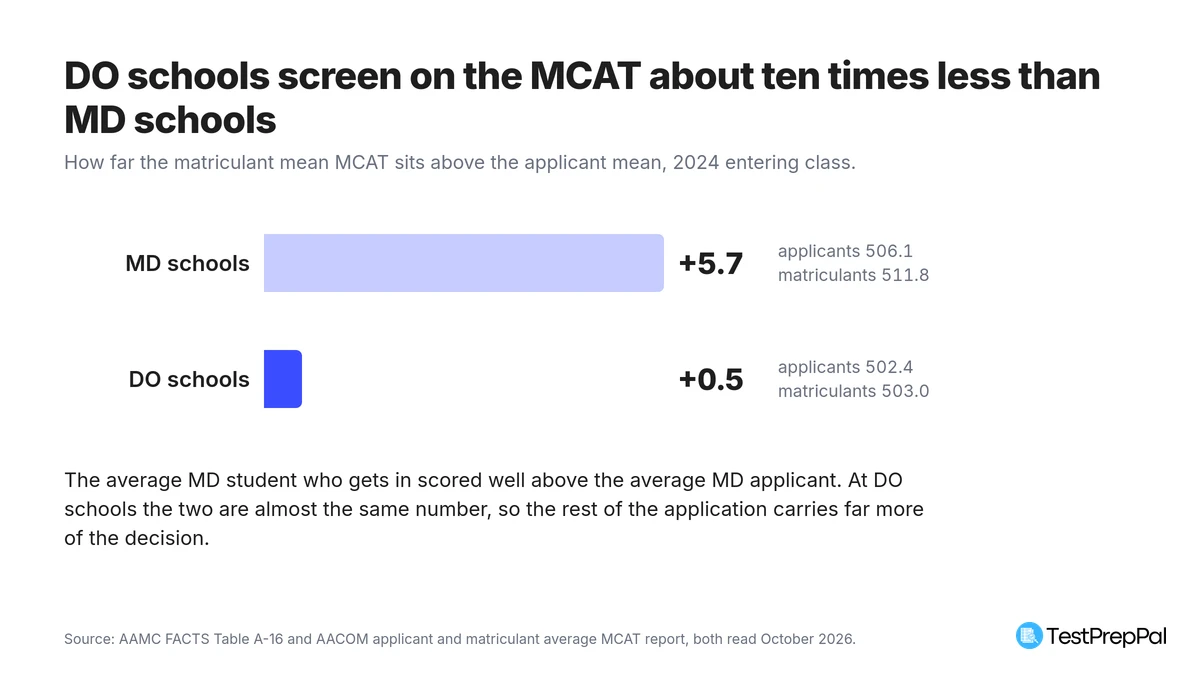 MD schools admit well above their applicant pool's mean score. DO schools barely do. Sources: AAMC Table A-16 and AACOM.
For the 2024 entering class, AAMC Table A-16 puts the MD applicant mean at 506.1 and the MD matriculant mean at 511.8, a gap of 5.7 points. AACOM's figures for the same entering year put DO applicants at 502.4 and DO matriculants at 503.0, a gap of 0.54 points. MD schools filter on the MCAT about ten times harder than DO schools do.
Read that as a strategy rather than a consolation prize. At a DO program, the students who got in scored almost exactly what the applicant pool scored, which means the rest of the file decided it. The most recent MD matriculant mean is 512.1, so the two means sit 8.8 points apart, or 26 percentile points. If your score is in the 490s, the DO route is not a long shot in the way the MD route is.
What should you do with a score below 500?
Treat the score as information, not a verdict. A 499 sits two standard deviations below the MD matriculant mean, which is a real gap and also a closable one.
The first decision is whether to retake, and that turns on why the score came out low rather than on the number itself. A score that matches your practice tests means the preparation needs to change. A score well below your practice average usually means test-day conditions did, and those are more fixable. Our MCAT retake calculator estimates the gain a second attempt is likely to produce from your own history, and the guide to improving an MCAT score covers what actually moves the number.
Four points is the most valuable improvement available at the bottom of the scale. Going from 490 to 494 takes your acceptance rate from 4.0 percent to 11.1 percent, which is a bigger proportional gain than going from 510 to 514.
The second decision is where to apply. Build the list around schools whose matriculant range actually contains your score, using the MCAT school comparison tool, and include DO programs rather than treating them as a fallback. Applying broadly to MD schools whose matriculants average 512 is how a low score becomes a wasted cycle. For a sense of where the scale turns competitive, whether a 508 is a good MCAT score covers the band just above the median. Everything else we publish for this exam starts from the MCAT hub.
Lowest MCAT score FAQs
What is the lowest MCAT score accepted?
There is no published minimum at any US MD school, and the AAMC does not define a floor. The lowest band it reports is "under 486", and 37 of the 6,116 applicants in that band were accepted across the 2023-2024 through 2025-2026 cycles, an acceptance rate of 0.6 percent. Acceptances happen at every band, but below 490 they are rare enough that no applicant should plan around them.
Can you score below a 472 on the MCAT?
No. A 472 is a 118 on each of the four sections, and 118 is the floor of each section scale, so 472 is the arithmetic minimum. Wrong answers and blank answers are scored the same way, with no penalty beyond the lost point, so even answering nothing returns a 472. The only alternative is voiding the exam, which produces no score rather than a lower one.
Is 500 a low MCAT score?
A 500 is the 48th percentile, so it is just below the median test taker rather than a low score in absolute terms. It is below both the MD matriculant mean of 512.1 and the DO matriculant mean of 503.0, and the 498 to 501 band has a 22.2 percent acceptance rate at MD schools. It is a workable score for DO programs and a difficult one for most MD programs.
Is a 480 bad on the MCAT?
A 480 is the 4th percentile and falls inside the "under 486" band, where the MD acceptance rate is 0.6 percent. It is a score to retake rather than apply with, and the gap between 480 and a competitive score is large enough that it usually points to a change in study approach rather than more of the same. The upside is that improvements are worth more here than anywhere else on the scale.
We may earn commissions from some links on this page, but this does not affect our reviews or your experience.