


The highest MCAT score is 528. There is exactly one way to get it: a 132 on each of the four sections, because your total is just the four section scores added together.
What almost nobody tells you is how thin the air is up there, or that the 100th percentile rank starts three points below the top of the scale.
- 528 is the highest possible total score and 472 is the lowest. Both fall out of the 118 to 132 section scale.
- A 528 means a 132 in all four sections at one sitting. There is no other route to it.
- The 100th percentile rank starts at 525, not 528, so a perfect score and a 100th-percentile score are not the same thing.
- At most about 510 examinees a year score above 525, out of roughly 101,800 who sit the exam.
- Moving from 520 to 528 buys you 3 percentile points. The same eight points lower down, 500 to 508, buys you 26.
What is the highest MCAT score?
528, and the arithmetic behind it is simple. The AAMC scores each of the four sections from a low of 118 to a high of 132, with a midpoint of 125. Your total score is those four section scores added together.
So the ceiling of the total scale is 4 x 132 = 528, and the floor is 4 x 118 = 472. That gives 57 possible total scores. The total has no scale of its own to learn: if you know your four section scores, you already know your total. The AAMC's own worked example adds a 128, a 125, a 129 and a 127 to reach 509.
This also means a 528 is four ceilings at once, not one. You cannot offset a 130 in Chem/Phys with a 134 somewhere else, because 134 does not exist. Every section has to land on its own maximum on the same day.
If you're converting a practice test instead of a real score report, the MCAT score calculator turns raw correct answers into scaled section scores and a total. For the full picture of what every score on the scale is worth, we cover that separately in our guide to the MCAT score range.
How rare is a 528?
Rarer than the ranking pages suggest, and the AAMC's own table tells you roughly how much rarer.
The current percentile ranks are in effect from May 1, 2026 through April 30, 2027, and they're rebuilt every May 1 from the three most recent testing years. The table itself is built on 305,494 scores from the 2023, 2024 and 2025 testing years. Divide that by three and you get about 101,800 examinees a year.
Percentile rank here means the percentage of scores equal to or lower than yours. Here is the top of that table:
| Total score | Percentile rank | Share scoring this or higher |
|---|---|---|
| 515 | 91 | 11% |
| 520 | 97 | 4% |
| 521 | 98 | 3% |
| 522 | 99 | 2% |
| 523 | 99 | 1% |
| 524 | 99 | 1% |
| 525 | 100 | 1% |
| 526 | 100 | under 0.5% |
| 527 | 100 | under 0.5% |
| 528 | 100 | under 0.5% |
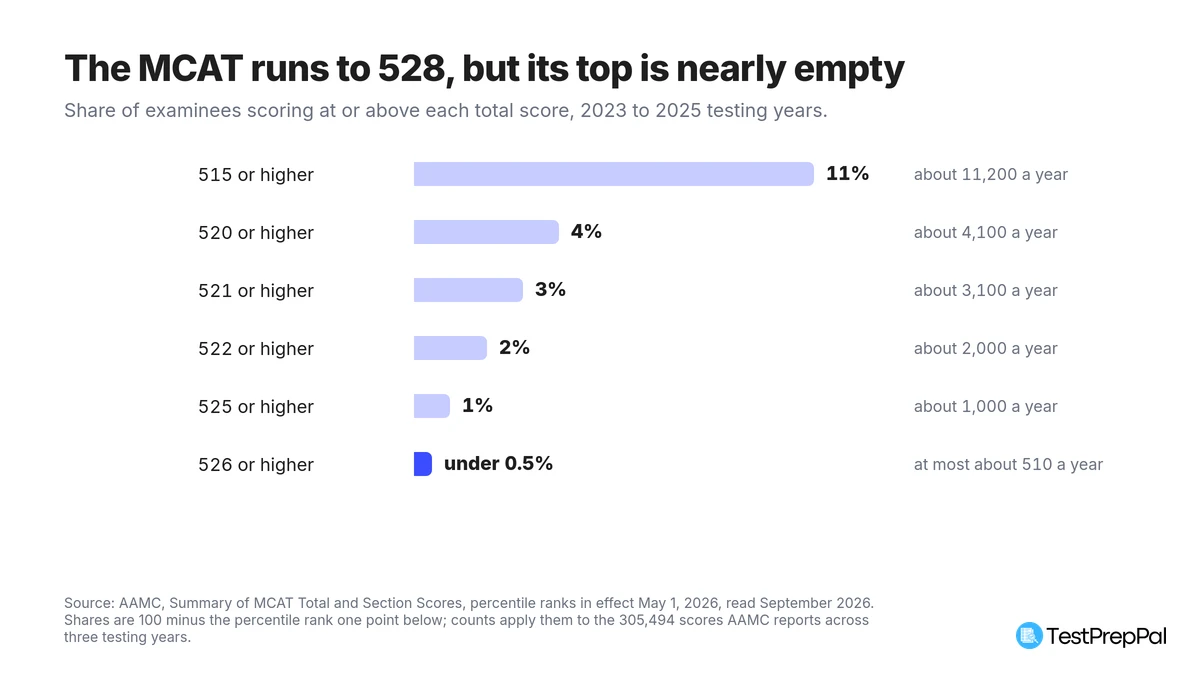 Share of examinees at or above each total score. Counts apply each share to the 305,494 scores AAMC reports across three testing years.
The AAMC prints percentile ranks as whole numbers, and that rounding is what lets you put a ceiling on the count. A printed 100 at a score of 525 means the true percentage of scores at or below 525 is at least 99.5. So everything above 525 is at most 0.5 percent of the sample. Half a percent of 305,494 is 1,527 scores across three years, or 509 a year.
At most about 510 examinees a year score 526, 527 or 528 combined, out of roughly 101,800 who test. A 528 on its own is a slice of that, so the real number of perfect scores is smaller still.
Run the same logic one point lower and you get a floor as well as a ceiling. A printed 99 at 524 means the true figure there is under 99.5, so more than 0.5 percent score 525 or higher, and at most 1.5 percent do. That puts somewhere between roughly 510 and 1,530 examinees a year at 525 or above.
Those bounds are wider than a single tidy statistic, and that's the honest shape of the data. Any page quoting an exact number of 528s a year is quoting something the AAMC does not publish.
Why the 100th percentile does not start at 528
Because the top of the scale is compressed, and the percentile table stops moving before the score does.
| Total score | Percentile rank |
|---|---|
| 519 | 96 |
| 520 | 97 |
| 521 | 98 |
| 522 | 99 |
| 523 | 99 |
| 524 | 99 |
| 525 | 100 |
| 526 | 100 |
| 527 | 100 |
| 528 | 100 |
The 100th percentile rank begins at 525, three full points below the maximum. Seven of the 57 possible total scores, everything from 522 up, share just two printed percentile ranks. Once you're at 525, the scale has nothing left to give you in percentile terms.
Worth checking your source on this one. Princeton Review's percentile table, which ranks first for this query, buckets the top as "524 to 528 = 100" and puts 515 at the 90th percentile. Blueprint's table does the same, and its own footnote dates it to the 2020, 2021 and 2022 testing years. The AAMC table in force since May 1, 2026 puts 524 at the 99th percentile and 515 at the 91st. Both of those pages move the 100th-percentile floor a point lower than the current data supports.
It's a small difference, and it matters mostly because of what it hides: the plateau at the top is real, and it starts earlier than a bucketed table lets you see.
Why 528 is the wrong target for almost every applicant
Look at what eight points are worth in two different places on the scale.
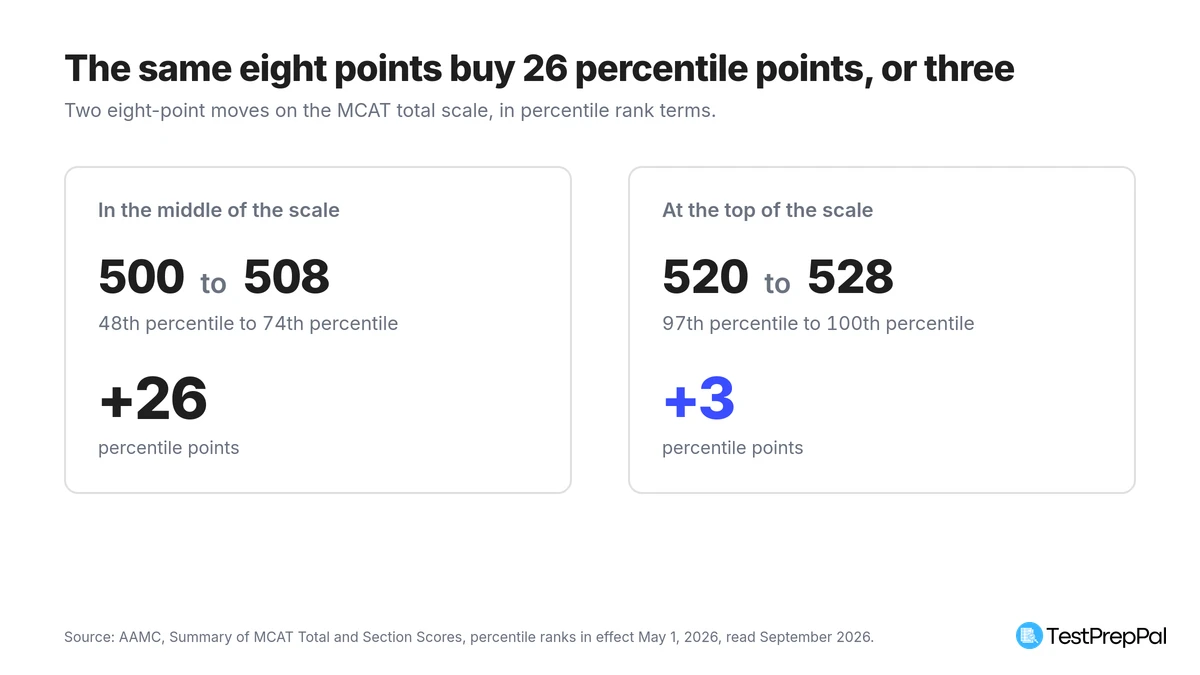 The same eight-point move is worth 26 percentile points in the middle of the scale and 3 at the top.
Going from 500 to 508 takes you from the 48th percentile to the 74th. That's 26 percentile points for eight scale points. Going from 520 to 528 takes you from the 97th to the 100th: three percentile points, for the same eight scale points, against the hardest questions the exam has.
Those eight points are also not equally hard to earn. The first eight come from fixing content gaps and timing. The last eight come from being near perfect in four separate sections on the same morning, with no room anywhere for a misread stem or a slow passage.
None of which makes a high score worthless. It means the return on each additional point collapses well before 528, and the effort you'd spend chasing the last three points almost always does more for you somewhere else in the application. If you're deciding whether your current score is already enough, our breakdown of whether a 508 is a good MCAT score walks through how to read your own number, and the MCAT statistics dashboard has the applicant and matriculant averages by year.
If you're sitting on a score you're unhappy with, the useful question isn't how close you can get to 528. It's whether a retake moves you enough to change outcomes, which the retake calculator is built to answer. And if you're still at the start, our honest read on how hard the MCAT is sets a more useful expectation than the top of the scale does. Before you pick any target, sit a free MCAT diagnostic and find out which end of that curve you are actually starting from. Everything else we publish for this exam sits on the MCAT hub.
Highest MCAT score FAQs
Has anyone ever gotten a 528 on the MCAT?
Yes. A 528 is an attainable score, and the AAMC reports a percentile rank for every total score up to and including 528. What the AAMC does not publish is a headcount, so treat any specific "N people got a 528 last year" figure with suspicion. The tightest honest statement the published table supports is that at most about 510 examinees a year score anywhere above 525, and 528 is a fraction of that group.
How rare is a 520 MCAT score?
A 520 is the 97th percentile, which means about 4 percent of examinees score 520 or higher. Across roughly 101,800 test takers a year, that's somewhere near 4,100 people. It is a genuinely excellent score, and it sits only three percentile points below a perfect 528.
Is 470 a good MCAT score?
470 is not an MCAT score at all. The lowest total the exam can report is 472, which is what you get with the minimum 118 in all four sections. If you've seen a 470 quoted somewhere, it's an error rather than a real result. For what happens at that end of the scale in admissions, see the lowest MCAT score that gets in.
Do you need a 528 to get into medical school?
No. No school requires a perfect score, and the percentile data shows why the idea doesn't hold up: a 520 already beats 96 percent of everyone who takes the exam, and the last eight points on the scale are worth only three percentile points. Look up the score ranges your target schools actually report, through the AAMC's Medical School Admission Requirements database, and aim at those rather than at the ceiling.
We may earn commissions from some links on this page, but this does not affect our reviews or your experience.