


Six of every ten hours in a working MCAT plan go to answering questions, not to reading content. For a student moving from a 500 baseline to a 512 target at 20 hours a week, that is 312 of 520 hours spent on questions, and 10.3 of the 12 points arrive after content review has finished.
Almost every guide to this question gives you the same nine steps in the same order. None of them tells you how many hours each step is worth, how many questions a day it implies, or how much of your score it actually moves. That is what the rest of this page does.
- Across a full plan, about 60 percent of your hours should be question time and 40 percent content time.
- The ratio is not constant. It runs roughly 1 hour of questions per 2 hours of content early, then flips to 2 to 1, then to 4 to 1 by the end.
- Our MCAT study hours calculator puts a 12-point gain at 520 hours over 26 weeks, split 8, 10 and 8 weeks across three phases.
- The same model gives content review only 1.7 of those 12 points. The practice and full-length phases carry the other 10.3.
- Question volume is an end-game property. Content review lands near 23 questions a day, not the 30 to 50 usually quoted.
The ratio that decides your score
Start with the split, because every other decision follows from it. The question is not how many weeks you have. It is what fraction of each week you spend answering questions rather than consuming content.
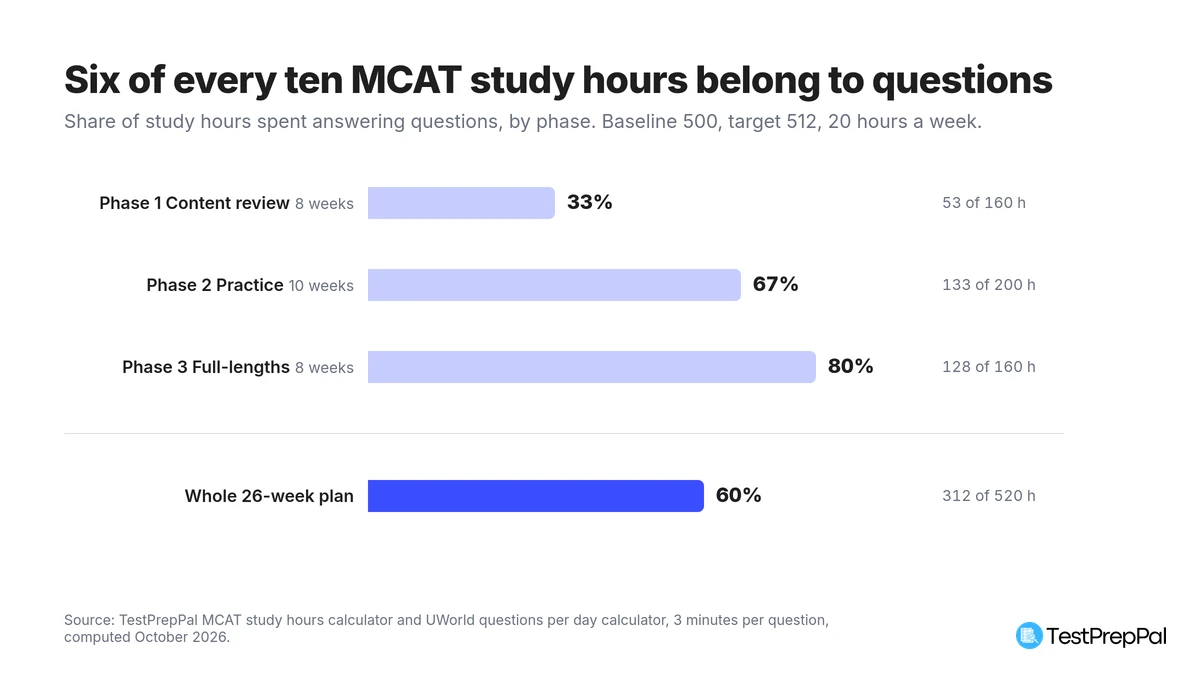 Share of study hours spent answering questions, by phase, for a 500 to 512 plan at 20 hours a week.
Here is the same thing as a table you can plan against. Hours come from our hours model, and question counts assume 3 minutes per question including review, the planning figure behind our UWorld questions per day calculator.
| Phase | Weeks | Hours | Content to questions | Content hours | Question hours | Questions |
|---|---|---|---|---|---|---|
| Content review | 8 | 160 | 2 to 1 | 107 | 53 | 1,067 |
| Practice and application | 10 | 200 | 1 to 2 | 67 | 133 | 2,667 |
| Full-lengths | 8 | 160 | 1 to 4 | 32 | 128 | 2,560 |
| Whole plan | 26 | 520 | 2 to 3 | 205 | 315 | 6,294 |
Two independent models agree on that bottom row. The hours model reaches its question count a different way, at 12 questions per study hour, which gives 6,240 questions and 312 hours of question time against 208 hours of content. The ratio allocation above lands at 315 and 205. On a 520-hour plan those two answers differ by under 1 percent.
What AAMC actually says to do
The AAMC study and practice cycle is nine boxes, and the ninth is "do it all over again with a new topic". So eight of them are the working loop you run on every topic you study:
- Learn a topic for the first time, or review it quickly to refresh.
- Test yourself with a short set of practice questions.
- Review your answers and explain why each choice is right or wrong.
- Review concepts and facts in your weak areas.
- Summarize the content from memory.
- Answer more questions in the same topic area.
- Answer a cumulative set covering every topic so far.
- Revisit material from previous days.
Count what those eight steps are made of. Two of them, the first and the fourth, are content intake. The other six are retrieval or question practice. AAMC adapted the cycle from a test-enhanced learning model published in Academic Medicine in 2020, and the design is doing exactly what that research says to do: get out of the reading chair early and keep testing yourself.
That is the same shape as the 60 percent figure above, arrived at from the official method rather than from an hours model. It is also the part of the cycle students skip. Steps 5 and 8, summarizing from memory and revisiting old material, cost nothing and get dropped first whenever a week runs tight.
Notice what AAMC does not give you: a number. The official MCAT study plan guidance says only that "your baseline assessment will determine the time it takes to complete each step". That is correct and it is unhelpful on its own, so the rest of this page supplies the hours.
Content review: 8 weeks, 160 hours, 23 questions a day
AAMC wants you to start with the free unscored Sample Test, then open the Content Outline course and mark every content area low, medium or high confidence against your score report's Content and Skills Breakdown. Low means you have never learned it, medium means you learned it and need a refresh. That map, not a book's table of contents, is what your first eight weeks should follow. The outline course also carries 120 free retired practice questions, which is enough to start step 2 of the cycle on day one.
At 20 hours a week this phase is 160 hours, of which about 107 are content and 53 are questions. Spread across six study days a week, 1,067 questions over 48 days is 23 a day.
Twenty-three questions a day is well below the 30 to 50 most guides quote for content review, and that is deliberate. Early hours are mostly first-time learning, so volume is low by design. Question volume is an end-game property, not an opening one.
The temptation here is to finish every book before you answer anything. Resist it. The cycle puts questions at step 2, before the weak-area review at step 4, because the questions are how you find the weak areas. If you want the calendar version of these eight weeks, our MCAT study schedule lays out 12, 8 and 4-week templates week by week.
Practice and application: 10 weeks, 200 hours, 45 questions a day
This is the longest phase and the one that moves the most score. Two hundred hours, about 133 of them on questions, which is 2,667 questions, or 45 a day across 60 study days. Our UWorld model calls that pace sustainable, in the band where students report they can still review properly rather than just clicking through.
A useful check: the UWorld bank holds roughly 3,000 questions, about 460 of them CARS. If you skip the CARS portion in favour of official material, as most high scorers do, the 2,540 remaining questions divide into these ten weeks at 43 a day on a six-day week, or 51 a day on a five-day week. Either way the bank fits inside this phase, which is the real answer to "when should I start UWorld". Not earlier, and not in the last month. Compare your options first in our MCAT question bank reviews.
The ratio flips here. You are now doing two hours of questions for every hour of content, and the content hours are no longer chapters. They are targeted repairs on whatever your error log keeps surfacing. If your score has stalled at this point, the diagnosis is usually in how to improve your MCAT score rather than in more hours.
Full-lengths: 8 weeks, six exams, 67 of 160 hours
The exam itself is 230 questions over 6 hours and 15 minutes of content time, and about 7 hours and 30 minutes seated once breaks are counted. That is why the last phase is not more studying. It is rehearsal.
Our hours model recommends 10 full-lengths for a 26-week plan. One is your early diagnostic, about three land in the practice phase, and six fall in these final eight weeks. Those six cost 37.5 hours of testing plus roughly 30 hours of review, at the 4 to 6 hours per exam we recommend in our guide to how many MCAT practice tests you need. Run at least two of them on the real MCAT test-day clock, starting at 8:00 a.m., so the back half of the exam is not new territory on the day. That is 67 of this phase's 160 hours gone before you answer a single extra question. The 1,380 questions inside those exams plus about 1,180 others get you to the phase's 2,560, and 32 hours remain for content repair.
Two warnings that come up constantly in r/Mcat threads. Third-party full-lengths tend to read low against official ones, so do not set your expectations from them until you have an AAMC exam to anchor on. And a score that moves nowhere after three or four exams is usually a reasoning or timing problem rather than a content one, which more reading will not fix.
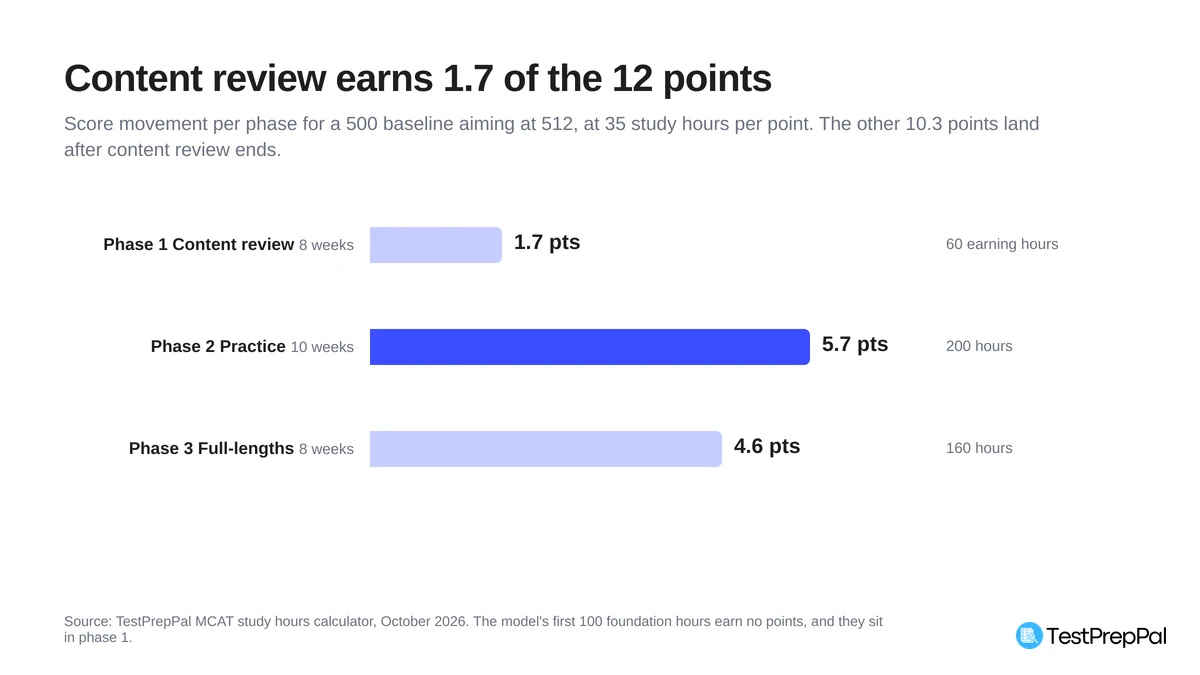 Expected score movement per phase. The model's first 100 foundation hours earn no points, and they sit in content review.
This is the chart worth sitting with. The model prices a 500 baseline at 35 hours per point, and it spends the first 100 hours building a floor that earns nothing on its own. Content review therefore has 60 earning hours in it and returns about 1.7 points. Practice returns 5.7 points and the full-length stretch another 4.6. Add them and you get exactly the 12 points you were aiming for, with 86 percent of them landing after content review is done.
The same numbers at other baselines
Your baseline changes the price per point, which changes everything downstream. These rows come from the same model.
| Baseline | Target | Hours a week | Hours per point | Total hours | Weeks | Phase weeks | Full-lengths |
|---|---|---|---|---|---|---|---|
| 490 | 508 | 20 | 40 | 820 | 41 | 12, 16, 13 | 12 |
| 495 | 505 | 15 | 35 | 450 | 30 | 9, 12, 9 | 12 |
| 500 | 512 | 20 | 35 | 520 | 26 | 8, 10, 8 | 10 |
| 505 | 515 | 25 | 30 | 400 | 16 | 5, 6, 5 | 7 |
| 508 | 518 | 20 | 30 | 400 | 20 | 6, 8, 6 | 8 |
The 490 row is the one to read twice. A lower baseline costs 40 hours per point instead of 30, so an 18-point climb runs to 820 hours and 41 weeks. The model also caps full-lengths at 12 no matter how long the plan runs, because a thirteenth exam is not what a 41-week plan is short of. Run your own numbers in the study hours calculator, then turn the result into dated weeks with the MCAT study plan generator.
Four ways this goes wrong
Front-loading all the content. Finishing every chapter before the first question block inverts the AAMC cycle and pushes your earning hours to the end of the plan, where there is no room left to use what they tell you.
Grinding volume early. The mirror image. Three hundred questions a day in week two, on content you have not learned, generates an error log you cannot act on.
Treating the foundation hours as score. The first 100 hours build a floor. They feel like work because they are, but on their own the model gives them nothing, which is why a plan that is all foundation stalls.
Reading without retrieval. Steps 5 and 8 of the official cycle, summarizing from memory and revisiting old topics, are the two that get cut when a week runs short. They are also the two that fight the forgetting curve, so cutting them quietly undoes the content hours you already paid for.
If you are still deciding whether to self-study at all, weigh that against the structure a course imposes in our MCAT prep course reviews, and get the full picture of what you are up against in how hard is the MCAT.
How to study for the MCAT FAQs
How long should it take to study for the MCAT?
It depends on the size of your gap, not on a standard number of months. Our model prices a 12-point gain from a 500 baseline at 520 hours, which is 26 weeks at 20 hours a week. A 10-point gain from a 505 baseline is cheaper per point and comes out at 400 hours, or 16 weeks at 25 hours a week. Larger gaps from lower baselines cost 40 hours per point and can run past 40 weeks.
How many hours a day should I study for the MCAT?
Twenty hours a week across six days is about 3.3 hours a day, which is the range most students sustain alongside classes or work. Going past 6 to 8 hours a day tends to cost you in retention rather than buy you time, so a longer plan at a lower daily load usually beats a compressed one. Check what your target implies with the MCAT score calculator.
How difficult is it to study for the MCAT?
The hard part is rarely the material. It is the shape of the day: 230 questions across about 7 hours and 30 minutes of seated time, which no amount of chapter reading prepares you for. That is why the last eight weeks are built around full exams rather than content, and why stamina is trained rather than assumed.
Is a 487 a bad MCAT score?
A 487 sits well below the mid-point of the scale and would be a difficult number to apply with, but it is a normal early diagnostic result and it is not a verdict. Treat it as the baseline input to a plan: at that level the model charges 40 hours per point, so a realistic target is a large but costly climb. For what the bands actually mean, see is 508 a good MCAT score and the rest of our MCAT guides.
We may earn commissions from some links on this page, but this does not affect our reviews or your experience.