
Best MCAT Anki Decks in 2026

by John Reed· Last Updated: Sep 24, 2026
The best all-around MCAT Anki deck is AnKing, a continuously updated mega-deck that merges the top community decks into one tagged resource. If you are new to Anki or short on time, MileDown is the easiest place to start. If you have five or more months and want maximum depth, JackSparrow2048 goes deepest, and for Psychology and Sociology, the Mr. Pankow deck is the gold standard. Below we compare seven of the best MCAT Anki decks and flashcard options so you can match one to your timeline and study style.
Flashcards are one of the most effective ways to memorize the massive amount of content tested on the MCAT. Spaced repetition, the method used by Anki and other flashcard tools, is backed by decades of learning science and is a staple in the study plans of top MCAT scorers.
The challenge is choosing the right deck. There are dozens of MCAT Anki decks floating around Reddit, Google Drive, and AnkiHub, and they vary widely in size, quality, and purpose.
We reviewed 7 of the best MCAT flashcard options to help you decide which one fits your study plan:
- Best all-around Anki deck: AnKing MCAT Deck, the most complete, continuously updated mega-deck.
- Best for beginners / quick start: MileDown Anki Deck, manageable size, high-yield focus.
- Best for long timelines: JackSparrow2048 Anki Deck, exhaustive basic-card deck for 5+ month study plans.
- Best without Anki setup: Blueprint MCAT Flashcards, polished platform with built-in analytics.
- Best for Kaplan users: Ortho528 Anki Deck, chapter-aligned with Kaplan books.
- Best for Psych/Soc: Mr. Pankow P/S Deck, the gold standard for P/S memorization.
- Best for exhaustive coverage: Bouras Anki Deck, the largest deck at ~13,000 cards.
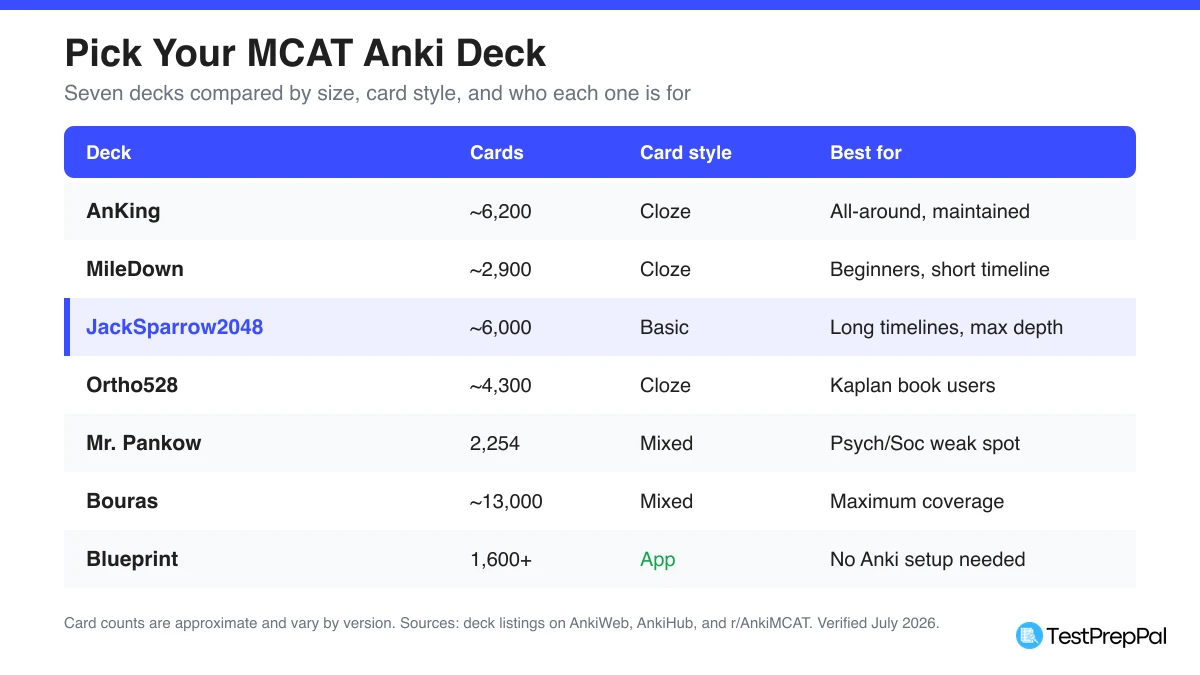 Our at-a-glance MCAT Anki deck picker. Card counts are approximate and vary by version.
Related free resource:

Blueprint's Free MCAT Flashcards
1,600+ expert-made cards covering every section. No Anki setup.
Free account · No credit card
Which MCAT Anki Deck Should You Use?
Not every deck is right for every student. Here is a quick guide based on your situation:
You are new to Anki and want something manageable: Start with MileDown. At ~2,900 cards, it covers high-yield content without overwhelming your daily review queue. It is the easiest community deck to pick up and stick with.
You want the most comprehensive single deck: Go with AnKing. It merges MileDown, Mr. Pankow, and MrPankow into ~6,200 well-tagged cards with ongoing updates through AnkiHub. This is the best choice if you want one deck to cover everything.
You do not want to use Anki at all: Blueprint Flashcards gives you 1,600+ expert-created cards with built-in spaced repetition, analytics, and customization, all in a browser. No downloads, no configuration, no learning curve.
You are using Kaplan books: Ortho528 is organized by Kaplan chapter, making it the most natural companion if Kaplan is your primary content source. At ~4,300 cards, it provides solid depth without mega-deck overload.
P/S is your weakest section: Add Mr. Pankow's P/S Deck to whatever general deck you are using. With 2,254 cards focused exclusively on Psychology and Sociology, it goes deeper into P/S than any all-in-one deck. Pair it with MileDown or Ortho528 for the other sections.
You have 5+ months and want maximum recall practice: JackSparrow2048 is the deepest basic-card deck, organized by MCAT section. Its front-and-back cards train recall and reasoning rather than fill-in-the-blank, which maps better to the real test. Keep new cards at or below 50 per day so the review load stays manageable, and only reach for it if your timeline is genuinely long.
You want maximum coverage and have 4+ months: The Bouras Deck at ~13,000 cards leaves nothing out. It merges content from Ortho528, MileDown, Khan Academy, and Science Simplified. This is for experienced Anki users who can manage a large daily review load.
MCAT Anki Flashcards Comparison Table
| AnKing | MileDown | JackSparrow2048 | Blueprint | Ortho528 | Mr. Pankow | Bouras | |
|---|---|---|---|---|---|---|---|
| Price | Free (AnkiHub ~$5/mo optional) | Free | Free | Free | Free | Free | Free |
| Card Count | ~6,200 | ~2,900 | ~6,000 | 1,600+ | ~4,300 | 2,254 | ~13,000 |
| Card Style | Mostly cloze | Cloze | Basic (front/back) | Basic | Mixed | Mixed | Mixed |
| MCAT Sections | All 4 | All 4 | All 4 | All 4 | All 4 | P/S only | All 4 |
| Platform | Anki | Anki | Anki | Blueprint web/mobile | Anki | Anki | Anki |
| Content Source | MileDown + Abdullah + MrPankow merged | Community (Reddit) | Community (Reddit) | Blueprint MCAT experts | Community (Kaplan-aligned) | Community (P/S specialist) | Ortho528 + MileDown + KA + more |
| Ongoing Updates | Yes (AnkiHub) | No | No | Yes (Blueprint team) | No | No | No |
| Built-in Analytics | No | No | No | Yes | No | No | No |
| UWorld Integration | Yes (tagged) | No | No | No | No | No | No |
| Anki Setup Required | Yes | Yes | Yes | No | Yes | Yes | No |
| Best For | All-around coverage | Beginners | Long timelines | Non-Anki users | Kaplan book users | P/S weak section | Maximum coverage |
Look Inside: The 7 MCAT Anki Flashcard Decks We Reviewed
1. AnKing MCAT Deck
The AnKing MCAT Deck is the most complete and best-maintained community Anki deck for MCAT prep. Its AnkiHub integration is what sets it apart from every other option.
This deck is best for students who want a single, comprehensive Anki deck with ongoing updates.
The AnKing team merged content from MileDown, Abdullah, and MrPankow into approximately 6,200 cards with consistent tagging across all subjects. Cards are tagged by MCAT section, subject area, and specific topic, with UWorld question IDs also mapped for cross-referencing.
✓ Pros
- Merges top community decks into one comprehensive resource
- Continuously updated through AnkiHub collaborative platform
- UWorld question integration for targeted review
- Excellent tagging system for focused drilling
✗ Cons
- AnkiHub subscription needed for automatic updates
- Large deck can overwhelm new Anki users
- Requires Anki setup knowledge
The key advantage is how updates reach you. Through AnkiHub (~$5/month), corrections and new cards push to your local deck automatically. Community contributors identify errors and submit fixes, so the deck improves over time without you having to re-download anything.
Without AnkiHub, the deck still works as a standalone Anki deck. You just won't receive updates.
For most students who are comfortable with Anki, the AnKing deck is the single best starting point.
2. MileDown Anki Deck
The MileDown Anki Deck is the most popular entry-level MCAT Anki deck, known for its manageable size and high-yield focus.
This deck is best for students new to Anki who want effective flashcards without a massive daily commitment.
At approximately 2,900 cards, MileDown covers the core content you need across all four MCAT sections without trying to be exhaustive. The deck uses cloze-deletion cards with tags by subject and subtopic.
✓ Pros
- Manageable size that won't overwhelm daily reviews
- Strong high-yield focus across all MCAT sections
- Easy to access from AnkiWeb with no signup
- Great for building an Anki habit
✗ Cons
- Less depth than larger decks on some topics
- No ongoing updates or official support
- Card quality varies in places
MileDown is the deck most students try first, and for good reason. The size-to-value ratio is excellent. If you have never used Anki before, MileDown is the least intimidating way to start.
The trade-off is depth. Students who want more granular coverage, especially in P/S or biochemistry, often pair MileDown with a section-specific deck like Mr. Pankow or move to AnKing after getting comfortable.
3. Blueprint MCAT Flashcards
Blueprint MCAT Flashcards offer the smoothest flashcard experience for students who do not want to deal with Anki setup.
This option is best for students who want expert-curated cards with built-in analytics and zero configuration.
Blueprint provides 1,600+ flashcards created by their MCAT content team, available for free through a Blueprint account. The cards cover high-yield content: amino acids, formulas, functional groups, physics equations, and key P/S terms.
✓ Pros
- No Anki setup; works in browser and mobile
- Built-in spaced repetition and progress analytics
- Expert-curated content, regularly updated
- Fully customizable: create, edit, and tag cards
✗ Cons
- Fewer cards than community Anki decks
- Less flexible than Anki for power users
- Requires Blueprint account (free but still a signup)
The analytics dashboard is the standout feature. You can track which cards you are weak on, set daily goals, and see your progress over time, all built into the platform. This is something Anki only offers through third-party add-ons.
Blueprint flashcards are the best option if you want to start reviewing content today without watching Anki tutorials or configuring settings. The card count is smaller, but the quality and convenience are high.
4. Ortho528 Anki Deck
The Ortho528 Anki Deck is the best community deck for students using Kaplan books as their primary content source.
This deck is best for Kaplan users who want chapter-aligned flashcards at a mid-range size.
With approximately 4,300 cards organized by Kaplan book chapters, Ortho528 makes it easy to sync your flashcard reviews with your content reading schedule. Cards use a mix of cloze deletion and standard Q&A formats.
✓ Pros
- Kaplan chapter-aligned tagging for easy integration
- Solid mid-range size with good depth
- Covers all MCAT subjects
- Free with no account required
✗ Cons
- No ongoing updates or community corrections
- Less useful if you are not using Kaplan
- Card quality varies across some topics
The Kaplan alignment is the main reason to choose Ortho528 over other decks. If you finish a Kaplan chapter on Tuesday, you can unsuspend exactly those cards and review them that week. No other deck makes this workflow as seamless.
Students not using Kaplan can still benefit from Ortho528, but the organizational advantage is less meaningful. In that case, AnKing or MileDown may be a better fit.
5. Mr. Pankow P/S Anki Deck
The Mr. Pankow P/S Deck is the gold standard for MCAT Psychology and Sociology flashcards.
This deck is best for students who want the deepest free P/S coverage or who find P/S to be their weakest section.
With 2,254 cards focused exclusively on Psychology and Sociology, Mr. Pankow goes significantly deeper into P/S content than any all-in-one deck. Cards include detailed explanations, real examples, and applied context rather than just definitions.
✓ Pros
- The best free P/S Anki deck by depth and quality
- Applied examples, not just definitions
- Aligned with AAMC P/S outline and Khan Academy
- Covers niche topics other decks miss
✗ Cons
- Covers P/S only, not other MCAT sections
- No ongoing updates
- Must pair with another deck for full MCAT coverage
The card quality is noticeably higher than P/S sections in general decks. Where MileDown might have a single card for a concept, Pankow often has multiple cards that test different angles and applications.
Most students use Mr. Pankow alongside a general deck. Common pairings are Pankow + MileDown or Pankow + Ortho528. If you use AnKing, note that much of Pankow's content is already merged into that deck.
6. Bouras Anki Deck
The Bouras Deck is the largest free MCAT Anki deck, merging content from multiple popular community sources into ~13,000 cards.
This deck is best for experienced Anki users with 4+ months of study time who want maximum coverage.
The Bouras Deck combines content from Ortho528, MilesDown, Khan Academy, and Science Simplified. The result is near-exhaustive MCAT topic coverage in a single downloadable file.
✓ Pros
- The most comprehensive MCAT deck available
- Content from multiple trusted sources
- Unlikely to miss any testable concept
- Free with no account or subscription
✗ Cons
- Very large size is overwhelming for most students
- No collaborative updates like AnKing
- Requires strong Anki skills to manage effectively
At 13,000 cards, completing the full Bouras Deck in a single study cycle is not realistic for most students. The practical approach is to treat it as a library: unsuspend cards by topic as you study, and skip what is not relevant to your timeline.
Students with shorter timelines or less Anki experience are better served by MileDown or AnKing. Bouras is the right choice only if you have the time and the discipline to manage it.
7. JackSparrow2048 Anki Deck
The JackSparrow2048 Anki Deck is the deepest free MCAT deck built on basic recall cards, made by a Reddit user who reported scoring a 527.
This deck is best for students with a long study runway who want maximum content depth and prefer recall over fill-in-the-blank.
At roughly 6,000 cards organized by MCAT section, JackSparrow2048 reaches into lower-yield topics most decks skip. Its defining trait is card style: instead of cloze deletions, most cards are basic front-and-back prompts, so you have to produce the full answer. That trains the recall and reasoning the real test rewards, at the cost of more time per card.
✓ Pros
- Exhaustive coverage across all MCAT content sections
- Basic cards build active recall and reasoning, not fill-in-the-blank
- Organized by section with a separate AAMC-mapped category
- Completely free
✗ Cons
- Large and slow, which is unrealistic on a short timeline
- Includes low-yield cards, so the daily review load is heavy
- No ongoing updates, analytics, or official support
The community's own advice is to keep new cards at or below 50 per day and to treat the deck as a library you draw from rather than a checklist you must finish. On a five-month-plus timeline that is workable. On anything shorter, MileDown or AnKing is the safer choice. For the full breakdown, see our JackSparrow2048 Anki deck review.
How to Use MCAT Anki Flashcards Effectively
Regardless of which deck you choose, a few principles apply:
Start with your content review, not before. Flashcards are a retention tool, not a learning tool. Study a topic first, then use flashcards to keep it in memory. Unsuspend cards by subject as you progress through your content review.
Be consistent. The power of spaced repetition comes from daily reviews. Skipping days causes reviews to pile up, which leads to burnout and missed cards. A manageable daily target you actually hit is better than an ambitious one you abandon.
Do not try to finish a mega-deck. If you are using AnKing or Bouras, you probably will not see every card. That is fine. Focus on high-yield content first and expand as your timeline allows.
Pair with practice questions. Flashcards build recall, but the MCAT tests application. Combine your Anki habit with regular passage-based practice from UWorld, AAMC materials, or your prep course.
Best MCAT Anki Flashcards FAQs
Which MCAT Anki deck should I start with?
If you are new to Anki, start with MileDown. If you are comfortable with Anki and want the most comprehensive option, go with AnKing. If you do not want to use Anki at all, choose Blueprint Flashcards.
Is AnKing or JackSparrow2048 better?
They suit different students. AnKing is the better default: it is maintained, mostly cloze, and faster to review. JackSparrow2048 goes deeper with basic recall cards, but it is larger and slower, so it only makes sense on a long timeline. If you have five or more months and want maximum depth, choose JackSparrow2048. Otherwise, AnKing.
Is AnKing enough for a 520?
For many students, yes. AnKing covers the high-yield content thoroughly, and plenty of 520-plus scorers used it as their only deck. Flashcards alone do not produce a 520, though. You still need strong content review and consistent full-length practice to get there.
Is 200 Anki cards a day too much?
For most MCAT students, 200 new cards a day is too much and leads to burnout and a ballooning review queue. A more sustainable range is 20 to 50 new cards per day. Reviews compound, so your total daily load is much higher than your new-card count alone.
Can I use multiple Anki decks at the same time?
You can, but it often leads to duplicate cards and an unmanageable review load. It is usually better to pick one primary deck. The exception is adding a section-specific deck like Mr. Pankow for P/S alongside a general deck.
Are MCAT Anki flashcards enough to score well?
Flashcards are excellent for memorization and retention, but they should not be your only resource. You still need content review (videos, books, or a course) and passage-based practice to develop MCAT reasoning skills.
Do I need to pay for any of these decks?
All 6 decks reviewed here are free. The only optional cost is an AnkiHub subscription ($5/month) for automatic updates to the AnKing deck, and the Anki mobile app on iOS ($25 one-time).
How many new cards per day should I do?
A common range is 20-40 new cards per day, depending on your timeline and review tolerance. The key is sustainability. A pace you can maintain every day is better than bursts followed by skipped days.
What about the free Gold Standard MCAT flashcard app?
It is a real free option, but a dated one. The Gold Standard MCAT Flashcards app holds 455 science cards and bundles almost four hours of video, yet its iOS build has not been updated since December 2017 and it covers no Psychology and Sociology or CARS content. Use it as a supplement for physics and chemistry recall, not as your main deck.
We may earn commissions from some links on this page, but this does not affect our reviews or your experience.


