


UWorld USMLE Step 1 Qbank Review
by UWorld
The gold-standard Step 1 question bank
✓Pros
- ✓3,600+ high-quality, exam-representative questions
- ✓Detailed explanations that teach, not just answer
- ✓Realistic exam interface and performance analytics
- ✓The near-universal Qbank standard for Step 1
✗Cons
- ✗Expensive, especially longer subscriptions
- ✗Explanations are dense — time-intensive to review well
Highlights
- ✓3,600+ Step 1 practice questions
- ✓In-depth answer explanations with illustrations
- ✓Custom tests, timed/tutor modes, and analytics
- ✓Self-assessment exams (add-on)
Price
$319 - $629
What Students Are Saying
Sign in to leave a review

Expert Rating
The UWorld USMLE Step 1 Qbank is the best question bank you can buy for Step 1, and the 360-day plan at $579 is the one most students should choose. It gives you 3,600 plus exam-style questions, 3 self-assessments and a one-time reset, which is what a two-pass study plan needs.
The cheaper plans look attractive until you do the math. The 30-day plan costs $349, has no reset and no self-assessment, and would need you to finish 120 questions a day to complete the bank once.
Summary table
| Feature | UWorld USMLE Step 1 Qbank |
|---|---|
| Price | $349 (30 days) to $749 (730 days) |
| Most popular plan | 360 days for $579 |
| Practice questions | 3,600 plus, written by licensed physicians |
| Self-assessments | 1, 2 or 3 included depending on plan, or $50 each |
| Self-assessment format | 160 questions in 8 blocks of 20, 30 minutes each |
| Reset | One-time reset on 180, 360 and 730-day plans only |
| Flashcards | 2,000 plus premade ReadyDecks, plus your own SmartCards |
| Medical Library | 1,300 plus articles linked from explanations |
| Videos | 500 plus, only with QBank Plus (+$99) |
| AI assistant | UAsk, capped at 100 to 1,000 prompts by plan |
| Mobile | iOS and Android apps, internet connection needed |
| Free trial | None |
| Refund | Within 1 week of activation, 10 percent or less used, 10 percent fee |
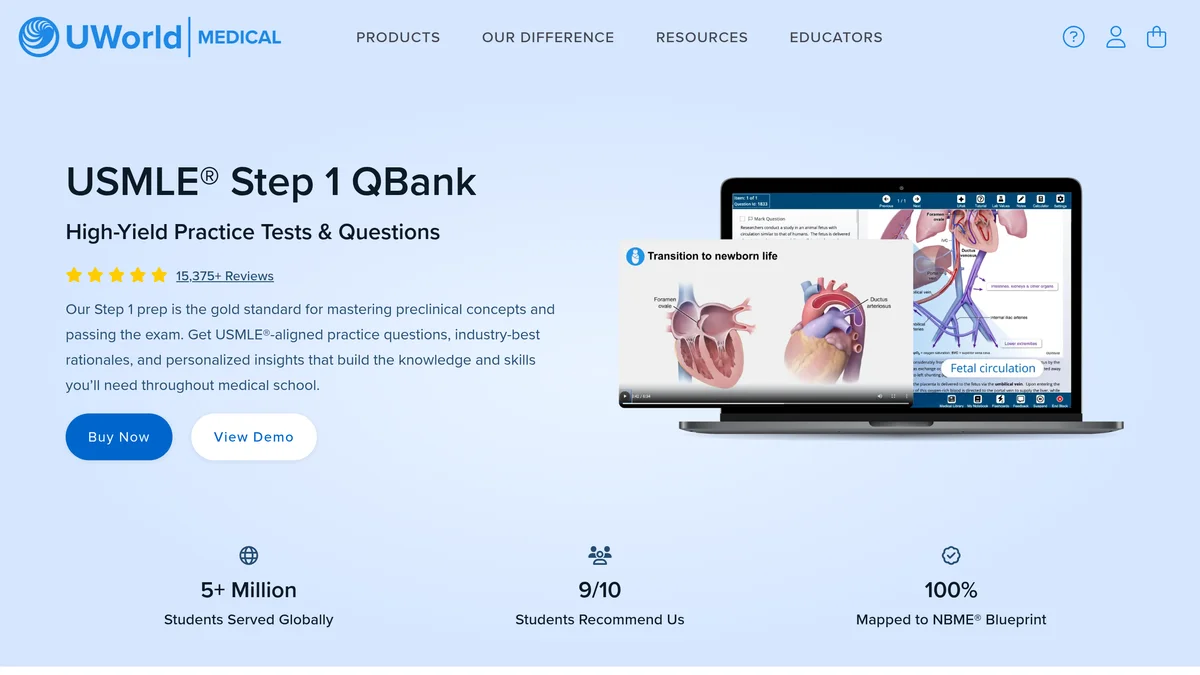 The UWorld USMLE Step 1 QBank page. Source: medical.uworld.com (captured November 2026).
What the UWorld Step 1 Qbank is
UWorld sells its USMLE Step 1 QBank as a time-limited subscription. Every plan unlocks the full bank of 3,600 plus questions. What changes as you pay more is how long you keep access and which extras come with it.
UWorld says every question and rationale is written by licensed, practicing physicians and mapped to the current Step 1 content outline. The bank covers 13 subjects: anatomy, behavioral science, biochemistry, biostatistics, embryology, genetics, histology, immunology, microbiology, pathology, pathophysiology, pharmacology and physiology. You can build custom blocks by subject and by organ system.
What a subscription includes:
- 3,600 plus exam-style Step 1 questions, including vignettes, basic science, data interpretation and image items
- An explanation for every answer choice, correct and incorrect, with illustrations, diagrams and tables
- Topic-level performance reports with peer comparisons by subject and system
- 2,000 plus premade ReadyDecks flashcards and custom SmartCards, both with spaced repetition
- 1,300 plus Medical Library articles linked from the explanations
- The UAsk AI study assistant, with a prompt cap that depends on your plan
- My Notebook for notes, and iOS and Android apps that sync your progress
- A Study Planner and self-assessments on the 90-day plan and up (see the pricing table)
It is a question bank first. UWorld's own FAQ says the Qbank "does not provide structured video lectures, content review modules, or a complete curriculum" the way a course does. Another answer on the same page claims it "functions as a complete Step 1 review course". The first statement is the accurate one, so plan to pair it with a content source.
UWorld Step 1 Qbank review for 2026
The explanations are what you are paying for
UWorld explains every option in a question, not just the right one. The sample questions on the product page show what that looks like: a short teaching paragraph on the tested concept, an illustration, and a line on why each distractor is wrong.
That changes how you use the bank. A block of 40 questions is really 200 answer choices you get taught about. Students learn content from the explanations rather than only checking whether they were right, which is why most Step 1 plans treat UWorld as the spine of dedicated study.
The best habit is also the slowest one. Read every explanation, including on questions you got right by guessing. If you use the AnKing Step Deck, its cards are tagged by UWorld question ID, so you can unsuspend the cards for the questions you missed instead of writing your own.
The interface copies the real exam
UWorld says its software simulates the NBME interface, and its practice tests let you mark questions, strike out answers and view exhibits the way you will on test day. The format matters because Step 1 is long.
According to the USMLE Step 1 page, the exam is fourteen 30-minute blocks in one 8-hour session, with no more than 20 questions per block and at least 55 minutes of break time. That is up to 280 questions. UWorld's timed mode lets you build 20-question, 30-minute blocks so your pacing matches that from the start.
One pass of 3,600 questions needs the right plan length
UWorld says many strong Step 1 performers complete 2 full passes of the bank. It suggests starting at 8 to 12 questions a day during coursework, then resetting and doing a second pass in dedicated study.
Here is what one pass of 3,600 questions costs you in daily volume, by plan:
| Plan | Days of access | Questions a day for one pass | Reset available |
|---|---|---|---|
| 30-day | 30 | 120 | No |
| 90-day | 90 | 40 | No |
| 180-day | 180 | 20 | Yes, once |
| 360-day | 360 | 10 | Yes, once |
| 730-day | 730 | About 5 | Yes, once |
These are our calculations from UWorld's question count and plan lengths. They do not include review time, which usually takes longer than answering. At 120 questions a day you are sitting six 20-question blocks before any review, which leaves very little time for the explanations that are the point of the product. Use our Step 1 study plan to set a pace before you choose a length.
The reset rule decides which plan you need
Only the 180, 360 and 730-day plans list a one-time reset option. UWorld's terms and conditions explain why. A reset is available after 180 days or more of continuous subscription without a previous reset, or when you buy a brand-new subscription after an old one expired. A renewal does not count as a new purchase, and you get one reset per active subscription.
The terms also say a reset permanently deletes all your test and performance data. Export or note anything you need first.
So if you want the standard two passes, the 30 and 90-day plans do not get you there unless you buy a second subscription later. That is the strongest argument for the 360-day plan.
Self-assessments: useful, and cheaper inside a bundle
Each UWorld Step 1 self-assessment form has 160 unique questions in 8 blocks of 20, with 30 minutes per block. After each one you get a 3-digit projected score, your relative ranking and a breakdown by subject and system.
Bought alone, a form costs $50, or $120 for all three. The 90-day plan includes 1, the 180-day plan 2, and the 360 and 730-day plans include 3. Use them alongside the official NBME forms, which we cover in our NBME practice tests review. Step 1 is pass/fail, so a 3-digit projection matters less than it once did. UWorld's own guidance is that a Qbank score of 60 percent or higher "indicates a high likelihood of passing", based on its performance data. Treat that as a rough threshold from the vendor, not a promise. Our guide to the Step 1 passing score covers what the official standard is.
What we would change
No free trial. You can view a demo and try sample questions on the product page, but there is no trial account. AMBOSS offers 5 days free.
You cannot sort by difficulty. UWorld says this is deliberate, because high-yield topics show up at every difficulty level. That is reasonable, but it means you cannot build an easy warm-up block.
The extras are rationed. UAsk, the AI assistant, is capped at 100 prompts on the 30-day plan and 250 on the 90-day plan. The 500 plus videos are not in the base plans at all and cost $99 more as QBank Plus.
No offline study. UWorld says the app works "wherever you have an internet connection". AMBOSS says its app works fully offline.
Pricing
All prices below are from the UWorld Step 1 page, checked on 26 November 2026. Each is a one-time payment for a fixed access period, with Affirm monthly financing offered at checkout.
| Plan | QBank | QBank Plus (with videos) | Self-assessments | Reset | UAsk prompts |
|---|---|---|---|---|---|
| 30 days | $349 | $448 | 0 | No | 100 |
| 90 days | $459 | $558 | 1 | No | 250 |
| 180 days | $519 | $618 | 2 | Yes | 1,000 |
| 360 days | $579 | $678 | 3 | Yes | 1,000 |
| 730 days | $749 | $848 | 3 | Yes | 1,000 |
Add-ons sold separately: each self-assessment form is $50 for 2 weeks of access, all three are $120, and the Biostatistics Review is $25 for 90 days.
The price curve is very flat at the top. Going from 30 days to 360 days costs $230 more and buys 330 extra days, 3 self-assessments worth $120 on their own, the reset and the Study Planner. Going from 180 to 360 days costs only $60 more. Unless your exam is within three months and you only want one pass, the 360-day plan is the better buy.
Activation, renewals and refunds
Time starts when you activate, not when you buy. The terms say the subscription period starts at activation, cannot be paused, and gives no free extension for unused time. Buying early and activating later is fine.
Renewals must be bought before your access expires. UWorld's contact and FAQ page says a renewal extends the current subscription from its existing expiry date, does not reset it, and is not offered for expired subscriptions. Miss the date and you pay full price for a new plan.
The refund rules are strict. A Qbank bought directly from UWorld can be refunded within 1 week of activation, only if no more than 10 percent of the course has been used, and a 10 percent cancellation fee (minimum $10) applies. Requests are judged case by case. Medical Videos, ReadyDecks, the Medical Library and reset or expired subscriptions are not refundable. If you never activate and ask for a refund 180 days or more after buying, you get store credit only. Purchases through an app store have to be refunded by that store.
How it compares with AMBOSS on price
AMBOSS prices its question bank as a yearly bundle across all exams, not by Step. Its pricing page lists the Yearly Membership plus Qbank bundle at $448 billed yearly, with unlimited Qbank access for 12 months and a membership that renews at $149 a year unless you cancel. The $19.99 monthly membership only includes 50 Qbank questions a month.
| UWorld Step 1 (360 days) | AMBOSS yearly + Qbank bundle | |
|---|---|---|
| Price | $579 one-time | $448 billed yearly |
| Step 1 questions | 3,600 plus | 2,840 plus |
| Other exams included | No, Step 1 only | Yes, 13,900 plus questions across exams |
| Self-assessments | 3 included | Step 1 form is $49.99 extra |
| Free trial | None | 5 days |
| Refund | 1 week after activation, 10 percent fee | 30 days, full refund |
| Offline app | No | Yes |
The AMBOSS Step 1 page gives the 2,840 plus Step 1 count and the $49.99 self-assessment price. AMBOSS is cheaper, carries over to Step 2 and shelf exams, and has far friendlier refund terms. UWorld has about 760 more Step 1 questions and three self-assessments in the box. Our AMBOSS review covers the rest.
Who the UWorld Step 1 Qbank is best for
Students starting in their preclinical years. The 360-day plan at $579 covers a slow first pass during coursework at about 10 questions a day, then a reset for dedicated. That is the pattern UWorld itself recommends.
Students who learn by doing questions. If you retain more from working a vignette and reading why each option is wrong than from watching lectures, the explanations are the best teaching material in Step 1 prep.
Retakers. Custom blocks by subject and system let you drill the areas your score report flagged. UWorld's FAQ makes the same case, and the 3 self-assessments in longer plans give you checkpoints before you sit again. Check our Step 1 pass rate data for context on repeat takers.
When you might look elsewhere
Buy AMBOSS instead if cost or flexibility matters most. The $448 bundle is $131 less than UWorld's 360-day plan, it covers your shelf exams and Step 2 too, and the 30-day full refund lets you walk away if it does not suit you.
Add a content course if you need to be taught from scratch. UWorld says itself that it has no structured lectures. Boards and Beyond and Pathoma are the usual pairings, with First Aid as the reference you annotate.
Skip the 30-day plan if your exam is more than a month away. At 120 questions a day to finish once, it pushes you to rush the explanations, and you cannot reset it.
Wait if you have not set a test date. Access starts at activation, so you lose nothing by buying later, but our guide on when to take Step 1 will help you pick the plan length. The USMLE hub and our Step 1 question bank roundup list everything else we cover, and our review methodology explains how ratings are set.
Final verdict
UWorld earns 4.7 out of 5. On the product itself it is hard to fault: 3,600 plus physician-written questions, explanations that teach every answer choice, a faithful exam interface and three solid self-assessments on the longer plans. It is still the Qbank we would build a Step 1 plan around.
It loses points on terms. There is no trial, the refund window closes a week after activation with a fee, the app needs a connection, and the cheapest plan is poor value because it cannot be reset. Buy the 360-day plan, activate it when you are ready to start, and read every explanation.
UWorld Step 1 Qbank FAQs
How much does the UWorld Step 1 Qbank cost?
The Qbank costs $349 for 30 days, $459 for 90 days, $519 for 180 days, $579 for 360 days and $749 for 730 days. QBank Plus adds 500 plus videos for $99 more on each plan. Self-assessments are included on the 90-day plan and up, or $50 each on their own.
How many questions are in UWorld Step 1?
UWorld lists 3,600 plus Step 1 questions, all included on every plan. Each self-assessment is a separate set of 160 questions. For comparison, AMBOSS lists 2,840 plus Step 1 questions.
Can you reset the UWorld Step 1 Qbank?
Yes, once, on the 180, 360 and 730-day plans. The terms require 180 days or more of continuous subscription without a previous reset, and the reset permanently deletes your performance data. The 30 and 90-day plans do not include a reset, and buying a renewal does not create a new reset.
Does UWorld offer a refund or free trial for Step 1?
There is no free trial, only a demo and sample questions on the product page. Refunds are possible within 1 week of activation if you have used no more than 10 percent of the course, minus a 10 percent cancellation fee of at least $10, and each request is reviewed case by case.
Is UWorld or AMBOSS better for Step 1?
UWorld has more Step 1 questions (3,600 plus against 2,840 plus) and includes up to 3 self-assessments. AMBOSS costs less at $448 a year, covers other exams, works offline and gives a 30-day full refund. If you can buy only one for dedicated Step 1 study, UWorld is the safer choice.
We may earn commissions from some links on this page, but this does not affect our reviews or your experience.
Our Verdict
UWorld is the Step 1 Qbank to build your prep around: 3,600 plus physician-written questions with explanations for every answer choice, in an interface that copies the real exam. The plan to buy for most students is the 360-day one at $579, which adds 3 self-assessments and the one-time reset you need for a second pass. The weaknesses are price and terms: $349 buys only 30 days, there is no free trial, and the refund window closes 1 week after activation with a 10 percent fee.