


The passing score for USMLE Step 1 is a minimum standard of 196 on the old three-digit scale. But here is the part that trips people up: since January 26, 2022, Step 1 has been reported as pass or fail only, so you will never see 196, or any number, printed on your score report. You either clear the bar or you do not.
This page is about the bar itself: what it is, where it came from, and how the exam decides you cleared it. For the exam around the bar, start with the Step 1 exam format: up to 280 questions in fourteen 30-minute blocks across an eight-hour day. If you are looking for how many people actually pass, that is a different question, and we break it out in our Step 1 pass rate data.
- The USMLE Step 1 passing score is a minimum standard of 196 on the three-digit scale, per official USMLE scoring data.
- Step 1 has been pass/fail only since January 26, 2022, so the 196 works behind the scenes and never appears on your report.
- The bar rose over time: 192 before 2018, 194 in 2018, 196 in 2022. A December 5, 2024 review kept it at 196.
- Passing is criterion-based, not a curve. You typically need about 60% of questions correct, and no fixed share of students is failed.
- If you fail, you can retake, but the USMLE now caps you at four attempts per Step (down from six).
What is the passing score for USMLE Step 1?
The passing score for USMLE Step 1 is a minimum passing standard of 196, measured on the three-digit score scale the exam used before it went pass/fail. You do not need to hit a specific number on test day. You need to perform at or above the level of proficiency that 196 represents. Clear it, and your report reads "pass."
That 196 figure is confirmed on the official USMLE examination results and scoring page, which lists the passing standard for Step 1 as 196 on the three-digit scale. For context, the other exams in the sequence are still scored: the Step 2 CK passing standard is 218 (effective July 1, 2025) and Step 3 is 200 (effective January 1, 2024). Step 1 is the only one that shows you nothing but a pass or fail outcome.
The Step 1 passing standard has risen over time
The 196 standard is not the number it has always been. The minimum passing standard has been raised twice in recent history, and each increase nudged the bar a little higher.
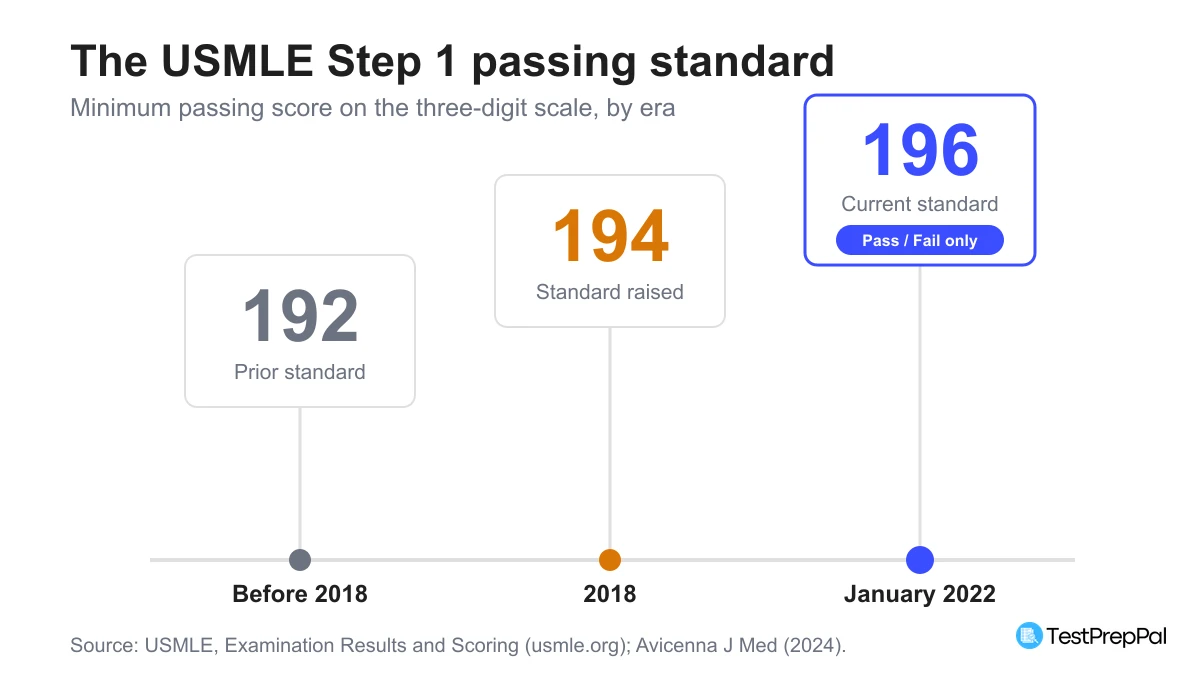 The USMLE Step 1 minimum passing standard, 192 to 196. Sources: USMLE Examination Results and Scoring (usmle.org) and Avicenna Journal of Medicine (2024).
Here is the path, per a 2024 peer-reviewed review in the Avicenna Journal of Medicine:
- Before 2018: the standard was 192.
- 2018: it rose to 194.
- January 2022: it rose to 196, at the same time Step 1 switched to pass/fail only.
A higher bar mechanically fails a few more people, and first-time pass rates did slide after the 2022 change. That said, a small standard bump is rarely the whole story. When the bar last went up, from 192 to 194 in 2018, the pass rate actually ticked up that year. We dig into what really moved the numbers in the Step 1 pass rate breakdown.
The most recent news is that the bar held. On December 5, 2024, the USMLE reviewed the Step 1 passing standard and voted to keep it unchanged at 196. A comprehensive review of each Step's standard happens roughly every three years, drawing on independent educator panels, survey feedback, and performance data, so 196 is the settled, current number heading into 2026.
Why you never see the Step 1 passing score on your report
Before the switch, a Step 1 score report showed a three-digit score plus a pass/fail outcome. Now it shows the outcome only.
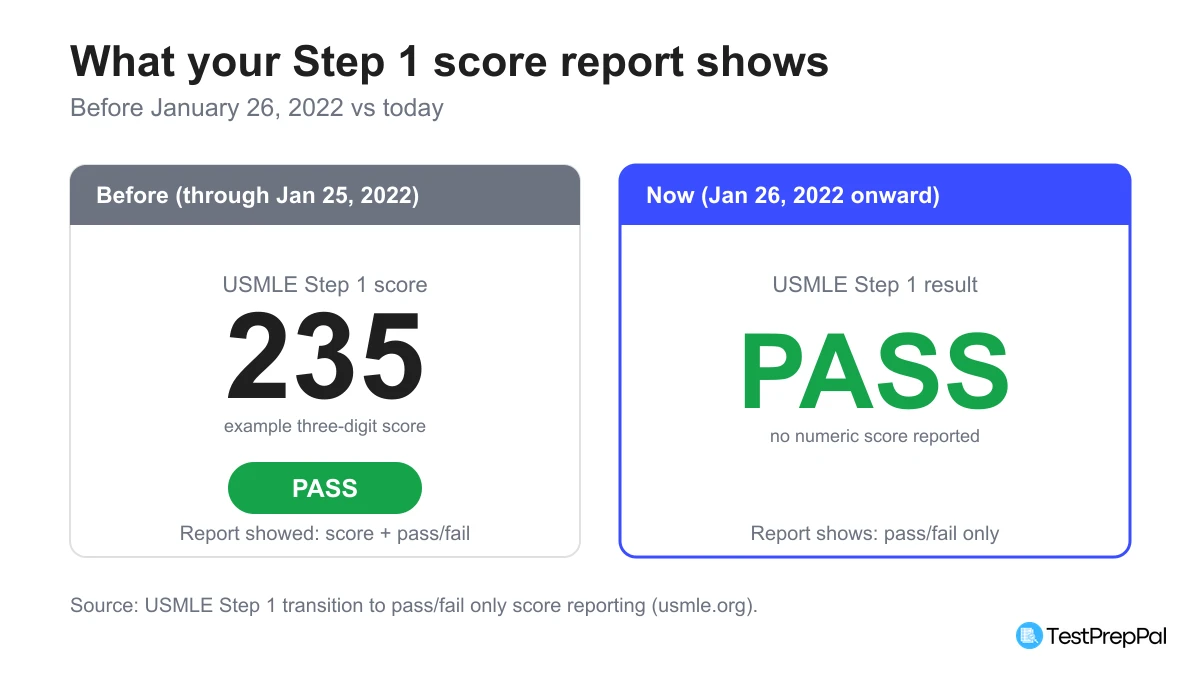 What a Step 1 score report showed before January 26, 2022 versus today. Source: USMLE Step 1 transition to pass/fail only score reporting (usmle.org).
Per the official USMLE transition notice, exams taken on or after January 26, 2022 return a pass/fail outcome only. The 196 standard still applies in the background. It just decides your result instead of printing on the page.
There is one exception worth knowing. If you fail, the report does not leave you guessing. You receive "information about how far they were from passing, as well as content-based feedback to guide the study plan," in the USMLE's words. So a passing candidate gets no number, while a failing candidate gets a rough sense of the gap and which content areas cost them.
How the equated passing standard works behind the scenes
The 196 is not a raw "get 196 questions right" target. It is a proficiency standard applied through a process called equating, and understanding it takes the mystery out of the pass/fail result.
Different examinees sit slightly different forms of the exam, with different questions at different difficulty levels. To keep things fair, the USMLE statistically equates scores so the same level of proficiency is required no matter which form you happened to get. If your form ran a little harder, you can miss a few more questions and still pass. If it ran a little easier, you need a few more correct. The bar in ability terms stays constant.
Two things follow from that:
- It is criterion-based, not a curve. The USMLE sets the standard to a defined level of competence, so, in its own words, "no predetermined percentage of examinees will pass or fail the examination." You are measured against the standard, not ranked against the people who tested the same day.
- You typically need about 60% correct. According to the USMLE bulletin on scoring, the percentage of questions you must answer correctly varies by Step and by form, but examinees "typically must answer approximately 60% of questions correctly to achieve a passing score." That is a rough guide, not a fixed cutoff, because equating adjusts it form to form.
The 196 itself is simply the equated cut point on the retired three-digit scale. Future reviews of the standard will not be expressed as a three-digit score, since the scale is no longer reported.
What passing Step 1 means for residency now
Because there is no number to compare, residency programs shifted the weight they used to place on Step 1 onto Step 2 CK, which is still scored (with its own passing standard of 218). Passing Step 1 is now a checkbox that says you cleared the foundational science gate, not a score that ranks you against other applicants.
That does not make it low-stakes. A fail is a serious flag that follows your application, and you still have to clear the bar before you can move forward. The practical takeaway is a shift in strategy, not effort: study hard enough to pass Step 1 comfortably, then put your score-maximizing energy into Step 2 CK, where the number still counts.
What happens if you fail USMLE Step 1
A fail is recoverable, but the rules around retaking changed in ways a lot of older guides get wrong.
First, you get feedback. Your report tells you that you did not pass, how far off you were, and which content areas need work. Use that to rebuild your plan rather than repeat it, and attack the named weak areas at concept level: the free Mehlman PDFs are built for exactly that kind of targeted repair and cost nothing.
Second, you can retake, but attempts are now capped. The USMLE reduced the limit from six attempts to four per Step. The current eligibility rules spell out the timing:
- You may not take the same Step more than three times within a 12-month period.
- Your fourth attempt must be at least 12 months after your first attempt at that exam and at least six months after your most recent attempt.
- If you have attempted a Step four or more times and have not passed, you are ineligible to apply for any Step in the USMLE sequence.
Those limits raise the stakes on the retake. Treat it as a full reset of your study plan, not a light touch-up, because repeaters pass at meaningfully lower rates than first-timers. We cover those repeater numbers in the Step 1 pass rate data.
How to tell if you are above the passing line before test day
Since your real report will not show a number, the job of translating your prep into a read on the 196 bar falls to your practice tools. Two official ones matter most.
- NBME self-assessments. The NBME self-assessments are built by the same organization that writes Step 1, and they give you a performance readout tied to your likelihood of passing. Take them across dedicated study to track whether you are moving toward the bar or stalling.
- The USMLE Free 120. The official Free 120 practice questions are the most exam-representative free practice you can get. Do the set timed, late in dedicated, and treat the result as a key readiness signal alongside your self-assessments.
How you space those forms matters as much as taking them. Our Step 1 study plan gives a cadence for a six-week dedicated period and a separate one for spreading the seven available forms across a three to six month runway.
Neither tool is worth much without volume behind it. The single most reliable driver of readiness is grinding a full question bank and reading every explanation, which is why most students build their plan around UWorld's Step 1 question bank anchored to First Aid. If you would rather start with a no-cost stack, our free USMLE Step 1 resources round up the best official and community tools, and the full USMLE resource directory reviews the paid banks and courses. Every pick above comes from our documented review methodology, not from who pays us.
Frequently asked questions
What is the minimum passing score for USMLE Step 1?
The minimum passing score is 196 on the three-digit scale, per official USMLE scoring data. However, Step 1 has been reported as pass/fail only since January 26, 2022, so you never receive a three-digit score. The 196 standard is applied behind the scenes, and your report shows only a pass or fail outcome.
Is USMLE Step 1 still scored?
No. Step 1 has been pass/fail only since January 26, 2022. The other exams in the sequence are still scored: Step 2 CK has a passing standard of 218 (effective July 1, 2025) and Step 3 has a passing standard of 200 (effective January 1, 2024). Only Step 1 returns a plain pass or fail.
What percentage do you need to pass USMLE Step 1?
You typically need to answer about 60% of questions correctly, according to the USMLE scoring bulletin. The exact percentage varies by Step and by test form, because scores are equated so the same level of proficiency is required regardless of which form you sit. It is a criterion-based standard, not a curve, so no fixed share of test-takers is failed.
Did the USMLE Step 1 passing score change recently?
The last change was the increase from 194 to 196 in January 2022, when Step 1 also went pass/fail. On December 5, 2024, the USMLE reviewed the Step 1 standard and voted to keep it at 196, so the current passing standard is unchanged heading into 2026.
How many times can you take USMLE Step 1?
You get four attempts per Step. You may not take the same Step more than three times within any 12-month period, and a fourth attempt must be at least 12 months after your first attempt and at least six months after your most recent. Four or more attempts without passing makes you ineligible for any USMLE Step.
Is the passing score different for IMGs or DO students?
No. The 196 passing standard is the same for everyone, whether you attend a U.S. MD school, a U.S. DO school, or an international medical school. What differs by group is the pass rate, not the bar. In 2024, first-time pass rates were 91% for U.S. MD, 86% for U.S. DO, and 73% for international graduates.
We may earn commissions from some links on this page, but this does not affect our reviews or your experience.