


In 2025, 93% of first-time test-takers from U.S. MD schools passed USMLE Step 1, along with 89% from U.S. DO schools and 75% from non-U.S. schools, according to official USMLE performance data. That is the most recent year in the official tables, and all three groups are back at their 2022 level after bottoming out in 2023 and 2024.
This is the number most people get wrong online, because a lot of published figures still quote 2022 or 2023 data, and many blur first-time takers together with repeaters. Below are the current rates straight from the USMLE, by group and by attempt, with the number of people behind each one, plus what actually moved the numbers and what the official data does not publish.
- In 2025, first-time Step 1 pass rates were 93% (U.S. MD), 89% (U.S. DO), and 75% (non-U.S. schools), per USMLE performance data.
- Those rates come from 23,028 U.S. MD, 4,623 U.S. DO, and 22,066 non-U.S. first-time examinees, so the non-U.S. group is almost as large as the U.S. MD group.
- Repeaters pass far less often: 71% for U.S. MD and 54% for non-U.S. schools in 2025.
- Pass rates fell after Step 1 went pass/fail in January 2022, bottomed out in 2023 and 2024, and recovered in 2025. No group is back to its 2021 level.
- USMLE publishes no pass rate for any individual medical school. The official cuts are degree type, U.S. versus non-U.S. school, and first attempt versus repeat.
- The passing standard is 196, and Step 1 is reported as pass/fail only, with no three-digit score.
What is the current USMLE Step 1 pass rate?
The single number most people mean by "the Step 1 pass rate" is the first-time, U.S. MD rate, because it describes the typical student sitting the exam for the first time. For 2025 that was 93%, according to the USMLE performance data. U.S. DO students passed at 89% and graduates of non-U.S. schools at 75%.
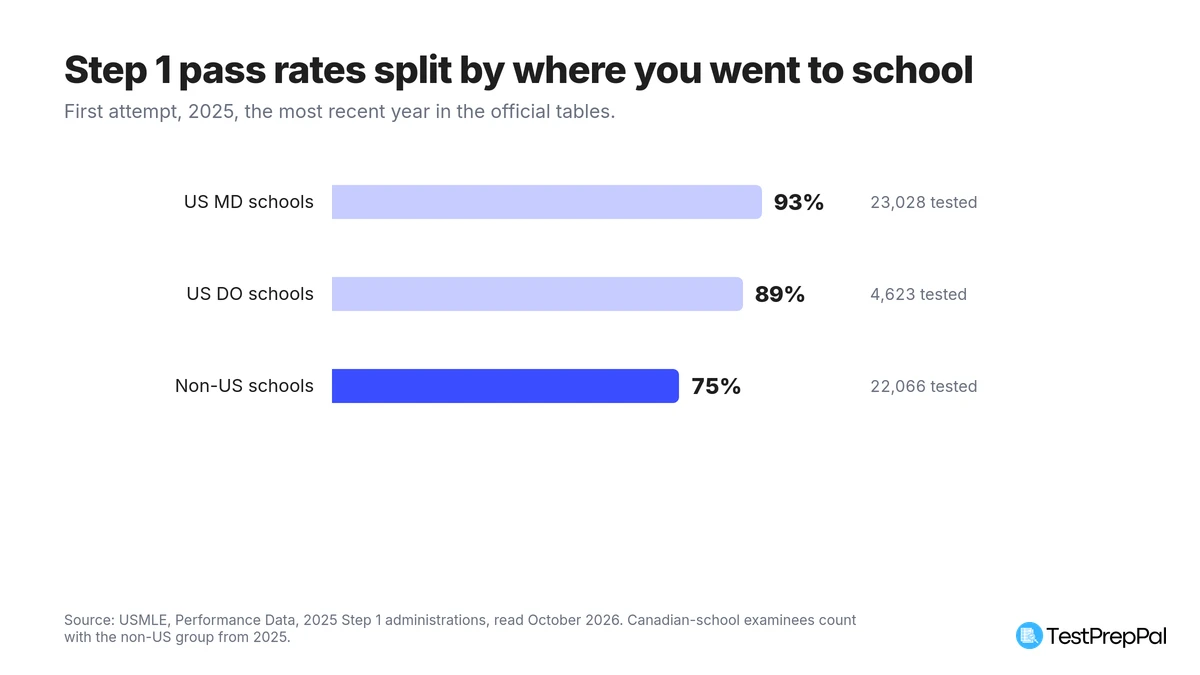 USMLE Step 1 first-attempt pass rates by examinee group, 2025. Source: USMLE Performance Data (usmle.org).
The gap between groups is the real story. A first-time U.S. MD student sits 18 points above a first-time non-U.S. graduate, and that spread has held for years. So the honest reference point depends entirely on which group you are in.
One caveat sits on the official tables, and it matters for the 2025 column. Canadian-school examinees were counted with the U.S. groups through 2024 and are counted with the non-U.S. group from 2025, so the newest non-U.S. figure covers a slightly different population than the older ones.
USMLE Step 1 pass rates by examinee group
Here is the full official picture for the two most recent reporting years, straight from the USMLE performance tables, including the number tested, which almost no other page prints. Percentages without counts hide how lopsided the groups are.
| Examinee group | 2024 tested | 2024 passing | 2025 tested | 2025 passing |
|---|---|---|---|---|
| U.S. MD, first attempt | 23,280 | 91% | 23,028 | 93% |
| U.S. MD, repeat attempt | 2,422 | 70% | 2,098 | 71% |
| U.S. MD, all attempts | 25,702 | 89% | 25,126 | 91% |
| U.S. DO, first attempt | 4,873 | 86% | 4,623 | 89% |
| U.S. DO, repeat attempt | 115 | 86% | 121 | 79% |
| U.S. DO, all attempts | 4,988 | 86% | 4,744 | 89% |
| All U.S. schools | 30,690 | 88% | 29,870 | 91% |
| Non-U.S. schools, first attempt | 22,713 | 73% | 22,066 | 75% |
| Non-U.S. schools, repeat attempt | 3,921 | 52% | 3,594 | 54% |
| Non-U.S. schools, all attempts | 26,634 | 70% | 25,660 | 72% |
Two things jump out of that table. First, blending attempts together drags every headline down: the same 2025 cycle reads 93% or 91% for U.S. MD students depending on which row someone quotes, and 75% or 72% for non-U.S. graduates. That is exactly why "the Step 1 pass rate" looks different in every article you read.
Second, the DO repeat row swings hard, from 86% to 79%, on 121 attempts. With a group that small, one bad quarter moves the percentage several points, so read it as a rough signal rather than a trend.
Does USMLE publish pass rates by medical school?
No. There is no official Step 1 pass rate for any individual medical school, in the United States or anywhere else. The USMLE performance tables publish three cuts and nothing finer: degree type (MD or DO), U.S. versus non-U.S. school, and first attempt versus repeat attempt. If a site shows you a ranked list of schools by Step 1 pass rate, it did not come from the USMLE.
What does exist is what each school chooses to publish about itself. Ohio State's College of Medicine, for example, posts its own first-attempt Step 1 rate by calendar year next to the national figure: 96% in 2023 against a national first-attempt rate of 92%. Many U.S. medical schools publish a similar table in their student-outcome pages. Those numbers are self-reported, they lag the national tables by a year or more, and they are not comparable school to school because each school decides which cohort to count.
For international schools the gap is wider. A pass rate advertised by a school outside the United States is not audited by the USMLE program and often covers only the students the school allowed to sit the exam, which is a filtered group by definition. The only official number that covers those students is the non-U.S. aggregate: 75% on a first attempt in 2025, across 22,066 examinees. That figure includes graduates of every country's schools together, so it cannot be split by nationality or by school either.
If you are weighing a specific school, the useful question is not its advertised pass rate. It is how many of its students reach the exam at all, how the school supports the ones who struggle, and what its match outcomes look like afterwards.
How USMLE Step 1 pass rates have changed
Step 1 pass rates are not static. First-attempt rates sat in the mid-90s for U.S. students before 2022, slid after the exam went pass/fail, bottomed out in 2023 and 2024, and recovered in 2025.
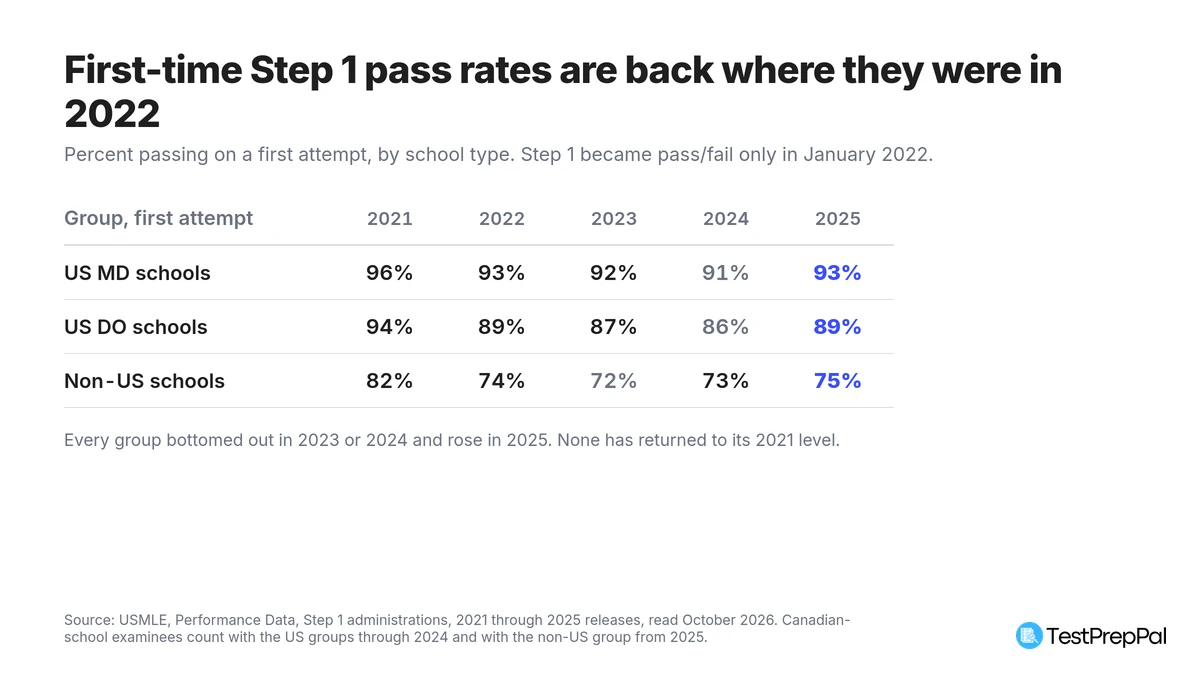 USMLE Step 1 first-attempt pass rates, 2021 to 2025. Source: USMLE Performance Data (usmle.org).
Read from the official tables, the first-attempt line for U.S. MD students runs 96% in 2021, 93% in 2022, 92% in 2023, 91% in 2024, and 93% in 2025. U.S. DO students ran 94%, 89%, 87%, 86%, then 89%. Non-U.S. graduates ran 82%, 74%, 72%, 73%, then 75%. Every group is back to roughly its 2022 level, and none has recovered to 2021.
Counting all examinees and all attempts together, the pass rate fell from 88% in 2021 to 82% in 2022, the sharpest single-year move in the series, according to a 2024 peer-reviewed review in the Avicenna Journal of Medicine.
Why USMLE Step 1 pass rates dropped after pass/fail
The decline lines up almost exactly with the January 2022 switch to pass/fail scoring, and the peer-reviewed analysis points to three overlapping causes.
A higher passing standard. When Step 1 went pass/fail, the minimum passing score rose from 194 to 196. A higher bar mechanically fails a few more people. On its own, though, that does not explain a six-point drop in the overall rate. When the standard last went up, from 192 to 194 in 2018, the number of students passing actually ticked up that year, so a small bar change is not usually enough to move the needle this much.
Pandemic disruption. The 2020 and 2021 classes had their preclinical training and testing scrambled by COVID-19, and those effects carried into 2022 exam takers. Step 1 is comprehensive, so gaps in foundational coursework show up across the whole exam.
Less studying. This is the one most people underestimate. Once the three-digit score disappeared, the incentive to grind for a high number disappeared with it, and students reported completing fewer practice questions during dedicated prep. The exam did not get much harder; a slice of test-takers simply prepared less intensely for a bar they assumed was easy to clear.
The 2025 recovery fits the same explanation in reverse. Nothing about the blueprint changed that year, and the passing standard did not move. What changed is that the cohorts who watched three years of falling rates took the bar more seriously.
What is the passing score for USMLE Step 1?
The current minimum passing standard is 196 on the three-digit scale, confirmed on the official USMLE examination results and scoring page as of October 2026. You will never see that number on your score report. Since January 26, 2022, Step 1 has been reported as pass or fail only, per the official USMLE transition notice. The 196 works behind the scenes as an equated standard; your report simply says whether you cleared it.
One detail is worth knowing if you are searching for a 2026 number. The USMLE program reviews each passing standard roughly every four years, and it has stated that future reviews of the Step 1 standard will not be reported in terms of a three-digit score. So 196 is the last public figure of its kind, and a changed standard would reach you as a changed pass rate, not as a new number.
Because there is no score to show off, residency programs shifted the weight they used to put on Step 1 onto Step 2 CK, which is still scored. Passing Step 1 is now a gate to get through, not a number to maximize, which changes how you should budget your effort.
How Step 1 pass rates compare to Step 2 CK
Step 1 rates look low next to Step 2 CK, and that gap is part of why programs lean on Step 2 now. In the 2024 to 2025 cycle, first-attempt Step 2 CK pass rates ran 98% for U.S. MD students, 96% for U.S. DO students, and 90% for graduates of non-U.S. schools, per the same USMLE performance data. Step 2 CK also still has a published minimum passing score, 218 for exams taken on or after July 1, 2025.
Step 2 CK is taken later, after clinical rotations, by students who have already cleared Step 1, so the tested pool is stronger and better prepared. The planning takeaway is simple: Step 1 is the harder gate to clear, and it deserves the heavier share of your dedicated study time.
Why repeaters and international graduates pass at lower rates
Two groups pull the headline "all candidates" figure down, and both drops are structural rather than random.
Repeaters. By definition, repeat testers are the people who did not clear the bar the first time, so a lower pass rate is expected. The size of the gap is still worth respecting: U.S. MD repeaters passed at 71% in 2025 versus 93% for first-timers. If you fail, treat the retake as a full reset of your study plan, not a light touch-up.
International graduates. Graduates of non-U.S. schools face variable preclinical curricula, exams in a second language for many, and preparation timelines that often run alongside clinical work back home. A 75% first-attempt rate is far better than the 54% repeat rate, which again underlines how much easier the first honest attempt is than a rushed one.
What the Step 1 pass rate does and does not tell you
A pass rate is a population statistic, not your personal probability. Your realistic odds depend on your NBME self-assessment scores, your question-bank performance, and whether you have finished your first two years of coursework, far more than on the group average. Use the number for context, not as a prediction.
It also does not measure difficulty in a vacuum. When a rate moves, it usually reflects who is testing and how they prepared, not a change in the exam blueprint. The 2022 dip is the clearest example: same exam, different behavior.
And it says nothing about your age, your gap years, or how long you have been out of school. The USMLE publishes no pass rate by age or by years since graduation, so anyone quoting one is guessing.
How to give yourself the best shot at passing
The students who clear Step 1 comfortably tend to do the same handful of things. It helps to first understand what Step 1 actually is and what it takes to pass, decide when to sit it, and build a week-by-week study plan. If you want the full USMLE resource landscape, start here:
- Do a real question bank, thoroughly. Working UWorld's Step 1 question bank and reading every explanation is the single most reliable predictor of readiness. The fewer questions you do, the worse the odds, which is exactly the pattern behind the post-2022 dip.
- Anchor everything to First Aid. First Aid for the USMLE Step 1 is the shared outline the whole ecosystem maps to; annotate it as you go, and here is how to use First Aid the right way.
- Lock in retention with spaced repetition. The free AnKing Step Deck is how most high scorers keep thousands of facts from slipping.
- Take the official practice. A timed USMLE Free 120 and NBME self-assessments late in dedicated are the best readiness signal you can get, and they are the closest thing to the real exam.
Every rating and pick above comes from our documented review methodology, not from who pays us.
Frequently asked questions
What is the USMLE Step 1 pass rate in 2026?
The most recent official data covers 2025, when 93% of first-time U.S. MD students, 89% of U.S. DO students, and 75% of first-time graduates of non-U.S. schools passed Step 1. Blended across first-timers and repeaters, the all-attempts totals were 91% for U.S. schools and 72% for non-U.S. schools. No 2026 figures have been published yet.
What is the passing score for USMLE Step 1?
The minimum passing standard is 196 on the three-digit scale. Step 1 has been reported as pass/fail only since January 26, 2022, so you do not receive a three-digit score, only a pass or fail outcome. Future reviews of the standard will not be published as a three-digit number.
Do I need about 60% correct to pass Step 1?
That figure circulates widely and it is not official. The USMLE publishes no percent-correct threshold, because the passing standard is set on the three-digit scale and equated across exam forms so that the proficiency required to pass stays the same no matter which form you sit. Treat any specific percentage as an estimate, not a target.
What are the Step 1 pass rates for a specific medical school?
The USMLE does not publish them. Its tables stop at degree type, U.S. versus non-U.S. school, and first attempt versus repeat. Individual U.S. schools often publish their own first-attempt rate, and schools abroad sometimes advertise one, but those are self-reported and are not comparable with each other.
How many international medical graduates take Step 1?
In 2025, 22,066 first-time examinees from non-U.S. schools sat Step 1, plus 3,594 repeat attempts, for 25,660 in total. That is close to the 25,126 administrations from U.S. MD schools in the same year, so roughly half of everyone taking Step 1 trained outside the United States.
How do repeater pass rates compare to first-time rates?
Repeaters pass at much lower rates. In 2025, U.S. MD repeaters passed at 71% versus 93% for first-timers, and repeaters from non-U.S. schools passed at 54% versus 75%. A first, well-prepared attempt is by far your best shot.
Does Step 1 still matter for residency if it is pass/fail?
Yes, but differently. You must pass to move forward, and a fail is a serious flag for programs. Since there is no score to compare, programs now put more weight on Step 2 CK, which remains scored.
We may earn commissions from some links on this page, but this does not affect our reviews or your experience.