


Most US MD and DO students take USMLE Step 1 at the end of their preclinical years, right before core clerkships, after a dedicated study block of roughly five to eight weeks. The honest answer to when you should take Step 1 is not a fixed date on the calendar: it is the point where you have finished the underlying coursework and your timed practice says you will pass. That means a strong, timed NBME self-assessment and a Free 120 you clear comfortably, not just a feeling that you have studied enough.
Eligibility works differently depending on who you are. If you are at a US MD or DO school, your school and the NBME handle it. If you are an international medical graduate (IMG), the ECFMG certifies you, and your timeline usually runs alongside or after your own program rather than on the standard US two-year clock. Below is the full timing decision: who is eligible, how the scheduling window actually works, how long to give yourself, and the four signals that tell you it is time to sit.
- When most people sit it: US MD and DO students take Step 1 at the end of preclinical study (before core clerkships); IMGs test on their own program's clock.
- Ready means data, not vibes: finished coursework, a timed NBME self-assessment above the passing line, question-bank scores trending up, and a Free 120 you clear comfortably.
- Eligibility: you must be officially enrolled in or a graduate of an LCME (MD), COCA (DO), or ECFMG-listed international school, at both application and test time.
- The window: you pick a three-month eligibility period, get a scheduling permit, and book at a Prometric center (no more than six months ahead). One contiguous extension is allowed.
- Do not rush it: Step 1 is pass/fail with only four attempts allowed, so sitting before you are ready is a real risk, not a free practice run.
When do most students take USMLE Step 1?
For US MD and DO students, Step 1 sits at the seam between the preclinical and clinical phases of medical school. You finish the foundational science curriculum (usually the first two years, though many schools now compress this into 18 months), then take a dedicated study period, then sit Step 1 before you start your core clinical rotations. That ordering exists because Step 1 tests the integrated basic science you just spent two years learning, so the closer you sit it to that coursework, the fresher the material is.
IMGs run on a different schedule. Because international curricula vary in length and structure, there is no single "end of year two" moment that fits everyone. Many IMGs take Step 1 after completing their basic science coursework, sometimes alongside their ongoing program and sometimes after graduating, once their school has certified their status to the ECFMG. The common thread across both paths is the same: coursework done, readiness confirmed, then the exam.
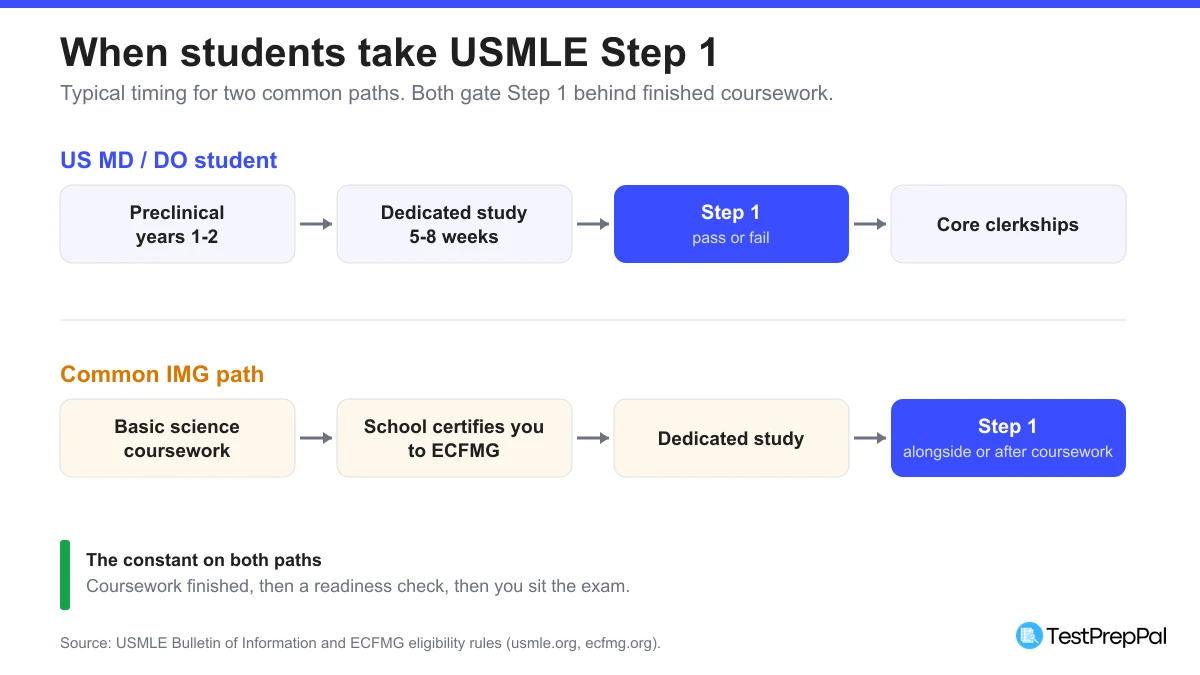 Two common Step 1 timelines. Both gate the exam behind finished coursework and a readiness check. Source: USMLE Bulletin of Information and ECFMG eligibility rules.
There is no national deadline for Step 1 itself, but your own school almost certainly sets one. Most US programs require you to pass Step 1 before you can advance into or complete clerkships, so the practical deadline is whatever your registrar enforces, not a rule from the USMLE program. Check your school's promotion policy early, because it usually matters more to your scheduling than anything on usmle.org.
Who is eligible to take USMLE Step 1?
To sit Step 1, you have to fall into one of three eligibility categories, and you must meet it both when you apply and on test day. According to the official USMLE eligibility requirements, you must be a medical student officially enrolled in, or a graduate of, one of these:
- A US or Canadian medical school leading to the MD degree that is accredited by the LCME.
- A US medical school leading to the DO degree that is accredited by the Commission on Osteopathic College Accreditation (COCA).
- A medical school outside the US and Canada that is listed in the World Directory of Medical Schools as meeting ECFMG eligibility requirements.
Notice what is not on that list: there is no minimum GPA, no prerequisite score, and no requirement to have finished a specific number of courses in the USMLE rules themselves. The gatekeeping happens through your school. If you are dismissed or withdraw, you lose eligibility immediately, which is why active enrollment status is the real requirement.
Who registers you depends on your category. The NBME registers US MD and DO students and graduates. For IMGs, the ECFMG handles registration, and the process has an extra verification layer. As the ECFMG exam-eligibility rules explain, an authorized official at your medical school must certify your enrollment and your completion of basic medical science coursework to the ECFMG, and the ECFMG then confirms your eligibility to the Federation of State Medical Boards (FSMB) when you apply. Graduates additionally need primary-source verification of their medical diploma. In practice, that means IMGs should start the ECFMG process well before they want to test, because the school certification and credential checks take time.
How the eligibility period and scheduling actually work
This is the part most timing guides skip, and it is where students lose weeks they did not plan for. Here is the sequence, straight from the USMLE Bulletin of Information.
When you apply, you select a three-month eligibility period during which you intend to test. Once your registration is complete, the organization that registered you (NBME or ECFMG) issues a scheduling permit by email. Only then can you go to the Prometric website and book an actual test date, and per the USMLE applying and scheduling rules, scheduling is not available more than six months in advance.
A few practical consequences fall out of this:
- Apply before you want the window to open, not on the day you hope to test. Registration and permit issuance take time, and popular test dates near the end of an academic term fill up.
- Book your Prometric seat as soon as the permit arrives. Seats at your preferred center and date are first come, first served, and waiting can push you later than you planned.
- You get one safety net. If you cannot test within your eligibility period, you can request a one-time contiguous extension to the next period from the organization that registered you. It is one extension, not unlimited, so do not treat your window as flexible.
The exam itself is a one-day, roughly eight-hour session of up to 280 multiple-choice questions, administered at a Prometric test center, per the USMLE Step 1 exam overview. None of that changes the timing decision much, but it is worth knowing that "test day" is a full, draining day, so you want to schedule it when your energy and preparation both peak.
How long should your dedicated study period be?
Most students give themselves a dedicated study period of about five to eight weeks between finishing coursework and sitting Step 1. That range is a rule of thumb, not an official requirement, and the right length depends on how strong your foundation already is when dedicated begins.
The mistake is treating dedicated as the time to learn the content for the first time. It is not. Dedicated works best as a consolidation and practice phase: you should already know the material reasonably well from your coursework and your day-to-day question practice, and you use these weeks to do large volumes of practice questions, patch weak areas, and take timed assessments. If you reach dedicated and realize you are learning whole subjects from scratch, that is a signal you may be sitting too early, not that you need a longer dedicated block.
If you want a week-by-week structure for those weeks, see our USMLE Step 1 study plan. This article is about when to sit; that one is about how to spend the run-up.
How do you know you are ready for Step 1?
Readiness is measurable, and you should treat it that way. The students who pass comfortably tend to clear the same four signals before they lock in a date. If you are missing one, it usually pays to move your date rather than hope.
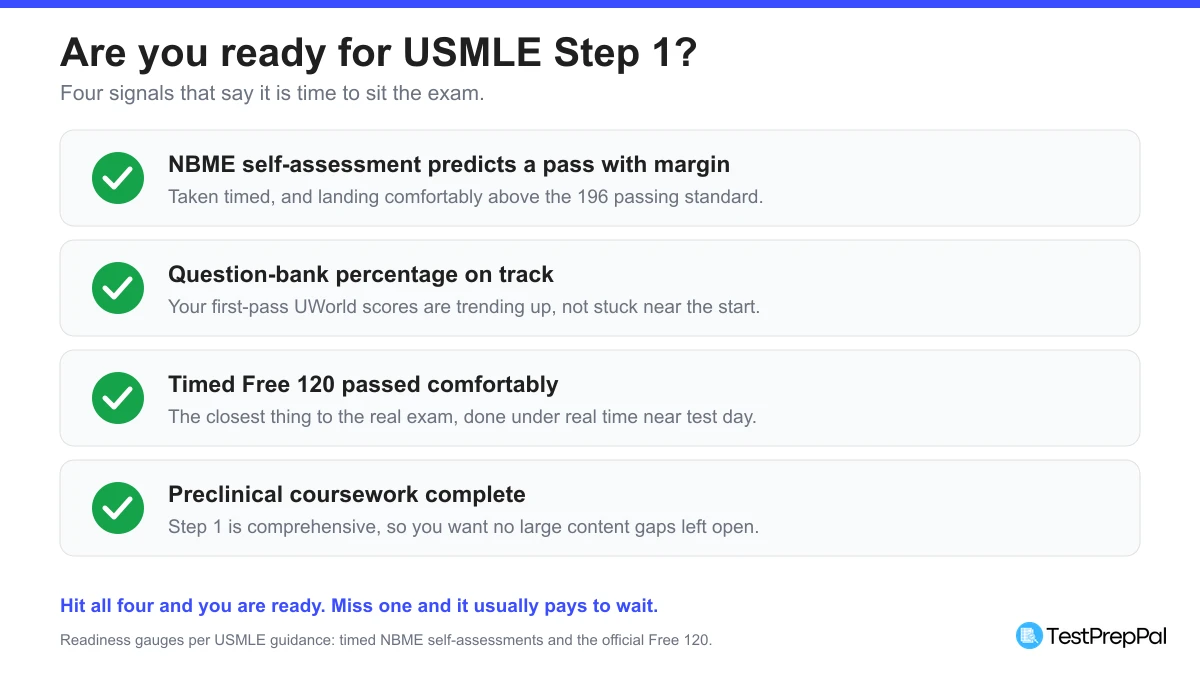 The four readiness signals that say it is time to sit Step 1. Source: standard USMLE readiness gauges (timed NBME self-assessments and the official Free 120).
1. Your NBME self-assessment predicts a pass with margin. The NBME Comprehensive Basic Science Self-Assessments are built by the same organization that writes the real exam, and they are the single most trusted readiness gauge. Take them timed, and you want a result that clears the passing standard with room to spare rather than one that lands right on the line.
2. Your question-bank percentage is on track. Working UWorld's Step 1 question bank thoroughly is the most reliable predictor of readiness, and what matters is the trend. First-pass scores that are climbing week over week signal that your reasoning is maturing; scores stuck near where you started signal that more time will help.
3. You passed a timed Free 120 comfortably. The official USMLE Free 120 is the closest thing to the real exam you can get, because the items come straight from the test makers. Do it timed, in the back half of your prep, and treat a comfortable pass as confirmation rather than a coin flip.
4. Your coursework is genuinely complete. Step 1 is comprehensive, so a large untouched subject (say, you never really learned renal or biochem) will cost you across the whole exam, not just one block. Finishing the underlying content is the precondition that makes the other three signals meaningful.
You can gut-check your practice percentages against the reality of current Step 1 pass rates, which in 2024 were 91% for first-time US MD students, 86% for US DO students, and 73% for IMGs, according to USMLE performance data. Those numbers describe populations, not your personal odds, but they are a useful reminder that a comfortable margin on your self-assessments beats a borderline one.
How pass/fail changed the timing decision
Step 1 has been reported as pass or fail only since January 26, 2022, with a minimum passing standard of 196 and no three-digit score, per the official USMLE transition notice. That change reshaped the timing conversation in two ways.
First, because there is no score to maximize, some schools have used the shift to move Step 1 later, after students' first clinical rotations, on the theory that clinical context helps and there is no high number to protect. If your school does this, follow your school's structure. For most programs, though, the end-of-preclinical slot is still standard.
Second, and more importantly for your decision, pass/fail did not make Step 1 a low-stakes formality. First-time pass rates actually fell after the change, largely because some students underprepared for a bar they assumed was easy. And the stakes of a failed attempt are real: the USMLE allows only four attempts to pass each Step, a limit reduced from six in July 2021, and you cannot take the same Step more than three times within a 12-month period. A failed attempt also shows up on your transcript for residency programs. So the pass/fail era did not lower the cost of sitting too early. If anything, the four-attempt cap raised it. "Take it and see" is not a strategy Step 1 rewards.
Common Step 1 timing mistakes
- Scheduling a date first, then reverse-engineering readiness. Pick your date from your practice data, not the other way around. A date you booked in a panic is not a deadline your NBME scores have to honor.
- Confusing "finished dedicated" with "ready." Time spent is not the metric. If your self-assessments are not clearing the bar, more calendar does not fix that on its own; targeted practice does.
- Applying too late. Registration, permit issuance, and Prometric availability all take time. Build in a buffer so a slow permit or a full test center does not force your hand.
- Ignoring your own school's rules. Your program's promotion and clerkship-entry policies are usually the real deadline. Read them before you plan anything around the USMLE's own (much looser) rules.
- For IMGs, starting the ECFMG process late. School certification and credential verification are not instant. Begin early so eligibility is not the thing standing between you and a test date.
The bottom line
Take Step 1 when your coursework is done and your timed practice says you will pass, not on a date you picked out of hope or panic. For US MD and DO students that lands at the end of preclinical study; for IMGs it lands wherever your program and the ECFMG process put you. Confirm eligibility early, book your Prometric seat the moment your permit arrives, and let your NBME self-assessments and a timed Free 120 make the final call. If you want to build the run-up itself, start with our free USMLE Step 1 resources and the wider USMLE resource directory, all rated against our documented review methodology.
Frequently asked questions
When do most medical students take USMLE Step 1?
Most US MD and DO students take Step 1 at the end of their preclinical years, before core clerkships, after a dedicated study period of about five to eight weeks. IMGs test on their own program's schedule, often after finishing basic science coursework and once their school has certified them to the ECFMG. There is no national deadline, but your own medical school usually requires a pass before you advance in clerkships.
What are the eligibility requirements for USMLE Step 1?
You must be officially enrolled in, or a graduate of, a medical school in one of three categories: a US or Canadian MD school accredited by the LCME, a US DO school accredited by COCA, or an international school listed in the World Directory of Medical Schools as meeting ECFMG requirements. You have to meet the category at both application and test time. US MD and DO candidates register through the NBME; IMGs register through the ECFMG.
How far in advance do you register and schedule Step 1?
You select a three-month eligibility period when you apply. After registration, the NBME or ECFMG issues a scheduling permit, and you then book a seat at a Prometric test center. Scheduling is not available more than six months in advance, so apply well before your target window and book as soon as your permit arrives.
Can you change your Step 1 test date or eligibility period?
Yes, within limits. You can reschedule your Prometric appointment (fees may apply depending on how close it is), and if you cannot test within your eligibility period you may request a one-time contiguous extension to the next period from the organization that registered you. It is a single extension, so do not rely on it as a general-purpose delay.
How do I know if I am ready to take Step 1?
Use four signals: a timed NBME self-assessment that predicts a pass with margin, question-bank scores that are trending up, a timed Free 120 you clear comfortably, and completed preclinical coursework with no large gaps. If you are missing one, moving your date is usually smarter than hoping. Readiness is measurable, so let the data decide rather than a feeling of "I have studied a lot."
Does it matter when you take Step 1 now that it is pass/fail?
The timing still matters, just for different reasons. Since there is no score to maximize, the goal is a confident pass, not a high number, and some schools have moved Step 1 slightly later. But pass/fail did not make it easy: first-time pass rates fell after the 2022 change, you get only four attempts to pass, and a failure appears on your transcript. Sitting before you are ready is a genuine risk, not a free trial.
Sources
- USMLE Bulletin of Information: Eligibility (usmle.org)
- USMLE Bulletin of Information: Applying & Scheduling (usmle.org)
- USMLE Attempt Limit (usmle.org)
- USMLE Step 1 Exam Overview (usmle.org)
- USMLE Step 1 Transition to Pass/Fail Only Score Reporting (usmle.org)
- ECFMG Eligibility for USMLE (ecfmg.org)
- USMLE Performance Data (usmle.org)
We may earn commissions from some links on this page, but this does not affect our reviews or your experience.