


Most students build a USMLE Step 1 study plan in two parts: longitudinal work through the preclinical years, then a protected dedicated period of about 5 to 8 weeks built around one question bank. You are aiming at a specific bar, not an open-ended one. USMLE states that examinees typically must answer approximately 60 percent of questions correctly to pass, per the official scoring guidance, so every plan below is built to clear that with margin.
This plan maps the specific resources most high scorers use to each phase of prep, so you know not just what to study but when each tool earns its place. It also covers the two situations the usual week-by-week schedule ignores: studying for Step 1 while your classes are still running, and planning Step 1 around a national licensing exam. Treat the week counts as guidance you shape around your own calendar, not fixed rules.
- Build the base during preclinical years: daily AnKing reviews plus Boards & Beyond or Pathoma alongside your coursework.
- Reserve a 5 to 8 week dedicated period and build it around UWorld (one to two passes), reading every explanation.
- Anchor everything to First Aid, and use Sketchy for the micro and pharm facts that will not stick.
- Gauge readiness with NBME self-assessments every 1 to 2 weeks and a timed Free 120 late in dedicated.
- Step 1 is pass/fail only (passing standard 196 on the retired score scale), and roughly 60 percent correct is the typical bar.
- Since May 14, 2026 the exam runs as fourteen 30-minute blocks, which changes how you practice.
The Step 1 study plan in one view
Here is the whole plan before the detail. Three phases, each with a clear job:
- Preclinical (longitudinal): learn the content with your classes, keep a daily AnKing habit, and start annotating First Aid. This is the base that makes dedicated study manageable.
- Dedicated (about 5 to 8 weeks): finish one full UWorld pass, shift into timed practice, review deeply, and take an NBME self-assessment every week or two to track readiness.
- Final week: taper. Light review, rest, and logistics. No new content.
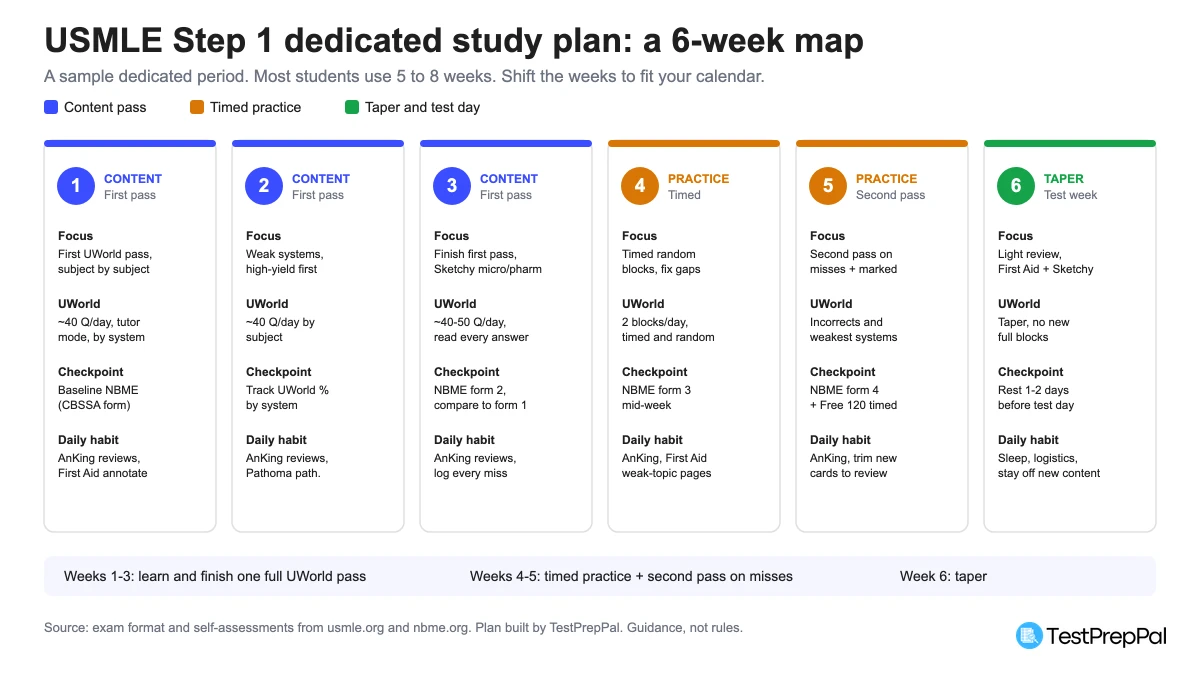 A sample 6-week dedicated period. Sources: usmle.org and nbme.org for exam and self-assessment details; plan by TestPrepPal.
The rest of this guide fills in each phase and shows which resource to reach for and when. If you want the full range of tools first, our USMLE resource directory reviews each one against a documented review methodology.
How long should you study for Step 1?
For a student in a US MD or DO program whose preclinical coursework is current, the honest answer is 5 to 8 weeks of dedicated study, sitting on top of the 18 to 24 months of coursework that already covered the content. The dedicated period is not where you learn Step 1 material. It is where you convert what you already half-know into exam performance.
If your coursework did not follow the Step 1 content outline, or you have been out of school for a year or more, the dedicated period stays about the same length but you need a content phase in front of it. That is the part most timelines leave out, and it is why two students can both say "I studied for six weeks" and mean completely different things.
| Your situation | Content phase before dedicated | Dedicated period | Rough total runway |
|---|---|---|---|
| US MD or DO student, preclinical coursework current | runs alongside your classes | 5 to 8 weeks | the dedicated block |
| Coursework finished but patchy in pathology or pharm | 6 to 10 weeks part time | 6 to 8 weeks | about 4 months |
| MBBS or other syllabus that is not built around Step 1 | 4 to 6 months part time | 6 to 8 weeks | about 6 to 9 months |
| Out of medical school a year or more | 3 to 4 months rebuilding content | 6 to 8 weeks | about 5 to 6 months |
Three practical notes on length. An 8-week plan is the right default if you want room for two UWorld passes and several readiness checks without rushing. Going beyond about 10 weeks of dedicated study rarely helps, because retention from week 1 starts decaying faster than you add new ground. And the calendar never decides on its own: your NBME trend does, which is the subject of the readiness section below.
For the separate question of when in your program to sit the exam, see our guide on when to take USMLE Step 1.
What your Step 1 plan has to work around
Before you schedule anything, know the exam you are building toward. Step 1 is a one-day, roughly 8-hour test. Since May 14, 2026, it is divided into fourteen 30-minute blocks of no more than 20 questions each, with a minimum of 55 minutes of break time and a 5-minute optional tutorial, per the official Step 1 exam content page. If you sat it before that date, it ran as seven 60-minute blocks of up to 40 questions, capped at 280 items, with 45 minutes of break time.
That change matters for your plan, not just for test day. A 30-minute, 20-question block is a single practice unit you can actually finish on a weeknight, and it is the unit your timed practice should use. Build your stamina by stacking blocks, not by inventing 60-minute sets the exam no longer uses.
Step 1 has been reported as pass/fail only since January 26, 2022, per the official USMLE transition notice. On the retired three-digit scale the passing standard is 196, and USMLE has said future reviews of that standard will not be reported as a three-digit score, per the examination results and scoring page. There is no number to chase anymore. That changes the goal of your plan: you are aiming for a confident, well-margined pass, then moving your energy to Step 2 CK, which is still scored. For where a realistic bar sits by group, see our breakdown of the current USMLE Step 1 pass rates, and for how the standard itself works, our explainer on the Step 1 passing score.
Which subjects to study first, and in what order
Step 1 is built on an integrated content outline that organizes basic science along two dimensions, system and process, with emphasis on the principles and mechanisms behind health and disease, per USMLE's own description of the exam. That shape tells you how to sequence your content.
Start with the material everything else references:
- General pathology. Cell injury, inflammation, neoplasia. The first three Pathoma chapters are the foundation that organ-system pathology builds on, and almost every system question leans on them.
- Physiology, system by system. Cardiology, pulmonology and renal first. They carry the heaviest physiology load, they share mechanisms, and they reappear inside other systems all year.
- Organ-system pathology, following the same order as your physiology.
- Micro and pharm, continuously. These are memorization-heavy and do not reward a single block of study. Run Sketchy alongside everything else from early on.
- Biochemistry, immunology, biostatistics and behavioral science in shorter, repeated passes rather than one long sitting.
On the question students ask most often, whether to do endocrine before GI or the other way round: it barely matters. Both sit in the middle of the sequence, both depend on the physiology you built in the first three systems, and the order within that middle group is not what separates a pass from a fail. What matters is that you finish all of them before dedicated starts. If you want a tiebreaker, take endocrine earlier if your physiology base is solid, because it pays off across repro and renal, and take GI earlier if you learn better from structure and histology.
Neurology, musculoskeletal and dermatology sit comfortably late. Biostatistics and behavioral science go last, but never get skipped: they are cheap points for a few hours of work.
Preclinical years: the longitudinal base
Your Step 1 plan really starts in your first two years, not the month before the exam. The students who find dedicated study calm are the ones who built retention slowly during coursework. Three habits carry the load.
Do the AnKing deck daily. The AnKing Step Deck holds over 30,000 crowd-maintained cards covering Step 1, Step 2 and Step 3, tagged to First Aid, Boards & Beyond, UWorld and the NBMEs, according to AnkiHub. The deck itself is free; an AnkiHub membership for automatic updates runs about $5 a month, or $55 a year. Unsuspend cards as you cover each topic in class and do your reviews every day. Spaced repetition is the most efficient way to keep the mountain of discrete facts Step 1 tests from slipping, and it only works if you start early.
Use one primary video course with your classes. Boards & Beyond covers the whole Step 1 syllabus and maps cleanly to First Aid, which makes it a strong preclinical spine. It is now sold through McGraw Hill and split by exam stage: the Step 1 Preclinical product page lists more than 440 videos and more than 2,300 quiz questions, with First Aid page references on most videos. Because Step 1 is so pathology-heavy, pair it with Pathoma, Dr. Sattar's concise pathology course and book, which runs 35 hours of video across the 19 chapters of Fundamentals of Pathology and is sold in 3, 12 and 21-month subscriptions, per pathoma.com. Watch Pathoma chapters 1 to 3 early: they are the foundation the rest of pathology builds on.
Start micro and pharm mnemonics before dedicated. Sketchy encodes microbiology and pharmacology facts into illustrated scenes that stick far better than lists. Building these worlds during your classes, rather than cramming them in dedicated, saves you weeks later.
Alongside all of this, keep First Aid for the USMLE Step 1 open and start annotating it. First Aid is the shared outline the entire Step 1 ecosystem maps to, so making it your central reference now pays off through dedicated and into the final week. Our guide on how to use First Aid covers the annotation habit in detail.
Studying for Step 1 alongside full-time classes
Most published schedules assume a protected block with nothing else in it. That is not the situation for a student whose classes are still running, and the fix is not to run the dedicated plan at lower volume. The job is genuinely different: your coursework sets the content order, and Step 1 work is a thin layer you add on top of it, every day, for a long time.
Four rules make this work.
Let your course schedule drive the sequence. Do not run a parallel Step 1 syllabus beside your classes. When your course is in renal, your Step 1 work is renal: unsuspend the renal cards, watch the renal videos, do renal questions. Studying two different systems at once is how students end up doing badly at both.
Cap the daily load at something you can repeat. About 60 to 90 minutes of Step 1 work on a class day is sustainable for two years. Three hours is not, and a plan you abandon in month two is worth less than a small one you keep.
Anki is the only non-negotiable. On a bad week, the reviews still happen and everything else gets dropped. A backlog of a few hundred cards is recoverable; a backlog of several thousand is not.
Use one weekend block for timed practice. This is where the new exam format helps you. A single 30-minute, 20-question block is now exactly one practice unit, so a timed block plus a careful review fits in a morning without needing a cleared day.
| Day type | Step 1 work on top of classes | Time |
|---|---|---|
| Class day | AnKing reviews, plus 10 to 20 questions on the system you are covering in class | 60 to 90 min |
| Lighter class day | The above, plus one video on your weakest topic in the current block | about 2 hours |
| Saturday | One timed 20-question block under exam timing, then a full review of every item | 2 to 3 hours |
| Sunday | Clear the Anki backlog and annotate First Aid for the week's topics | 1 to 2 hours |
| School exam week | Course exams only. Anki reviews, nothing new | reviews only |
Two warnings. First, a longitudinal plan is not a substitute for dedicated: it makes dedicated shorter and calmer, it does not replace it, so protect those weeks anyway. Second, do not burn the whole UWorld bank during coursework. Use a few hundred questions tied to your current system and save the bulk for dedicated, when the data from it is worth the most.
The dedicated period: about 5 to 8 weeks
Dedicated is where the plan tightens. Most students protect 5 to 8 weeks with few other commitments and build the whole period around one question bank. The engine is UWorld's Step 1 Qbank, 3,600+ exam-style questions with detailed explanations. Current pricing on UWorld's Step 1 page runs $349 for 30 days, $459 for 90 days, $519 for 180 days, $579 for 360 days and $749 for 730 days, with the longer plans bundling self-assessments and a reset. If UWorld is out of budget, AMBOSS is the usual alternative. The rule that matters most, whichever bank you use: the learning is in the review. Read every explanation, including for questions you got right, and turn misses into new Anki cards.
A workable shape is one to two passes of UWorld. The first pass is subject by subject in tutor mode to learn; the second pass is timed and random, focused on your incorrects and weakest systems. Annotate First Aid from what UWorld and Anki keep exposing, and use Sketchy to patch the specific bugs and drugs you keep missing. UWorld's own self-assessment forms now run as 8 blocks of 20 questions at 30 minutes per block, which mirrors the current exam, so they are useful stamina practice as well as a score check.
The other half of dedicated is honest measurement. Take an NBME self-assessment every 1 to 2 weeks. The Comprehensive Basic Science Self-Assessment comes in seven forms and reports an estimated probability of passing Step 1 alongside your equated percent correct, according to NBME, so it is the cleanest readiness signal you have. Each form is four sections of 50 questions and starts at $62. Budget the time properly: standard-paced timing gives you 1 hour 15 minutes per section, so a full form is most of a day once you add review, and self-paced timing stretches each section to 5 hours.
Late in dedicated, take the Free 120 timed, in one sitting, as the closest free thing to the real exam. It is published as both a PDF booklet and an interactive testing experience, and USMLE added a new interactive version alongside the May 14 format change, so use that one rather than an older copy, per the Step 1 sample test questions page.
How to space NBME self-assessments across a longer plan
Over a 3 to 6 month plan the weekly cadence above is wasteful: you will run out of forms before the exam and spend money measuring a number that has not had time to move. Seven forms exist, so spend them where they tell you something.
| When | Form | What you are asking it |
|---|---|---|
| Start of the content phase | 1 | A baseline. Expect it to be low, and do not read anything into it beyond which systems are weakest |
| Halfway through content | 1 | Is the content phase working, or is the method the problem |
| Start of dedicated | 1 | The real starting point, and the number your dedicated plan is built around |
| Every 1 to 2 weeks in dedicated | 2 to 3 | Is the trend rising, and which systems are still costing points |
| About 5 to 7 days out | 1 (a recent form) | The final go or no-go call |
| Final week | Free 120, timed | Format, stamina and pacing, not a score |
Save your most recent forms for late in the plan, when their estimate is worth the most. A rising trend with your last form clearly above the passing probability you are comfortable with is the signal to sit the exam. A flat trend is a reason to extend, not a reason to study harder at the same thing.
A sample 6-week dedicated schedule
This mirrors the timeline above. Slide the weeks to fit a 5 or 8 week window.
| Week | Main focus | UWorld pace | Readiness checkpoint |
|---|---|---|---|
| 1 | First UWorld pass, subject by subject | ~40 questions/day, tutor mode | Baseline NBME (CBSSA form) |
| 2 | Weak systems, high-yield first | ~40 questions/day by subject | Track UWorld % by system |
| 3 | Finish first pass, Sketchy micro and pharm | ~40 to 50 questions/day | NBME form 2 |
| 4 | Timed random blocks, fix gaps | 2 timed blocks/day | NBME form 3 mid-week |
| 5 | Second pass on misses and marked items | Incorrects and weakest systems | NBME form 4 plus Free 120 |
| 6 | Light review and taper | No new full blocks | Rest 1 to 2 days before test |
A reusable dedicated-period week
Once you are in dedicated, most weeks follow the same rhythm. Reuse this template and adjust the volume to your energy.
| Day | Main work |
|---|---|
| Monday | 2 UWorld blocks + deep review + AnKing + First Aid annotation |
| Tuesday | 2 UWorld blocks + deep review + weakest-system video (Pathoma or Boards & Beyond) |
| Wednesday | 2 UWorld blocks + deep review + Sketchy micro/pharm repair |
| Thursday | 2 UWorld blocks + deep review + First Aid weak-topic pages |
| Friday | NBME or Free 120 in the morning, then review what it exposed |
| Saturday | Lighter block set + clean up your error log and Anki backlog |
| Sunday | Rest or catch up, no heavy new content |
The point of the daily rhythm is consistency, not heroics. A repeatable 6-day week with one lighter day beats a burnout sprint that collapses in week 4.
Planning Step 1 around a national licensing exam
If you are an international medical graduate, your plan has a constraint the standard schedules never mention: Step 1 is not the only exam you have to pass. Candidates pairing Step 1 with a national licensing exam such as India's FMGE are effectively running two preparations, and the common mistake is to run them as if they were one.
They are not the same test. Step 1 is deliberately mechanism-first, built on an integrated content outline organized by system and process, with emphasis on the principles underlying health, disease and modes of therapy. A national licensing exam is typically broad recall across an entire undergraduate medical syllabus, including clinical and allied subjects Step 1 never touches. Where they do overlap is the basic science core: pathology, pharmacology, microbiology and physiology. That overlap is the whole basis of a combined plan.
Sequence the two rather than interleaving them:
- Build the shared core first. Pathology, pharmacology, microbiology and physiology. Studied at Step 1 depth, this material serves both exams; studied at recall depth, it serves only one.
- Then add the Step 1 specific layer. Biochemistry, immunology, biostatistics and behavioral science, plus the mechanism-level detail that recall-based revision skips.
- Then take one dedicated period and sit one exam. Six to eight weeks, one bank, NBME forms, Free 120, exam.
- Then switch to the other exam's own subjects. The clinical and allied material has its own revision, and it is far easier to do after one exam is finished than beside it.
Two rules hold regardless of which exam you put first. Never run two dedicated periods at the same time: it is the single most reliable way to be underprepared for both. And pick the order from your own calendar, which usually means whichever exam has the harder date to move goes first, with the flexible one following it.
A candidate starting from a standing start, with an MBBS syllabus that was never built around Step 1, should expect something closer to the 6 to 9 month row of the table above than to a six-week plan. That is not a reason to be discouraged. It is a reason to start the shared core early and keep it boring and daily, exactly as the longitudinal section describes.
Which resource does what, and when
The same core stack works across all three phases; you just use each tool differently. The matrix below is the quick reference.
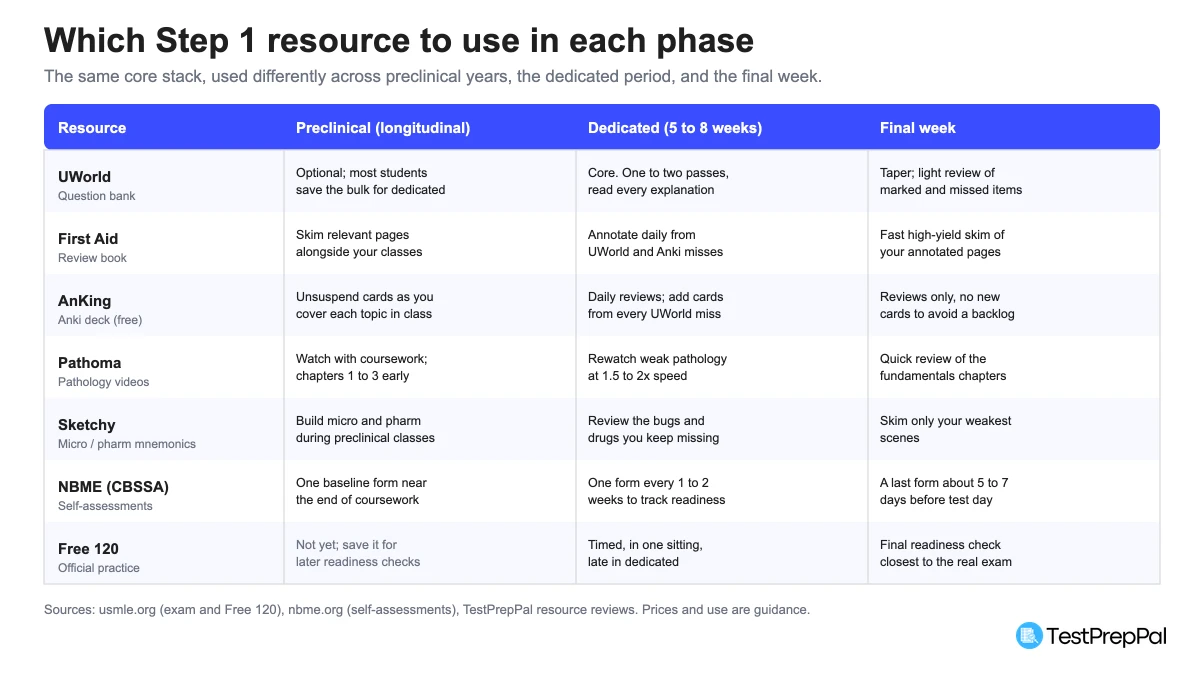 How each Step 1 resource earns its place in each phase. Sources: usmle.org, nbme.org, and TestPrepPal resource reviews.
A few patterns are worth calling out. UWorld does its heavy work in dedicated, not preclinical, so many students save the bulk of the bank for then. AnKing runs the entire way through but shifts to reviews-only in the final week so you do not build a backlog. NBME self-assessments start as a single baseline near the end of coursework, become a weekly readiness check in dedicated, and finish with one last form about 5 to 7 days out. If your budget is tight, note that a real amount of this stack is free: our roundup of free USMLE Step 1 resources shows how far AnKing, the Free 120, and a few free video channels can take you. If you would rather have the whole stack assembled for you, compare the best USMLE Step 1 prep courses instead of building it piece by piece.
How to adjust the plan to your timeline
There is no single correct length, so match the dedicated window to your baseline and your calendar.
- 8 weeks suits most students who want room for two UWorld passes and several NBME checks without rushing.
- 6 weeks is the common middle: one thorough pass, a partial second pass on misses, and weekly readiness checks.
- 5 weeks works if you enter dedicated with strong preclinical retention and a high baseline NBME. It leaves little slack, so protect your study days.
Two signals should override the calendar. If your NBME forms are trending well above the passing standard and holding, you can test on the earlier end. If they are flat or below the standard, buying another week or two of dedicated is almost always a better decision than testing on schedule and hoping.
Common Step 1 study plan mistakes
- Starting Anki too late. The deck is enormous. Begin it in preclinical, or you will drown in reviews during dedicated.
- Rushing UWorld to boost your percentage. The percentage is not the point; the explanations are. Slow down and read them.
- Skipping timed practice until the end. Step 1 is a stamina test. Do timed, random blocks well before the final weeks.
- Practicing in blocks the exam no longer uses. Since May 2026 the unit is 30 minutes and 20 questions. Practise in that unit.
- Ignoring your NBME data. The self-assessments exist to tell you the truth. Reallocate your time toward what they flag, not toward your favorite subjects.
- Cramming new content in the final week. Late gains come from review, rest, and pacing, not from a new resource.
Frequently asked questions
How long should a USMLE Step 1 study plan be?
Most students use a 5 to 8 week dedicated period on top of longitudinal preclinical study. Six weeks is a common middle ground that allows one full UWorld pass, a partial second pass on your misses, and an NBME self-assessment every 1 to 2 weeks. If your coursework was not built around the Step 1 content outline, add a content phase of 4 to 6 months in front of that dedicated block.
Can I study for Step 1 while classes are still running?
Yes, and for most students it is the plan rather than an exception. Keep it to about 60 to 90 minutes on a class day, follow whatever system your course is covering rather than a separate syllabus, do your AnKing reviews every single day, and use one weekend morning for a timed 20-question block. This does not replace a dedicated period. It makes the dedicated period much shorter and much calmer.
What resources do I actually need for Step 1?
The core stack is small: a question bank (UWorld), a review book (First Aid), a spaced-repetition deck (AnKing), pathology videos (Pathoma), micro and pharm mnemonics (Sketchy), and official practice (NBME self-assessments and the Free 120). Boards & Beyond is a strong optional video spine during preclinical years.
When should I take NBME self-assessments?
Take one baseline form near the end of your coursework, then one every 1 to 2 weeks during dedicated to track your trend, and a final form about 5 to 7 days before test day. Over a longer 3 to 6 month plan, spread the seven available forms out instead: one baseline, one mid-content, one at the start of dedicated, then the weekly cadence. The self-assessment reports an estimated probability of passing Step 1, so it is the most direct readiness signal available.
What should I do in the last three days before Step 1?
Nothing new. Review your own annotations and your error log, do a light set of questions to stay warm rather than a full day of blocks, and keep your Anki to reviews only. Sort the logistics early: test center route, identification, and what you will eat during the 55 minutes of break time. Most students take the day before the exam off entirely, and the evidence from their own NBME trend, not a last-minute cram, is what decides the outcome.
How many times should I do UWorld?
Aim for one thorough pass, with a second pass focused on your incorrects and weakest systems if time allows. Doing the whole bank twice with shallow review is worse than doing it once and reading every explanation carefully. Convert misses into Anki cards so the review compounds.
Can I pass Step 1 without spending a lot?
Partly. A meaningful share of the best Step 1 tools are free, including the AnKing deck and the official Free 120. Most students still add at least one paid question bank because nothing free matches UWorld's volume and explanations. See our guide to free USMLE Step 1 resources for how to build the free foundation first.
Does Step 1 being pass/fail change how I should study?
Not the daily work, but the target. Since Step 1 is pass/fail only, you are aiming for a comfortable pass rather than a maximized number, then shifting effort to the still-scored Step 2 CK. USMLE puts the typical bar at roughly 60 percent of questions correct, which is a useful thing to measure your practice against. Do not treat pass/fail as a reason to under-prepare; first-time pass rates fell after the change.
We may earn commissions from some links on this page, but this does not affect our reviews or your experience.