

USMLE Step 1 prep has a reputation for being expensive, and the big question banks are not cheap.
But some of the most-used resources for the exam are completely free, and a few of them are ones that top scorers rely on just as heavily as the paid tools.
Below we have compiled the best free USMLE Step 1 resources, what each one is genuinely good for, and how to combine them into a real study plan without spending a cent up front.
Here are the main takeaways:
-
USMLE Free 120 (NBME): Best for the most exam-representative practice you can get, straight from the people who write Step 1.
-
AnKing Step Deck: Best for long-term memorization through spaced repetition, mapped to First Aid, Pathoma, and Sketchy.
-
Divine Intervention Podcast: Best for passive high-yield review on commutes, plus the famous "night before the exam" rapid-review episodes.
-
Dirty Medicine: Best for biostatistics, ethics, and quality, the low-yield-feeling topics that quietly decide scores.
-
Mehlman Medical: Best for pathophysiology reasoning through free high-yield PDFs and self-assessments.
-
Osmosis: Best for visual concept videos when a topic will not click from text alone.
-
r/step1: Best for honest, unsponsored strategy and community score reports.
Free USMLE Step 1 Resources Summary Table
| Resource | Cost | Type | What You Get |
|---|---|---|---|
| USMLE Free 120 (NBME) | Free | Official practice | ~120 real-style sample questions (PDF + interactive) |
| AnKing Step Deck | Free (Anki) | Flashcards | 30,000+ crowd-maintained cards |
| Divine Intervention | Free | Podcast + video | Hundreds of high-yield episodes |
| Dirty Medicine | Free | YouTube | Biostats, ethics, quality, and pharm videos |
| Mehlman Medical | Free | High-yield PDFs | Free documents + self-assessments |
| Osmosis | Free videos | Video library | Large free YouTube collection |
| r/step1 | Free | Community | Guides, score reports, resource threads |
Free USMLE Step 1 Resources In 2026
1. USMLE Free 120 (Official Sample Questions)
The USMLE Free 120 is the official set of Step 1 sample questions published on USMLE.org by the same program that builds the real exam. The booklet was updated in April 2026 and holds 119 items in six blocks; the interactive version adds a 120th item with audio findings. Our full review of the NBME Free 120 covers the current release, the official timing, and which of the two interactive links to use.
What you get:
a) 119 official sample questions in the booklet, 120 in the interactive version: Written by USMLE test constructors, in both a downloadable PDF and an interactive format that runs in the real exam software.
b) A true readiness check: Most students do the Free 120 timed, in one sitting, in the back half of dedicated study, and treat the result as a key signal alongside their NBME self-assessments.
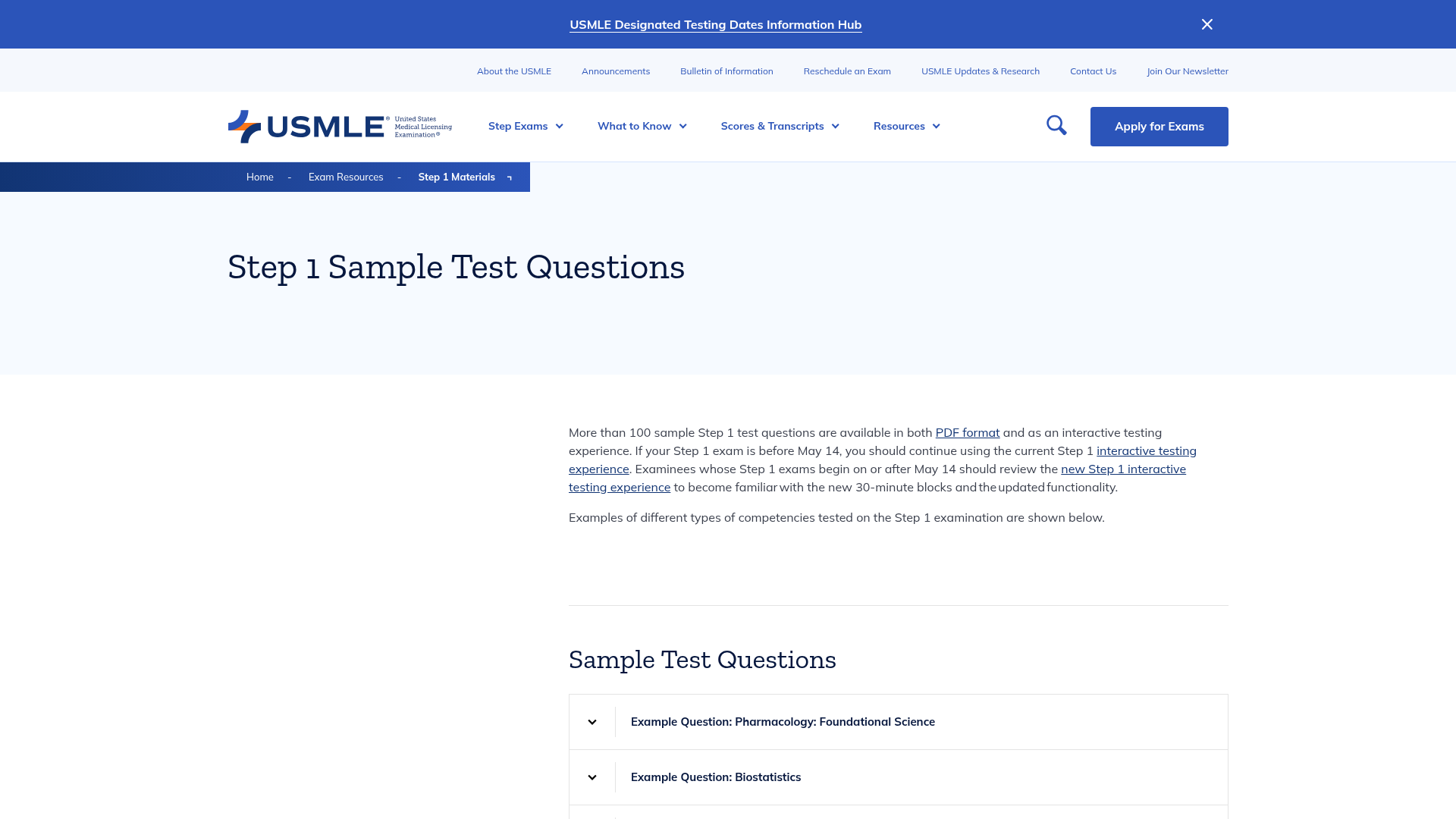 The official USMLE Step 1 sample-questions page. Source: usmle.org (captured July 2026).
The Free 120 is the closest thing to the real exam that you can get for free, so every candidate should use it, at the start to learn the format and near the end to gauge readiness.
What Is The USMLE Free 120 Best Suited For?
Best for a timed, exam-representative readiness check late in dedicated study, and for learning the real Step 1 question style early on.
PROS
- Official items written by the people who make Step 1.
- Free in both PDF and interactive formats.
- The single most representative free practice available.
- Widely used as a readiness benchmark.
CONS
- Only ~120 questions, so it is not enough to study from.
- No official explanations (community walkthroughs fill the gap).
2. AnKing Step Deck
The AnKing Step Deck is the definitive community Anki deck for Step 1. It is free to download, and it is how a huge share of high scorers keep the mountain of Step 1 facts from slipping away.
What you get:
a) 30,000+ crowd-maintained cards: Continuously refined and cross-tagged to First Aid, Pathoma, Sketchy, and Boards & Beyond, so you can review exactly the cards that match what you just studied.
b) Spaced repetition: Anki schedules each card right before you would forget it, which is the most efficient way to retain the discrete factual recall Step 1 demands.
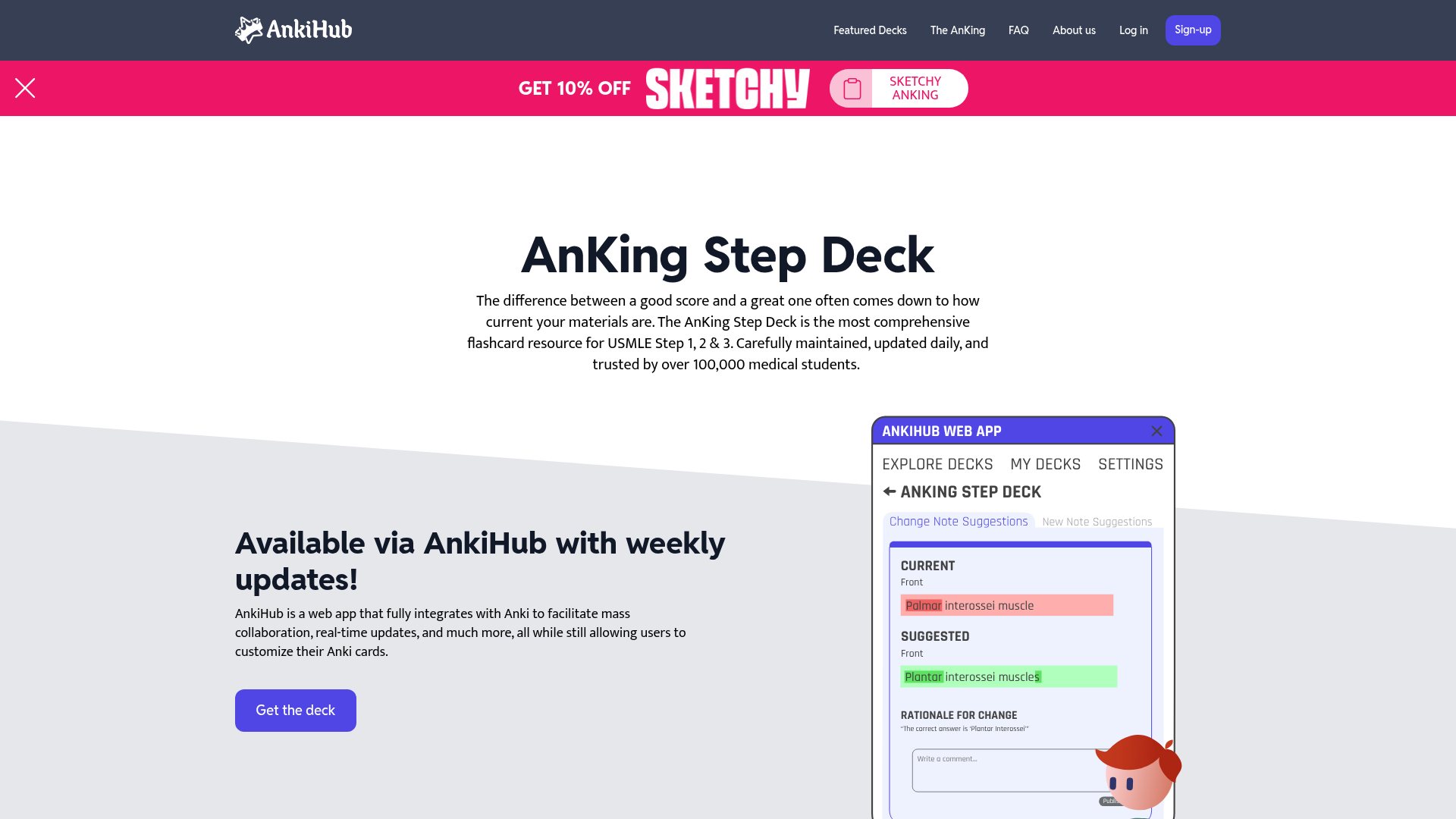 The AnKing Step Deck. Source: ankihub.net (captured July 2026).
The AnKing deck is the retention layer under the entire study plan. The deck itself is free; the only potential cost is AnkiMobile on iOS, since Anki on desktop and Android is free.
What Is The AnKing Step Deck Best Suited For?
Best for long-term memorization through spaced repetition, especially for students who start early and review daily.
PROS
- Free, 30,000+ cards, continuously updated.
- Mapped to First Aid, Pathoma, and Sketchy.
- The de facto standard for Step 1 spaced repetition.
CONS
- Enormous, so it must be started early and reviewed daily.
- Steep learning curve if you are new to Anki.
3. Divine Intervention Podcast
The Divine Intervention podcast is a free, long-running series of high-yield USMLE review episodes. Students play it on commutes, at the gym, and, famously, the night before the exam.
What you get:
a) Hundreds of free episodes: Covering pathology, physiology, pharmacology, biostatistics, ethics, and more, with many also posted on YouTube.
b) Rapid-review episodes: The "high-yield for the night before" and rapid-review episodes are near-mandatory folklore on r/step1.
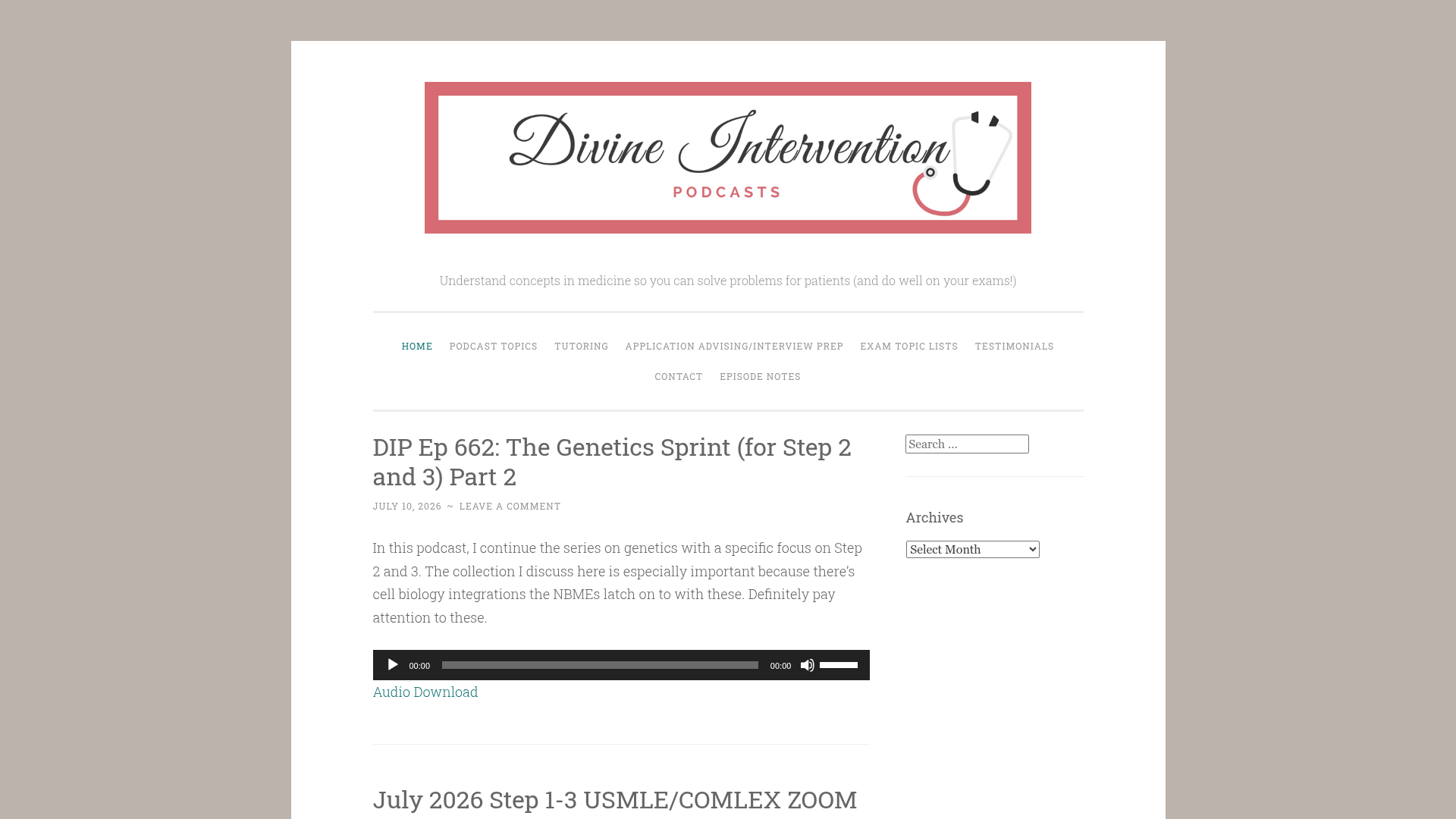 The Divine Intervention podcast site. Source: divineinterventionpodcasts.com (captured July 2026).
Divine Intervention turns dead time into high-yield review, which compounds over a long study period. Use a community-curated episode list rather than starting at episode one.
What Is Divine Intervention Best Suited For?
Best for passive, high-yield review of weak topics, and for calming pre-exam nerves with the rapid-review episodes.
PROS
- Completely free, hundreds of episodes.
- Perfect for review while doing something else.
- Strong on ethics and biostatistics.
CONS
- Audio-first, with no visuals or question bank.
- The huge catalog needs a curated episode list.
4. Dirty Medicine
Dirty Medicine is a free YouTube channel that distills the messy, high-yield topics into clear frameworks. Its biostatistics and ethics videos in particular are a rite of passage for Step 1 students.
What you get:
a) Fast, high-yield videos: Especially strong on biostatistics, ethics, patient safety, and quality improvement, the topics a question bank struggles to teach.
b) Clear mnemonics: Simplified frameworks that make notoriously frustrating material stick.
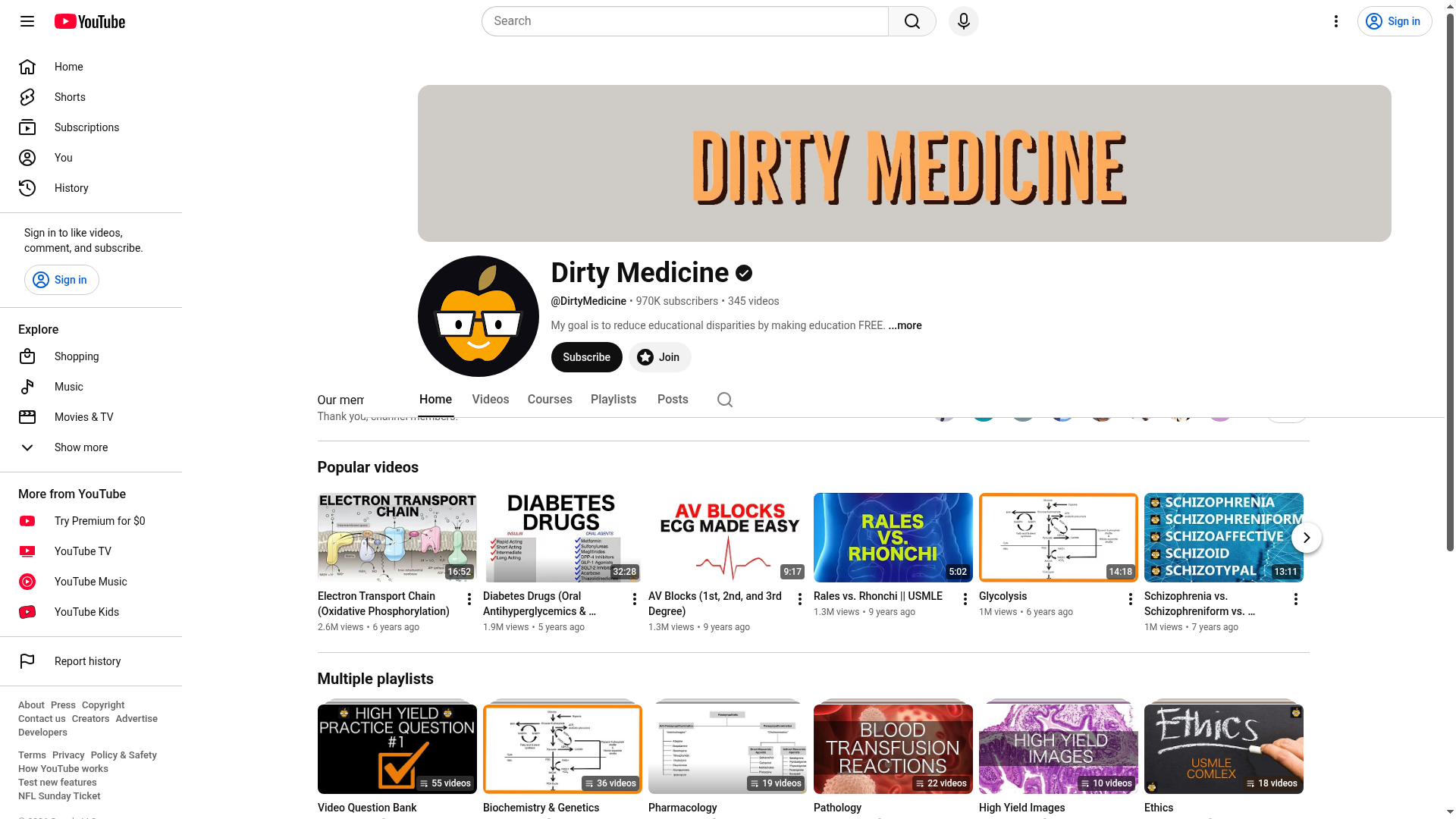 The Dirty Medicine YouTube channel. Source: youtube.com/@DirtyMedicine (captured July 2026).
Dirty Medicine is the free fix for the exact topics that quietly cost points. Use it to shore up biostats and ethics, then reinforce with practice questions.
What Is Dirty Medicine Best Suited For?
Best for biostatistics, ethics, and quality, plus quick pharmacology refreshers.
PROS
- Free, efficient, high-yield videos.
- Excellent for biostats and ethics.
- Short enough to fit between study blocks.
CONS
- Not a complete Step 1 curriculum.
- No integrated question bank.
5. Mehlman Medical
Mehlman Medical gives away 29 high-yield PDF documents, 6 self-assessments and 107 pre-recorded lectures, none of them behind a login. The material is plain and text-heavy, but it targets exactly the reasoning patterns NBME loves to test. Our review of the Mehlman free PDFs lists every document by name, says where each one downloads from, and covers what the paid products cost.
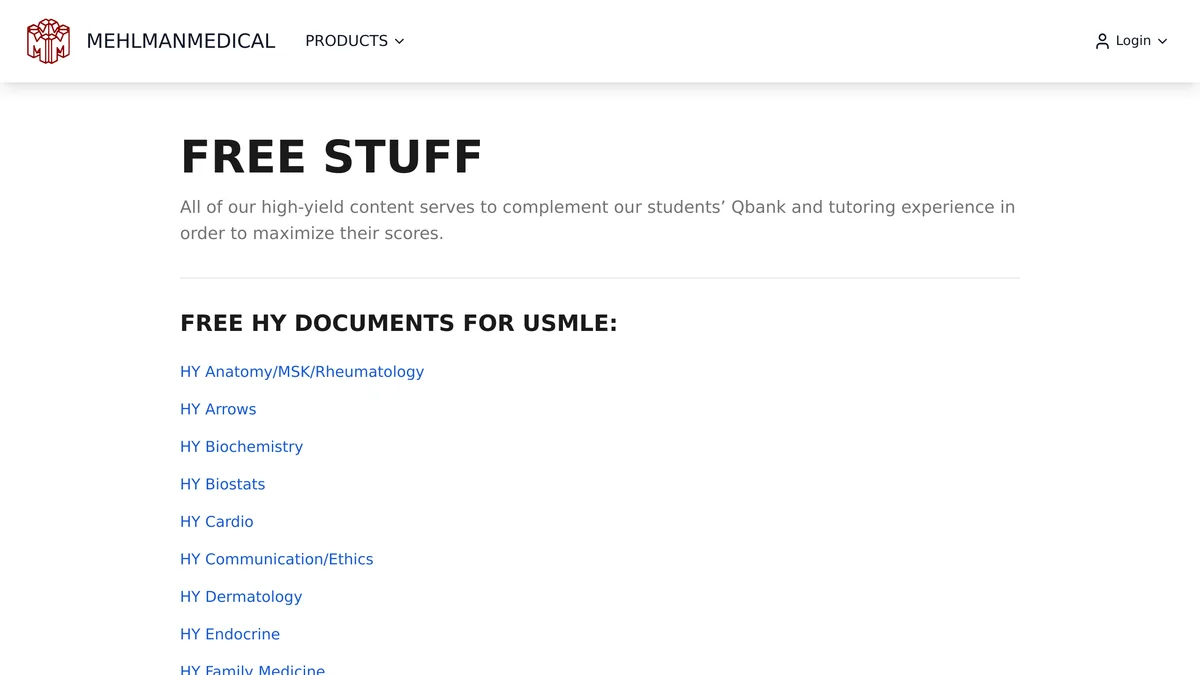 The free-stuff portal at freestuff.mehlmanmedical.com. Source: mehlmanmedical.com (captured October 2026).
Mehlman Medical is a free hidden gem for concept-level understanding, especially pathophysiology. Use the PDFs to fix weak concepts a question bank keeps exposing.
What Is Mehlman Medical Best Suited For?
Best for fixing pathophysiology reasoning through dense, no-frills high-yield notes.
PROS
- 29 free high-yield PDFs covering foundations, organ systems and clinical subjects.
- The "arrows" document is genuinely excellent.
- 6 free self-assessments included.
CONS
- Plain, text-heavy PDFs with no polished platform.
- Best as targeted review, not a full curriculum.
6. Osmosis
Osmosis is known for clear animated concept videos, and a large chunk of its library is free on YouTube. It is the resource to reach for when a mechanism will not click from a wall of text.
What you get:
a) Free animated videos: Search a topic on the Osmosis YouTube channel and you will usually find a clean animated explainer, ideal for visual learners.
b) A free trial of the full platform: Osmosis Prime adds flashcards, questions, and study tools, but the videos alone deliver a lot of value for free.
 The Osmosis homepage. Source: osmosis.org (captured July 2026).
Osmosis is a strong free video backup for tough concepts. For Step 1 specifically, most students use Pathoma and Boards & Beyond as their primary videos and keep Osmosis as a supplement.
What Is Osmosis Best Suited For?
Best for visual learners who want free animated explanations of concepts that will not click.
PROS
- Excellent animated explanations.
- Large free YouTube library.
- Good for visual learners.
CONS
- The full platform (Prime) is paid.
- Less exam-specific than Pathoma or Boards & Beyond.
7. r/step1 (Reddit)
r/step1 is the largest free Step 1 community. When students want honest, unsponsored advice on what to study and what to buy, this is where they go.
What you get:
a) Resource and strategy threads: Recurring "Ultimate Step 1 Guide" posts collect the community's best advice in one place.
b) Score reports: Members post their NBME and Free 120 percentages next to their real outcome, which helps you calibrate your own readiness.
 The r/step1 subreddit. Source: reddit.com/r/step1 (captured July 2026).
r/step1 is one of the most useful free tools for deciding how to study and which resources to trust. Treat it as crowdsourced strategy, verify specifics, and set a time limit so it does not become procrastination.
What Is r/step1 Best Suited For?
Best for unsponsored resource comparisons and real readiness data from other test-takers.
PROS
- Thousands of real test-takers.
- Honest, unsponsored resource comparisons.
- Score reports help you calibrate readiness.
CONS
- Advice is anecdotal, so verify the specifics.
- Easy to fall into anxiety-driven scrolling.
How To Combine Free USMLE Step 1 Resources
No single free tool covers everything. The winning move is to layer them so you build content understanding, active recall, and realistic practice together.
Build Content Understanding
- Osmosis and Dirty Medicine: Use the free videos to learn or relearn concepts, especially biostatistics, ethics, and any mechanism that will not click.
- Mehlman Medical PDFs: Fix pathophysiology reasoning and the "arrows" that NBME questions constantly test.
Lock In Retention
- AnKing Step Deck: Do your daily reviews without fail, unsuspending cards as you cover each topic. This is the single most important free habit for Step 1.
Reinforce Passively
- Divine Intervention: Fill commutes and downtime with high-yield episodes on your weak areas.
Check Readiness
- Mehlman self-assessments early to find gaps, then the USMLE Free 120 timed near your test date as the closest thing to the real exam.
- Read your practice percentages against the current USMLE Step 1 pass rates so you know where a realistic bar sits.
Get Strategy Right
- r/step1: Use it to decide what to prioritize and which paid tools, if any, are worth adding, then close the tab and study.
New to the exam? Start with what the USMLE Step 1 is, then map these free resources onto a week-by-week study plan.
If you do decide to add a paid question bank, our full USMLE resource directory reviews the main options against a documented methodology. Free content builds your foundation; a thorough question bank is what most students add on top. Students who want video lectures and questions in one place usually end up on a USMLE prep course rather than assembling five free tools.
FAQs About Free USMLE Step 1 Resources
Can you pass USMLE Step 1 with only free resources?
It is possible, but most students pair free tools with at least one paid question bank. The free stack (AnKing, Divine Intervention, Dirty Medicine, Mehlman, Osmosis, and the Free 120) covers content and retention well. What free resources lack is the large, exam-representative practice volume that a paid bank provides.
What is the best free USMLE Step 1 practice?
The official USMLE Free 120 is the most exam-representative free practice, because it comes straight from the test makers. Do it timed, late in your prep, as a readiness check. Mehlman Medical's free self-assessments are a useful supplement.
Is the AnKing deck really free?
Yes. The AnKing Step Deck is free to download, and Anki is free on desktop and Android. The only potential cost is the AnkiMobile app on iPhone or iPad.
Which free resource is best for biostatistics and ethics?
Dirty Medicine. Its biostatistics and ethics videos are the fastest free way to lock down those topics, which are worth more points than most students expect.
How should I combine free USMLE resources without getting overwhelmed?
Follow a sequence: learn concepts with Osmosis, Dirty Medicine, and Mehlman; retain them with the AnKing deck; reinforce passively with Divine Intervention; then check readiness with self-assessments and the Free 120. Keep a simple weekly schedule so the tools support each other instead of competing for your time.
We may earn commissions from some links on this page, but this does not affect our reviews or your experience.