


The USMLE Step 1 is the first of the three United States Medical Licensing Examination exams, and it is a one-day, pass/fail test of the sciences basic to medicine. Every Step 1 taken on or after May 14, 2026 is up to 280 multiple-choice questions, split into fourteen 30-minute blocks, inside one eight-hour testing session, per the official Step 1 page at usmle.org.
Nearly every US medical student has to pass it to move on to clinical training, and international graduates take it as part of qualifying for US residency. This guide gives you the full specification first, then what Step 1 tests, how it is scored, who is eligible, what it costs, and where it sits in the licensing path.
- The format is up to 280 questions in fourteen 30-minute blocks, no more than 20 questions per block, inside an eight-hour testing session.
- Every scored item is multiple choice. There is no essay, no oral component, and no clinical skills station.
- Scoring is pass/fail only since January 26, 2022. The passing standard is 196 on the retired three-digit scale, and you never see it.
- 2025 first-time pass rates: 93% US MD, 89% US DO, 75% from non-US schools. All three are back at their 2022 level.
- The 2026 and 2027 fee is $695, plus a $210 region fee outside the US and Canada.
USMLE Step 1 format at a glance
| Specification | Step 1 as administered now |
|---|---|
| Total questions | Up to 280, all multiple choice |
| Blocks | 14 blocks of 30 minutes |
| Questions per block | No more than 20, and the count can vary by form |
| Testing session | One 8-hour day |
| Minimum break time | 55 minutes |
| Optional tutorial | 5 minutes |
| Result reported | Pass or fail only |
| Passing standard | 196 on the retired three-digit scale |
| 2026 and 2027 fee | $695, plus $210 outside the US and Canada |
| Delivered at | Prometric test centers |
Every figure in that table was re-checked against the official USMLE Step 1 overview and application pages in October 2026.
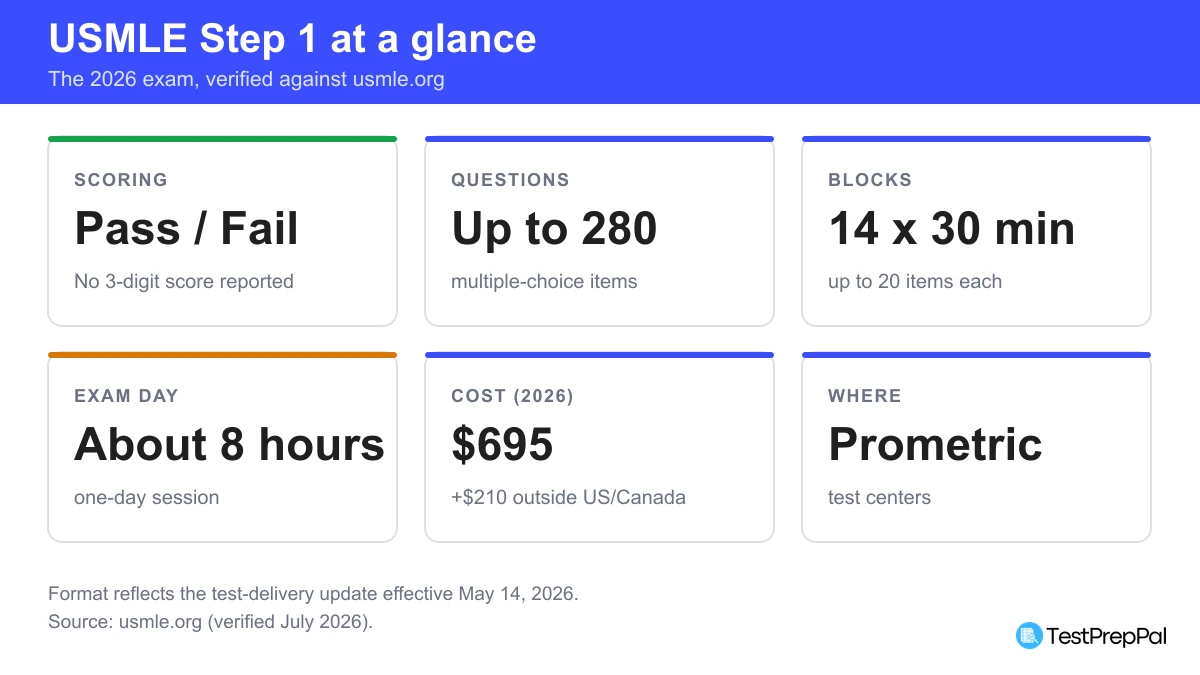 USMLE Step 1 at a glance, current for the 2026 and 2027 cycle. Source: usmle.org.
What is the USMLE Step 1?
Step 1 is the first exam in the sequence US physicians must pass to become licensed. It checks whether you understand and can apply the sciences basic to the practice of medicine, with emphasis on the principles and mechanisms behind health, disease, and treatment. It is co-sponsored by the National Board of Medical Examiners (NBME) and the Federation of State Medical Boards (FSMB), and delivered at Prometric test centers. It is the exam students mean when they say "boards," and for years it carried enormous weight in residency selection. That changed when it went pass/fail.
Is the USMLE the same as Step 1?
No. The USMLE is the three-exam sequence, and Step 1 is the first of the three. The other two are Step 2 CK, taken during or after clinical clerkships, and Step 3, usually taken in the first year of residency. People say "the USMLE" when they mean whichever Step they are sitting next, which is why the two names get used interchangeably. If someone tells you they are studying for the USMLE as a second-year medical student, they mean Step 1.
How many questions are on USMLE Step 1?
Step 1 has up to 280 multiple-choice questions, and no form will exceed that number. Those questions are split into 14 blocks of 30 minutes, with no more than 20 questions per block. The per-block count can vary between forms, so two people sitting on the same day may not get an identical split.
Every scored item is a multiple-choice question, most of them built as a clinical vignette with a single best answer. There is no essay section, no oral exam, and no separate clinical skills component, since Step 2 CS was discontinued in 2021.
That structural change is the biggest recent format shift, and many third-party articles still quote the old seven-block layout. The content and the length are the same; only the block sizing moved.
How long is the USMLE Step 1 exam?
Step 1 is one eight-hour testing session on a single day. That eight hours is the whole appointment, not just the questions: 14 blocks of 30 minutes comes to seven hours of testing time, and the rest is a minimum of 55 minutes of break time plus a 5-minute optional tutorial.
Break time is a bank, not a schedule. Finishing a block or the tutorial before its time expires rolls the unused minutes into your break allowance, so working efficiently early buys you more rest later. Skipping the tutorial entirely adds those five minutes to the bank.
One rule catches people off guard: once you close a block, you cannot reopen it. You can flag and review items inside the block you are on, but previous blocks are locked. With 30-minute blocks that is a tighter loop than the old format, so the per-question pacing matters more than it used to. At 20 questions in 30 minutes you have 90 seconds per item, which is the number worth rehearsing against in your Step 1 study plan.
What does USMLE Step 1 test?
Step 1 organizes its content around organ systems, physician tasks, and academic disciplines. You are not tested on trivia in isolation; you are tested on foundational science in the context of disease. The majority of questions require you to interpret graphs and tables, identify normal and abnormal specimens, and solve problems using basic science principles, per the official content outline and specifications.
Here is the complete official system weighting, all eleven categories. Most guides publish only the top five or six.
| Content area (system) | Share of exam |
|---|---|
| Reproductive & Endocrine Systems | 12 to 16% |
| Respiratory & Renal/Urinary Systems | 11 to 15% |
| Behavioral Health & Nervous Systems/Special Senses | 10 to 14% |
| Blood & Lymphoreticular/Immune Systems | 9 to 13% |
| Musculoskeletal, Skin & Subcutaneous Tissue | 8 to 12% |
| Multisystem Processes & Disorders | 8 to 12% |
| Cardiovascular System | 7 to 11% |
| Gastrointestinal System | 6 to 10% |
| Social Sciences: Communication & Interpersonal Skills | 6 to 9% |
| Biostatistics & Epidemiology/Population Health | 4 to 6% |
| Human Development | 1 to 3% |
Foundational science is not a separate section. It is distributed across the organ systems based on the disease process being tested. On top of the systems, each question is tagged to a physician competency: Medical Knowledge, applying foundational science concepts, is 60 to 70% of the exam, followed by Patient Care: Diagnosis at 20 to 25%, Communication and Interpersonal Skills at 6 to 9%, and Practice-based Learning and Improvement at 4 to 6%.
By traditional discipline, Step 1 leans heaviest on pathology (45 to 55%) and physiology (30 to 40%). The third largest slice surprises most students: nutrition, at 15 to 20%, ahead of gross anatomy and embryology, microbiology, and pharmacology, which sit at 10 to 20% each. Behavioral sciences is 10 to 15%, then biochemistry, histology and cell biology, and immunology at 5 to 15%, and genetics at 5 to 10%. Because items are deliberately integrative, one question is often classified under several disciplines at once, which is why these add up to more than 100. The practical takeaway: broad, connected understanding beats narrow fact-cramming.
How is USMLE Step 1 scored?
Step 1 is reported as pass or fail only. There is no three-digit score for exams taken on or after January 26, 2022, per the USMLE scoring page. Behind the scenes the passing standard is 196 on the old scale, your report simply states whether you cleared it, and USMLE has said future reviews of that standard will not be expressed as a three-digit score at all.
Results are typically available within four weeks of your test date, but USMLE asks you to allow at least eight weeks before chasing them, because several things can delay reporting. Plan your residency application dates around eight weeks, not four.
Because there is no number to maximize, residency programs shifted the weight they used to put on Step 1 onto Step 2 CK, which is still scored. Passing Step 1 is now a gate you clear, not a trophy you chase.
That does not make it easy, but the data has turned. First-time pass rates slid for two years after the switch and then recovered: in 2025 they were 93% for US MD students, 89% for US DO students, and 75% for graduates of non-US schools, according to USMLE performance data. All three groups are back at their 2022 levels, and all three are above 2024 (91%, 86% and 73%). One caveat sits on the official tables: Canadian-school examinees counted with the US groups through 2024 and count with the non-US group from 2025. Our data study on USMLE Step 1 pass rates breaks the figures down by group and attempt.
Who takes USMLE Step 1, and who is eligible?
Three groups are eligible to sit Step 1, according to the USMLE eligibility rules:
- US MD students and graduates from a school accredited by the Liaison Committee on Medical Education (LCME).
- US DO students and graduates from a school accredited by the Commission on Osteopathic College Accreditation (COCA).
- International medical graduates (IMGs) enrolled in or graduated from a school listed in the World Directory of Medical Schools as meeting ECFMG eligibility requirements.
You register through a different entity depending on your school. US MD and DO students apply through NBME; students and graduates of schools outside the US apply through FSMB at usmle.fsmb.org. International graduates still need ECFMG Certification to enter residency and to become eligible for Step 3, so for IMGs the certification and the Step exams run in parallel.
Timing varies. US students traditionally take Step 1 after their preclinical or foundational-science years, before or during clinical rotations, and our guide on when to take Step 1 walks through the trade-offs. Attempts are capped: you cannot take the same Step more than three times within a 12-month period, and a fourth attempt must come at least 12 months after your first attempt at that exam and at least six months after your most recent one. If you have attempted a Step four or more times, including incomplete attempts, without passing, you become ineligible for the entire USMLE sequence. That ceiling is a real reason to treat your first sitting as your best shot.
How much does USMLE Step 1 cost in 2026?
The Step 1 application fee is $695 for 2026 and 2027, whether you apply through NBME or FSMB, per the USMLE application page. If you test outside the United States and Canada, add a $210 region fee, which brings the total to $905. Testing in India carries an additional 18% government tax, collected on behalf of the Indian government since December 2024.
That fee only covers registration and delivery. It does not include prep, which is where most of your real spending goes. NBME runs a Fee Assistance program for examinees with demonstrated financial need, which can offset the registration cost. Before you spend on question banks and courses, it is worth mapping the free Step 1 resources first, since several of the tools top scorers rely on cost nothing.
Where does Step 1 fit in the path to medical licensure?
Step 1 is the first of three USMLE exams, and you take them at different stages of training. Step 1 covers foundational science, Step 2 CK covers clinical knowledge, and Step 3 covers the management decisions of an unsupervised physician.
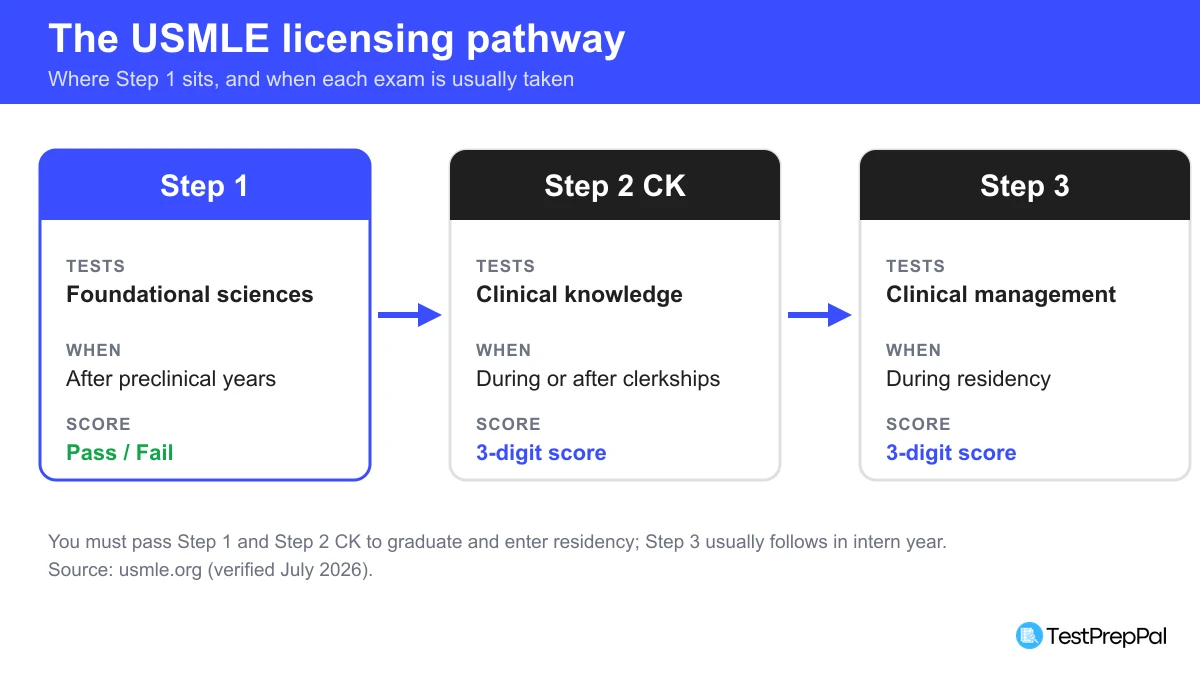 The three-exam USMLE sequence and when each is usually taken. Source: usmle.org.
In practice, a typical US student passes Step 1 after the basic-science phase, takes Step 2 CK during or after core clinical clerkships, and then sits Step 3 during the first year of residency. Step 2 CK and Step 3 remain scored with three-digit results, which is why Step 2 CK now carries the numeric weight Step 1 used to. For international graduates, ECFMG Certification is required before Step 3. Understanding this order matters for planning: Step 1 is the foundation the later exams build on, so the science you lock down here keeps paying off.
How should you prepare for Step 1?
Because Step 1 rewards applied understanding over rote recall, most students build their plan around a large question bank plus a spaced-repetition and review layer. Every pick below is rated against our documented review methodology, not who pays us.
- A thorough question bank. Working UWorld's Step 1 question bank and reading every explanation is the most reliable readiness driver, because it trains the applied reasoning the exam tests.
- A shared outline. First Aid for the USMLE Step 1 is the reference the whole ecosystem maps to; annotate it as you learn.
- Pathology video review. Pathoma is the standard for the pathology that makes up the largest discipline slice of the exam.
- Spaced repetition. The free AnKing Step Deck keeps thousands of facts from slipping.
- Official practice. Timed NBME practice tests and the Free 120 are the closest read on your real readiness, and they are worth timing in 30-minute chunks now that the real exam runs that way.
If you want the full picture of tools across every category, the USMLE resource hub reviews the main options side by side.
Frequently asked questions
How many questions are on USMLE Step 1?
Step 1 has up to 280 multiple-choice questions, delivered in 14 blocks of 30 minutes with no more than 20 questions per block. The number of questions per block can vary by exam form, but the total never exceeds 280 items across the day.
How long is the USMLE Step 1 exam?
Step 1 is a one-day exam with an eight-hour testing session. That covers 14 thirty-minute question blocks, a minimum of 55 minutes of break time, and a 5-minute optional tutorial. Finishing blocks or the tutorial early adds the unused time to your break bank.
Is USMLE Step 1 pass or fail?
Yes. Step 1 has been reported as pass/fail only since January 26, 2022. You do not receive a three-digit score, only a pass or fail outcome. The underlying passing standard is 196 on the retired scale, but that number is not shown on your score report.
Is the USMLE the same as Step 1?
Not quite. The USMLE is a three-exam sequence and Step 1 is the first exam in it, followed by Step 2 CK and Step 3. Students often say "the USMLE" when they mean the Step they are about to sit, which is usually Step 1 in the preclinical years.
How much does USMLE Step 1 cost?
The 2026 and 2027 application fee is $695 through NBME or FSMB. Testing outside the United States and Canada adds a $210 region fee, for a total of $905. That covers registration and delivery only, not prep materials, and testing in India adds an 18% government tax.
What is the Step 1 pass rate?
In 2025, first-time pass rates were 93% for US MD students, 89% for US DO students, and 75% for examinees from non-US schools. Those figures are back at their 2022 levels after dipping in 2023 and 2024. Repeater rates are far lower, at 71% for US MD examinees and 54% for non-US examinees.
We may earn commissions from some links on this page, but this does not affect our reviews or your experience.