


First Aid for the USMLE Step 1 is not a textbook you read. It is a reference outline you annotate. The students who get the most out of it treat the book as the spine of their prep: they learn each concept from UWorld, Pathoma, and Sketchy, then write what made it click onto the matching First Aid page, so that by test day the book has become their personalized master review.
That single reframe, from reading First Aid to annotating into it, is the difference between the book earning its keep and the book collecting dust. Below is the exact annotation and integration system top scorers use, block by block, plus a final-two-weeks rapid-review method and the mistakes that waste the book's potential.
- First Aid is a terse, high-yield reference (864 pages, updated yearly by McGraw Hill), not a course that teaches concepts. Do not read it cover to cover as your first pass.
- Use it as your annotation hub: learn from UWorld, Pathoma, and Sketchy, then write the insight onto the matching First Aid page.
- The whole ecosystem maps to it. AnKing Anki cards are tagged to First Aid sections, and the major video courses follow its order.
- One fact gets one home. Consolidate every source's version of a topic onto its single page so you review once, not five times.
- In the last two weeks, a well-annotated First Aid becomes your single rapid-review document.
What First Aid for the USMLE Step 1 actually is
First Aid for the USMLE Step 1 is a dense, high-yield compendium of the facts most tested on Step 1, refreshed in a new edition every year. The 2026 edition runs 864 pages and is published by McGraw Hill, written by Tao Le, Vikas Bhushan, and a large student and faculty team. McGraw Hill positions it as the most recommended USMLE prep resource available, packing in more than 1,300 high-yield facts, over 1,000 color clinical images, and mnemonics organized by system.
The important word there is "facts." First Aid is a compressed outline, not an explanation. It opens with a General Principles section (biochemistry, immunology, microbiology, pharmacology, pathology) and then marches through the organ systems, which is close to, but not the same as, the Step 1 exam format and its official system weightings. Each page is bullet points, tables, and images that assume you already understand the underlying concept. At around $50 for the current print edition, it is the cheapest and highest-value purchase in the Step 1 stack, which is why our First Aid for the USMLE Step 1 review rates it the organizing spine of the whole plan.
Why reading First Aid cover to cover fails
Reading First Aid front to back as your primary learning tool is the single most common way students waste it. The book is deliberately terse, so a straight read-through means memorizing hundreds of disconnected facts you cannot yet apply. You finish a chapter, remember almost none of it a week later, and confuse "I have seen this" with "I know this."
Step 1 does not test recognition of isolated facts. It tests whether you can reason through a clinical vignette, which means you have to learn the concept somewhere that actually teaches, then use First Aid to consolidate and retrieve it. That is why the book is built to be annotated. Learn the mechanism from a video or a question explanation, then annotate First Aid with the sentence that made it stick. When a topic stays stubborn, the free Mehlman PDFs are a cheap way to get the concept explained before you write anything in the margin. As we put it in our review, you do not study First Aid, you study into it.
The First Aid annotation system
Here is the core idea that makes the book work: every topic gets exactly one home page in First Aid, and you feed annotations into that page from all four of your other resources. Instead of scattered notes across five apps, you build one document where each fact lives in one place. By the end you are not reviewing UWorld, Pathoma, Sketchy, and your own notes separately, you are reviewing one annotated book.
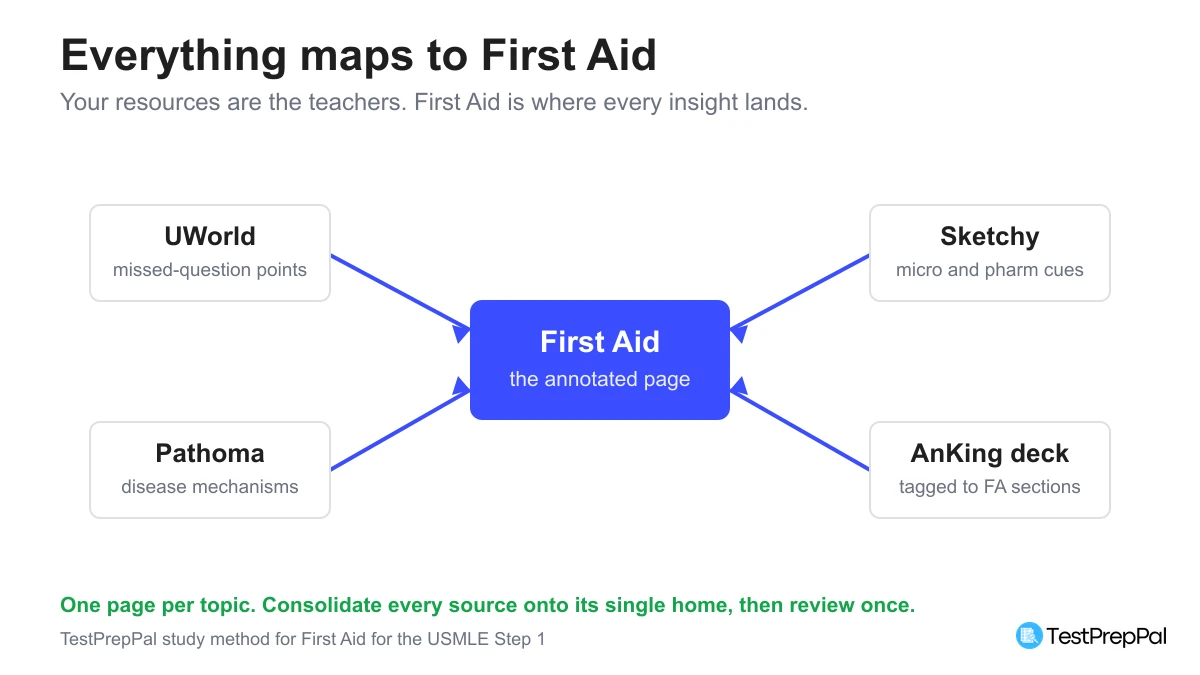 How the Step 1 ecosystem maps onto First Aid. Every resource feeds annotations into one page. Source: TestPrepPal.
Here is what to pull from each source and where it lands:
- UWorld explanations (your highest-yield annotations). After every UWorld block, the teaching points from questions you missed, and the ones you got right for the wrong reason, go straight onto the relevant First Aid page. This is where most of your value comes from, because UWorld explanations are written to teach, and the fact that tripped you up is exactly the fact you need to see again in your final review.
- Pathoma mechanisms. Pathoma is where the "why" of pathology clicks. When Dr. Sattar explains a mechanism First Aid only lists, write the one-line reason next to First Aid's bullet so the fact stops being arbitrary.
- Sketchy cues. Sketchy turns microbiology and pharmacology into visual stories. Jot the association trigger (the symbol that brings back the drug or bug) in the margin so the picture comes back when you see the page.
- Your own recurring misses. Anything that keeps slipping, a lab value, an arrow, a buzzword, gets a bright annotation so your eye lands on it every pass.
Keep the system consistent and legible. A simple approach is one pen color per source, plus sticky tabs on the pages you keep bombing. If you use a digital copy, the equivalent is one highlight color per source and a "weak pages" bookmark list. You will be reading these annotations under pressure in the final weeks, so write less than you think and make it scannable.
The annotation workflow, block by block
The system above is what you build. This is the loop you actually run, every single day of dedicated study. It is the same five steps after every question block.
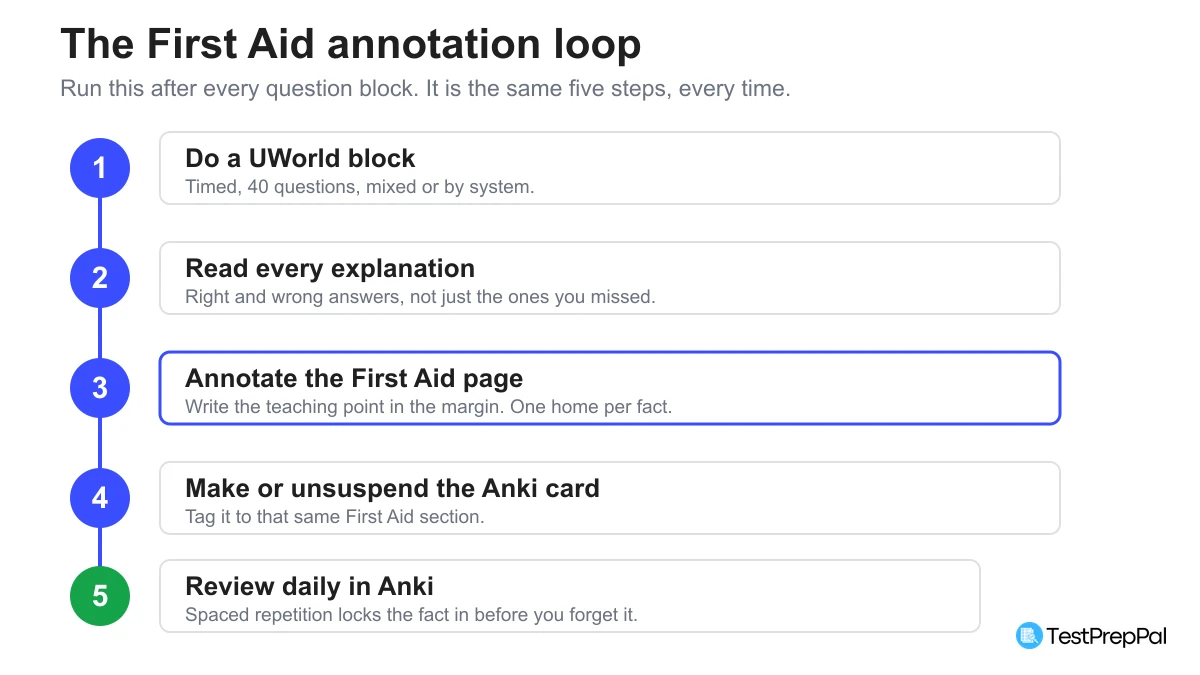 The daily annotation loop, run after every question block. Source: TestPrepPal.
- Do a UWorld block. Timed, 40 questions, mixed or by the system you are studying. Done right, you have a list of items you missed or guessed.
- Read every explanation, not just the ones you missed. Read the whole explanation for right and wrong answers. The wrong-answer explanations are half the teaching. Done right, you can say in one sentence why each answer was correct or incorrect.
- Annotate the matching First Aid page. Find the topic's home page and write the teaching point in the margin. Do not copy the whole explanation, capture only the piece First Aid was missing. Done right, the page now contains the fact that just cost you a question.
- Make or unsuspend the matching Anki card. If the fact is in the AnKing Step Deck, unsuspend the card tagged to that First Aid section. If it is genuinely not covered, make a quick card. Done right, the fact is now scheduled for review.
- Review in Anki daily. Spaced repetition brings the card back right before you would forget it, which is how you hold thousands of facts through a months-long prep. Done right, you never let the daily review queue pile up.
The loop is deliberately boring. Its power is in repetition: run it a few hundred times over dedicated study and your First Aid quietly turns into the most useful document you own.
How First Aid is the spine everything maps to
The reason this system works is that the rest of the Step 1 ecosystem is already built around First Aid, so annotating into it is swimming downstream, not against the current.
The clearest example is the AnKing Step Deck. Its 30,000-plus cards are tagged by First Aid section, alongside tags for Pathoma chapters, Boards and Beyond, and Sketchy. That means when you finish a First Aid page, you can unsuspend exactly the cards mapped to it, and every card you review points back at a page you have annotated. The major video courses follow First Aid's structure too, so a lecture, its cards, and its First Aid page all line up. Owning and annotating the book is what lets every other resource click into place, and it is why our free USMLE Step 1 resource guide describes the AnKing deck as mapped to First Aid, Pathoma, and Sketchy.
Practically, that gives you a clean unit of work: pick a First Aid page, learn it from your video and your questions, annotate it, unsuspend its cards, and move on. The book is the index that keeps a sprawling study plan from turning into chaos. For the order to work through those pages in, and how much First Aid work realistically fits into a day when your classes are still running, see our USMLE Step 1 study plan.
The final two weeks: First Aid rapid review
Everything above pays off in the last stretch. In the final 10 to 14 days before your test date, you stop learning new content and switch to consolidation, and your annotated First Aid becomes the star of that phase.
Do three things in this window. First, read your annotated First Aid cover to cover. This is the one time the cover-to-cover read makes sense, because now it is your book, full of the exact points that caught you out all year. Second, prioritize the tabbed pages, the weak spots you flagged, and hit those twice. Third, keep your Anki reviews going so retention does not slip while you read. First Aid also includes a Rapid Review section and high-yield image sets at the back that are built for exactly this pass, so do not skip them.
If you want a realistic sense of what "ready" looks like before test day, read your practice percentages against the current USMLE Step 1 pass rates, and lean on your NBME self-assessments and the Free 120 for the actual readiness signal. First Aid consolidates what you know; the practice exams tell you whether it is enough.
Common mistakes to avoid
Most First Aid problems come down to a handful of habits. Watch for these:
- Using First Aid as your primary teacher. Reading it first, before videos and questions, is the classic mistake. Learn the concept elsewhere, then annotate.
- Keeping the book pristine. An un-annotated First Aid is a wasted First Aid. If your copy still looks new in month two, the system is not running.
- Over-annotating. Copying entire UWorld explanations into the margins makes the book unreadable and slow to review. Annotate the delta, the piece First Aid was missing, and nothing more.
- Scattering a fact across five pages. Put each fact on its one home page. Five partial notes in five places means you review it five times and trust none of them.
- Buying a heavily outdated used edition to save a few dollars. The content is updated yearly and corrections matter, so use the current edition rather than a copy several years old.
- Skipping the Rapid Review and high-yield image sections. They are built for final review and are some of the highest-yield pages in the book.
- Starting too late. The annotation habit should run alongside UWorld from the very start of dedicated study, ideally earlier during your coursework, not something you attempt to cram in the last month.
Every pick and rating we point you to above comes from our documented review methodology, and you can see the full set of options in the USMLE resource directory.
Frequently asked questions
Should I read First Aid for Step 1 cover to cover?
Not as your first pass. First Aid is a terse reference, so reading it straight through before you understand the concepts means memorizing facts you cannot apply. Learn each topic from videos and questions, annotate it into First Aid, and save the full cover-to-cover read for your final two weeks, when the book is full of your own annotations.
Is First Aid enough to pass Step 1 by itself?
No. First Aid is a reference outline, not a complete study tool. You need a question bank such as UWorld to learn how the concepts are tested and to check your readiness. First Aid is where you consolidate what those questions and your videos teach you, not a standalone course.
Should I use the print or digital version of First Aid?
Either works, and it comes down to how you annotate. Print is easy to write in, tab, and flip through fast, which many students prefer for final review. Digital lets you search, sync across devices, and never run out of margin space. Pick one and commit, because splitting your annotations across both defeats the one-home-per-fact rule.
When should I start using First Aid?
As early as you can, ideally during your coursework and definitely from day one of dedicated study. The whole value is in the annotations you build over months, so the earlier you start feeding UWorld, Pathoma, and Sketchy into it, the more complete your final-review document will be.
Do I need the newest edition of First Aid?
Yes, buy the current edition. First Aid is updated every year with new high-yield content and corrections, and since it costs around $50, saving a few dollars on an old used copy is a poor trade for a book you will annotate all year and rely on at the end.
Is First Aid still worth it now that Step 1 is pass/fail?
Yes. Step 1 has been reported as pass or fail only since January 2022, but you still have to pass a comprehensive exam, and first-time pass rates actually fell after the change. First Aid remains the shared outline the whole ecosystem maps to, so it is as useful for clearing the bar as it ever was for chasing a score.
We may earn commissions from some links on this page, but this does not affect our reviews or your experience.