

Best Free MCAT Diagnostic Tests in 2026

by John Reed· Last Updated: Nov 26, 2026
Take a free AAMC full-length first if you can give up a whole day: the AAMC gives away two 230-question exams, and Practice Exam 1 returns an official scaled score and percentile rank. If you only have a morning, take the free Blueprint half-length diagnostic, the only third-party diagnostic here with a published accuracy figure (a mean 0.3 points from an official AAMC score across 91 students, in Blueprint's own study).
A diagnostic is a baseline, not a study tool. Its job is to show which sections are costing you points before you plan your content review. All four options below cost $0, so the real trade-offs are length, whether you get a trustworthy score, and how much contact information you hand over.
The limit every half-length shares: it cannot measure endurance. The real MCAT runs about 7 hours and 30 minutes of seated time, and only a full-length tells you what your accuracy does in the last section.
Here are the main takeaways:
- AAMC Unscored Sample Test: Best for a full-length rehearsal written by the test makers. 230 questions with rationales for all four answer options, but no scaled score.
- Blueprint diagnostic: Best for a scored baseline in about 3 hours. Blueprint's study of 91 students puts it a mean 0.3 points from an official AAMC score.
- Altius free exam: Best for a stated question count you can retake. 113 questions across all four sections, with five attempts.
- MedSchoolCoach half-length: Best for retaking one test as you study. Unlimited attempts, plus a score report covering timing, AAMC categories and topic mastery.
MCAT diagnostic test summary table
| Resource | Cost | Length | Scoring | Published accuracy | Retakes | Best for |
|---|---|---|---|---|---|---|
| AAMC Unscored Sample Test | Free | 230 questions, about 7 hours 30 minutes seated | No scaled score or percentile. Free Practice Exam 1 adds both | Not applicable: written by the test makers | Resettable, same questions | Full-length rehearsal |
| Blueprint diagnostic | Free inside a 14-day trial, no credit card | Half-length, about 3 hours (Blueprint publishes no time) | Score on the MCAT scale plus section analytics | Mean 0.3 points from an official AAMC score, 91 students (vendor study) | Within the trial window | Scored baseline in a morning |
| Altius free exam | Free, no payment card | Half-length, 113 questions | Not specified for the free exam | None published | 5 attempts | Known length, a few retakes |
| MedSchoolCoach half-length | $0 | Half-length, question count and time not published | Score report with analytics; the sample report shows a total score and percentile | None published | Unlimited | Repeated retakes |
Which MCAT diagnostic test is right for you?
- If you need an official scaled score and can spare a full day, use AAMC Practice Exam 1, covered in our AAMC Unscored Sample Test review.
- If you need a full-length rehearsal without spending your free scored exam, use the AAMC Unscored Sample Test.
- If you need a scored baseline in about 3 hours, use the Blueprint diagnostic.
- If you need to know exactly how many questions you are sitting, use the Altius free exam.
- If you need one test to retake after every content block, use the MedSchoolCoach half-length.
The MCAT diagnostic tests we reviewed
1. AAMC Unscored Sample Test
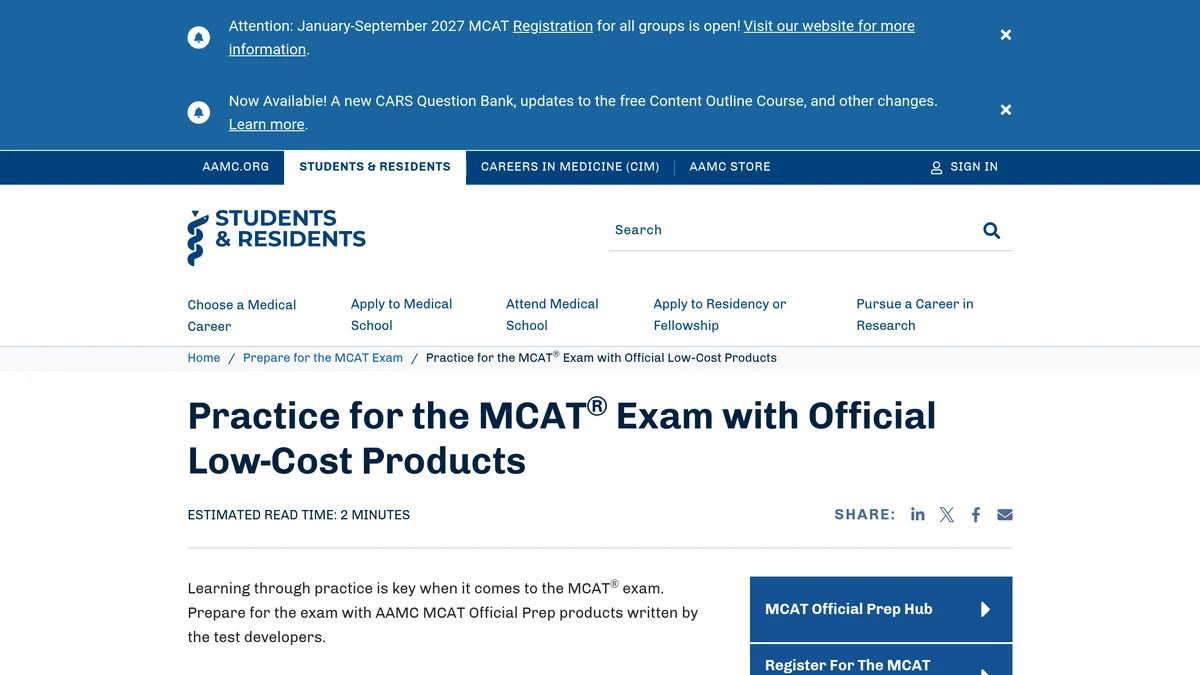
The AAMC Unscored Sample Test is a free, 230-question, full-length MCAT practice exam from the organization that writes the real one, opened through the MCAT Official Prep Hub with a free AAMC account.
What you get:
a) Real exam length and interface: 230 questions across all four sections, with the same look, feel, length and functionality as the actual MCAT.
b) Full explanations: Rationales for all four answer options in every section, links to Khan Academy lessons, and video walkthroughs for four CARS passage sets.
c) Official question style: Some questions come from previously administered MCATs, and the rest are written by the same developers.
d) A free scored sibling: Practice Exam 1, also free and also 230 questions, returns a scaled score and percentile rank. Practice Exams 2 to 6 are $35 each for a one-year subscription.
Best for: Students who want to feel a real full-length before they study, and who want to save Practice Exam 1 to measure progress later.
Limitation: No scaled score and no percentile rank, and the AAMC publishes no conversion for it. It also takes most of a day.
2. Blueprint diagnostic
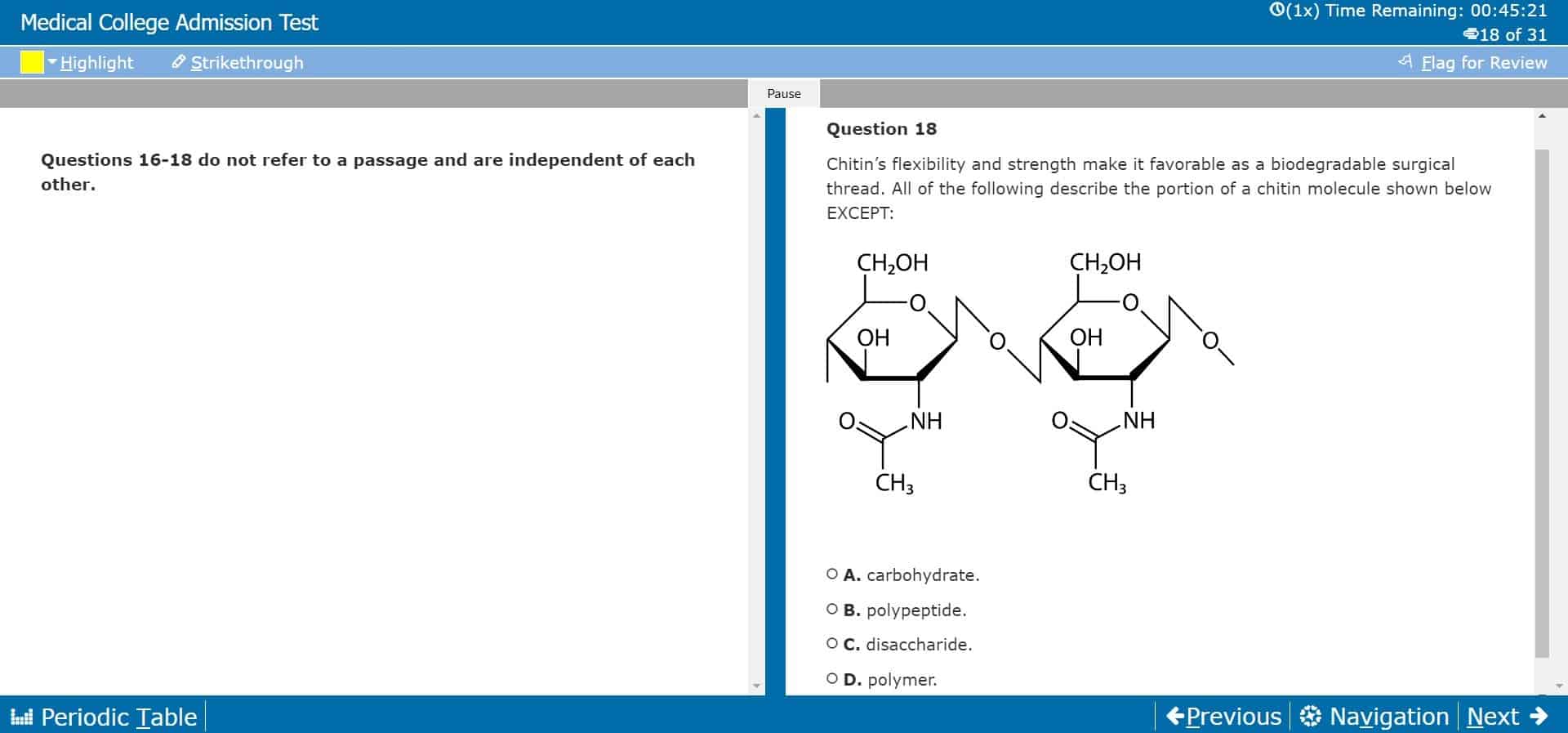
The Blueprint diagnostic is a free half-length MCAT exam that you open through Blueprint's 14-day free trial, which asks for no credit card.
What you get:
a) A score with accuracy data: A score on the MCAT scale plus section-level analytics. Blueprint reports a study of 91 students who had taken an official AAMC exam within 18 months, with a mean difference of 0.3 points.
b) About 3 hours of testing: Blueprint calls it half-length and publishes no time. Half of the real exam's 6 hours and 15 minutes of content time is about 3 hours.
c) The rest of the free trial: A full-length practice exam, 10 learning modules, a study plan and two live office-hours sessions, all inside the same 14 days.
d) Easy access: You can start it through the Blueprint free trial without buying a course.
Best for: Students who want a scored baseline before content review and cannot give up a full day.
Limitation: The accuracy figure is Blueprint's own study on a small sample, not an independent one. Access is limited to the 14-day trial, and a half-length tells you nothing about stamina.
3. Altius free exam
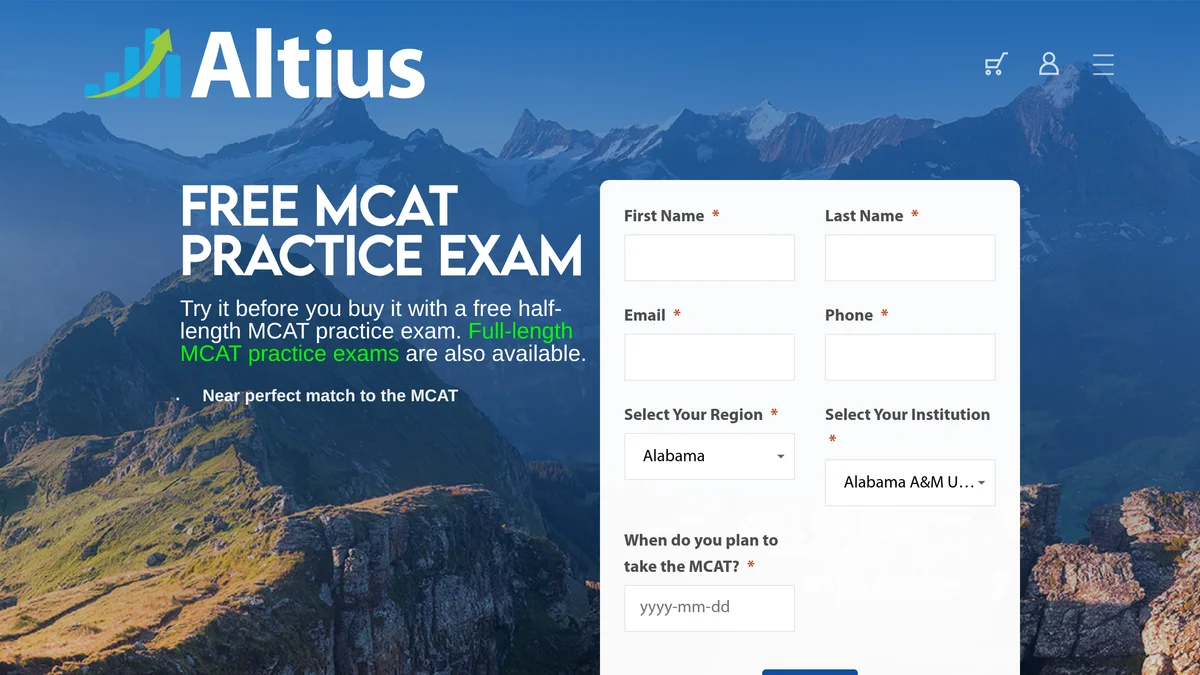
The Altius free exam is a free half-length MCAT test that serves as the entry point to the practice exams Altius sells.
What you get:
a) A stated length: 113 questions drawn from all four sections (CPBS, CARS, BBLS and PSBB). A full-length MCAT is 230, so the free test is 117 questions short.
b) Five attempts: Take it cold in week one, then again after a content block to see whether a weak section is moving.
c) No payment card: Nothing is charged at any point.
d) A preview of the paid line: The same software as the paid full-lengths, which cost $40 for one, $169 for five or $299 for ten, each with one year of access.
Best for: Students who have not taken anything yet and want a broad first look at all four sections, and students weighing the Altius paid exams.
Limitation: Altius does not say how much of its reporting comes with the free exam. The signup form asks for your phone number, school and planned test date, so expect contact.
4. MedSchoolCoach half-length

The MedSchoolCoach half-length is a $0 MCAT practice exam claimed through the MedSchoolCoach store, from a company whose main business is tutoring and admissions consulting.
What you get:
a) Unlimited attempts: The free half-length has no cap, while paid MedSchoolCoach exams get four attempts each.
b) A detailed score report: Analytics on time per question, performance across AAMC categories and topic mastery. The sample report shows a total score, a percentile and bars for all four sections.
c) Explanations for every answer: Correct and incorrect answers are explained, with paragraph summaries for CARS passages.
d) Adjustable timing: Useful if you have approved test-day accommodations. Without them, keep the standard clock on your first attempt.
Best for: Students who want to retake one diagnostic as they study and track the sections they missed.
Limitation: MedSchoolCoach publishes no question count, no running time and no accuracy data. The checkout form asks for your phone number and anticipated MCAT date.
How to use these together
- Week one: Take the Blueprint diagnostic or the AAMC Unscored Sample Test cold, before any content review. Do not stretch the timing.
- Set targets: Turn your section results into goals with our MCAT score calculator, and read our MCAT score range guide to see what each section score means.
- Plan review: Build a schedule around your weakest sections with our MCAT study plan generator, and pull free material from our free MCAT resources page.
- Check progress: Retake the Altius or MedSchoolCoach half-length after a content block. Watch the sections you missed first, since the total will rise partly because you remember questions.
- Measure for real: Sit AAMC Practice Exam 1, then the paid AAMC full-lengths in our AAMC practice exams review. Our guide to how many MCAT practice tests to take covers the spacing, and our MCAT practice test roundup covers third-party options.
Every resource for the exam is on our MCAT hub, and how we rate each product is set out in our review methodology.
MCAT diagnostic test FAQs
What is the best free MCAT diagnostic test?
For an official score, AAMC Practice Exam 1 is free, full-length and returns a scaled score and percentile rank. For a shorter scored baseline, the free Blueprint half-length takes about 3 hours and is the only third-party diagnostic here with a published accuracy figure. The AAMC Unscored Sample Test is the best free rehearsal, but it gives no score.
How accurate are free MCAT diagnostic tests?
Only Blueprint publishes a number: its study of 91 students found a mean difference of 0.3 points from an official AAMC score. That is a vendor study on a small sample. Altius and MedSchoolCoach publish no accuracy data, so treat their scores as direction rather than prediction.
Should my MCAT diagnostic be full-length or half-length?
A half-length takes about 3 hours and is enough to find your weak sections. A full-length takes about 7 hours and 30 minutes seated and is the only way to test endurance. Many students take a half-length first and a free AAMC full-length a few weeks later.
What is a good MCAT diagnostic score?
The diagnostic is a starting point, so the number matters less than the section breakdown. For context, the AAMC's current percentile table puts 500 at the 48th percentile and 501 at the 52nd, with a mean of 500.6. Our guide to how the MCAT is scored explains the scale.
Can I retake a free MCAT diagnostic?
Yes, with limits that vary. MedSchoolCoach allows unlimited attempts, Altius allows five, and the AAMC says its Official Prep products can be reset with the same questions each time. A retake of the same questions is not a fresh measurement, because you will remember passages.
We may earn commissions from some links on this page, but this does not affect our reviews or your experience.


