


AAMC MCAT Unscored Sample Test Review
by AAMC
The official free full-length MCAT diagnostic from the test makers themselves.
✓Pros
- ✓Created by the actual MCAT test developers — the most authentic diagnostic available
- ✓Full 230-question exam that mirrors real MCAT format, length, and interface
- ✓Completely free with just an AAMC account
- ✓Ideal baseline assessment before starting any prep
✗Cons
- ✗Unscored — no scaled score or percentile rank provided
- ✗No answer explanations included
- ✗Can only be taken once (no reset option)
- ✗Requires AAMC account login to access
Highlights
- ✓230 MCAT-style questions across all 4 sections
- ✓Full-length exam format matching the real MCAT
- ✓Authentic MCAT testing interface and features
- ✓Self-assessment opportunity for baseline measurement
Price
✓Free
What Students Are Saying
Sign in to leave a review

Expert Rating
If you're about to start studying for the MCAT, your very first step should be establishing a baseline — and there's no better way to do that than with the AAMC's own Unscored Sample Test. This is the official diagnostic made by the Association of American Medical Colleges, the same organization that develops and administers the actual MCAT exam.
Unlike third-party diagnostics from Blueprint or Kaplan, this test uses real MCAT-style questions written by the actual test developers. That makes it the gold standard for understanding where you stand before you begin your prep journey.
Related free resource:
Blueprint's Free MCAT Diagnostic
Scored, half-length, with full answer explanations.
Free account · No credit card
Summary Table
| Feature | AAMC Unscored Sample Test |
|---|---|
| Price | Free |
| Format | Full-length diagnostic (230 questions) |
| Duration | ~7.5 hours (same as real MCAT) |
| Scored | No — unscored (no scaled score or percentile) |
| Sections | All 4 MCAT sections |
| Answer Explanations | No |
| Access | AAMC account required |
| Best Time to Take | Very beginning of MCAT prep |
| Get it | Take it free at AAMC → |
What Is the AAMC Unscored Sample Test?
The AAMC MCAT Official Prep Unscored Sample Test is a free, full-length practice exam that mirrors the actual MCAT in every way — except it doesn't provide a scaled score or percentile rank. You'll see 230 questions spread across all four sections of the MCAT:
- Chemical and Physical Foundations of Biological Systems (Chem/Phys) — 59 questions
- Critical Analysis and Reasoning Skills (CARS) — 53 questions
- Biological and Biochemical Foundations of Living Systems (Bio/Biochem) — 59 questions
- Psychological, Social, and Biological Foundations of Behavior (Psych/Soc) — 59 questions
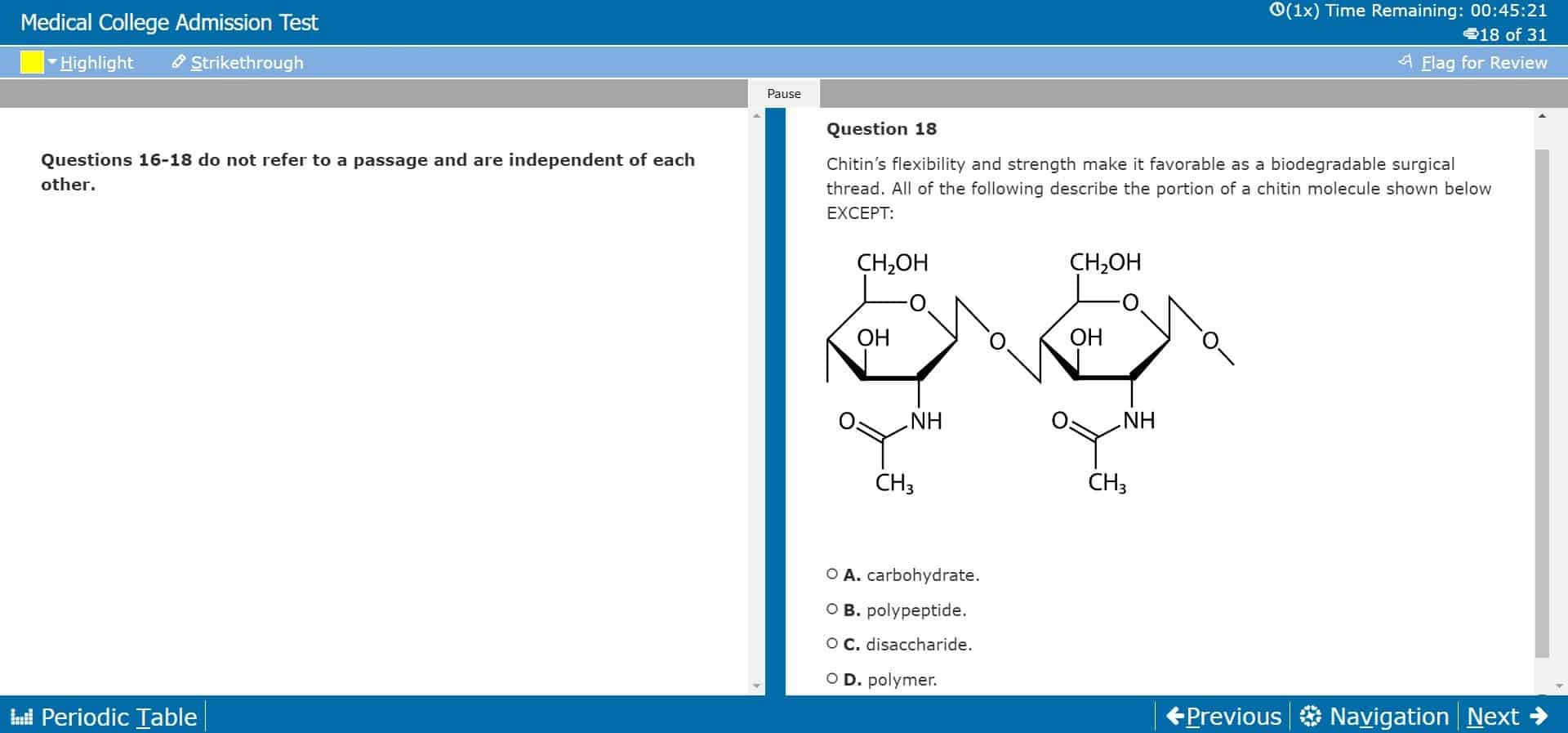
The exam uses the same interface, timing, and format as the real MCAT. You'll experience the same question types (passage-based and discrete), the same section timing, and the same break structure.
AAMC Unscored Sample Test Review For 2026
Why Use It as a Diagnostic?
The primary value of the Unscored Sample Test is as a baseline diagnostic. Even though it doesn't give you a scaled score, you can still calculate your raw percentage correct in each section. This gives you a clear picture of your strengths and weaknesses before you invest time and money in a study plan.
Here's why it works so well as a diagnostic:
- Authentic question style: These aren't approximations of MCAT questions — they're the real deal, written by the same team that creates the actual exam.
- Full-length format: You experience the full 7.5-hour marathon, which helps you understand the stamina demands of the MCAT.
- No score pressure: Since it's unscored, there's zero pressure. You're just gathering data about where you stand.
Many students take this test before even opening a prep book. The results help you decide how many months of prep you need, which subjects require the most attention, and whether you need a structured course or can self-study.
How to Use Your Results
Since the test is unscored, you won't get a 472–528 scaled score. Instead, here's what to do:
- Track your raw performance: Count how many questions you got right in each section and convert to a percentage.
- Identify weak sections: If you're scoring below 60% in Chem/Phys but 80% in Bio/Biochem, you know where to focus.
- Review missed questions: Even without official explanations, go through each wrong answer and figure out why you missed it — was it a content gap, a reasoning error, or a time management issue?
- Set your target: Compare your baseline to your target score to determine how much improvement you need.
How It Compares to Other Diagnostics
| Feature | AAMC Unscored Sample | Blueprint Diagnostic | MedSchoolCoach Diagnostic |
|---|---|---|---|
| Price | Free | Free | Free |
| Length | Full-length (230 questions) | Half-length (~115 questions) | Half-length |
| Scored | No | Yes (estimated score) | Yes (estimated score) |
| Question Source | AAMC (test makers) | Blueprint (third-party) | MedSchoolCoach (third-party) |
| Explanations | No | Yes | Yes |
| Realism | Highest | High | Moderate |
| Get it | Visit AAMC → | Start free → | Visit → |
The biggest trade-off is clear: the AAMC test is the most realistic but doesn't give you a score, while third-party diagnostics score you but use approximated questions. Ideally, take the AAMC Unscored Sample first for the most authentic baseline, then take a scored third-party diagnostic to get a number to work with.
When to Take the AAMC Unscored Sample Test
The ideal time to take this test is at the very beginning of your MCAT prep — before you start any content review or practice. Here's a suggested timeline:
- 3–6 months before your exam date: Take the Unscored Sample Test as your first diagnostic.
- Use results to build your study plan: Allocate more time to weak sections.
- Save scored practice exams for later: The AAMC's scored Practice Exams (1–6) are more valuable when used later in your prep to track progress and predict your actual score.
Who the AAMC Unscored Sample Test Is Best For
- Students just starting their MCAT prep who want the most realistic baseline assessment
- Anyone who wants to experience the full-length MCAT format before committing to a study plan
- Budget-conscious students looking for high-quality free resources
- Students who plan to use the scored AAMC Practice Exams later and want a diagnostic that doesn't "waste" a scored test
When You Might Look Elsewhere
- If you need a scaled score and percentile rank for your diagnostic — consider Blueprint's free diagnostic instead
- If you want detailed answer explanations to learn from your mistakes immediately
- If a 7.5-hour commitment feels too long for an initial diagnostic — half-length diagnostics take about 4 hours
Final Verdict
The AAMC Unscored Sample Test is the most authentic MCAT diagnostic available, period. No third-party test can match the question quality and format of a test made by the actual exam developers. While the lack of a scaled score is a real limitation, the trade-off is worth it for the unmatched realism.
The smart strategy is to take this test first for your baseline, then use scored third-party diagnostics and eventually the AAMC scored Practice Exams to track your progress over time.
Head to the AAMC MCAT Official Prep Hub to access the Unscored Sample Test (free AAMC account required).
AAMC Unscored Sample Test FAQs
How Much Does the AAMC Unscored Sample Test Cost?
The AAMC Unscored Sample Test is completely free. You just need to create a free AAMC account to access it through the MCAT Official Prep Hub.
Is the AAMC Unscored Sample Test Worth It?
Absolutely. It's the most realistic MCAT diagnostic available because it's made by the test developers themselves. Even without a scaled score, the raw performance data and the experience of sitting through a full-length exam are invaluable for starting your prep.
Can I Take the AAMC Unscored Sample Test More Than Once?
The test is designed to be taken once. While you may be able to review your answers after completing it, you generally cannot reset it and take it fresh a second time. Treat it as a one-time diagnostic opportunity.
What's the Difference Between the Unscored Sample Test and Practice Exam 1?
The Unscored Sample Test does not provide a scaled score or percentile rank — it's purely for baseline assessment. Practice Exam 1 (also free) gives you a scaled 472–528 score and percentile rank, making it better for predicting your actual MCAT score. Save Practice Exam 1 for later in your prep when you want a scored check-in.
Should I Take the Unscored Sample Test or a Third-Party Diagnostic First?
Take the AAMC Unscored Sample Test first. Its question quality is unmatched since it comes from the test makers. After that, you can take a scored third-party diagnostic like Blueprint's free diagnostic to get a numerical baseline.
We may earn commissions from some links on this page, but this does not affect our reviews or your experience.
Our Verdict
The AAMC Unscored Sample Test is the single most authentic MCAT diagnostic you can take because it's made by the same people who write the real exam. While it lacks a scaled score and answer explanations, it gives you the most realistic baseline assessment possible — and it's completely free. Every MCAT student should take this before starting their prep.