


The MCAT is scored by counting the questions you answer correctly in each of the four sections, converting each of those raw counts to a scaled score between 118 and 132, adding the four together for a total between 472 and 528, and then attaching a percentile rank. Nothing in that chain is a curve, and one extra correct answer usually moves nothing at all: it takes roughly two to three more right answers in a section to buy a single point, and that point is worth four percentile ranks at a 500 and one at a 515.
- Your raw score is just the number of correct answers. A wrong answer and a blank score identically, so never leave a question empty.
- Each section's raw count is converted to the 118 to 132 scale through equating, which is tailored to the exact test form you sat.
- The total is a plain sum of the four section scores, which is why it runs 472 to 528 with a midpoint of 500.
- The AAMC publishes only two illustrative conversions: 35 to 37 correct might be a 123, and 46 to 48 correct might be a 128. There is no fixed table.
- One total point is worth 4 percentile ranks at 500 but only 1 at 515, so the same study effort buys far less the higher you already are.
- The "average MCAT score" has three official values depending on the group: 500.6 for everyone who tests, 506.3 for applicants, 512.1 for matriculants.
What the MCAT actually scores
You get five numbers, according to the AAMC: one score for each of the four sections, and one combined total. There is no percentage, no letter grade, and no pass mark anywhere on the report.
Each section is scored from a low of 118 to a high of 132, with a midpoint of 125. The total is those four numbers added together, which puts the scale at 472 on the floor and 528 at the ceiling with 500 in the middle. The AAMC's own worked example adds a 128, a 125, a 129 and a 127 to reach a total of 509.
The four sections are not the same length. Chem/Phys, Bio/Biochem and Psych/Soc run 59 questions each and CARS runs 53, for 230 questions across 6 hours and 15 minutes of content time. They still count equally toward the total, which is the first thing most students get wrong about the math. A full breakdown of that structure sits in our guide to the MCAT sections.
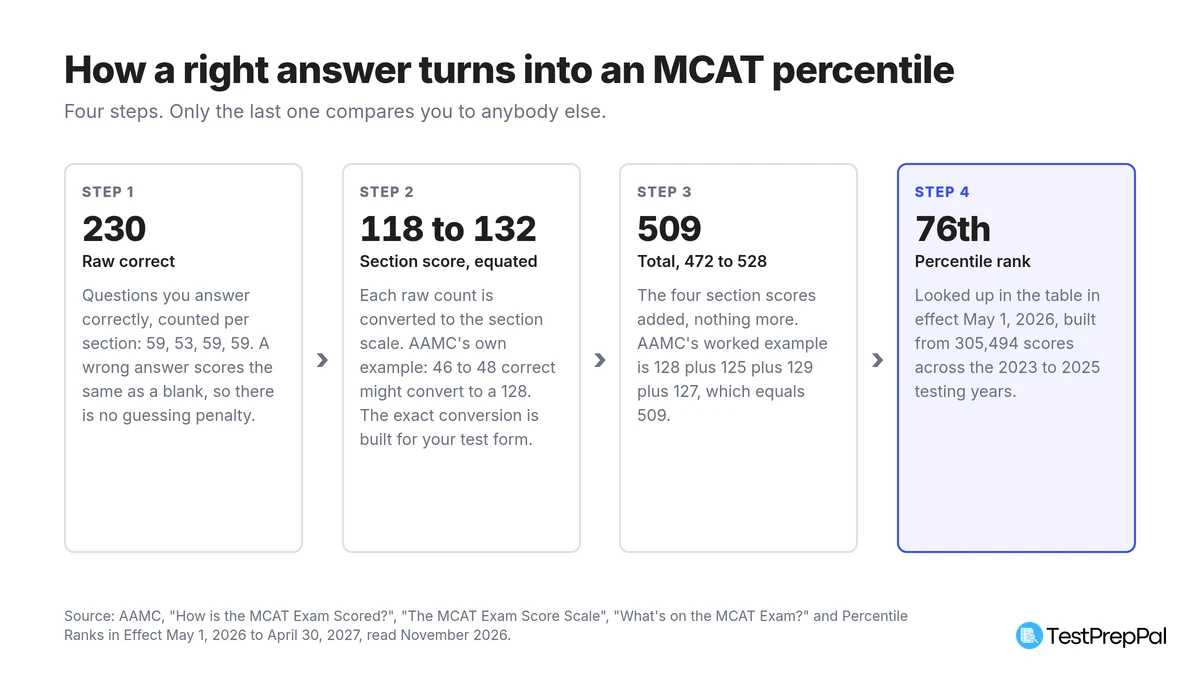 Only the final step compares you to other test takers. The first three are arithmetic on your own answers.
How your raw score becomes a section score
Your raw score for a section is the number of questions you answered correctly in it. The AAMC is explicit that wrong answers are scored exactly the same as unanswered ones, with no additional penalty, so a guess is strictly better than a blank on all 230 questions.
That raw count is then converted to the 118 to 132 scale through a process called equating. The conversion exists because several test forms run in a given year, and one form may come out slightly harder than another. Equating compensates, so the exact conversion is built for the specific set of questions on your form and is not constant from form to form.
This is why no raw-to-scaled table exists, and why every chart promising one is guessing. The AAMC publishes exactly two illustrations, and they are worth memorizing because they are the only official anchors there are:
| AAMC illustration | Share of a 59 question science section | Share of 53 question CARS |
|---|---|---|
| A raw score of 35 to 37 might convert to a 123 | 59 to 63 percent | 66 to 70 percent |
| A raw score of 46 to 48 might convert to a 128 | 78 to 81 percent | 87 to 91 percent |
Two things fall out of that table. First, each illustrated band covers three different raw scores mapping to one scaled score, so a single extra correct answer frequently changes nothing. Second, the two anchors are 11 raw points apart and 5 scaled points apart, which works out to roughly 2.2 correct answers per scaled point through that stretch of the scale.
Notice also that the same raw count is a different share of CARS than of a science section, because CARS is six questions shorter. That alone makes a universal conversion table impossible. If you want an estimate from a practice test rather than a rule, the MCAT score calculator converts raw correct answers into section scores and a total, with the usual caveat that your real form will convert slightly differently.
What one more correct answer is worth
Here is the part the explainers skip. Chain the two halves together: about two to three more correct answers in one section buys one scaled point in that section, and because the total is a plain sum, one scaled section point is exactly one total point. So what does one total point actually buy?
That depends entirely on where you already are. Using the percentile ranks in effect from May 1, 2026 to April 30, 2027, built from 305,494 scores across the 2023, 2024 and 2025 testing years:
| Moving from | To | Percentile ranks gained |
|---|---|---|
| 495 (33rd) | 496 (36th) | 3 |
| 500 (48th) | 501 (52nd) | 4 |
| 505 (64th) | 506 (67th) | 3 |
| 508 (74th) | 509 (76th) | 2 |
| 512 (84th) | 513 (86th) | 2 |
| 515 (91st) | 516 (92nd) | 1 |
| 520 (97th) | 521 (98th) | 1 |
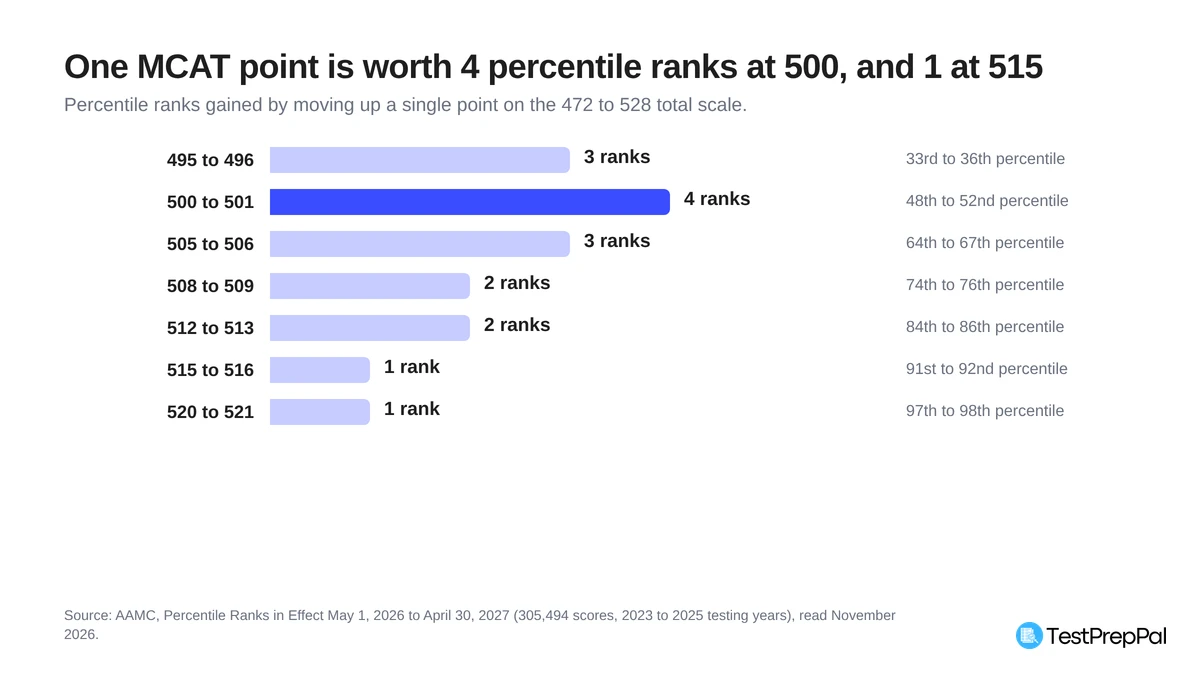 The same point of improvement is worth four times as much at 500 as it is at 515.
The table reports whole percentiles, so single steps round. Widen the window and the pattern holds anyway: 498 to 502 moves you 13 percentile ranks across four points, 506 to 510 moves you 12, 513 to 517 moves you 8, and 518 to 522 moves you just 4.
Scoring near the middle of the scale means your next right answer is worth more than it will ever be again. Two or three more correct answers in one section, from a 500, moves you past four percent of everyone who takes the exam. The identical gain at 515 moves you past one percent.
That is an argument for where to spend time, not an argument against aiming high. It does mean a retaker sitting at 498 has far more to gain from a few weeks of targeted work than a retaker sitting at 517, and the MCAT retake calculator works that trade through with your own numbers. The full 57 row percentile table lives in our breakdown of the MCAT score range.
One more warning on percentiles. The ranks are rebuilt every May 1 from the three most recent testing years, and stale tables keep circulating. Tables still labelled 2023-2024 run about two ranks low through the middle of the scale: they put a 500 at the 46th percentile where the current table puts it at the 48th, and a 508 at the 72nd where the current table says 74th. Check the window on any table before you trust it.
Equating is not a curve, and that matters most on a retake
Students ask constantly whether some test dates are easier to score well on. The AAMC's answer is direct: the MCAT is not graded on a curve. A 124 in CARS on one form means the same thing as a 124 in CARS on any other form, on any date, against any group of people sitting that day.
Three practical consequences follow.
- There is no good test date to pick. You are not competing against the people in the room with you, so choosing a quieter administration buys nothing.
- Your retake is directly comparable to your first attempt. Both sit on the same equated scale, so a school reading a 505 then a 512 is reading a real 7 point improvement, not a difference in form difficulty.
- A harder form does not punish you. If your form ran tough, the conversion for that form reflects it, which is exactly what equating is for.
Equating is also why you wait. The AAMC quotes 30 to 35 days to scale and equate each administration, which is why no score appears on test day. Our list of MCAT score release dates tracks where each administration lands in that window.
The three MCAT averages, and which one applies to you
Ask what the average MCAT score is and you will get 506, or 507, or 511, depending on who answers. All of those numbers are real. They describe different groups of people.
| Group | Mean total | Size | Where it sits among all test takers |
|---|---|---|---|
| Everyone who takes the MCAT, 2023 to 2025 | 500.6 | 305,494 scores | 48th percentile |
| Applicants to MD schools, 2025-2026 | 506.3 | 54,699 applicants | 67th percentile |
| Matriculants, 2025-2026 | 512.1 | 23,440 matriculants | 84th percentile |
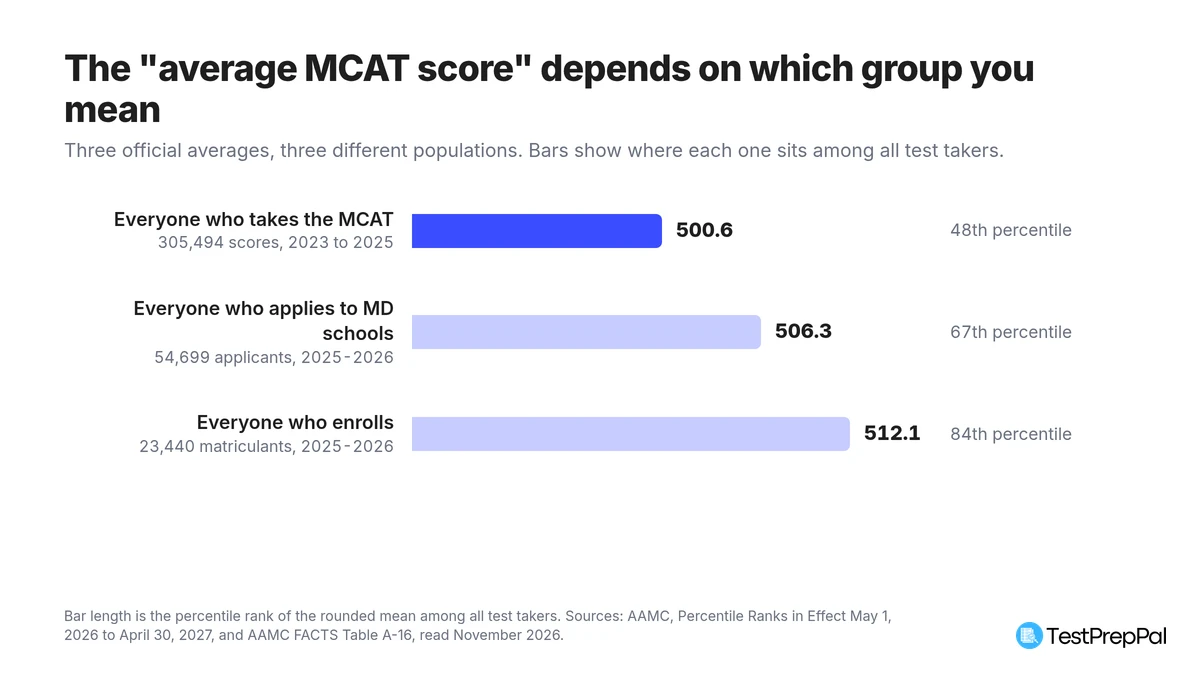 Each average describes a smaller, more self-selected group than the one above it.
The all-test-taker mean of 500.6 comes from the AAMC percentile document. The applicant and matriculant figures come from AAMC FACTS Table A-16, which tracks MCAT scores and GPAs for applicants and matriculants to US MD-granting schools.
The gap between the first row and the third is 11.5 points, and it is almost entirely self-selection: people who score poorly often do not apply, and people who apply with low scores often do not enroll. So a score sitting at the 48th percentile of all test takers is well below the middle of the applicant pool, which is the comparison that actually decides anything. Our analysis of whether a 508 is a good MCAT score works through how admissions committees read a number in that band, and the MCAT statistics dashboard holds the rest of the current data.
Why the same score means different things in different sections
Each section is scored on the same 118 to 132 scale, but the four score distributions are not identical. In the same AAMC percentile document, section means run from 124.6 in CARS to 125.9 in Psych/Soc, a 1.3 point spread.
That spread shows up in percentiles. A 128 is the 85th percentile in Chem/Phys but only the 76th in Psych/Soc, because more people score well in Psych/Soc. Two students with the same total can therefore have beaten a different share of the field, which is one reason schools look at the section breakdown and not just the total. The highest MCAT score page covers what happens at the top of each of those distributions, and the MCAT hub collects the rest of our scoring coverage.
How is the MCAT scored FAQs
How many questions can you get wrong on the MCAT?
There is no fixed answer, because the raw-to-scaled conversion is built for your specific test form. The AAMC's own higher illustration is that 46 to 48 correct might convert to a 128, which on a 59 question science section means 11 to 13 wrong answers still produces a score at roughly the 85th percentile for that section. Treat that as the scale of the thing rather than a target.
Is the MCAT curved?
No. The AAMC states plainly that the exam is scaled and equated rather than curved, so your score does not depend on how the people who tested the same day performed. Equating adjusts only for small differences in difficulty between test forms, which means a given section score carries the same meaning on every form and every date.
What MCAT score is the 25th percentile?
A total of 492 is the 25th percentile in the ranks currently in effect, meaning 25 percent of scores across the 2023 to 2025 testing years were at or below it. The 50th percentile falls at 501, and the 75th falls between 508 and 509.
Is a 492 a horrible MCAT score?
A 492 is the 25th percentile, so three quarters of test takers scored higher, and it sits about 14 points below the 506.3 applicant mean. It is a weak score for an MD application as it stands, but it is also in the part of the scale where improvement pays most: a few points from there buy three to four percentile ranks each, which is more than the same effort returns anywhere above 512.
We may earn commissions from some links on this page, but this does not affect our reviews or your experience.